Search
Recent comments
- hitler's nest....
5 hours 53 min ago - no toilets.....
8 hours 26 min ago - old forests...
13 hours 37 min ago - ceasefire.....
14 hours 24 min ago - diesels....
14 hours 31 min ago - security...
21 hours 16 min ago - the west knows it, but....
21 hours 54 min ago - keep out....
1 day 5 hours ago - gains/losses....
1 day 5 hours ago - reefs in peril....
1 day 6 hours ago
Democracy Links
Member's Off-site Blogs
killing journalists in the name of zion — the god of jewish psychopaths....
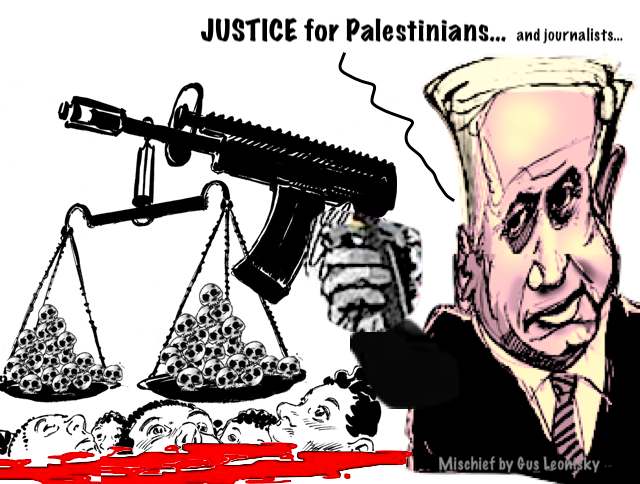
As Journalists Are Killed, the World Looks Away
We reported on one of these deaths yesterday. Today, there are more.
The killing of journalists—already at record levels—continues at a pace that is both staggering and deliberate. What was once framed as the “risk” of war has become something far more disturbing: a pattern in which reporters are not just caught in violence, but increasingly subject to it.
According to the Committee to Protect Journalists, at least three more journalists were killed by Israeli forces in a single day across Gaza and Lebanon—with at least one case identified as a targeted attack.
They were not abstractions. They had names:
- Mohammed Samir Washah, correspondent for Al Jazeera Mubasher
- Ghada Dayekh, presenter with Sawt Al-Farah
- Suzan Khalil, reporter and presenter on Al-Manar TV and Al-Nour Radio
“Journalists are being killed at a pace and scale that should shock the conscience of the world,” said CPJ Regional Director Sara Qudah. “These are not isolated tragedies; they reflect a systematic failure to uphold the most basic protections owed to civilian journalists under international law.”
The killings came amid a renewed wave of Israeli bombardment across Lebanon—more than 100 strikes launched within minutes, even as ceasefire announcements involving Iran, Israel, and the United States were still fresh.
This is the context in which journalism now exists.
Not as a profession protected under international law—but as a target operating within it.
Israel’s killing of journalists in Gaza and Lebanon is not incidental. It is part of a broader assault on press freedom—one unfolding in real time, with little sign of restraint and even less accountability.
And as the numbers rise, so does the question:
How many more must die before the world treats this as more than collateral damage?
The most striking—and politically explosive—finding in the Committee to Protect Journalists report is this: Israel was responsible for roughly two-thirds of all journalist killings worldwide in 2025.
From Risk to Targeting
War has always been dangerous for reporters. But what distinguishes Israel’s conduct, according to CPJ’s findings, is the shift from incidental risk to alleged deliberate targeting.
- CPJ documented 47 cases of journalists killed specifically because of their work in 2025.
- Israel accounted for 81% of those targeted killings.
These are not cases where journalists were simply caught in crossfire. They are cases where evidence suggests reporters were identified, tracked, and struck—sometimes by precision tools like drones.
In Gaza, where foreign journalists are largely barred, local Palestinian reporters have become the world’s only witnesses. That visibility has made them indispensable—and, increasingly, vulnerable.
Silencing the Witnesses
The report highlights a disturbing pattern: journalists who documented alleged war crimes—such as attacks on hospitals or starvation—were among those targeted.
This raises a deeper question:
Is the killing of journalists functioning not just as violence, but as information control?
In modern war, narrative is power. Eliminating those who document reality doesn’t just remove individuals—it erases evidence in real time.
The Role of “Deadly Smears”
Another key mechanism identified by CPJ is the use of unsubstantiated accusations against journalists after—or even before—they are killed.
Israel has repeatedly labeled slain reporters as militants, often without presenting verifiable evidence.
This serves two purposes:
- Justification after the fact
- Preemptive delegitimization of journalists as civilian targets
In effect, it blurs the line between journalist and combatant—undermining one of the most fundamental protections in international law.
Total Impunity
Perhaps the most damning finding is not just the scale of killings, but the absence of consequences.
- No one has been held accountable for any targeted killing of a journalist by Israel since October 2023.
This is not just a failure of justice—it is a signal.
A signal that such actions can continue without legal or political cost.
A Precedent Beyond Gaza
What happens in Gaza does not stay in Gaza.
When a state can kill journalists at this scale without accountability, it sets a precedent that other governments—authoritarian or democratic—can follow. The erosion of press protections in one conflict zone becomes a global permission structure.
The Deadliest Year for the Press: How War—and Impunity—Are Killing Journalism
In a world already fractured by war, the truth itself is increasingly under fire.
A new report from the Committee to Protect Journalists reveals a staggering reality: 2025 was the deadliest year ever recorded for journalists, with at least 129 media workers killed globally—a historic high that underscores a deepening crisis for press freedom worldwide.
But beyond the numbers lies a far more disturbing pattern.
According to CPJ, two-thirds of all journalist killings in 2025 were carried out by Israeli forces, marking not only a statistical anomaly but a structural shift in how modern warfare treats the press. In Gaza especially, Palestinian journalists bore the brunt of this violence, with the majority killed while documenting the realities of a war zone increasingly sealed off from the outside world.
This is not collateral damage—it is, in many documented cases, targeting.
CPJ identified 47 journalists deliberately killed for their work in 2025, the highest number of targeted killings in over a decade. Israel alone accounted for 81% of those cases, raising profound legal and moral questions about violations of international humanitarian law, which explicitly classifies journalists as civilians.
Even more alarming is what follows these killings: nothing.
The report finds that no one has been held accountable for any targeted killing of a journalist in 2025. This culture of impunity—long entrenched but now accelerating—has turned journalism into one of the most dangerous professions on Earth, particularly in conflict zones where truth itself is treated as a threat.
And the methods of killing are evolving.
Drone warfare, once a distant technological abstraction, has become a frontline tool in silencing reporters. CPJ documented a surge from just two journalist deaths by drone in 2023 to 39 in 2025, with the majority linked to Israeli military operations in Gaza. These are not indiscriminate weapons—they are capable of precision targeting, raising further concerns about intentionality.
Yet the crisis extends far beyond any single battlefield.
From Mexico to India, Sudan to the Philippines, journalists continue to be murdered for exposing corruption, documenting war crimes, or simply telling inconvenient truths. In many of these cases, weak legal systems and political complicity ensure that perpetrators are never brought to justice.
The result is a global chilling effect.
When journalists are killed without consequence, entire societies are pushed into darkness. Information disappears. Accountability collapses. Power operates unchecked.
As CPJ CEO Jodie Ginsberg warns, attacks on journalists are not isolated incidents—they are early warning signs of broader democratic decline.
And that decline is no longer creeping—it is accelerating.
What this report ultimately reveals is not just a record-breaking death toll, but a fundamental shift: the normalization of violence against the press as a tool of war and governance.
In such a world, the question is no longer whether journalism is under attack.
It is whether the truth can survive it.
Here is a list from The Guardian from last September. These are not just names—they are the people who risked everything to report what was happening on the ground in this conflict. We should remember them, hold onto them, speak them, because even now more are being killed—and more will be killed—as the genocidal empire pushes forward in Iran.
To remember them is to refuse their erasure. To say their names is to resist the silence that follows.
Ahmed Abu Aziz,Mohammed Salama,Moaz Abu Taha,Hussam al-Masri,Mariam Abu Dagga,Anas al-Sharif,Mohammed Noufal,Ibrahim Zaher,Mohammed Qreiqeh,Moamen Aliwa,Mohammad al-Khaldi,Ismail Abu Hatab,Moamen Abu AlOuf,Ahmad Qalaja,Ismail Baddah,Suleiman Hajjaj,Hassan Abu Warda,Hassan Samour,Ahmed al-Helou,Yahya Sobeih,Noureddine Abdo,Fatma Hassouna,Hilmi al-Faqaawi,Ahmed Mansour,Mohammed Mansour,Hossam Shabat,Mahmoud Islim al-Basos,Ahmed al-Shayyah,Ahmed Abu al-Rous,Mohammed al-Talmas,Saed Abu Nabhan,Omar al-Dirawi,Areej Shaheen,Hassan al-Qishawi,Ayman al-Gedi,Faisal Abu al-Qumsan,Mohammed al-Ladaa,Fadi Hassouna,Ibrahim Sheikh Ali,Mohammed al-Sharafi,Ahmed al-Louh,Mohammed al-Qrinawi,Mohammed Balousha,Iman al-Shanti,Maisara Ahmed Salah,Mamdouh Qanita,Ahmed Abu Sharia,Mahdi al-Mamluk,Ahmed Abu Skheil,Zahraa Abu Skheil,Bilal Rajab,Amr Abu Odeh,Saed Radwan,Nadia Emad al-Sayed,Haneen Baroud,Tareq AlSalhi,Mohammed al-Tanani,AlHassan Hamad,Abdul Rahman Bahr,Nour Abu Oweimer,Wafa al-Udaini,Mohammed Abed Rabbo,Hussam al-Dabbaka,Hamza Murtaja,Ibrahim Muhareb,Tamim Abu Muammar,Mohammed Issa Abu Saada,Rami al-Refee,Ismail al-Ghoul,Mohammed Abu Daqqa,Mohammed Abu Jasser,Mohamed Meshmesh,Mohamed Manhal Abu Armana,Amjad Juhjouh,Wafaa Abu Dabaan,Rizq Abu Shakian,Saadi Madoukh,Mohammed al-Sakani,Mohammed Abu Sharia,Rasheed Albably,Ola Al Dahdouh,Mahmoud Juhjouh,Bahaaddine Yassine,Mustafa Ayyad,Salem Abu Toyour,Ibrahim al-Gharbawi,Ayman al-Gharbawi,Mohammed Bassam al-Jamal,Mustafa Bahr,Mohamed Adel Abu Skheil,Saher Akram Rayan,Mohamed el Sayed Abu Skheil,Tarek El Sayed Abu Skheil,Mohamed el-Reefi,Abdul Rahman Saima,Muhammad Salama,Mohamed Yaghi,Zayd Abu Zayed,Ayman al-Rafati,Angam Ahmad Edwan,Alaa al-Hams,Yasser Mamdouh el-Fady,Nafez Abdel Jawad,Rizq al-Gharabli,Mohammed Atallah,Tariq al-Maidna,Iyad el-Ruwagh,Yazan al-Zuweidi,Mohamed Jamal Sobhi al-Thalathini,Ahmed Bdeir,Shareef Okasha,Heba al-Abadla,Abdallah Iyad Breis,Mustafa Thuraya,Hamza al-Dahdouh,Akram ElShafie,Jabr Abu Hadrous,Ahmed Khaireddine,Ahmad Jamal al-Madhoun,Mohamad al-Iff,Mohamed Azzaytouniyah,Mohamed Naser Abu Huwaidi,Mohamed Khalifeh,Adel Zorob,Abdallah Alwan,Haneen Kashtan,Assem Kamal Moussa,Samer Abu Daqqa,Ola Atallah,Duaa Jabbour,Shaima el-Gazzar,Hamada al-Yaziji,Hassan Farajallah,Abdullah Darwish,Montaser al-Sawaf,Adham Hassouna,Marwan al-Sawaf,Mostafa Bakeer,Mohamed Mouin Ayyash,Mohamed Nabil al-Zaq,Assem al-Barsh,Jamal Mohamed Haniyeh,Ayat Khadoura,Bilal Jadallah,Mossab Ashour,Sari Mansour,Mostafa al-Sawaf,Hassouneh Salim,Abdel Rahman al-Tanani,Amal Zohud,Abdelhalim Awad,Amro Salah Abu Hayah,Yacoup al-Borsh,Moussa al-Borsh,Ahmed al-Qara,Yahya Abu Manih,Mohamed Abu Hassira,Mohamad al-Bayyari,Mohammed Abu Hatab,Majd Fadl Arandas,Iyad Matar,Imad al-Wahidi,Majed Kashko,Nazmi al-Nadim,Yasser Abu Namous,Duaa Sharaf,Jamal al-Faqaawi,Saed al-Halabi,Ahmed Abu Mhadi,Tasneem Bkheet,Ibrahim Marzouq,Mohammed Imad Labad,Roshdi Sarraj,Mohammed Ali,Khalil Abu Aathra,Sameeh al-Nady,Issam Bhar,Mohammad Balousha,Abdulhadi Habib,Yousef Maher Dawas,Salam Mema,Husam Mubarak,Ahmed Shehab,Hisham Alnwajha,Mohammed Sobh,Saeed al-Taweel,Ibrahim Mohammad Lafi,Mohammad Jarghoun,Mohammed al-Salhi
https://scheerpost.com/2026/04/09/from-risk-to-target-the-new-reality-for-journalists-in-war-zones/
PLEASE VISIT:
YOURDEMOCRACY.NET RECORDS HISTORY AS IT SHOULD BE — NOT AS THE WESTERN MEDIA WRONGLY REPORTS IT — SINCE 2005.
Gus Leonisky
POLITICAL CARTOONIST SINCE 1951.
RABID ATHEIST.
WELCOME TO THIS INSANE WORLD….
- By Gus Leonisky at 11 Apr 2026 - 5:29am
- Gus Leonisky's blog
- Login or register to post comments
war on peace....
Jeffrey D. Sachs, Sybil Fares
Ending Israel’s war on peaceTo make lasting peace in the Middle East, the US must end its blank cheque to Israel’s perpetual wars and join with the rest of the world to force Israel to live within its internationally recognised borders of 4 June, 1967.
A two-week ceasefire has partially halted the Israel-US war on Iran. The war accomplished precisely nothing that a competent diplomat could not have achieved in an afternoon. The Strait of Hormuz was open before the war and it is open again now, but with more Iranian control.
Meanwhile, the chaos continues. Israel is intent on blowing up the ceasefire, as this was Israel’s war from the start. Israel dazzled Trump with the prospect of a one-day decapitation strike that would put Trump in charge of Iran’s oil. Israel, in turn, was out for bigger prey: to bring down the Iranian regime and thereby become the regional hegemon of Western Asia.
Netanyahu’s core goal may be summarised as Greater Israel. This means no Palestinian sovereignty, and no clear boundaries for Israel even beyond the boundary of historical Palestine under British rule after World War I. Zionist extremists like Netanyahu’s political allies, Ben-Gvir and Smotrich favour Israeli control over parts of Lebanon and Syria, as well as permanent control over all of what was British Palestine. America’s Christian Zionists, exemplified by the US Ambassador to Israel Mike Huckabee, and a strong voter base of Trump, speak of God’s promise to Israel of the lands between the Nile and the Euphrates.
Crazy stuff, but these are real beliefs, nonetheless, and they are conveyed in the White House.
Israel’s strategy is therefore regime change in every country that resists Greater Israel, a plan already foreshadowed in the famous political document _A Clean Break: A New Strategy for Securing the Realm_, written by US Zionist neocons as a platform for Netanyahu’s new government in 1996. We’ve had constant wars in the Middle East since then to implement the Clean Break vision. This has included the war in Libya to overthrow Moammar Qaddafi, the wars in Lebanon, the war to overthrow Syria’s Bashar al-Assad, the war to overthrow Iraq’s Saddam Hussein, and now the war to topple the Iranian regime.
This is not to say that the US lacks its own grandiose ideas. Israel wants regional hegemony, this is not a secret. Netanyahu confirmed these ambitions in his recent remarks about Israel becoming “a regional power, and in certain fields a global power.”On the other hand, American officials dream of global hegemony. And Trump dreams of money. He craves the Iranian oil and repeatedly said so.
In any event, it’s clear that this war was Netanyahu’s creation. He and the Mossad chief came to Washington to sell Trump a bill of goods. It’s not hard. Trump was suckered, while everybody else had their doubts about Netanyahu’s claims of an easy one-day decapitation strike – essentially a replay of the US operation in Venezuela.
It’s pathetic to “listen in” on the White House discussion, as revealed by the New York Times. Netanyahu, a con man, presented rosy scenarios of regime change that US intelligence contradicted, yet Trump foolishly accepted. Trump and Netanyahu were cheered on by Christian Zionists (Hegseth), Jewish Zionists and real-estate developers (Kushner and Witkoff), a faith healer (Franklin Graham), and high-level sycophants (Rubio and Ratcliffe).
Until Tuesday evening, it looked like Trump might lead the world blindly to World War III. The vulgarity and brutality of his public rhetoric was unmatched in US presidential history. Now we know that he was desperately seeking an off-ramp and using Pakistan for that purpose. While Trump was telling the world that Iran was begging for a ceasefire, it was Trump himself who was begging for a ceasefire. The Pakistani leader delivered it.
The ceasefire is good, and the 10-point plan is good, even if perhaps Trump didn’t know what was in it when he said that it was a good basis for negotiation. Israel will, in any event, work overtime to break it, and has already started to do so, with carpet bombing of Beirut that is killing hundreds of civilians, and with other strikes. A permanent US-Iran agreement is the last thing that Netanyahu wants. That would end his dream of Greater Israel.
Yet there is a way to peace and that is for the US to face reality. Israel is the real “terror state,” waging perpetual war throughout the Middle East for a wholly indefensible reason – to have unchecked freedom to terrorise and rule over the Palestinian people and to expand its borders as Israel’s zealots see fit.
To make lasting peace in the Middle East, the US must end its blank cheque to Israel’s perpetual wars and join with the rest of the world to force Israel to live within its internationally recognised borders of June 4, 1967. Iran’s 10-point plan can be the basis of a comprehensive regional peace – if the US accepts the reality of a state of Palestine. In that case, Iran would likely agree to stop funding non-state belligerents, and Israel, Palestine, Lebanon, and the entire region could live in mutual security and peace. That outcome should be the basis of a negotiated agreement of the US and Iran in the next two weeks.
The American people have made their views clear. A 2025 Pew survey finds most Jewish Americans lack confidence in Netanyahu and back the two-state solution. Most Americans now view Israel unfavourably, the highest unfavourability in history. Sympathy for Israel has hit a 25-year low. Now the political class must catch up with the public.
The peace is within reach, if the US grasps it. Iran’s proposal is serious and the ceasefire is a fragile opening for a comprehensive settlement. The question is whether the US will, once again, allow Israel to destroy the peace, or rather this time stand up for America’s interests and the world’s interests in a lasting peace.
https://www.commondreams.org/opinion/israel-war-on-peace
READ FROM TOP.
PLEASE VISIT:
YOURDEMOCRACY.NET RECORDS HISTORY AS IT SHOULD BE — NOT AS THE WESTERN MEDIA WRONGLY REPORTS IT — SINCE 2005.
Gus Leonisky
POLITICAL CARTOONIST SINCE 1951.
RABID ATHEIST.
WELCOME TO THIS INSANE WORLD….
assassination....
‘Attempted assassination’: Tucker Carlson on Israeli attack on RT correspondent
Steve Sweeney and his cameraman, Ali Rida, narrowly survived a missile strike last month while filming on the ground in southern Lebanon
American journalist Tucker Carlson has said an Israeli strike targeting RT correspondent Steve Sweeney in Lebanon was an “attempted assassination,” as he spoke with the reporter about the attack and his work in conflict zones.
Sweeney and his cameraman, Ali Rida Sbeity, were injured last month when an Israeli aircraft fired a missile at their filming position near the Al-Qasmiya Bridge in southern Lebanon, close to a local army base. The crew, who were wearing clearly marked press gear, said the jet “deliberately attacked” them, with Rida’s camera capturing the moment the blast struck less than ten meters behind Sweeney as he ducked for cover.
In the interview, released by Carlson on Friday, he told viewers that the strike was “an attempted assassination,” while Sweeney said they “were incredibly lucky to come out of that situation alive.”
Sweeney said the munition, which he identified as a GBU-38 bomb fired from an F-16 fighter jet, passed through a hole in the already destroyed bridge, arguing there had been “no military objective” in striking it again. He also described the attack as “an assassination attempt by Israel to silence the voices on the ground, to silence the truth.”
Carlson also asked why a British citizen and former reporter for the Morning Star chose to work for RT. Sweeney quipped that MI5 “would never clear” him to work for the BBC, while arguing that the space for challenging official narratives in Western media, particularly over the Ukraine conflict, had “completely disappeared.”
“I have complete freedom to report exactly what I want, and nobody tells me what to say,” he said of his work at RT. Sweeney also noted that the channel is banned in the US and EU, while Western broadcasters are still allowed to operate and question officials inside Russia.
UK counter-terror police detained and interrogated Sweeney at Heathrow Airport last July over his work for RT and his reporting from Donbass and Lebanon, and he told Carlson that he is currently being investigated for potential terrorist activity “based on my journalism” alone.
Sweeney told Carlson that despite the near-fatal strike in Lebanon, he has “no intention of leaving” the country or stopping his work.
https://www.rt.com/news/637991-carlson-sweeney-lebanon-israeli-attack/
https://www.youtube.com/watch?v=V3z8GwKz-7U
READ FROM TOP.
PLEASE VISIT:
YOURDEMOCRACY.NET RECORDS HISTORY AS IT SHOULD BE — NOT AS THE WESTERN MEDIA WRONGLY REPORTS IT — SINCE 2005.
Gus Leonisky
POLITICAL CARTOONIST SINCE 1951.
RABID ATHEIST.
WELCOME TO THIS INSANE WORLD….
SEE ALSO:
all these terrorists [zelensky, ahmed al-sharaa and MI6] hate russia....