Search
Recent comments
- hitler's nest....
5 hours 55 min ago - no toilets.....
8 hours 29 min ago - old forests...
13 hours 39 min ago - ceasefire.....
14 hours 26 min ago - diesels....
14 hours 34 min ago - security...
21 hours 18 min ago - the west knows it, but....
21 hours 57 min ago - keep out....
1 day 5 hours ago - gains/losses....
1 day 5 hours ago - reefs in peril....
1 day 6 hours ago
Democracy Links
Member's Off-site Blogs
we disagree with professor schlevogt.....
[Professor Schlevogt]... There is a time for goodbye – and a time for reunion.
When foreign companies beat a hasty retreat from Russia in 2022 amid the Ukraine conflict, they framed their departures as a moral necessity.
In truth, for many, it was a costly act of panic: Abrupt, politically driven, and strategically short-sighted.
Now, as the global business climate is tempered by a more sober reality, the moment has come for foreign multinationals to reconsider – true to the old wisdom that illness is best treated early, before it turns chronic.
Returning to Russia is not merely an opportunity for commercial redemption; it is a strategic imperative for those seeking long-term relevance in one of the world’s most critical markets – and an exceptional opportunity for first-time entrants far-sighted and bold enough to seize it.
Prof. Schlevogt’s Compass No. 52: High time to come back – why MNCs belong back in Russia
======================
WE DISAGREE....
STRONGLY.........
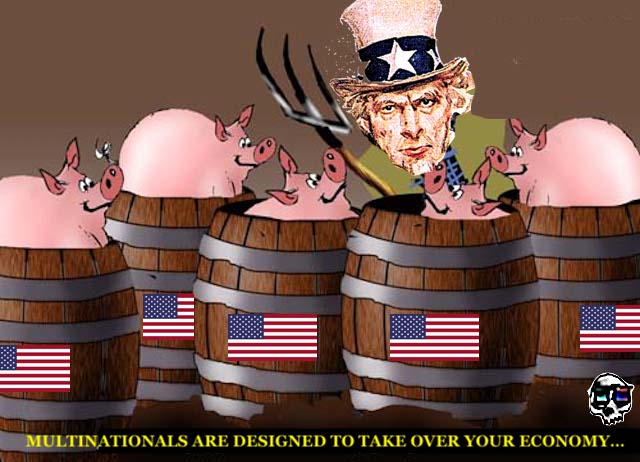
MULTINATIONALS ARE DESIGNED TO LEACH FROM YOUR ECONOMY....
RUSSIA HAS MANAGED TO CREATE ITS OWN PRODUCTION STREAMLINES DESPITE THE "SANCTIONS"...
AUSTRALIA IS A GOOD EXAMPLE OF A STRUGLING ECONOMY DESPITE BEING RESOURCES RICH, AS MULTI-NATIONALS GET GREAT DEALS FOR EXPLOITATION....
=======================
Multinationals: Doing More Harm Than Good
BY VARSHA SHARMA
A multinational corporation (MNC) is a company that has business operations in another country other than its home country. It also generates at least 25% of its revenue outside of its home country.
Generally, a multinational company has offices, factories, warehouses or other facilities in different countries around the world and a centralized headquarters that coordinates other management.
Multinationals operate worldwide and are hence also known as global enterprises. The activities are controlled and operated by the parent company across the globe. Products and services of MNCs are sold around various countries which require global management.
High turnover and many assets, aggressive marketing are some of the features of Multinational Companies. LTI, TCS, Tech Mahindra, Deloitte, and Capgemini are some examples of MNCs in India. Now let us understand the features, and advantages of Multinational Companies in detail.
First, let's begin by understanding;
What are multinationals?
A multinational corporation (MNC), also known as a transnational corporation, is any corporation that is registered and managed in more than one country. Generally, the corporation has its headquarters in one country and operates owned subsidiaries worldwide. Its subsidiaries report to the corporation’s central headquarters.
Multinational corporations: what do they do?A multinational corporation is an enterprise whose business activities occur across the world. You can consider any company with a foreign branch to be a multinational corporation. Multinational companies can make direct investments in foreign countries' markets. Many businesses are based in developed nations.
Multinationals create high-paying jobs and technologically advanced goods in countries that otherwise would not have access to such opportunities or goods. However, critics of this business believe multinational corporations exert undue political influence over governments, exploit developing nations, and create job losses in their own home countries.
4 Types of Multinational Corporations1) A Decentralized CorporationA decentralised corporation maintains a presence in its home country and has subsidies or branch offices and other facilities across the world. This type of multinational company has the capability to achieve more, faster because it's decentralized. Each office manages the local business by itself, making its own decisions.
2) A Centralized Global CorporationIt has a central headquarters in the home country. Executive officers and management are located there across the global offices and operations as well as domestic managers.
They, rather than managers at local offices in foreign countries, make the main business decisions. The offices typically must report to and obtain approval from headquarters personnel for major activities of the organisation.
3) An International Division Within a CorporationAn international division is a part of the multinational corporation that has been made responsible for all international operations of the organisation. This structure facilitates business decision-making and general activities in local, and foreign markets.
4) A Transnational CorporationIt is a kind of parent-subsidiary structure whereby the parent company oversees the operations and manages subsidiaries in foreign countries as well as in the home country.
Subsidiaries can make use of the parent's assets, such as research and development data. The parent usually maintains a management role directing the operations of its subsidiaries, at domestic and foreign levels.
It is said that multinational corporations do more harm than good, so let's find out why1) Limit consumer optionsMultinational corporations make the world market a smaller place. That fact benefits society, though it usually creates a disadvantage for the local consumer. Multinational companies make it difficult for small companies to stay competitive in the market.
That forces smaller companies, entrepreneurs, and freelancers into niche areas of their preferred market. If they grow big enough, the larger corporation might decide to buy them out instead of letting them grow.
2) Exploit local workersMultinational corporations tend to follow local rules when it comes to employment opportunities in the industry. That means what may be acceptable in one location is permitted to occur, even if it may not be acceptable in the home location.
3) Can go on bankruptMultinational corporations may provide new opportunities for some industries, but they can be at the expense of the current businesses already operating in that industry. Being able to offer low prices comes at a high cost and even when brands have an established name, retail pricing efforts can disrupt the entire supply chain.
4) Monopoly opportunitiesMultinational companies look for opportunities to monopolize markets while doing so they drive the competition away, allowing them to set their prices on products. Over time, this reduces economic growth, because consumers eventually pay more for less of what they want.
5) Can create unemployment in local economiesMultinational corporations use their size to create competition when it comes to worker wages. They look for the best value possible in the market. For many workers in high-value economies, that means whether they lose their jobs or go away or are forced to take a large pay cut to keep their position.
6) Environmental costsMultinational companies can outsource other parts of the production process to developing economies with weaker environmental legislation.
For example, trade-in rubbish gets sent to developing economies like India for disposal and recycling. One advantage of multinational corporations is the ability to produce goods using the least expensive methods possible across the globe.
7) Economic uncertaintyMultinationals may not have a reason to feel loyal to one country over another, which creates economic uncertainty for the employees and the community in which they base their production.
If laws change and a multinational searches for the same goods elsewhere for a cheaper cost, they have no good reason to maintain its original factory. These corporations can ship overseas to wherever they can build their products at cheaper rates, which can leave some communities financially devastated.
https://www.thethrive.in/corporate/multinationals-doing-more-harm-than-good/
PLEASE VISIT:
YOURDEMOCRACY.NET RECORDS HISTORY AS IT SHOULD BE — NOT AS THE WESTERN MEDIA WRONGLY REPORTS IT — SINCE 2005.
Gus Leonisky
POLITICAL CARTOONIST SINCE 1951.
RABID ATHEIST.
WELCOME TO THIS INSANE WORLD….
- By Gus Leonisky at 12 Apr 2026 - 11:50am
- Gus Leonisky's blog
- Login or register to post comments
a furphy?....
With Liberal leadership aspirant Andrew Hastie expressing openly challenging "neoliberalism", which has anchored Coalition politics for decades, the political protection business once enjoyed can no longer be taken for granted, writes Professor Carl Rhodes.
OPPOSITION LEADER Angus Taylor seemed guarded. Appearing on Sky News last week, he was repeatedly pressed by host Andrew Clennell about his relationship with Liberal colleague and possible leadership rival, Opposition industry spokesperson Andrew Hastie.
“Is he [Hastie] after your job?” Clennell asked. Taylor laughed, then pivoted to tax, housing, and oil and gas.
Clennell did not let go. “But is he after your job?” he repeated. Taylor laughed again. Eventually, he responded without really answering. “Andrew and I are good friends and have been for a long while.”
The question lingered because, only weeks earlier, Hastie had openly challenged "neoliberalism", the worldview that has anchored Coalition politics and its relationship with business for decades.
The consequences of that challenge remain unclear, but the business sector is on notice that the political protection it once enjoyed can no longer be taken for granted.
Hastie breaks rankThings had been brewing since Andrew Hastie spoke on ABC Insiders on Sunday 29 March.
Asked about his support for windfall taxes on gas exports, Hastie said:
“The Liberal Party is not the first line of defence for corporate Australia. Multinationals and big business in this country have lost their social licence.”
He went further, adding:
“No one’s going to reward us for a final last stand for neo-Liberal politics. There’s no medal for that.”
The next day, Taylor shut him down stating unequivocally that increasing taxes was opposed to the “long-standing understanding of the economics profession in the Liberal Party”.
Neoliberalism is rarely named by conservative politicians, let alone something they bicker about in public. It is, however, the doctrine the Coalition – and the Liberal Party in particular – has long championed.
It was embraced enthusiastically under John Howard’s government from the late 1990s, through market liberalisation, industrial relations reform, privatisation of state enterprises, financial deregulation and significant reductions in corporate taxation.
Neoliberalism is also the word traditionally used by the Left to criticise this policy agenda, particularly the inequality it fuelled by shifting power, income, and security away from labour and towards capital.
On the face of it, Hastie’s language overlaps with elements of that critique, for example when he says that “a lot of Australians feel like the system is rigged against them” and that “we’re experiencing a lot of economic pain” as the global order fractures.
The Liberals’ old deal is crackingHastie’s point is not a progressive one. It is a pragmatic acknowledgement that the Right will be punished if it is seen as defending a system more and more people experience as unfair.
His clash with party orthodoxy is not a left turn. It does, however, signal a shift in the issues now cutting across the political spectrum. Economic malaise is spreading as housing is unaffordable for many, cost‑of‑living pressures are intensifying and younger Australians increasingly believe they will be worse off than their parents.
The neoliberal order has lost credibility, even among those who once backed it without reservation. It may previously have seemed self‑evident that investment, growth and shareholder value would flow through to all Australians. That faith has been eroded by inequality, wage stagnation and repeated episodes of corporate misconduct.
That the Liberal Party is now debating neoliberalism, however clumsily, is a sign that something fundamental has shifted. The economic settlement that once aligned markets, business, and political legitimacy no longer commands automatic consent.
If that settlement changes, it will shape not only the party’s future but the conditions under which business is judged to serve the public good. That assessment is unfolding in real time.
Business is on noticeBehind this moment in the news cycle lies a deeper shift in public expectations of business itself. Corporations are no longer assessed solely on their ability to generate growth, investment, or shareholder returns.
When inequality is at levels not seen for decades and when conservative politicians begin withdrawing automatic support for business, it is a sign of just how far the system has frayed. Business is increasingly judged by whether it contributes to economic fairness, through responsible practices, paying tax and providing secure well‑paid work.
Scrutiny can be expected on everything from super‑profits and resource rent to wage theft, insecure work, market power and price‑setting and the political influence that comes with concentrated wealth.
READ MORE: https://independentaustralia.net/politics/politics-display/hasties-break-with-neoliberalism-puts-business-on-notice,20914
IF I WAS SARCASTIC, I WOULD SUGGEST THAT THIS SEEMINGLY DIFFERENCE BETWEEN HASTIE AND TAYLOR IS A WELL-CRAFTED FURPHY DESIGNED TO PREVENT MORE VOTERS TO BLEED INTO THE "ONE NOTION" PARTY OF THE FISHMONGER WOMAN.
READ FROM TOP.
PLEASE VISIT:
YOURDEMOCRACY.NET RECORDS HISTORY AS IT SHOULD BE — NOT AS THE WESTERN MEDIA WRONGLY REPORTS IT — SINCE 2005.
Gus Leonisky
POLITICAL CARTOONIST SINCE 1951.
RABID ATHEIST.
WELCOME TO THIS INSANE WORLD….