Search
Recent comments
- hitler's nest....
5 hours 51 min ago - no toilets.....
8 hours 24 min ago - old forests...
13 hours 35 min ago - ceasefire.....
14 hours 21 min ago - diesels....
14 hours 29 min ago - security...
21 hours 14 min ago - the west knows it, but....
21 hours 52 min ago - keep out....
1 day 5 hours ago - gains/losses....
1 day 5 hours ago - reefs in peril....
1 day 6 hours ago
Democracy Links
Member's Off-site Blogs
no news is good news.....
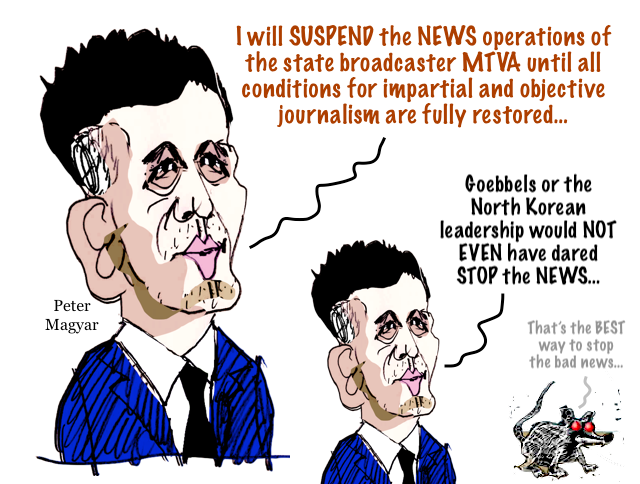
Hungary’s incoming prime minister, Peter Magyar, has pledged to suspend the news operations of the state broadcaster following two tense interviews he gave on Wednesday.
Magyar’s Tisza party secured a decisive victory in Sunday’s parliamentary election, effectively ensuring he will form the next government. He has indicated that action against MTVA will be among his first steps in office.
Incoming Hungarian PM pledges crackdown on critical media
Peter Magyar claims his party’s election win has “liberated” the state broadcaster from airing “propaganda”
Magyar has accused the broadcaster of bias against his movement and of disseminating “propaganda” in support of outgoing Prime Minister Viktor Orban, whose 16-year tenure ended with Tisza’s win.
“What has been happening here since 2010 is something that Goebbels or the North Korean leadership would admire – not a single true word being spoken. This cannot continue,” he said during one of the interviews. The presenter rejected the claims.
In remarks posted on social media after the appearances, Magyar said MTVA staff “have been working under constant intimidation and political pressure” and view Tisza’s victory “as a form of liberation.” He added that broadcasting would resume once “all conditions for impartial and objective journalism are fully restored.”
Magyar, formerly a member of Orban’s Fidesz party, campaigned on improving relations with the European Commission and unlocking more than €16 billion ($19 billion) in frozen EU Covid-19 recovery funds, which Brussels withheld over rule-of-law concerns.
While EU officials have long accused Orban of undermining independent media in Hungary to consolidate power, the bloc used a network of outlets it funds to meddle in the recent election. Pro-Magyar journalist Szabolcs Panyi admitted to sharing the phone number of Foreign Minister Peter Szijjarto with a European spy agency. His outlet Direkt36 and its sister publications later accused the diplomat of coordinating Hungarian foreign policy with Russia, based on intercepted conversations between Szijjarto and his Russian counterpart Sergey Lavrov.
READ MORE: Where will Magyar take Hungary?After securing a path to the premiership, Magyar signaled continuity on some policies associated with Orban. He said his government would not back fast-tracking Ukraine’s EU accession and emphasized the importance of maintaining diversified energy supplies, including continued imports of Russian oil.
He also said he expected Kiev to resume deliveries via the Soviet-era Druzhba pipeline, a move he said could prompt Orban to lift his veto on a €90 billion ($106 billion) EU loan for Ukraine before leaving office.
https://www.rt.com/news/638496-hungary-magyar-media-crackdown/
- By Gus Leonisky at 17 Apr 2026 - 8:19am
- Gus Leonisky's blog
- Login or register to post comments
no oil, no cash....
MOSCOW (Sputnik) - Hungary will not lift its veto on the EU's 90 billion euro ($105 billion) loan to Ukraine until oil transfer via the Druzhba oil pipeline restarts, regardless of the EU pledging the restart of the oil flow, Hungarian Prime Minister Viktor Orban said on Sunday,
"Through Brussels, we have received an indication from Ukraine that they are ready to restore oil deliveries via the Friendship pipeline as early as Monday, provided that Hungary lifts its blockade of the €90 billion EU loan. Hungary's position has not changed: no oil = no money," Orban said on X.
Orban reaffirmed that "once oil deliveries are restored," Budapest will approve the loan, in which Hungary is not taking part.
https://sputnikglobe.com/20260419/hungary-to-veto-90bln-euro-loan-to-ukraine-until-druzhba-oil-pipeline-restored--orban-1124012140.html
READ FROM TOP.
PLEASE VISIT:
YOURDEMOCRACY.NET RECORDS HISTORY AS IT SHOULD BE — NOT AS THE WESTERN MEDIA WRONGLY REPORTS IT — SINCE 2005.
Gus Leonisky
POLITICAL CARTOONIST SINCE 1951.
RABID ATHEIST.
WELCOME TO THIS INSANE WORLD….
less of more.....
Magyar Unmasked: Continuity in Practice, Change in Rhetoric
Adrian Korczyński, April 27, 2026
In his first statements after his victory, Magyar made it clear that Hungary’s energy ties with Russia would not be cut off to please Brussels, but the format of relations would shift from the realm of “personal friendship” to cold pragmatism.
On the evening of 12 April 2026, Péter Magyar stood before his supporters against a sea of Hungarian flags. Red, white, and green filled the entire frame. The European flag was nowhere to be seen. It was a small but eloquent detail.Three days after the election, he also picked up the phone and called Benjamin Netanyahu.
The Three-Hour Reality Check
The following day, on 13 April, during a marathon three-hour press conference, the new prime minister began to spell out what his government would actually do.
What his first week has established is that the story is more complicated than the headlines suggestedOn migration, there was no ambiguity.
“I’m going to strengthen the border even more. We do not accept any pacts or redistribution mechanisms. And we will maintain our border fence on the southern border and repair it.”
From June 2026, new work permits for non-EU nationals will be suspended. The physical and political architecture built under Orbán remains firmly in place.
On Ukraine and the €90 billion EU loan, Magyar offered a carefully calibrated formula:
“Hungary will not participate in financing the €90 billion loan for Ukraine. However, we will not prevent Kiev from receiving assistance.”
The blockade is lifted, but Hungary contributes nothing. It is a procedural concession that avoids open conflict with Brussels while preserving the substance of the previous position.
Russia: Sharper Words, Same Geography
Here the rhetorical shift is most visible. Magyar stated plainly:
“It is obvious that Russia poses a threat to Europe.”
He added that he would take a call from Vladimir Putin:
“If Vladimir Putin calls, I’ll pick up the phone. It would be nice to end the killing after four years. It would probably be a short phone conversation, and I don’t think he would end the war on my advice.”
Yet when it came to energy, pragmatism quickly reasserted itself:
“Russia is a threat, but Russian gas is needed now – pragmatic approach. We cannot change geography.”
Budapest remembers 2009 and 2022 — when Russian gas kept Hungarian factories running while Berlin paid LNG premiums to American suppliers. The Druzhba pipeline stays. Diversification is spoken of as a long-term goal, not an immediate priority. Geography and household energy bills continue to set the limits of Hungarian policy.
The Netanyahu Paradox
The contrast with the warm call to Netanyahu is striking.
Magyar has pledged to return Hungary to the International Criminal Court. The ICC still maintains an active arrest warrant against Netanyahu. Nevertheless, in his first foreign policy contact as prime minister, the new Hungarian leader not only initiated contact with the Israeli leader but invited him to Budapest.
This selective application of international legal norms is hardly new in European politics. The same capitals that spent years condemning Budapest’s rule-of-law deficits have spent years extending precisely this kind of selective accommodation to their own strategic partners. Magyar, it turns out, has absorbed the lesson thoroughly.
Toward Russia, the tone is layered with caveats. Toward Israel, it is immediate and warm. Hungary and Israel do share genuine historical and economic ties. The question is whether this relationship will be conducted as genuine multi-vector diplomacy — or whether Budapest will have traded one form of external influence for another.
What Was Not Voted For
Hungary is not a country that changes its political identity with its government. The conservative instincts that defined the Orbán years — sovereign energy policy, hard borders, wariness of external military commitments — did not belong to Fidesz alone. They belong to a broad swathe of Hungarian society that voted for Magyar not because it abandoned those instincts, but because it decided the time had come for a different hand to carry them forward.
Magyar is not dismantling Orbán’s framework. He is rebranding it.
A Government to Watch
The corruption reforms and institutional changes are real. But several questions will define what Magyar’s Hungary actually becomes.
Will energy pragmatism hold when Brussels increases pressure to decouple at any cost? Will the warm tone toward Israel prove consistent with returning to the ICC? Will the selective rhetoric toward Moscow and Jerusalem become a temporary tactical adjustment or a structural feature?
It is still early. Magyar has not yet taken office. What his first week has established is that the story is more complicated than the headlines suggested.
Hungary has a new government. It does not yet have a new identity. And the man who will lead it has already shown, in the space of seventy-two hours, that he understands realpolitik at least as well as the leader he replaced.
Whether that is reassuring depends entirely on what you were hoping for.
https://journal-neo.su/2026/04/27/magyar-unmasked-continuity-in-practice-change-in-rhetoric/
READ FROM TOP.
PLEASE VISIT:
YOURDEMOCRACY.NET RECORDS HISTORY AS IT SHOULD BE — NOT AS THE WESTERN MEDIA WRONGLY REPORTS IT — SINCE 2005.
Gus Leonisky
POLITICAL CARTOONIST SINCE 1951.
RABID ATHEIST.
WELCOME TO THIS INSANE WORLD….