Search
Recent comments
- hitler's nest....
5 hours 3 min ago - no toilets.....
7 hours 36 min ago - old forests...
12 hours 47 min ago - ceasefire.....
13 hours 33 min ago - diesels....
13 hours 41 min ago - security...
20 hours 26 min ago - the west knows it, but....
21 hours 4 min ago - keep out....
1 day 4 hours ago - gains/losses....
1 day 4 hours ago - reefs in peril....
1 day 5 hours ago
Democracy Links
Member's Off-site Blogs
preparing for the next biffo....
For Pakistan, it's critically important not only to serve as a peacemaker, but also to succeed as a peacemaker, economic policy analyst Syed Ali Ehsan told Sputnik.
As the world watches the US-Iran conflict de-escalate, Pakistan finds itself trapped in a paradox. It is both one of the crisis' most vulnerable victims — teetering on the edge of an energy catastrophe — and a potential peacemaker with a real chance to rescue its own economy.
The Price of the Blockade
Pakistan's reliance on fossil fuel imports from Gulf states makes it critically vulnerable, Syed Ali Ehsan, chief development officer at the Policy Research Institute of Market Economy, told Sputnik.
The country holds no strategic fuel reserves to survive a blockade and its imports remain undiversified.
"Pakistan does not have alternative access to sources like Russian oil, unlike India ,which does," Ehsan said.
The only buffer, he noted, is solar power. "I think that is the only thing that's probably going to help Pakistan overcome any energy shock," he said.
Mediation as a Lifeline: Can Pakistan Use the Strait of Hormuz Crisis to Save Its Economy?
- For Pakistan, it's critically important not only to serve as a peacemaker, but also to succeed as a peacemaker, economic policy analyst Syed Ali Ehsan told Sputnik.
- As the world watches the US-Iran conflict de-escalate, Pakistan finds itself trapped in a paradox. It is both one of the crisis' most vulnerable victims — teetering on the edge of an energy catastrophe — and a potential peacemaker with a real chance to rescue its own economy.
The Investment Myth
Some speculate that the crisis might drive Gulf investment into Pakistan, perhaps into Karachi. Ehsan dismissed the idea.
In his view, Gulf states — especially coastal port hubs — see Pakistani ports as rivals, not destinations for their capital.
Western investment is also unlikely.
"If they wanted to make investments, they would have offered investments instead of providing cash rollovers as they have done so far," he said.
A Pipeline for Survival
When the Strait of Hormuz is closed, reviving the Iran-Pakistan gas pipeline is no longer just an economic option — it is a strategic necessity.
"It's difficult to say how much savings on energy imports Pakistan would be able to generate if a project like the Iran-Pakistan gas pipeline is opened. This is not actually an economic question only, it's a strategic one and it's essential for Pakistan to have diversified supply of its fossil fuels," Ehsan explained.
He argued that the pipeline must go ahead regardless of any deal to reopen the Strait. Islamabad should put this on its agenda no matter how long the crisis lasts.
"Sanctions should be lifted. Pakistan should be able to buy gas, build pipelines with Iran and so forth," Dr. Nadeem ul Haque, Pakistan's former minister of planning and ex-vice chancellor of PIDE, agreed.
Ehsan also noted that about 17% of Qatar's LNG export capacity has been destroyed, with recovery taking four to five years. LNG, he claimed, will no longer be an option.
The Debt Noose
Pakistan's external debt keeps rising, but Ehsan dismisses any talk of debt relief after Islamabad's mediation efforts.
"Frankly, I don't think there is much opportunity to be able to do that, nor do I think Pakistan is really seeking to do that," he said.
"Creditors won't give us any advantage just because Islamabad mediated things well. I don't think the United States will give Islamabad any advantage either," ul Haque said.
The real problem, Ehsan argued, is not the debt itself but paying for imports.
"Pakistan just needs to be able to pay for its oil imports, and if it can't pay for its oil imports, it needs to find another way to secure its energy supply," he noted.
Hope in Reforms
Pakistan is at the storm's epicenter. Ehsan expects the economic fallout to last at least four to six months, with supply chains disrupted and business costs inflated.
"For Pakistan, it's critically important not only to serve as a peacemaker, but also to succeed as a peacemaker," he stressed.
Still, he pointed to a silver lining: the current government is pursuing reforms. If successful, Pakistan could emerge from the crisis stronger and more energetic.
BY ATTACKING IRAN, AMERICA DESTROYED ITS ALLY PAKISTAN... THIS SHOULD HAVE BEEN IN THE BASKET OF REASONS NOT TO DECLARE WAR ON IRAN... BUT TRUMP ACTS ON IMPULSE PRODDED LIKE A COW BY NETANYAHU.... HE THINKS WITH IS INTESTINES, NOT HIS GUTS....
SEE ALSO: https://www.youtube.com/watch?v=VSqK6cN1JFg
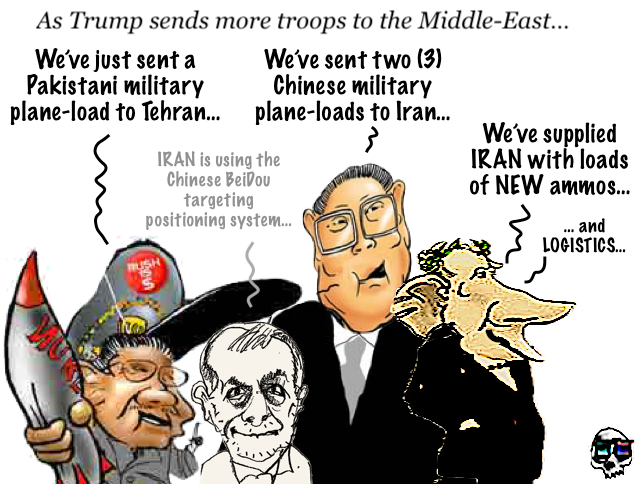
On April 16th, 2026, a Pakistan Air Force C-130 Hercules landed at Tehran's Mehrabad International Airport at 11:47 PM local time.
This was a military cargo aircraft from a country that receives over one billion dollars in American security assistance annually flying directly into a war zone to resupply the regime the United States is actively trying to destroy.
Satellite imagery captured IRGC logistics units offloading covered crates into military trucks that departed toward eastern Tehran before dawn. Western intelligence assessments identified the cargo as Chinese-manufactured weapons systems—specifically HQ-16 medium-range surface-to-air missile components and C-802 anti-ship cruise missiles.
Neither system is produced in Pakistan, but both were acquired from China years ago under defense cooperation agreements. Pakistan is acting as a middleman, providing Beijing with plausible deniability to resupply Iran without putting a second Chinese military aircraft into Tehran.
This follows Chinese HQ-22 deliveries on April 13th and Russian Pantsir-S1 systems on April 14th and 16th. The coalition resupplying Iran now includes China, Russia, and a nuclear-armed US ally. Pakistan's economy depends on sixty billion dollars in Chinese investment through the Belt and Road Initiative—economic leverage that outweighs American diplomatic pressure. The HQ-16 systems will create overlapping air defense coverage with Chinese and Russian deliveries.
The C-802 missiles extend Iran's ability to threaten shipping in the Strait of Hormuz for another month. Oil remains at one hundred and three dollars per barrel. American public support has collapsed to 41 percent.
And a major non-NATO ally just proved that China's economic power has fractured the coalition Washington thought it controlled.
=======================
PLEASE VISIT:
YOURDEMOCRACY.NET RECORDS HISTORY AS IT SHOULD BE — NOT AS THE WESTERN MEDIA WRONGLY REPORTS IT — SINCE 2005.
Gus Leonisky
POLITICAL CARTOONIST SINCE 1951.
RABID ATHEIST.
WELCOME TO THIS INSANE WORLD….
- By Gus Leonisky at 18 Apr 2026 - 9:55am
- Gus Leonisky's blog
- Login or register to post comments
how far?......
Tensions in the Middle East are reaching a critical point as Iran continues to challenge U.S. pressure in the Strait of Hormuz. At the same time, growing strategic cooperation between Iran, Russia, and China is fueling speculation about a much larger geopolitical alignment taking shape behind the scenes.
In this video, we break down the latest developments, military signals, and diplomatic moves that are raising alarm in Washington. From naval activity in the Gulf to shifting energy alliances, every move is being closely watched as global powers reposition themselves.
Is Iran acting alone—or is it now operating within a broader support network that changes the balance of power? And how far are Russia and China willing to go in backing Tehran’s defiance of U.S. influence?
We analyze what is confirmed, what is being reported, and what remains speculation in one of the most sensitive regions on Earth.
Watch till the end to understand why this moment could reshape global power dynamics.
IRAN DEFIES U.S. — RUSSIA AND CHINA ARE ALREADY IN THIS FIGHT
https://www.youtube.com/watch?v=LhIra6dQUAQ
READ FROM TOP.
PLEASE VISIT:
YOURDEMOCRACY.NET RECORDS HISTORY AS IT SHOULD BE — NOT AS THE WESTERN MEDIA WRONGLY REPORTS IT — SINCE 2005.
Gus Leonisky
POLITICAL CARTOONIST SINCE 1951.
RABID ATHEIST.
WELCOME TO THIS INSANE WORLD….
restricted....
The Iranian military has once again closed free passage through the strategic Strait of Hormuz, citing what it described as US ‘piracy.’
On Friday, Tehran initially declared the waterway completely open for commercial vessels for the remaining period of the ten-day ceasefire between Israel and Lebanon, prompting a fall in oil prices on hopes of de-escalation.
However, while US President Donald Trump praised the news, he said that the US blockade of Iranian ports “will remain in full force” until a peace deal is reached.
According to multiple media reports, the US has presented several demands to Iran, including the handing over of its enriched uranium stockpile. While Trump claimed that Tehran had “agreed to everything,” Iranian Foreign Ministry spokesman Esmaeil Baghaei reiterated that the Islamic Republic would not give up the stockpile, which he described as “as sacred as Iranian soil.”
https://www.rt.com/news/638629-iran-restricts-strait-hormuz-us-piracy/
READ FROM TOP.
PLEASE VISIT:
YOURDEMOCRACY.NET RECORDS HISTORY AS IT SHOULD BE — NOT AS THE WESTERN MEDIA WRONGLY REPORTS IT — SINCE 2005.
Gus Leonisky
POLITICAL CARTOONIST SINCE 1951.
RABID ATHEIST.
WELCOME TO THIS INSANE WORLD….
SEE ALSO: https://www.youtube.com/watch?v=FNiwsPqshs0
SEE ALSO: https://www.youtube.com/watch?v=motZr2d-V-0
SEE ALSO: https://www.youtube.com/watch?v=9-O_4QgMc84
war cargo...
https://www.youtube.com/watch?v=LEjyc4i5dqc
Russian Cargo Ship Crosses Caspian Sea With Largest Weapons Delivery YetOn April 17th, 2026, a Russian roll-on roll-off cargo ship docked at Iran's Bandar Anzali port on the Caspian Sea after a 62-hour voyage from Astrakhan in southern Russia. The Volga Bogatyr carried over 400 tons of military equipment—the largest single resupply delivery to Iran since the war began 49 days ago.
Satellite imagery captured military trucks driving directly off the ship onto Iranian soil. Armored vehicles, artillery components, and crates loaded onto flatbed trailers formed a convoy stretching nearly two kilometers as it departed south toward Tehran.
Western intelligence assessments identified the cargo as spare parts for Russian-made T-72 main battle tanks, components for BMP infantry fighting vehicles, and thousands of 152mm artillery shells. Iran operates an estimated 480 T-72 tanks, but fewer than 60 percent remain operational after seven weeks of sustained combat operations.
Russia just delivered the engines, transmission assemblies, track links, and fire control components needed to bring those damaged vehicles back into service. The Caspian Sea is a landlocked body of water bordered by Russia, Kazakhstan, Turkmenistan, Iran, and Azerbaijan. No Western naval forces operate there. The United States has no access.
This is a supply corridor America cannot physically close. This delivery follows Chinese air defense components on April 13th, Russian Pantsir-S1 systems on April 14th and 16th, and Pakistani weapons on April 16th. The coalition resupplying Iran is expanding. Air delivers precision components quickly. Sea delivers bulk cargo efficiently. Russia is now using both.
Oil remains at 104 dollars per barrel. The Strait of Hormuz stays closed. American carrier groups are in their eighth week at sea. Public support has collapsed to 36 percent. And a Russian cargo ship just proved that the supply routes keeping Iran fighting are beyond American reach.
READ FROM TOP.
PLEASE VISIT:
YOURDEMOCRACY.NET RECORDS HISTORY AS IT SHOULD BE — NOT AS THE WESTERN MEDIA WRONGLY REPORTS IT — SINCE 2005.
Gus Leonisky
POLITICAL CARTOONIST SINCE 1951.
RABID ATHEIST.
WELCOME TO THIS INSANE WORLD….
MEANWHILE, THEN US TROOPS ARE RUNNING OUT OF FOOD....
https://www.independent.co.uk/news/world/americas/us-politics/iran-war-soldiers-food-shortages-mail-b2959960.html