Search
Recent comments
- hitler's nest....
5 hours 1 min ago - no toilets.....
7 hours 34 min ago - old forests...
12 hours 45 min ago - ceasefire.....
13 hours 32 min ago - diesels....
13 hours 39 min ago - security...
20 hours 24 min ago - the west knows it, but....
21 hours 2 min ago - keep out....
1 day 4 hours ago - gains/losses....
1 day 4 hours ago - reefs in peril....
1 day 5 hours ago
Democracy Links
Member's Off-site Blogs
the elephant in the room....
"I am the evidence," was the eyebrow-raising comment made by Donald Trump when he appeared before the Scottish Parliament in 2012.
He was speaking as an "expert" witness on green energy targets, describing how he believed wind turbines were damaging tourism in Scotland.
Five years before he first became US president, it was one of his earliest interventions on renewable energy - but since then his opposition to them has grown to become government policy in the world's biggest economy.
He was objecting to 11 turbines which were planned - and ultimately constructed - alongside his Aberdeenshire golf course.
On his latest visit to Scotland, he described those turbines as "some of the ugliest you've ever seen".
When Trump bought the Menie estate, about eight miles north of Aberdeen, in 2006, he promised to create the "world's greatest" golf course.
But he soon became infuriated at plans to construct an offshore wind farm nearby, arguing that the "windmills" - as he prefers to call the structures - would ruin the view.
The Aberdeen Bay Wind Farm contained the world's most powerful turbines when they were built in 2018.
They generate enough electricity to supply up to 80,000 homes but the wind farm was also built as a test and demonstration facility for new technology.
Trump battled the plans through the Scottish courts, then appealed to the UK's Supreme Court - but he was unable to stop the "monsters" from going ahead.
It clearly left him smarting and he's not had a good word to say about wind power since.
Before making the transatlantic crossing for his Scottish summer jaunt, the US president urged the UK to "get rid of the windmills and bring back the oil".
He repeated his animosity on the tarmac of Glasgow Prestwick Airport, saying they were "ruining" Europe's fields and valleys.
READ MORE: https://www.bbc.com/news/articles/c15l3knp4xyo?ysclid=mohpg462wf776378521
SEE ALSO: https://www.youtube.com/watch?v=dG56zsG2dSY
Trump Pays French Firm $1bn To Cancel Wind Farm Project | The Daily Show
========================
Trump's 'assault on science': Bad for the US, good for EU?
BY Fred Schwaller
The Trump administration's science policies are driving scientists to look for jobs in Europe. Europe wants to help. But some warn against exploiting the situation.
Barely six weeks after taking office for a second term, the Trump administration's cost-cutting in science and technology may result in a positive outcome for research in Europe. The journal Nature has called the moves an "assault on science" in the US — but they may have worldwide ramifications.
What is Trump's 'assault on science'?President Donald Trump and his team have laid off thousands of employees at US science agencies: These include senior positions at NASA, the Centers for Disease Control and Prevention (CDC), and at the National Oceanic and Atmospheric Administration (NOAA), which is considered one of the world's most important sites for climate and weather research.
The job cuts have involved work on nuclear safety, disease surveillance — including that of measles and avian flu, both currently circulating in the US — extreme-weather forecasting and climate research.
Even among those scientists who have retained their jobs, some are questioning whether they still have a future at American agencies and research institutes.
They say they face further funding and hiring freezes, restrictions on data transfer, and censorship around climate change, gender studies and vaccine hesitancy.
US science brain drain"We can suddenly recruit talent that we would not have been able to attract under normal circumstances," said Patrick Cramer, President of the Max Planck Society in Germany.
The prospect of a US science brain drain is seen as "a great opportunity for Europe as a research location," said Cramer.
Applications from US scientists to the group of 84 Max Planck Institutes have at least doubled and, in some cases, tripled.
"But for research as a whole, it is a clear step backwards, something that worries me greatly," he said.
Will displaced US scientists find a home in Europe?"It's important to stand ready to take in outstanding researchers who have to or want to leave the US," said Christina Beck, head of communications at the Max Planck Society in Munich.
Beck told DW that universities and research centers around Germany were "expecting a lot more applications from the US."
Some European research institutes were looking to attract US-based researchers by making it easier for them to relocate and continue their work here.
France's Aix-Marseille University (AMU) announced on March 5 that it was setting up a program dedicated to attracting scientists whose research faces possible censorship in the US.
The university said it aimed to welcome researchers into "an environment conducive to innovation, excellence and academic freedom."
European funders aim to attract top research talentMajor European science innovation and funding agencies are also considering measures to attract US-based scientists.
Michiel Scheffer at the European Innovation Council (EIC) wrote on social media that "a concept" to welcome scientists from the US would be discussed at an EIC board meeting in April.
The European Commission, which funds major European research projects, including a €95 billion ($103 billion) program called Horizon Europe, is considering the creation of "a special passport" for scientists — an EU visa policy to attract talented researchers.
The policy, which the Commission plans to present later this year, would aim to attract US-based researchers, and researchers elsewhere, who feel their work may be hindered by current trends in the US.
However, it's not just European research centers looking to attract US-based researchers. On March 5, the Chinese government said it would expand its efforts to attract researchers affected by Trump's funding cuts.
South Korea is also formulating a response, with the government planning to revise visa policies for foreign scientists to make it easier for them to work in the country.
Stand Up for Science protests show global solidaritySome European science funders warn against exploiting the challenges US-based scientists face.
"We should avoid saying 'God, they are having a bad time over there, now let's go and snatch them all back,'" said Maria Leptin, president of the European Research Council, at the European Parliament in February.
But many others feel that Trump's science policies will affect science globally and say that that is what they are fighting against. As some expressed in that article in Nature, scientific research is an inherently international, collaborative effort. And there are indications that some of the cuts to US research have already affected projects in other countries.
On March 7, thousands of researchers and science supporters protested in cities across the US against the Trump administration's policies. These "Stand Up for Science" protests mobilized across Europe, as well, including at nearly 40 university cities in France. They were inspired by the March for Science movement, inaugurated during President Trump's first term in office between 2017-2021.
Edited by: Zulfikar Abbany
https://www.dw.com/en/trumps-assault-on-science-bad-for-the-us-good-for-eu/a-71897988
======================
PLEASE VISIT:
YOURDEMOCRACY.NET RECORDS HISTORY AS IT SHOULD BE — NOT AS THE WESTERN MEDIA WRONGLY REPORTS IT — SINCE 2005.
Gus Leonisky
POLITICAL CARTOONIST SINCE 1951.
RABID ATHEIST.
WELCOME TO THIS INSANE WORLD….
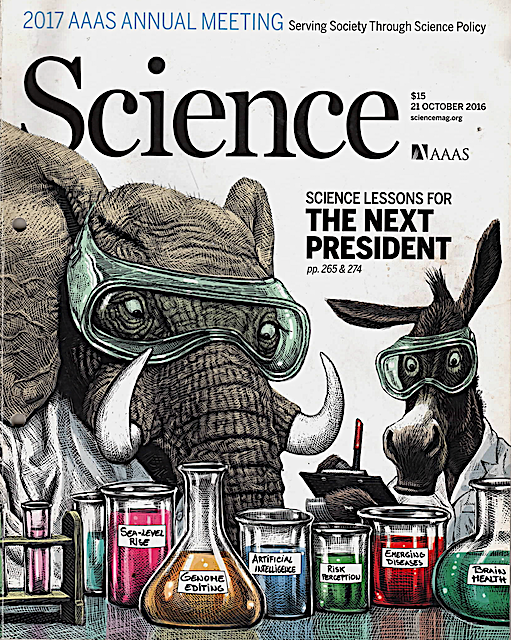
PICTURE AT TOP: SCIENCE [MAGAZINE] OCTOBER 2016...
- By Gus Leonisky at 28 Apr 2026 - 7:32am
- Gus Leonisky's blog
- Login or register to post comments
2022....
AbstractDuring his campaign for president, Joe Biden vowed to “end the politics and follow the science” when dealing with the COVID-19 pandemic and other public health and environmental crises. He was immediately criticized by then President Trump, who cast “listen[ing] to the scientists” as something only a fool would do, and warned that it would result in a “massive [economic] depression.” It is hardly surprising that Trump would take that position. After all, the Trump administration routinely prioritized economic interests, and worked tirelessly to remove what it viewed as unnecessary regulatory burdens on economic activity. The Trump administration regularly suppressed, downplayed, or simply ignored scientific research demonstrating the need for regulation to protect public health and the environment. The Biden administration has vowed to reverse course, but faces challenges in doing so due to the widespread assault on science led by former President Trump.
The Trump administration's efforts to undermine science are documented in the Silencing Science Tracker, an online database, which records anti-science actions taken by the federal, state, and local governments. Drawing on more than four years of tracker data—from Trump's election to Biden's inauguration—we show that the Trump presidency fundamentally changed how federal government agencies perform, use, and communicate scientific research. While the Biden administration has taken initial steps to undo some of those changes, it still has significant work to do to restore the role of science in federal government decision-making. Its task is made more difficult by the public distrust of science engendered by the Trump presidency.
Keywords: Climate change, Science, Biden, Trump
1. The Silencing Science TrackerThe Silencing Science Tracker is a joint project of the Climate Science Legal Defense Fund1and Columbia Law School's Sabin Center for Climate Change Law.2 The tracker records reported attempts by federal, state, and local government actors to restrict or prohibit scientific research, education, or discussion, or the publication or use of scientific information (“anti-science actions”). According to the tracker, 346 anti-science actions were taken by the federal government between President Trump's election and President Biden's inauguration (i.e., from November 8, 2016 to January 20, 2021). During the same period, a further 156 anti-science actions were taken by state and local governments, but those actions are not discussed in this chapter.
Federal actions recorded in the tracker are categorized as follows:
government censorship;
self-censorship;
budget cuts;
personnel changes;
research hindrance; and
bias and misrepresentation.
Within the above categories, the tracker records actions taken by the federal executive and Congress, except legislative proposals. Many tracker entries involve multiple types of action or actors. For the purposes of this analysis, those entries were separated into their component parts, resulting in 428 unique instances of anti-science behavior, each of which involves one type of action (i.e., from the list above), performed by one actor (e.g., a specific executive agency). The figures shown below were calculated based on that total.. There is reason to believe that many anti-science actions were not reported and thus are not captured in the tracker, and therefore the total represents a conservative estimate of anti-science actions taken between November 2016 and January 2021. In a survey conducted by the Office of Inspector General for the Environmental Protection Agency (EPA), nearly 400 EPA scientists said they had observed violations of the agency's scientific integrity policy in the second half of 2018, but did not report them due to “fear of retaliation, belief that reporting would make no difference, perceived suppression or interference by Agency leadership, and belief that politics and policy outweigh science.”3 Given the Trump administration's widespread and continued attacks on science, similar concerns were likely also held by scientists at other federal agencies throughout the second half of the Trump presidency. It is, therefore, reasonable to assume that a large number of anti-science actions went unreported.
2. Anti-science actions under TrumpDuring his first presidential campaign, Donald Trump promised to “ensure... total [scientific] transparency and accountability without political bias.”4 That was a promise he didn’t keep. As detailed further below, during his four years in office, former President Trump led a concerted effort to undermine federal scientific research, particularly research relating to climate change. The Trump administration's attacks on climate science dovetailed neatly with one of the former President's key goals: to roll-back climate regulations that scientific research shows would advance public health and environmental quality. Faced with this contradiction, the Trump administration sought to restrict access to scientific information or cast doubt on its veracity, thereby limiting public understanding of the issues and reducing possible opposition to the administration's plans. Those actions created a culture of fear among federal scientists, leading some to voluntarily suppress or distort information at odds with former President Trump's agenda. Many of the scientists who did speak out were removed from their positions, while others were prevented from conducting further research on topics deemed “controversial,” such as climate change.
2.1. Censorship and self-censorshipDuring President Trump's time in office (including the transition period), there were 154 documented instances of federal government censorship of scientists, and 19 instances of scientists engaging in self-censorship. Approximately 72% involved the suppression of information about climate change. This began even before President Trump took office. In November 2016, staff at Centers for Disease Control and Prevention (CDC) deleted content discussing the relationship between climate change and human health from at least four webpages, reportedly to “avoid drawing the new president's ire.” Similar changes were made to other federal agency websites after President Trump took office. In total, during the Trump administration, climate change and other scientific information was removed from the websites of twelve federal bodies, in most cases at the direction of administration officials.5This made it more difficult for Americans to educate themselves about climate change and other scientific issues, which may, in turn, have made it easier for the Trump administration to act on those issues by allowing them to “fly under the radar” or obscuring the consequences of administration action.
The Trump administration also removed scientific information from regulatory documents. For example, in or around August 2018, administration officials deleted information6 on the local health effects of climate change from regulatory documents supporting the weakening of greenhouse gas emissions controls. Again, this helped the Trump administration advance its deregulatory agenda, including by casting doubt on the need for climate regulations. Trump administration officials also attempted to suppress information that could lead to demands for stricter regulation (e.g., because it shed additional light on the impacts of climate change or demonstrated the inadequacy of that existing attempts to address it).7 This could have lasting consequences, making it more difficult for the current and future administrations to take regulatory action, due to a lack of information or sense of urgency.
This type of scientific censorship was widespread during the Trump administration, having been documented at 20 federal bodies—more than any other type of anti-science action. Notably however, the number of documented instances of government censorship declined slightly over time, falling by 26% from 2017 to 2018, a further 18% in 2019, and 10% more in 2020. This is not necessarily good news; it may simply reflect the fact that less science was done because of personnel changes, budget cuts, and other anti-science actions taken by the Trump Administration. There is also reason to believe that the attacks on science created a culture of fear among federal employees and led some to self-censor. A survey conducted in 2016—before President Trump's election—found that 72% of EPA scientists felt they could “openly express scientific opinions about the Agency's scientific work without fear of retaliation.”8 That number dropped to just 57% in a repeat survey conducted in 2018—almost two years into Trump presidency.8 In the 2018 survey, over 600 scientists said their “management chains do not consistently stand behind scientific staff who put forth scientifically defensible positions, including those that may be controversial.”8 It is, then, hardly surprising that some scientists would choose to self-censor. However, while understandable, such behavior could undermine public trust in science by creating the impression that scientists “pick and choose” what to disclose and regularly “hide” information. Both self- and government censorship may also cause the public to question whether research conducted or overseen by federal scientist is truly impartial and lead some to belief that such research is inherently political and thus untrustworthy.
2.2. Personnel changesIn addition to suppressing information, the Trump administration also sought to restrict or prevent further climate change research, including by removing9 and reassigning10 federal government scientists. This reduced the capacity of key science agencies. For example, the U.S. Geological Survey—the science arm of the U.S. Department of the Interior (DOI)—lost 150 staff scientists or over 2% of its total scientific workforce between 2016 and 2020.11During the same period, 672 scientists left the Environmental Protection Agency (EPA), resulting in 6% decline its total scientific workforce.12
As well as reducing federal agencies’ internal scientific expertise, the Trump administration also sought to limit their access to outside experts. To that end, in June 2019, President Trump issued an Executive Order directing each federal agency to eliminate at least one-third of its current scientific advisory committees.13 Following the order, at least nine advisory committees across the Department of Commerce, Department of Energy,14 DOI,15and EPA16 were terminated. Many other advisory committees (e.g., at EPA,17 DOI, and the Department of Labor18) were unofficially suspended or had their membership changed, with independent scientists replaced by industry representatives.19 In some cases, the new appointees lacked appropriate expertise, leading to concerns that the Trump administration was stacking advisory committees with favored “experts” who would be unable or unwilling to question the science behind its decisions. This was, perhaps, most obvious at EPA where members of the committee responsible for advising on particulate matter pollution themselves warned that they did “not have the breadth and depth of knowledge or expertise . . . necessary to adequately advise the EPA and to meet the statutory requirement for a thorough and accurate review” of existing or proposed particulate matter controls.20
The dismantling of science advisory committees furthered the Trump administration's goal of rolling back climate change regulations in several ways. Perhaps most importantly, it limited external review of the scientific bases for the Trump administration's deregulatory actions, many of which were subsequently struck down by the courts on the basis that they were not supported by the available evidence or the result of reasoned decision-making. Expert review could have identified those flaws before action was taken, but the Trump administration seemingly thought it was more important to move ahead quickly and avoid the possibility of anyone questioning its approach. The administration's actions also had the effect of restricting federal agency and therefore public access to information that might justify action on climate change. That appears to have been the Trump administration's goal when it disbanded the Advisory Committee for the Sustained National Climate Assessment while it was in the process of drafting a report intended to assist government officials to use the National Climate Assessment in long-term planning.21 These types of actions again undermine trust in science by suggesting that scientific research and findings can be easily manipulated to achieve political ends.
2.3. Budget cutsUnder President Trump, federal agencies also faced pressure to reduce spending on scientific research, with the administration proposing deep across-the-board cuts in many budget cycles.22 Those proposals were largely rejected by Congress, which actually increased research funding during the Trump presidency.22 Nevertheless, many existing research programs had their funding cut or entirely eliminated. For example, in August 2017, DOI halted ongoing research into the health impacts of mountaintop removal coal mining, pending a review.23 The research was officially cancelled in April 2018, with DOI claiming that it was “redundant.”23 A subsequent investigation found that DOI's then principal deputy assistant secretary for land and minerals management, Katherine MacGregor, had pushed for cancellation of the study after repeatedly meeting with the National Mining Association and companies engaged in mountaintop removal coal mining.23 Another DOI official, Landon “Tucker” Davis, reportedly said the study should be cancelled because “science was a Democrat thing,” reinforcing the idea that scientific research is inherently political.23
Further supporting this view, under President Trump, some federal agencies also began requiring new research programs to be reviewed by political appointees to ensure they “promote the [Trump administration’s] priorities.”24 It appears that appointees often used the review process to further deregulatory initiatives, blocking funding for research that might otherwise underpin environmental regulations. For example, EPA refused new grants for climate research.24
2.4. Research hindranceThe Trump administration also restricted research in other ways. For example, in September 2018, DOI announced plans to destroy records relating to several of its program areas, including “biological resources and marine conservation.”25 The records included, among other things, data on the size and location of various fish and wildlife populations that is used in researching species health.25 In addition to limiting access to data needed for research, DOI also interfered with research processes. For example, scientists at DOI's U.S. Geological Survey were directed not to model the impacts of climate change beyond 2040, presumably because the worst impacts are expected to occur in the second half of the century.26
In total, in the time between President Trump's election and President Biden's inauguration, there were 43 documented examples of research hindrance. The number of incidents rose by 157% from 2017 to 2018—the largest year-on-year increase in any category recorded in the Silencing Science Tracker—before dropping in 2019 and then increasing to 2017 levels again in 2020. Again, many of the actions taken furthered the Trump administration's deregulatory agenda, including by obscuring the harms caused by climate change and thus making it easier to justify the weakening of climate regulations. Other actions appear to have been intended to help President Trump politically. For example, during the COVID-19 pandemic, Trump administration officials pressured the Food and Drug Administration to approve new vaccines and treatments before they had been fully tested.27 President Trump had previously accused the “deep state, or whoever, over at FDA” of intentionally slowing work to hinder his chances of re-election.27 His supporters could easily have interpreted this to mean that FDA scientists were pursuing their own (anti-Trump) agenda and thus should not be trusted to deliver impartial advice about COVID-19 or other issues.
READ MORE: https://pmc.ncbi.nlm.nih.gov/articles/PMC8793038/
=====================
AND TRUMP GOT ELECTED BACK IN 2024.........
READ FROM TOP.
PLEASE VISIT:
YOURDEMOCRACY.NET RECORDS HISTORY AS IT SHOULD BE — NOT AS THE WESTERN MEDIA WRONGLY REPORTS IT — SINCE 2005.
Gus Leonisky
POLITICAL CARTOONIST SINCE 1951.
RABID ATHEIST.
WELCOME TO THIS INSANE WORLD….
TRUMP’S POLARIZATION OF
TRUMP’S POLARIZATION OF SCIENCE IS BAD FOR EVERYONE
A reelected Donald Trump would continue to attack studies that stand in the way of his agenda—and to make support for scientific inquiry a tribal belief.
By Sarah Zhang
Editor’s Note [THE ATLANTIC]: This article is part of “If Trump Wins,” a project considering what Donald Trump might do if reelected in 2024.
The president of the United States cannot control the trajectory of a hurricane, but he can—we learned in 2019—force the National Oceanic and Atmospheric Administration to endorse a trajectory that he invented. Thus went Sharpiegate, the brief episode that began when Donald Trump tweeted a warning about Hurricane Dorian’s danger to several states. It was one of his more anodyne tweets, but he erroneously included Alabama. He doubled down when questioned, producing as proof a NOAA forecast altered with what looked suspiciously like a Sharpie. When this failed to quiet criticism, he strong-armed the agency into a statement that affirmed his tweet.
By then, Dorian was already making landfall nowhere near Alabama. But so what? Even if Trump could not bend reality, he found that he could bend the federal bureaucracy to his lies. Given another four years in the White House, he will certainly do so again and again.
When science gets in his way, Trump is happy to attack or distort it—or block it altogether. His administration kicked scientists off EPA advisory panels, replacing them with allies who questioned the need to regulate smog and greenhouse gases. It canceled a $1 million study on the risks of mountaintop-removal coal mining. It stopped funding children’s health centers that studied the impact of pollution.
READ MORE: https://www.theatlantic.com/magazine/archive/2024/01/trump-reelection-covid-pandemic-science/676127/
=======================
AND TRUMP GOT ELECTED BACK IN 2024.........
READ FROM TOP.
PLEASE VISIT:
YOURDEMOCRACY.NET RECORDS HISTORY AS IT SHOULD BE — NOT AS THE WESTERN MEDIA WRONGLY REPORTS IT — SINCE 2005.
Gus Leonisky
POLITICAL CARTOONIST SINCE 1951.
RABID ATHEIST.
WELCOME TO THIS INSANE WORLD….
2025.....
Friday essay: Trump and Kennedy are destroying global science. Even Einstein questioned facts – but there’s a method to it
BY Elizabeth Finkel
Eight months into Donald Trump’s second presidency of the United States, truth and science are again under attack – with global consequences. USAID, which tackled HIV, TB, malaria and child malnutrition is gone. Funding has been withdrawn from GAVI, a public–private global alliance that helps buy vaccines for the world’s poorest children. Malnourished children are already dying.
Besides these brutal consequences, the scientific machine that delivered America’s scientific and technological dominance is being ruthlessly dismantled. Any research project that mentions diversity, equity and inclusion (DEI), climate change or addresses the causes of vaccine hesitancy is a prime target. But even US space science, once the pride of the nation, is facing “an extinction-level event,” according to the US Planetary Society.
Across the spectrum of science, some 4,000 research grants have been cancelled. Unbelievably, bird-flu experts were fired in the middle of an outbreak. That was topped last May by cancelling a US$600M grant to the company Moderna to develop an mRNA vaccine against bird flu.
And this Tuesday, US$500 million was cancelled for 22 more projects developing mRNA vaccines. Bear in mind that under Operation Warp Speed, the first Trump administration funded the development of Moderna’s mRNA vaccine against COVID. Moderna and Pfizer-BioNTech both delivered mRNA vaccines in the record time of less than a year, winning mRNA vaccine technology a Nobel Prize in 2023.
It’s not just American science that’s being dismantled.
Threats to Australian science, tooIn March, the Trump administration sent a questionnaire to researchers receiving US funding in Australia, the European Union, the United Kingdom and Canada. The 36 questions included whether their project related to climate, whether it is taking “appropriate measures” to defend against “gender ideology” and whether the organisation receives funding from China.
US funding for collaborative science projects with Australia amounts to AUD$386 million. So, the threat of losing those substantial funds is dire. As the Australian Academy of Science warned last March, if US–Australian collaboration ceases, “it will directly threaten […] strategic capability in areas of national interest such as defence, health, disaster mitigation and response, AI and quantum technology”.
By June, Australian medical research institutes were “suspending projects on malaria, tuberculosis and women’s health”. It’s like “having a bomb thrown into the middle of science”, notedProfessor Brendan Crabb, director of the Burnet Institute, a Melbourne-based global health research centre.
The fallout for US medical research is worse. The Trump administration’s proposed funding cut, to the National Institutes of health, the largest funder of medical research in the world, will see its budget slashed by 40% – and over 2,400 projects cancelled. They include research into cancer, Parkinson’s disease, Alzheimer’s disease, tuberculosis, HIV prevention, COVID vaccines and long-COVID.
Experts have been summarily fired and replaced by sycophants. And of course, the Department of Health and Human Services is now led by America’s most prominent anti-vaxxer, Robert F. Kennedy Junior. Elite research universities, including Harvard, Columbia, Princeton and Cornell, continue to be prime targets.
“It’s hard to overstate how serious this is […] Today, as we’re witnessing kind of the destruction of the institutions behind American science, it’s hard to believe. It’s hard to believe any administration would do this,” noted Alan Bernstein, director of global public health at Oxford University, in April.
Indeed, how could this be happening?
Erika Nolan, a MAHA (Make America Healthy Again) stalwart and YouTube influencer, provides a candid answer: “Facts no longer matter.” Nolan plies her 200,000 strong audience with idyllic scenes of herding chickens and goats while snuggling her baby in a front pack.
Like Kennedy, Nolan believes America’s big health issues relate to food dyes and seed oils. Hopefully she does not live in a part of the US where measles or whooping cough is raging, and that her chicken flock won’t come down with bird flu.
She says it was COVID, and the pressure to be vaccinated, that “fast-tracked” her. And when asked about the 14 million lives saved in the first year, as reported in peer-reviewed medical journal, the Lancet, her answer is, “Everything can be manipulated.”
What Nolan doesn’t understand is that modern science emerged precisely to deal with the way everything can be manipulated. The very word science comes from scientia, Latin for knowledge. The gist of it is captured by the motto adopted in 1663 by the Royal Society in London: “Nullius in verba.”. That’s Latin for “Take nobody’s word for it.” In other words, experimentation and observation is what counts, not the opinions of influencers.
Nolan might be surprised to find her scepticism over “facts” goes all the way back to Socrates.
Knowledge, power and scienceHe left no written works, but we hear his voice through the “dialogues” of his student Plato. Ever so gently, Socrates probes the beliefs of his conversation partner, methodically laying bare their logical fallacies. It has come to be known as the Socratic method.
One of the most famous dialogues employs the allegory of a cave to teach Socrates’ primary lesson: knowledge can be based on false beliefs.
The cave is home to a group of prisoners who have been chained up for their entire lives. All they have ever been allowed to see is the cave wall in front of them. Shadows dance across it, representing the reality of the external world. The prisoners have no idea that the images are created by puppets paraded past a blazing fire just behind them.
One prisoner breaks free and climbs out of the cave. Dazed by the sunlight, it takes time for his sensitive eyes to adapt. At first, he is only able to look at shadows, then reflections, then real objects. He dashes back to the cave to enlighten his fellow captives. But his eyes have not readjusted to the dark and he stumbles around.
The prisoners perceive a blinded, deranged man, raving about a parallel world. They want nothing to do with him and become aggressive. This is Plato’s second lesson: the danger of trying to enlighten those wedded to pre-existing beliefs. Poignantly, Socrates would pay with his life for trying to enlighten others.
READ MORE: https://theconversation.com/friday-essay-trump-and-kennedy-are-destroying-global-science-even-einstein-questioned-facts-but-theres-a-method-to-it-261568
AND TRUMP GOT ELECTED BACK IN 2024.........
READ FROM TOP.
PLEASE VISIT:
YOURDEMOCRACY.NET RECORDS HISTORY AS IT SHOULD BE — NOT AS THE WESTERN MEDIA WRONGLY REPORTS IT — SINCE 2005.
Gus Leonisky
POLITICAL CARTOONIST SINCE 1951.
RABID ATHEIST.
WELCOME TO THIS INSANE WORLD….
fired....
Jake Johnson
‘More destruction of science’: Trump fires every member of US National Science BoardDonald Trump has dismissed every member of the National Science Board, escalating a broader push to dismantle independent scientific advice and cut research funding across the US government.
US President Donald Trump on Friday quietly fired every member of the independent board that governs the National Science Foundation, a move seen as an escalation of the administration’s destructive war on science.
Members of the National Science Board (NSB) were notified in a brief email “on behalf of President Donald J Trump” that their “position as a member of the National Science Board is terminated, effective immediately.” One fired board member, chemist Willie May, told The New York Times that he was “disappointed” but not “entirely surprised,” adding, “I have watched the systematic dismantling of the scientific advisory infrastructure of this government with growing alarm, and the National Science Board is simply the latest casualty.”
The NSB sets the policies of the US National Science Foundation (NSF), approves major funding decisions for NSF, and advises Congress and the president on “policy matters related to science and engineering.”
Rep. Zoe Lofgren (D-Calif.), the ranking member of the House Committee on Science, Space, and Technology, said in a statement Saturday that “this is the latest stupid move made by a president who continues to harm science and American innovation.”
“The NSB is apolitical,” said Lofgren. “It advises the president on the future of NSF. It unfortunately is no surprise a president who has attacked NSF from day one would seek to destroy the board that helps guide the foundation. Will the president fill the NSB with MAGA loyalists who won’t stand up to him as he hands over our leadership in science to our adversaries? A real bozo the clown move.”
Alondra Nelson, an academic who resigned from the NSB last May over concerns of political interference, wrote on social media that “history will not look kindly on this administration for many reasons, but the systematic silencing of independent expertise is particularly troubling.”
Since the start of his second term, Trump and his deputies have assailed science across the federal government, including by eliminating the Environmental Protection Agency’s scientific research arm and firing experts en masse.
In the coming fiscal year, Trump has proposed cutting NSF’s budget by nearly 55 per cent. Additionally, the president’s budget would “eliminate funding for the National Oceanic and Atmospheric Administration’s Office of Oceanic and Atmospheric Research,” Scientific American reported. The White House plan, if approved by Congress, would also slash NASA’s budget by nearly 25 per cent.
“This is how the US loses its scientific leadership – with a reckless budget line,” Leigh Stearns, a glaciologist at the University of Pennsylvania, told Scientific American.
https://www.commondreams.org/news/trump-fires-national-science-board
READ FROM TOP.
PLEASE VISIT:
YOURDEMOCRACY.NET RECORDS HISTORY AS IT SHOULD BE — NOT AS THE WESTERN MEDIA WRONGLY REPORTS IT — SINCE 2005.
Gus Leonisky
POLITICAL CARTOONIST SINCE 1951.
RABID ATHEIST.
WELCOME TO THIS INSANE WORLD….