Search
Recent comments
- hitler's nest....
4 hours 14 min ago - no toilets.....
6 hours 47 min ago - old forests...
11 hours 58 min ago - ceasefire.....
12 hours 45 min ago - diesels....
12 hours 52 min ago - security...
19 hours 37 min ago - the west knows it, but....
20 hours 15 min ago - keep out....
1 day 3 hours ago - gains/losses....
1 day 3 hours ago - reefs in peril....
1 day 4 hours ago
Democracy Links
Member's Off-site Blogs
japanese rearmament.....
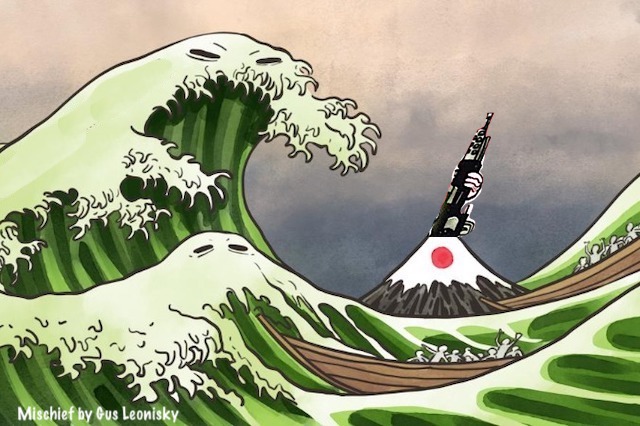
During the Allied occupation of Japan after World War II, Prime Minister Shigeru Yoshida developed a set of postwar foreign and security policies that came to be known as the Yoshida Doctrine. Masataka Kosaka has defined the doctrine as follows: (1) Japan ensures its national security through an alliance with the United States; (2) Japan maintains a low capacity for self-defense; and (3) Japan spends resources conserved by the first and second policies on economic activities to develop the country as a trading nation.1
The Yoshida Doctrine as a Myth
BY Yoneyuki Sugita*
The Japanese Journal of American Studies, No. 27 (2016)
The term “Yoshida Doctrine” was coined in 1977 by Masashi Nishihara, a prominent expert, as a way to define a consistent, pragmatic strategy in postwar Japan.2 It became a fixture among Japanese scholars in the late 1970s and early 1980s, when US hegemony was gradually declining and Japan was becoming an economic giant.3
This interpretation of the postwar era appropriately validated an emerging self-confidence about Japan’s role in the world. This article addresses a following research question: What were the terms and conditions for Japan, a vanquished, weak country, to be able to establish the Yoshida Doctrine? This article verifies my hypothesis that it was possible for Japan to do so because the United States acquiesced to it.
Many scholars have since analyzed the significance of the Yoshida Doctrine, and, roughly speaking, their interpretations fall into two categories: those that criticize Yoshida’s naïve judgements, secrecy, and inappropriate policies;4 and those that praise Yoshida’s foresight, strategic thinking, and pragmatic approach.5 The latter interpretation is the more widely accepted, along with the assumption that Yoshida, or for that matter Japan, was powerful enough to resist consistent and strong pressure from the United States for rearmament and instead was able to implement (wisely) an economy-first policy favorable to Japan.
Yet how could it have been possible for Japan, a vanquished, weak country after World War II, to implement such an important independent policy if it went against the wishes of the United States, a hegemonic power at that time? In short, Japan could not and did not, and the policy was not. The doctrine was possible only because it satisfied the interests of the United States—or at least because the United States acquiesced to it. Thus this article focuses on American perceptions and policies that established the framework within which Yoshida and other Japanese policymakers tried their best, in a rational and strategic manner, to advance Japan’s national interests. Ultimately, the Yoshida Doctrine proves to be not only of historical interest but also still relevant to the understanding of Japan’s current foreign and security policies.6
I. rearmament
As early as 1946, the Joint Staff Planners, a principal planning agency serving the US Joint Chiefs of Staff (JCS), began considering Japan’s rearmament in preparation for a presumed Soviet attack against Japan.7 Within General Headquarters in Japan, Gen. Charles Willoughby, Chief of Intelligence Division, and Lt. Gen. Robert Eichelberger, Eighth Army commander, were earnest advocates of Japanese rearmament.8 In March 1948, when Washington considered starting peace treaty negotiations with Japan, Under Secretary of the Army William Draper stated that the War Department was generally in favor of Japanese rearmament.9 In response to an inquiry by the secretary of defense, the JCS stated: “Solely from the military viewpoint, the establishment of Japanese armed forces is desirable” to offset “our own limited manpower.”10
Yet there were those who had reservations about Japanese rearmament. George Kennan, director of the Policy Planning Staff in the State Department, asserted that Washington should neither proceed with the peace treaty nor allow Japanese rearmament.11 Gen. Douglas MacArthur, Supreme Commander for the Allied Powers (SCAP), vehemently opposed the idea of Japanese rearmament as running counter to US international commitments and Occupation objectives.12 Secretary of the Army Kenneth Royall supported Japanese rearmament in principle, considering the critical shortage of manpower in the US military; however, Japan’s depressed economy at the time precluded pursuing this idea.13
Without consensus among Washington officials, NSC13/2, an important document prepared by the National Security Council, represented a turning point in US thoughts about the Allied occupation of Japan. It supported strengthening the Japanese police force without making any definite commitment in US policy on the matter of Japanese rearmament, and it was approved by President Harry S. Truman on 9 October 1948.14 NSC13/2 checked the desires of the JCS to promote Japanese rearmament. Even limited Japanese rearmament was deemed inadvisable because it would require amending the new Japanese constitution, abrogate the Potsdam Declaration, and adversely affect Japanese economic recovery. Thus, the JCS had to be content with merely planning for future limited rearmament in Japan while still insisting that “the terms of NSC 13/2 should now be reviewed.”15
NSC13/3, a revision of NSC13/2, was adopted on 6 May 1949, but no amendment was made under the subtitle, “The Post-Treaty Arrangements.”16 Taking NSC13/3 into consideration, the JCS claimed, “from the military point of view, that a peace treaty would, at the present time, be premature.”17 However, according to the JCS, “plans . . . for limited Japanese armed forces for self-defense to be effectuated in war emergency” should be included in peace negotiations.18 Agreeing with the JCS, the Defense Department advocated Japanese rearmament as being “consistent with the overall strategy of the United States of concentrating its power in Europe and maintaining minimum strength in the Far East.”19
Nevertheless, the Central Intelligence Agency emphasized that, no matter how important Japanese rearmament might be for the US military establishment, it could have unpredictable consequences. “There would be no assurance that those forces would be used in opposition to Communism, if there were compelling economic reasons for an accommodation with the Communist world,”20 one memo cautioned. Aside from the trust issues, the Central Intelligence Agency was also worried about negative reactions to Japanese rearmament from Japan’s former enemies.21 John B. Howard,
special adviser to the secretary of state, was likewise distrustful and asserted that “a decision to rearm Japan should not be made without more adequate assurances than are now present that Japan will continue to be friendly, or at least not hostile, toward the United States.”22 Harboring similar suspicions, the JCS pursued a limited Japanese rearmament that would be easy to control.23
In November 1949, the Defense Department recommended postponing the decision about Japanese rearmament, given that Washington officials could not yet reach a consensus.24 Secretary of State Dean Acheson made it clear that “the rearming of Japan for self-defense is not under present circumstances an acceptable alternative.”25 Even Gen. Omar Bradley, chairman of the JCS, grudgingly agreed that Japan should have its armed forces in the future but that “at the present it was not feasible to permit Japan to rearm.”26 In April 1950, William Sebald, political adviser to SCAP, concluded that Japanese rearmament “in the immediate post treaty period must be rejected.”27
II. Impacts of the korean War on Japanese rearmament
The outbreak of the Korean War seemed to decide the controversy in favor of rearmament. In July 1950, SCAP issued a directive to the Japanese government to establish a Police Reserve Force totaling 75,000 men and increasing the number of the Maritime Safety Force by 8,500 men.28 SCAP claimed that the Police Reserve Force was separate and distinct from the regular police. Gen. Willoughby even devised a plan to organize the Police Reserve Force into four armed divisions.29 Changing his opinion, Sebald acknowledged in September that “Japan must be partially rearmed” to defend against a possible Communist attack.30 Facing a “new situation radically different from that envisaged in the Potsdam Proclamation,” the Policy Planning Staff also expressed its support for Japanese rearmament.31 US officials were not, however, monolithic in their opinions of how much pressure they should apply to Japan for rearmament. Even after the outbreak of the Korean War, John Foster Dulles, special consultant to the secretary of state, said that former victims of Japanese aggression as well as the Japanese themselves would oppose the plan to rearm Japan.32 General MacArthur argued that the Allied Powers should be more concerned about the threat from a remilitarized Japan than a threat of attack against Japan.33
READ MORE: https://www.jaas.gr.jp/jjas/pdf/2016/06_SUGIYAMA.pdf
- By Gus Leonisky at 30 Apr 2026 - 5:44am
- Gus Leonisky's blog
- Login or register to post comments
policy shifts....
End-of-the “Pacifist Japan” Scenario
Expanded Justification for Defense Buildup Amid U.S. Alliance Restructuring
Germany’s Rearmament Trend Also Catalyzing Japan’s Policy Shift
“From Exclusive Self-Defense to Active Deterrence” Japan Accelerates Militarization, Reflecting U.S. Strategic Demands and Germany’s Rearmament Trend
BY Anne-Marie Nicholson
Japan, which has constrained its military autonomy for 80 years since World War II, is now approaching a pivotal turning point. Following the revision of its three core security documents, Tokyo is simultaneously pursuing the operational deployment of counterstrike capabilities and a restructuring of its defense industry, signaling a rapid shift in its security policy from a defense-oriented posture to an active deterrence strategy. Against the backdrop of mounting pressure from the United States to recalibrate alliance structures and the parallel rearmament of Germany, the historical constraints tied to its status as a former aggressor nation are increasingly receding from the center of policymaking.
Takaichi Pushes Security Document Revisions Following Arms Export Policy ShiftAccording to Kyodo News on the 28th, the inaugural meeting of the “Expert Panel on Security from a Comprehensive National Power Perspective,” established by the Japanese government to revise its three key security documents, was held the previous evening at the Prime Minister’s Office. The panel comprises 15 members, including former Ambassador to the United States Kenichiro Sasae, former Vice Defense Minister Tetsuro Kuroe, University of Tokyo Graduate School of Public Policy professor Kazuto Suzuki, and Waseda University professor Noriko Endo.
The formation of this panel follows Prime Minister Sanae Takaichi’s pledge during a parliamentary address in October last year to revise the three cornerstone security documents—namely the National Security Strategy, the National Defense Strategy, and the Defense Buildup Program—within the year. At the meeting, Takaichi stated, “The relatively stable international order that persisted after the Cold War has become a relic of the past,” adding, “We must proactively pursue a fundamental strengthening of our defense capabilities.” She also emphasized the need to examine new modes of warfare and establish systems capable of sustaining prolonged conflicts, referencing Russia’s invasion of Ukraine and evolving conditions in the Middle East.
Japan’s security policy is guided by three principal documents. The first is the National Security Strategy (NSS), which serves as the highest-level directive for foreign and security policy, defining how Japan perceives and responds to threats. The second is the National Defense Strategy (NDS), a military strategy document derived from the NSS that outlines the role of the Self-Defense Forces, operational concepts, and force deployment direction. The third is the Defense Buildup Program (DBP), an execution roadmap detailing specific weapons acquisitions, budgets, and force enhancement plans. These three documents are interlinked, forming a “blueprint–strategy–budget” framework for Japan’s security policy. The most recent revision occurred in 2022, when Japan formally declared its possession of “counterstrike capabilities,” signaling a major policy shift.
The upcoming revisions are expected to reflect changes in the international security environment since 2022. Beyond the military expansion of China and North Korea, the prolonged Russia-Ukraine war and the conflict between the United States and Israel and Iran that began in February this year have significantly altered both the security landscape and the nature of warfare. Accordingly, measures such as deploying long-range missiles, refining strike systems, and strengthening command and control frameworks are likely to be included, with the aim of elevating previously declaratory “counterstrike capabilities” to operational readiness.
A central issue will be preparedness for “new modes of warfare.” In conflicts involving Ukraine and Iran, large-scale deployment of low-cost drones and the rapid proliferation of artificial intelligence (AI) applications have become defining features. Given the limitations of existing equipment systems in addressing these developments, how Japan adapts to such changes will emerge as a key point of contention. Another focal issue is the establishment of “sustained combat capability,” enabling prolonged military engagement. Experts underscore that strengthening the domestic defense industrial base is essential to ensure the autonomous procurement of ammunition and weapons in times of crisis.
Ahead of the expert panel meeting, the Japanese government had already abolished the “Three Principles on Transfer of Defense Equipment,” which had restricted the export of lethal weapons, on the 21st. By removing provisions that limited exports to five categories—rescue, transport, warning, surveillance, and minesweeping—the move effectively opens the door to the export of lethal arms. This is intended to bolster the competitiveness of Japan’s defense industry while enhancing its combat readiness in contingency scenarios. At the meeting, Takaichi reiterated her firm commitment to strengthening defense capabilities, declaring that “there is not a moment to spare.”
U.S. Demands Expanded Japanese Role as a Pillar of Indo-Pacific StrategyAt its core, the revision reflects a transformation in the character of Japan’s security policy. As a former aggressor nation in World War II, Japan has long adhered to the principle of “exclusive self-defense,” exercising only the minimum necessary force in response to an attack under its postwar pacifist constitution. Recent developments, however, point in a different direction. The acquisition of preemptive strike capabilities, the possession of long-range offensive assets, and the expansion of multilateral security cooperation beyond the U.S.-Japan alliance all indicate a transition from passive defense to active deterrence.
This transformation is unfolding with tacit approval or strategic utilization by the United States. Japan’s postwar security strategy has historically operated on a framework of “trading autonomy for security.” Under the San Francisco Treaty system, Japan restrained military expansion under Article 9 of its constitution while accepting U.S. military protection through the U.S.-Japan Security Treaty. Within this arrangement, Japan adopted the “Yoshida Doctrine,” prioritizing economic development while relying on the United States for security, thereby sustaining an asymmetric alliance structure centered on U.S. leadership.
This framework persisted after the Cold War. During major international conflicts such as the Gulf War (1990–1991) and the War on Terror (2001–2021), Japan refrained from direct military intervention while expanding financial and logistical support, adjusting its mode of alliance contribution. At the same time, as the security environment in Northeast Asia deteriorated, Japan’s dependence on the United States intensified. Consequently, Japan has faced the dual challenge of expanding military autonomy while maintaining alliance dependence, a dynamic often characterized in academia as a “tension between relinquished autonomy and secured deterrence.”
However, the second Trump administration has introduced a shift in U.S. strategic expectations toward Japan. According to the National Security Strategy released in December last year, Washington is simultaneously demanding a structural recalibration of the alliance and a redefinition of Japan’s national security identity. The sustainability of the alliance, it argues, must be underpinned by tangible actions such as strengthening Japan’s defense capabilities and enhancing its autonomous operational capacity.
Japanese political circles interpret the Trump administration’s NSS as explicitly reaffirming the “conditional nature of alliances.” Rather than emphasizing values-based alliances, the United States is redefining partnerships in transactional terms, prioritizing tangible contributions to its security and economic interests. This shift indicates that the U.S. no longer provides military protection as a public good, instead moving toward a transactional alliance model predicated on mutual contributions. At present, Washington’s foremost priority is countering China. To this end, it requires a regional actor capable of sharing the burden in East Asia, with Japan emerging as the optimal candidate. From the U.S. perspective, Japan’s rearmament effectively serves as a cost-saving mechanism.
Germany’s Military Return Provides Additional Justification for Japan’s RearmamentGermany’s rearmament is also providing strategic justification for Japan. Following Russia’s invasion of Ukraine, Germany declared a “Zeitenwende” (historic turning point), elevating its defense spending this year to over 100 billion euros and positioning itself among the world’s top military spenders. It is advancing military expansion outside traditional fiscal constraints while increasing troop levels and debating the reinstatement of conscription. On the 22nd of this month, Germany also unveiled a comprehensive military strategy titled “Overall Concept for Military Defense.” This marks the first time since the establishment of the Bundeswehr in 1955 during the Cold War division of East and West Germany that Berlin has formulated such a comprehensive strategy.
Under the subtitle “Responsibility for Europe,” the document emphasizes Germany’s status as Europe’s largest economy and the largest NATO ally without nuclear weapons, declaring its intent to assume a leading role as the central pillar of continental defense. It also sets the goal of building one of Europe’s most powerful conventional military forces while expanding the scope of military engagement beyond national defense to a global scale. This signals a departure from regionally confined defensive strategies toward the development of capabilities capable of conducting operations worldwide when necessary.
Germany’s policy shift is driven by heightened threat perceptions regarding Russia and the strategic pivot of the United States. Berlin assesses that Russia’s military threat has reached unprecedented levels and is preparing for the possibility of direct military provocations against NATO in the medium to long term. In particular, it identifies the expansion of hybrid warfare—combining cyber and information operations—and the increasing pressure exerted through long-range strike capabilities as key risks.
This sense of urgency is translating into concrete military restructuring. Germany has outlined a phased force modernization roadmap targeting 2039. Phase one (2026–2029) focuses on building a force capable of immediate combat readiness; phase two (2029–2035) aims to position Germany as a leading NATO military power; and phase three (2035–2039) envisions the completion of a “technologically superior military” integrating advanced innovations. The plan includes securing a total force of 460,000 personnel—260,000 active-duty and 200,000 reservists—as well as long-range precision strike weapons. Germany amended its constitution last year to remove limits on defense spending and has set this year’s defense budget at 108 billion euros, an increase of more than 25% from the previous year.
Germany’s rearmament, as a fellow former aggressor nation, is serving as a powerful factor legitimizing Japan’s discourse on becoming a “normal military power.” A military security expert noted, “With Germany moving toward rearmament, the argument that Japan alone should be constrained due to its past as an aggressor nation has lost much of its persuasive force,” adding, “As security threats materialize globally, deterrence capability in the present is increasingly replacing historical responsibility as the central criterion in policymaking.”
https://economy.ac/news/2026/04/202604288931
READ FROM TOP.
PLEASE VISIT:
YOURDEMOCRACY.NET RECORDS HISTORY AS IT SHOULD BE — NOT AS THE WESTERN MEDIA WRONGLY REPORTS IT — SINCE 2005.
Gus Leonisky
POLITICAL CARTOONIST SINCE 1951.
RABID ATHEIST.
WELCOME TO THIS INSANE WORLD….