Search
Recent comments
- hitler's nest....
4 hours 14 min ago - no toilets.....
6 hours 47 min ago - old forests...
11 hours 58 min ago - ceasefire.....
12 hours 45 min ago - diesels....
12 hours 52 min ago - security...
19 hours 37 min ago - the west knows it, but....
20 hours 15 min ago - keep out....
1 day 3 hours ago - gains/losses....
1 day 3 hours ago - reefs in peril....
1 day 4 hours ago
Democracy Links
Member's Off-site Blogs
60 days later: The US-israeli war on iran so far....
Things did not go according to plan. Iran struck back against US bases and Gulf energy infrastructure, blockaded the Strait of Hormuz, and with its government still intact, now insists that any peace deal leave its nuclear program off the table. Meanwhile, US President Donald Trump’s approval rating is in freefall and his NATO ‘allies’ have deserted him while struggling to deal with the economic fallout at home.
60 days later: The US-Israeli war on Iran so far
Donald Trump’s misadventure in the Persian Gulf has become a quagmire
Following the announcement of a US-Iran ceasefire deal, Israel launched a brutal invasion of Lebanon, killing hundreds of people in attacks on urban areas within minutes, invading the south of the country and triggering another spiral of violence where dozens of people are killed every day despite the announcement of a truce.
Did Israel drag the US into war with Iran?Trump and his cabinet struggled from the outset to describe both their objectives and their rationale for attacking Iran. Trump initially told the public that the US faced “imminent threats from the Iranian regime,”later claiming that Tehran was “two weeks away” from developing a nuclear weapon. Six months earlier, Trump proclaimed Iran’s nuclear program “totally obliterated” after US strikes on several key nuclear sites in Iran.
Secretary of State Marco Rubio told reporters that the US knew that Israel was going to attack Iran with or without American support. The US joined in the attack, he said, believing that “if we didn’t preemptively go after them before they launched those attacks, we would suffer higher casualties.”
Has the US achieved its objectives in Iran?The US’ military goals – as laid out by Trump – remain unchanged since February 28: “obliterate Iran’s missiles and production, annihilate its navy, sever its support for terrorist proxies, and ensure it never acquires a nuclear weapon.”
Prior to the first attacks on Iran, the CIA predicted that Khamenei would be immediately replaced by a successor, and that hardliners within the Islamic Revolutionary Guard Corps (IRGC) would strengthen their position in Tehran, Reuters reported. This prediction has been proven correct.
Trump has claimed that Iran’s navy is “completely obliterated,” while Secretary of War Pete Hegseth has described Iran’s missile arsenal as “functionally destroyed” and “combat ineffective for years to come.”However, US and Israeli military officials believe that around half of the Islamic Republic’s missile launchers and thousands of one-way attack drones are still operational, and roughly 60% of its navy – mostly fast-attack speedboats – is intact.
Iran’s support for Lebanon’s Hezbollah movement is degraded, but not severed. Meanwhile, the status of Tehran’s nuclear weapons program remains unchanged: both Iran and US intelligence assessments maintain that it has been paused since 2003.
How has Iran defended itself?Iran has, in the words of Foreign Minister Abbas Araghchi, “had two decades to study defeats of the US military to our immediate east and west,” and has “incorporated lessons accordingly.”
The most valuable of these is the concept of “mosaic defense” where commanders of Iran’s regional military districts are empowered to conduct strikes without approval from Tehran. This has allowed the IRGC to order attacks on Israeli and Gulf targets despite dozens of its senior leaders in the Iranian capital being killed.
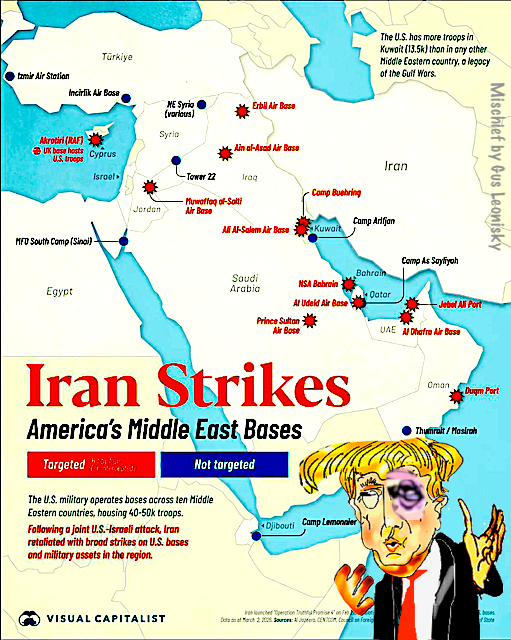
Iran responded to the US-Israeli attacks by launching ballistic missiles at Israel and at American bases and interests in the Gulf region. Israel’s military censorship regime makes assessing the damage to the Jewish state difficult. A combination of satellite footage, media reports, and social media footage makes, it possible to confirm that the following US bases have been hit, often more than once:
Naval Support Activity, Bahrain
Erbil International Airport, Iraq
Al-Asad Airbase, Iraq
Victory Base complex (Baghdad International Airport area)
Muwaffaq Salti Air Base, Jordan
Ali Al-Salem Air Base, Kuwait
Camp Buehring, Kuwait
Camp Arifjan, Kuwait
Mohammed Al-Ahmad Naval Base, Kuwait
Al-Udeid Air Base, Qatar
Al-Dhafra Air Base, UAE
Jebel Ali Port, UAE
Prince Sultan Air Base, Saudi Arabia
These facilities account for more than half of the US’ temporary and permanent military bases in the region, which together host between 40,000 and 50,000 American troops at any given time.
Iran’s target selection appears methodical, with radar installations prioritized in the early days of the conflict. Among the equipment hit was an AN/FPS-132 early warning radar system at Al Udeid Air Base, one of only six worldwide, and an AN/TPS-59 radar dome at Naval Support Activity Bahrain.
Iran has also struck energy infrastructure in Gulf states hosting the US military. Saudi Arabia’s Ras Tanura oil refinery and Qatar’s Ras Laffan LNG hub were both hit by drones on March 2. Production at Ras Laffan has since been indefinitely halted, wiping out a fifth of the world’s LNG supply. Iran broadened its campaign of energy strikes after an Israeli attack on its Pars gas field on March 18, and has since struck dozens of refineries, pipelines, and extraction sites in Bahrain, Qatar, Saudi Arabia, and the UAE, while its allied militias have struck oil fields and refineries in Iraq.
How has the US military performed against Iran?Despite inflicting severe damage on Iran, the Pentagon suffered several humiliations in the opening weeks of the conflict: fires and plumbing failures aboard the USS Gerald R. Ford; the forced retreat of two aircraft carriers – the Ford and the USS Abraham Lincoln – out of range of Iranian missiles; the evacuation of tanker aircraft from Al-Udeid and Prince Sultan airbases under Iranian fire; the downing of five fighter jets; and a series of ‘friendly fire’ incidents that Tehran claims were concocted to conceal the US’ true losses.
Damage to American bases in the region is far more extensive than publicly acknowledged by the Pentagon, and may take several years and “up to $5 billion to repair,” NBC News reported in late April.
At least 15 US service personnel have been killed and more than 520 wounded since February 28, although the Pentagon has been accused of manipulating casualty lists to hide its true losses.
Which Iranian elites did the US and Israel target?At least 48 senior Iranian political, clerical, and defense officials have been assassinated, including seven Defense Ministry and IRGC leaders killed at the same Iranian Defense Council meeting on February 28. The list of officials includes:
Supreme Leader Ayatollah Ali Khamenei
Iranian Defence Council Secretary Ali Shamkhani
IRGC Commander-in-Chief Mohammad Pakpour
Iranian Armed Forces Chief of the General Staff Abdolrahim Mousavi
Defense Minister Aziz Nasirzadeh
Head of the Military Office of the Supreme Leader Mohammad Shirazi
Secretary of the Supreme National Security Council Ali Larijani
Intelligence Minister Esmaeil Khatib
Several officials were killed along with their families. Khamenei’s daughter, son-in-law, and granddaughter were killed alongside the supreme leader, while former Foreign Minister Kamal Kharazi and IRGC budget chief Jamshid Eshaghi, among others, lost their wives and children to US and Israeli missiles.
According to Tehran’s figures, almost 3,500 people have been killed and 26,500 wounded in Iran since the conflict began, just under half of them civilians.
What is the situation in the Strait of Hormuz?The Strait of Hormuz, a vital waterway through which just under a third of the world’s seaborne oil and a fifth of its LNG flows, has been de-facto closed since the beginning of the conflict. Iran formalized the blockade on March 4, with the IRGC announcing that it alone would decide which ships could pass through the 34km-wide strait. In late March, passage was opened up to shipping from neutral countries willing to pay tolls, but shut down again in April after the US imposed its own blockade on the strait.
The American ‘double blockade’ is Trump’s latest strategy to resolve the crisis. Within the span of two weeks Trump declared the strait open, begged his NATO “allies” and China to help open it, threatened to unleash “hell” on Iran if it did not allow shipping through, before settling on imposing a blockade of his own on the Strait on April 13.
Iran maintains that it is able to export its oil by other means, and insists that the US must lift its blockade or bear responsibility for the wider economic damage resulting from the closure. “One cannot restrict Iran’s oil exports while expecting free security for others,” Iranian First Vice President Mohammad Reza Aref wrote on X on April 19. “The choice is clear: either a free oil market for all, or the risk of significant costs for everyone.”
What kind of economic damage has the war caused?Global energy markets have been thrown into chaos. The closure of Hormuz is the main bottleneck but it isn’t the only problem: key pieces of energy infrastructure in the Middle East have sustained damage that will be expensive and could take years to repair.
Major international energy agencies, including the International Atomic Energy Association (IAEA), the International Air Association (IATA), the International Monetary Fund (IMF), as well as shipping giants such as Vitol have warned of an energy crisis that could be substantially larger than the oil shocks of the 1970s. OPEC, the oil producing cartel, has also fractured, with the United Arab Emirates leaving in April 2026.
Meanwhile, shortages have emerged across numerous petroleum products, from naphtha to diesel and jet fuel. Rationing has been introduced in some countries, especially in Asia. Around one-third of the global fertilizer trade passes through the region, making this disruption a particularly ominous one for food prices.
Analysts warn of a slow-moving hurricane stalking the global economy as supply chains are pressured, inventories run low, and the specter of inflation returns. Although a global recession would eventually reach all corners of the globe, the effects so far have been disproportionately felt in Asia, which is more reliant on energy flows through Hormuz.
Oddly, stock markets have in many cases surged to new highs. This has led some analysts to talk about a disconnect between financial markets and physical reality. Such a disconnect is also evident in the often vast spread between the spot price of oil (for physical cargoes) and the much lower futures price. On the other hand, a new bout of inflation would be bullish for stocks – as long as the economic carnage is contained.
How are peace talks progressing?A ceasefire between the US and Iran took effect on April 8, with Israel and Hezbollah entering a fragile truce a week later. Talks between Washington and Tehran, however, have shown little sign of a breakthrough. Iran wants an immediate end to hostilities, security guarantees, and the lifting of the US blockade, while the US wants any deal to involve restrictions on Iran’s nuclear enrichment.
Iranian Foreign Minister Araghchi has spent the last week meeting with mediators in Pakistan and Oman, and shoring up diplomatic support in Moscow. According to Reuters, however, Trump is unhappy with Tehran’s latest proposal, and talks remain at an impasse.
What happens next?Two months since the war began, the US is bogged down in a conflict that Trump predicted would be over four weeks ago, with few of its objectives achieved. Washington’s European allies have refused Trump’s pleas and admonishments for help, American warplanes are banned from NATO airbases in multiple European countries, and even former backers of Trump, like Italian Prime Minister Giorgia Meloni, have distanced themselves from the US president.
At home in the US, the war on Iran is the least popular military escapade in American history. With Trump’s approval rating sinking to a new low of 34% on April 29, the embattled president faces a new legal threat on May 1, when, 60 days after he first notified Capitol Hill of the war, Congress is formally required to authorize its continuation. Should Trump return to hostilities after that date, Democrats are reportedly planning legal action to end the war.
Israel has continued to wage war on Lebanon, regardless of the insistence by two parties to the negotiations that the Jewish state was bound to a ceasefire agreement.
Iran has been significantly damaged, but has emerged in control of the Strait of Hormuz and therefore much of the world’s oil supply. Although the US is now preventing Iranian vessels from transiting the strait, Tehran – sanctioned for decades by the West – is betting that it can withstand more economic pain than Trump and his allies can.
Trump now faces an unenviable choice: cut his losses, take a deal, and retreat, or drag the US and the world economy into the kind of Middle Eastern quagmire he once swore he’d never end up in.
https://www.rt.com/news/639259-iran-war-60-days/
PLEASE VISIT:
YOURDEMOCRACY.NET RECORDS HISTORY AS IT SHOULD BE — NOT AS THE WESTERN MEDIA WRONGLY REPORTS IT — SINCE 2005.
Gus Leonisky
POLITICAL CARTOONIST SINCE 1951.
RABID ATHEIST.
WELCOME TO THIS INSANE WORLD….
- By Gus Leonisky at 30 Apr 2026 - 5:55am
- Gus Leonisky's blog
- Login or register to post comments
no off-ramps....
The Failure of Trump’s Iran Policy: ‘Bad Luck,’ Design, or Happenstance?
Henry Kamens
The Trump administration’s policy toward Iran — accompanied by mixed signals and increased pressure — is leading to a diplomatic deadlock, raising the risk of a large-scale conflict, and undermining confidence in American diplomacy.
WASHINGTON / ISLAMABAD — if you think Trump’s foreign policy has been rocky so far, imagine sending US ground troops into Iran. Like the captive in the Soviet film White Sun of the Desert—he was asked whether he prefers a quick death or prolonged torture — Washington seems to be choosing the slow, humiliating option.Mixed messages, grandiose public claims, and a naval blockade that undercuts talks have turned peaceful diplomacy into a farce. The result: US credibility is shredded, negotiations are stalled, and a fragile cease-fire is teetering on the brink of collapse—exactly the kind of mess that could make a short war drag into a strategic disaster.
“Bad So Far” vs. “Worse to Come”
This approach ignores the principles of effective negotiation outlined in Getting to Yes, a staple in diplomatic trainingApplying this to Trump’s foreign policy regarding Iran, especially the prospect of introducing ground troops, the analogy suggests that facing “death” in the movie scenario could be framed as a devastating regional conflict, immense human suffering, and a significant blow to US strategic interests and global stability, mirroring the inevitability and severity of the movie character’s fate, but on a geopolitical scale
The “worse to come” option exposes the potential for a full-scale ground war, followed by the crash of the world’s economy. Foreign wars have historically not worked out well for the United States. The option of “declaring victory and leaving with Trump’s proverbial tail between his legs” may be the best option for the world in general and the US in particular.
Even if a US military victory could be achieved, it would be nominal or fleeting, followed either by a difficult withdrawal, or a prolonged guerilla war, much like the Russian character in the movie who was facing either a quick death or prolonged torture.
Here are just some of Trump’s failures so far, domestic ones too:
1) A failed trade war with China
2) Annexation threats towards Greenland that reaped only indignation and ended in backtracking
3) Pressure on Canada that led to Mark Carney’s victory and brought Ottawa closer to Beijing
4) Congress’s decision to limit the White House’s ability to withdraw troops from Europe
5) The Supreme Court ruling that overturned the tariff war
6) His humiliation in ‘I’ ran, and it is growing!
7) And of course – the Epstein files
8) Relations with NATO being strained to the point of breaking
If history is any indication of things to come, the combination of bad timing, mixed messages, and coercive measures has so far sabotaged prospects for meaningful US–Iran talks in Pakistan and increased the danger the ceasefire will collapse—and by design!
Meanwhile, Trump is crashing and burning not only in terms of foreign policy, but now has fired another woman from his cabinet, on the domestic front. The first to go, on March 5, was ex-Homeland Security Secretary Kristi Noem. Then, less than a month later, Trump ousted former Attorney General Pam Bondi. Today, April 21, 2026, Labor Secretary Lori Chavez-DeRemer announced her resignation. The knives also seem out for Tulsi Gabbard, the Director of National Intelligence.
Never Ending War as a GREAT Distraction
So now he needs a great distraction, if not a victory in Iran, perhaps one in Cuba or some even greater distraction, to dial down the heat. The failure to negotiate without any desire for a good outcome, in at least to go through the motions, is most revealing. As of April 21, all efforts to negotiate face-to-face peace between the US and Iran remained unclear amid confusion over the US negotiators’ plans and uncertainty over whether Tehran would agree to take part.
Iran, with good justification, questions the good faith and real intentions of the US to come to the table with any actual intention of ending the war, as the US only wants to show to a domestic audience that it is the “shifty Iranians” who are spoiling a fair a and lasting deal.
Finger Pointing but the truth is clear!
Despite repeated public claims of progress, US-led efforts to broker a ceasefire and broader peace talks have so far failed to produce a durable breakthrough, or any breakthrough at all. Both sides continue to accuse each other of violating the fragile truce, while fundamental disagreements remain unresolved. If diplomacy continues to stall, that alone will stand as a significant policy failure, regardless of how either side seeks to frame it politically.
Crying Uncle!
It does not help with Trump making public statements of no compromise until a “deal” with the Iranians is about to happen, and how the Iranians are begging to negotiate does not help, which undermines trust and any semblance of legitimate leverage in the process.
It is almost certain that Steve Witkoff and Jared Kushner are involved in any official negotiations for the purpose of making sure that no deals are made. They are most certainly Israeli assets and know who is buttering their bread.
Steve Witkoff | U.S. Special Envoy to the Middle East
Witkoff is the quintessential Trump’s “closest buddy”—a billionaire real estate developer with zero prior diplomatic experience but too close for comfort to the President. Now he is tasked with handling the most radioactive files in the administration, including the Russia-Ukraine war, and the Iran nuclear standoff. The fact that he is the face of “deal-making” is nothing but a sick joke. In his world, a negotiation is only successful if the other side folds completely.
Jared Kushner | Special Envoy for Peace Missions
Perhaps one of the few, if not the only, close members of the family that Trump can trust, he has played a shadow-diplomacy role for years; Kushner was officially named Special Envoy earlier this year. Having brokered the Abraham Accords, he is the administration’s ideological anchor in the region. His role in the Islamabad talks is to ensure that any potential “breakthrough” aligns with the administration’s broader vision—one that prioritizes strategic alignment with traditional allies, demands of donors, and this leaves little room for Tehran’s current red lines. In other words, he is there to do Netanyahu’s bidding.
To the administration’s detractors, these two aren’t negotiators so much as “enforcers” and Israeli assets. They have extensive private business ties to the region, and see eye to eye with Trump, and everything has a payoff. It is clear, and even Trump has signaled that the purpose of the Islamabad talks isn’t to find a middle ground but to dictate the terms of surrender. If their goal is to ensure “no deals are made” unless they are entirely on Washington’s terms, they are the perfect hitmen for the job.
It is a similar situation to the Trump administration’s approach to the so-called peace talks regarding Ukraine, where the losing side seems to think it can dictate terms to the side that is winning.
Diplomatic optimism fades
Any veneer of optimism around U.S.-led peace efforts with Iran is quickly washing away. Progress has given way to entrenched gridlock, by design, and the fragile, frequently violated ceasefire looks less like a path to peace than a temporary pause in conflict.
Islamabad demonstrates the divide between Tehran and Washington is widening, and with JD Vance just walking away. Disputes over Iran’s nuclear program and the Strait of Hormuz have hardened into non-negotiable positions. Tehran refuses to negotiate under a U.S. naval blockade, blackmail, while President Donald Trump insists he faces “no pressure whatsoever” to ease sanctions—further undermining incentives for compromise.
The result is a volatile mix of mixed messaging and saber-rattling, pointing to a broader breakdown in negotiations. With the ceasefire fraying—including in Lebanon—and Islamabad talks weighed down by unrealistic preconditions, renewed conflict appears increasingly likely. What the administration frames as resolve instead reflects stagnation, raising the risk of wider instability and economic fallout.
Getting to Yes!
Critics argue this approach ignores the principles of effective negotiation outlined in Getting to Yes, a staple in diplomatic training. Its focus on mutual gains, trust, and interests over rigid positions stands in stark contrast to current U.S. strategy—one that appears to prioritize pressure over progress.
Trump and his backers want to keep up the “maximum pressure,” and without clear off-ramps. Thus, Washington has engineered conditions for assured failure and painted itself into a corner. The result is a chaotic, fatal cocktail of mixed messaging and saber-rattling that shows a total breakdown in diplomacy.
What Donald Trump and his team, including the official US State Department, are practicing under the guise of diplomacy falls face flat in terms of making a win-win deal and does not even come anywhere close to leading down the proverbial road of good intentions.
https://journal-neo.su/2026/04/29/the-failure-of-trumps-iran-policy-bad-luck-design-or-happenstance/
READ FROM TOP.
PLEASE VISIT:
YOURDEMOCRACY.NET RECORDS HISTORY AS IT SHOULD BE — NOT AS THE WESTERN MEDIA WRONGLY REPORTS IT — SINCE 2005.
Gus Leonisky
POLITICAL CARTOONIST SINCE 1951.
RABID ATHEIST.
WELCOME TO THIS INSANE WORLD….
hezbollah.....
Israel spent eighteen months doing what military analysts called impossible. They detonated Hezbollah's pagers. They killed Hassan Nasrallah after thirty-two years of leadership. They invaded southern Lebanon, destroyed tunnel infrastructure, dismantled command networks, and forced a ceasefire that repositioned Hezbollah's fighters north of the Litani River. Every major intelligence assessment said the same thing — Hezbollah was finished as a serious military threat. Some said it would take a decade to recover. Some said it would never fully recover.
Seventeen months later, Israeli Merkava tanks — the most battle-hardened armored vehicles Israel fields — advanced on Bint Jbeil and were stopped three hundred meters from their objective.
This video examines how that happened. Not from a political position. Not as advocacy for any side. But as a serious analytical question that has consequences far beyond Lebanon's borders — because what happened in the streets of Bint Jbeil in April 2026 is being studied right now by military planners in Moscow, Beijing, and Ankara who are drawing their own conclusions about the future of warfare.
In this video we cover the full timeline from the September 2024 pager attack through the November ceasefire, the rebuilding period that Western media largely ignored, the resumption of hostilities in March 2026, and the battle of Bint Jbeil itself. We look at the intelligence failure at the center of the story — not a failure of collection, but a failure of analysis. We examine the tunnel architecture that made Hezbollah's defensive position possible. We connect the Lebanon conflict to the broader regional picture including the Iran war, the fall of Assad, the closure of Syrian supply corridors, and the geopolitical stakes for great power competition. And we lay out three specific scenarios for how this ends, with real probabilities and a stated position on which outcome is most likely.
This is the kind of story that does not fit neatly into a headline. It requires context, timeline, and an understanding of asymmetric warfare doctrine that most coverage simply does not provide. That is what this video is built to give you.
The World Bank's Lebanon damage assessment found total conflict costs of fourteen billion dollars from the 2024 invasion alone, before the 2026 war began. Lebanon's real GDP declined 7.1% in 2024. More than ten thousand buildings were damaged or destroyed. Over sixty schools. Sixty-eight hospitals. A country already experiencing one of the worst economic collapses in modern history is now absorbing a second consecutive devastating military conflict with no reconstruction funding and no political resolution in sight. These numbers matter. The human cost behind them matters more.
Understanding this conflict accurately — who the actors are, what they want, what they are capable of, and what the realistic outcomes look like — is not just relevant to people in the Middle East. It is relevant to anyone trying to understand how military power, intelligence capability, and asymmetric resistance interact in the modern world. That understanding has direct implications for how the next decade of geopolitical competition unfolds.
This channel is committed to covering complex global events with the depth, accuracy, and honesty they deserve. Every claim in this video is sourced from verified, named institutions including the Lebanese Health Ministry, the World Bank, the Israeli Defense Forces' own public statements, Amnesty International, the Associated Press, Save the Children, and Doctors Without Borders. No speculation is presented as fact. No outcome is guaranteed. This is analysis, not prediction.
If this kind of coverage is useful to you, subscribing and sharing this video is the most direct way to support more of it. The comment section is open for serious discussion....
https://www.youtube.com/watch?v=jFlfDn4U638
========================
https://www.youtube.com/watch?v=Bhtc9COUi78
FPV Drones Are Destroying the Israeli Military
========================
READ FROM TOP.
PLEASE VISIT:
YOURDEMOCRACY.NET RECORDS HISTORY AS IT SHOULD BE — NOT AS THE WESTERN MEDIA WRONGLY REPORTS IT — SINCE 2005.
Gus Leonisky
POLITICAL CARTOONIST SINCE 1951.
RABID ATHEIST.
WELCOME TO THIS INSANE WORLD….
veterans....
Iran Leaders Understand War /Larry Johnson & Lt Col Daniel Davis
https://www.youtube.com/watch?v=dPDbkXh8ifk
READ FROM TOP.
PLEASE VISIT:
YOURDEMOCRACY.NET RECORDS HISTORY AS IT SHOULD BE — NOT AS THE WESTERN MEDIA WRONGLY REPORTS IT — SINCE 2005.
Gus Leonisky
POLITICAL CARTOONIST SINCE 1951.
RABID ATHEIST.
WELCOME TO THIS INSANE WORLD….
war again?....
https://www.youtube.com/watch?v=L8i63oDZV_E
IRAN WAR TAG TEAM /Lt Col Daniel Davis & Col Doug MacgregorREAD FROM TOP.
PLEASE VISIT:
YOURDEMOCRACY.NET RECORDS HISTORY AS IT SHOULD BE — NOT AS THE WESTERN MEDIA WRONGLY REPORTS IT — SINCE 2005.
Gus Leonisky
POLITICAL CARTOONIST SINCE 1951.
RABID ATHEIST.
WELCOME TO THIS INSANE WORLD….