Search
Recent comments
- security...
3 hours 19 min ago - the west knows it, but....
3 hours 57 min ago - keep out....
11 hours 12 min ago - gains/losses....
11 hours 31 min ago - reefs in peril....
12 hours 25 min ago - hippies....
15 hours 36 min ago - boycott....
17 hours 15 min ago - anti-zionistic....
22 hours 53 min ago - no thieving....
22 hours 58 min ago - sniffles....
23 hours 2 min ago
Democracy Links
Member's Off-site Blogs
our strange constitutional arrangements....
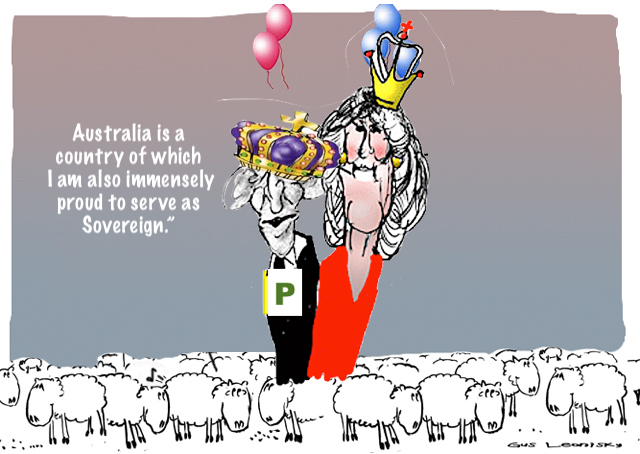
Our media has been full of praise for King Charles and his handling of President Trump on the recent state visit. His mention of AUKUS has been hailed as a great moment for Australia.
On the contrary, the King’s visit merely underlined our strange constitutional arrangements, essentially a Clayton’s monarchy [or, as the advertisements said, “the drink you have when you’re not having a drink”].
Charles is not my King
Queen Victoria could not have said it better. Addressing the US Congress, King Charles referred to Australia as “a country of which I am also immensely proud to serve as Sovereign.”
None of the other fourteen countries which, along with the United Kingdom, retain Charles as head of state were mentioned, not, I suspect, a matter of great concern for the citizens of Canada, Papua New Guinea or Jamaica.
Charles was in Washington as an emissary of the British government, and his trip was reported with bated breath as an attempt to restore the ‘special relationship’ between the two countries. What it underlined for me was that we are a country without an effective head of state, although the Governor General exercises the powers of the King in his absence from the country.
It was striking that the only Australian at the state dinner for Charles and Camilla was billionaire Anthony Pratt: as far as I can tell, no official representative of any of his other realms and territories was present. The White House clearly is not interested in the bizarre situation that they were entertaining a head of state of multiple independent countries.
In the usual sycophantic style of our media when confronted with the Royals, the visit received massive and favourable coverage. The King’s two major speeches, to Congress and at the State dinner, were politically sophisticated and included subtle criticisms of the Trump Administration’s policies on Ukraine, climate change and democratic norms.
Most Australians would agree with the King’s sentiments. But he was expressing them as the sovereign of the United Kingdom, without any input from the Australian government.
Prime Minister Albanese has now ruled out any further attempts to alter the Constitution, following the defeat of the Voice. The position of an assistant minister for the republic, created in his first government, has now been quietly shelved.
The image of our absent sovereign—who has so far spent five days in Australia—remains on our coins and we require our Parliamentarians to swear allegiance to him, leading to an understandable outburst from Senator Lidia Thorpe in 2024. For practical purposes he is represented by the Governor General, and the current holder of that office, Sam Mostyn, is gracious, smart and engaged.
But unlike the British prime minister, who has no choice in his sovereign, the Governor General is the personal appointee of the prime minister. This contributes to the marked tendency over recent decades to see prime ministers adopt more of the ceremonial roles normally associated with a head of state.
When Scott Morrison was attacked for being absent from the country during the bushfires of 2022, no one asked where was the Governor-General. Yet it is precisely in moments of national emergency that a non-partisan head of state is expected to take the lead.
For most Australians the confusion around our head of state is largely irrelevant. We accept an ongoing anomaly, maybe even enjoy the legacy of nineteenth century empire, which means we also have state governors who directly represent the British sovereign.
Albanese’s guess that a republican referendum would fail is almost certainly correct: any proposal would be countered by the current deep suspicion of politicians and a reluctance to change something that barely impinges on our daily lives. As long as Donald Trump rules, any proposal that included the concept of a president, however limited their powers, would be defeated.
But there is one move that Albanese could take, and that is to institute a process for appointing a Governor General that is bipartisan, either through two thirds vote in both houses of federal parliament or support from state parliaments.
I would hope that such a process would have supported Sam Mostyn, who brings a breath of fresh air to Yarralumla. But it would mean that Australians might feel a greater sense of connection with the person who for all practical purposes is our head of state.
https://johnmenadue.com/post/2026/05/charles-is-not-my-king/
- By Gus Leonisky at 5 May 2026 - 5:55am
- Gus Leonisky's blog
- Login or register to post comments
no toad kissing....
The Australian Republic Movement is the peak membership body advocating on behalf of the Australian people for an Australian republic with an Australian as our Head of State.
Let’s chart our own course.
Australia’s First Nations are the world’s oldest continuing cultures. We’re a uniquely successful multicultural country. Only someone who truly understands us can be a unifying symbol at home, safeguarding our Constitution and representing us proudly abroad.
Our Head of State should work for us full-time, fully committed to Australia. They should be elected on merit and be one of us – with the skills to do the job, accountable to us and unwaveringly loyal to us. Let’s make this happen.
Who are we?We’re Australians advocating for an Australian republic with an Australian as our Head of State.
We believe that the Australian people are best served by a local who champions our needs and interests.
We’re committed to strengthening our democracy and celebrating who we are as a nation.
As a grassroots, Member-driven body, the Australian people are at the heart of our movement.
Our Members are in neighbourhoods, towns and cities all over Australia. Our leaders are elected to steer the organisation on their behalf. They’re all volunteers who are passionate about an Australian republic.
Australians have the power to decide how we’re governed and by whom. We’re the conversation-starter, facilitator and campaigner. Our work can’t happen without you.
What is a republic?A republic is a system of government where citizens elect people from within their own communities to serve as their representatives and make decisions on their behalf. In a republic, the people’s elected representatives govern the nation, responsible to the people and acting in their best interests. At the apex of a republic sits a democratically selected head of state.
At present, Australia is a constitutional monarchy. We have a King. King Charles III is King of Australia. He is our Head of State. The King is gifted this position by birthright. He isn’t elected, appointed, nor even endorsed by the people. He holds that position for life, and then it’s passed on to his first-born child. Even though Charles is King of Australia, he is in fact a British citizen and lives in the United Kingdom.
To serve as his local representative, the King appoints a Governor-General on the advice of the Prime Minister. The Governor-General is vested with the King’s powers to act on behalf of His Majesty to provide Royal Assent to legislative bills, to issue writs for elections, and to appoint (and dismiss) officeholders, including the Prime Minister, who is our Head of Government.
In some countries, like the United States, the President is both Head of State and Head of Government, serving as an executive president. In other countries, like Ireland, the President is largely a ceremonial Head of State, while the Prime Minister is the Head of Government and holds executive power.
We think it’s time for an Australian to be our Head of State: to ensure the smooth operation of parliament and government, to safeguard our Constitution, and represent us at home and abroad – while the Prime Minister, as Head of Government, continues to administer the country and set public policy through the Executive (government ministers) and Parliament.
Our Values
Unity And Belonging
We celebrate Australia as the most successful multicultural community in the world – honouring more than 65 millennia of First Nations culture, with more than two centuries of European settlement and British institutions, and vibrant immigration that welcomes all people.
Equality And Aspiration
We believe in merit, equal opportunity, the Australian notion of having a go, and the principle that every job should be filled by an Australian with the right skills and experience.
Democracy And Choice
We embrace the Westminster system of government, the separation of powers, the rule of law, responsible government, free and fair elections, and the primacy of the will of the Australian people to be masters of our own destiny.
Non-Partisanship And Collaboration
We believe an Australian republic is beyond politics and goes to the very heart of who we are as a nation, and as such seek to collaborate and engage with Australians from all walks of life to achieve a shared vision for Australia’s future.
Integrity And Leadership
We champion truth, honesty and respect, and believe in accountability, integrity and leadership in the best interests of Australia and our people.
https://republic.org.au/
READ FROM TOP.
PLEASE VISIT:
YOURDEMOCRACY.NET RECORDS HISTORY AS IT SHOULD BE — NOT AS THE WESTERN MEDIA WRONGLY REPORTS IT — SINCE 2005.
Gus Leonisky
POLITICAL CARTOONIST SINCE 1951.
RABID ATHEIST.
WELCOME TO THIS INSANE WORLD….