Search
Recent comments
- anti-zionistic....
2 hours 31 min ago - no thieving....
2 hours 36 min ago - sniffles....
2 hours 40 min ago - grumpies....
2 hours 50 min ago - capitulation.....
5 hours 39 min ago - in polandia....
18 hours 39 min ago - deluded....
18 hours 47 min ago - ISW’s porkies....
1 day 54 min ago - generation Z....
1 day 58 min ago - jesus revolution...
1 day 1 hour ago
Democracy Links
Member's Off-site Blogs
a dream of a pleasant nightmarish budget....
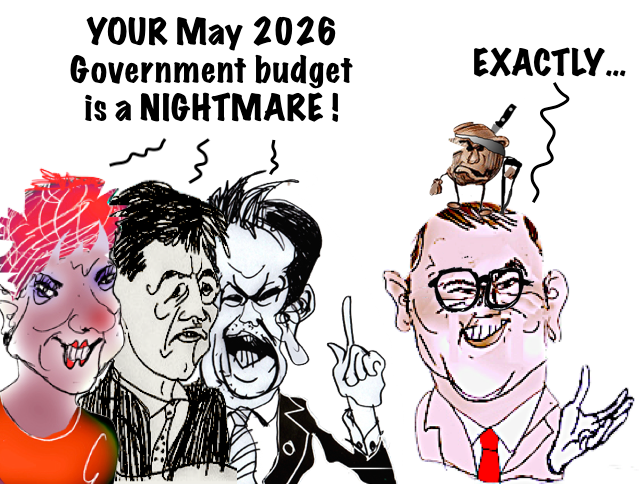
This budget is a Labor dream come true. It will redistribute income from investors to workers.
It will redistribute real estate opportunity from the prosperous old to the aspirational young.
And, because it’s a Labor dream, it’ll be attacked by the Coalition as a nightmare. Which is exactly what the Albanese government is hoping for.
This budget will be attacked as a nightmare. That’s exactly what the PM wants
BY [SMH] Peter Hartcher
By fighting to protect investors and older people, the Coalition will defend a dying demographic. And alienate the fast-growing younger. Already, voters under the age of 45 – Millennials and Gen Zs – constitute the majority of the electorate.
And, by the next election, there will be 700,000 more Gen Z voters on the electoral rolls than there were at the last. Among these, only one in five consider themselves Coalition voters, according to Kos Samaras of RedBridge, “and that’s on a good day”.
“We are giving hope to younger generations,” Treasurer Jim Chalmers told reporters. “That’s what this budget is all about.”
Labor’s hope is that the Coalition, by trying to take the hope away, will deal the political deathblow to itself.
If the Coalition is true to its recent punch-drunk form, it will oblige.
Is the government breaking its word? Its pledge before the last election that it would not touch capital gains tax and negative gearing? Absolutely. But the chance to break the Coalition is so tempting that Anthony Albanese is prepared to break his word to do it.
For Albanese, who once said his purpose was to “fight Tories”, this will be the sweetest victory of all.
The budget might not do enough to douse the flames of the populist fire fanned by One Nation because it doesn’t lead Australia out of its low-growth, low-productivity road of economic mediocrity. The simmering popular disgruntlement that has fuelled One Nation will probably continue to rise towards boiling point.
If so, the demise of the responsible right might merely open the way to the irresponsible far-right.
But Albanese will be content to take his enemies one at a time.
It was Brutus who spoke the famous line that “there is a tide in the affairs of men, which taken at the flood, leads on to fortune”.
For Albanese, the tide is at flood. With a dominant parliamentary majority, an opposition in disarray and two years until the next election, the conditions for bold action are ideal.
“We must take the current when it serves, or lose our ventures,” Brutus urged Cassius in Julius Caesar.
And the reform need is real. Albanese hasn’t confected a warped tax system that privileges investors over workers, and well-off retirees over first home buyers. These are persistent problems, long identified by economists, that governments have feared to address.
Jim Chalmers says that the budget will “dial up tax relief for people who work for a living”. They’ll get an automatic $1000 tax deduction every year from now, plus a $250 working Australian tax offset every year from next year.
As opposed to people who depend on income from investments – “not making any judgments”, Chalmers reassures as he announces a new minimum tax on distributions from trusts, which the wealthy commonly use as tax shelters.
This budget requires the trust to pay a minimum 30 per cent, “more closely aligning the tax rates from trusts with the rates paid by workers who earn a living from wages”, as the budget papers explain.
As for housing, this is where Albanese’s Labor dream is aiming to revive the Australian Dream. Over the past quarter-century, average incomes doubled. But home prices quadrupled. This broke the dream of home ownership for ordinary workers and stoked the wealth of canny investors who bought real estate for the tax benefits.
This budget seeks to make real estate less attractive to investors, and therefore more available to first-home buyers.
But while the prime minister and his treasurer are acting boldly to rebalance the system, they are not doing it recklessly. They’re trying to not punish existing investors. There are grandfathering provisions to protect existing negative gearing arrangements, for instance. Existing capital gains will be taxed under the old regime.
Any investor looking for new negative gearing opportunities can still find them; they’ll just be limited to newly built homes, not existing ones.
The Treasury modelling guesses that the net effect of all the changes will be to temper price growth by 2 per cent, or about $19,000 for the median home, over several years. So they expect home prices not to fall, but merely to moderate in the rate of growth. This is hardly a communist revolution.
Chalmers expects that these changes will help about 75,000 Australians buy their first home over the course of a decade. This is marginal, equivalent to increasing the rate of home ownership from 66 per cent to 67. The budget contains other measures to boost home-building, including the $2 billion for local water and road connections, an initiative inspired by the independent Helen Haines.
But the tax changes themselves will make only a very modest contribution to increasing the supply of homes. As Chalmers says, they’re more about increasing the supply of hope.
Yet the big picture of Australian economic performance is not terribly hopeful.
Chalmers announced a range of productivity measures, yet none, singly or together, is sufficiently serious enough to boost productivity. The treasurer says that they will, but his budget papers don’t support the rhetoric. The papers say the outlook for productivity growth is unchanged at a plodding 1.2 per cent.
In other words, Australia is stuck at its current economic growth limit of 1.5 to 2 per cent a year. Anything faster induces the friction known as inflation, demanding Reserve Bank corrective action.
The budget redistributes hope, but, at this sclerotic rate of national growth, it doesn’t create much. A high-growth, high-hope economy? That remains a dream.
=======================
It pains me to say nice things about politicians, but this is a good budget
BY [SMH] Ross Gittins
Much as it pains me to say anything nice about politicians, this is a good budget. Translation: there’s a lot in it you’re not gonna like, and not much you will.
The budget’s far from perfect, of course. We’re talking about politicians, after all. But it’s good because it gets on with doing what needs to be done – not something you can say about every budget.
You were hoping there might be a big tax cut? Sorry, your timing’s out. The first rule of budgets is that they follow a cycle. If the budget comes before an election, guess what? It’s about time we had a tax cut.
But if the budget comes after an election, it’s time for some spring cleaning. Get the budget deficit heading down, not up. Stop that wasteful spending over there. End that special tax break you’re giving someone who doesn’t particularly need it.
The area where government spending has really broken out is on the National Disability Insurance Scheme. Some of it’s going to people who probably didn’t need it, so let’s stop their payments. Doing so will save more than half the net savings of $64 billion over four years the government claims it’s making.
Well, maybe. It wouldn’t be the first time a government fell short of its savings goal. Not quite as tough-guy as they’d hoped to be.
For years pollies have talked about abolishing the tax breaks that allow people to borrow heavily and get a big discount on the capital gains tax when they sell a rental property, and now they’ve finally decided to do it.
======================
PLEASE VISIT:
YOURDEMOCRACY.NET RECORDS HISTORY AS IT SHOULD BE — NOT AS THE WESTERN MEDIA WRONGLY REPORTS IT — SINCE 2005.
Gus Leonisky
POLITICAL CARTOONIST SINCE 1951.
RABID ATHEIST.
WELCOME TO THIS INSANE WORLD….
- By Gus Leonisky at 14 May 2026 - 5:55am
- Gus Leonisky's blog
- Login or register to post comments
"all good"....
Michael Pascoe thought no budget had had a bigger build up than this one. As it turns out …
In summary, this Chalmers budget is wildly optimistic on housing investment, kind to small business, incrementally better on productivity issues, gives the Opposition not much to rage about, picks the low-hanging fruit on taxing discretionary trusts more fairly, delivers a new acronym (WATO! The Working Australians Tax Offset) and, despite all the headlines, does little to help our housing crisis.
For all the noise around capital gains tax and negative gearing, the government claims the changes will only “help around 75,000 homeowners into the market over the next decade” (my emphasis).
Ditto the announced-prior $2B spread over four years for infrastructure, the government says it will promote “up to” 65,000 extra homes over a decade.
So, on average, we’re hoping for just 14,000 extra homes a year. In the context of our housing shortfall and how far behind the government is on its 1.2 million new homes target, it is almost marginal.
Negative gearing lives!And the message for retail investors who have come to love the concept of negative gearing is: Buy shares! Buy commercial property! Buy off the plan! Buy a new house! Buy through your superannuation fund! Negative gearing lives! Heck, on new housing you can keep the existing capital gains tax regime if you prefer it.
Yes, the negative gearing change only applies to existing housing purchased from July 1, 2027.
Not such a big deal, is it?
Along with the CGT reform, the policy aim is to deter retail investors from buying existing housing (as they overwhelmingly do), reducing the competition for owner-occupiers and developers who want to knock down existing housing to build higher density.
And even if you insist on buying an existing house – maybe a holiday home you eventually intend to retire to – Gentleman Jim will let you carry forward any property losses in excess of rental income to use when, in time, you’ve reduced the mortgage and the rent has risen to more than cover interest.
In marked contrast to the Reserve Bank’s pessimistic forecasts last week, Treasury reckons the tax changes will cause a sharp increase in dwelling investment. The RBA, without knowledge of the changes, guessed dwelling investment would shrink by 1.1% in 2027-28.
Treasury says it will rise by 3.5%. Good luck with that.
Landlord subsidiesWhat should be a Budget headline is that we are spending $7B this financial year and $7.4B in the new financial year on Commonwealth Rent Assistance – effectively subsidising landlords for the 1.4 million renters who otherwise couldn’t pay the asking price.
That is the cost of governments collectively walking away from public housing over the past three decades, roughly halving the percentage of homes that are available for social housing.
This budget, like its predecessors, is doing nothing to fundamentally change that failure.
It is barely maintaining the status quo.
But the MSM usual suspects don’t care about that. With the negative gearing change turning out to be a bit of a damp squib, the Opposition both in Parliament and the media will be left to rail about the inflationary impact of a deficit and that some people a fair way in the future will pay more tax on their capital gains.
Scaremongering just thatThe later is an equity measure. It’s become the norm for rich people to become richer because most of their income comes lightly-taxed capital gains. Read Harry’s piece.
No, there wasn’t mass emigration of our entrepreneurs to New Zealand and Singapore during the 14 years the CGT discount was actually based on the inflation rate. And Jim Chalmers says the alleged tricky bit for the minority of wildly successful startups is open to “further consultation”.
In a calmly rational AFR article as opposed to the paper’s recent opinion columns, economist Christian Gillitzer showed that even for someone on the top marginal tax rate with an investment appreciating by 9% a year (i.e. a good one), yes, more tax will be paid but capital gains will still be treated more favourably than ordinary income. For investments averaging annual appreciation of 5%, the difference with the current system is marginal ($).
And the deficit?As for the deficit, yes, if we crashed government spending to fast track to a surplus, inflation would be lower. A recession will do that for you.
Basically, maintaining public sector spending at its present share of the economy will help maintain our weak economic growth with a marginal impact on inflation. Of course government needs to spend smarter, but the quantum isn’t scary on the OECD scale.
Despite the budget’s business investment incentives, Treasury reckons total business investment growth will fall from 4% this financial year to 2.5% next financial year and 2% in 2027-28. Not flash.
Three random observations as I run out of time:
*The Treasurer is seeking a headline for $59.4 million going to community housing providers specifically for 16 to 24 year-olds in danger of homelessness. That won’t go very far and compares with an extra $110.0 million “to support housing and related services for personnel deployed to Submarine Rotational Force – West” i.e.
housing for the American submarine base in WA.
*Always concentrate on what politicians do rather than what they say. For all the talk of fighting terrorism and drugs and such, spending on “public order and safety” is slated to be cut by 11% over the next four years from this budget’s $9.7B. Border protection spending drops from $2.1B in 2026-27 to $1.7B in 29-30. AI to do all?
*I’m writing in the Budget lock-up having to guess what the fishwrappers’ inevitable lists of winners and losers will be.
The biggest winners should be accountants who charge by the hour.
Any tax change makes them busy and the CGT indexation changes will help keep them busy into the future. What’s more, the raft of R&D and small business measures – loss refundability for start-ups, loss carry back, the instant asset write-off – will mean AI isn’t replacing accountants just yet.
https://michaelwest.com.au/scaremongers-alert-like-negative-gearing-buy-shares/
READ FROM TOP.
PLEASE VISIT:
YOURDEMOCRACY.NET RECORDS HISTORY AS IT SHOULD BE — NOT AS THE WESTERN MEDIA WRONGLY REPORTS IT — SINCE 2005.
Gus Leonisky
POLITICAL CARTOONIST SINCE 1951.
RABID ATHEIST.
WELCOME TO THIS INSANE WORLD….
sugar sweet....
This week’s federal budget was meant to help tackle the cost-of-living crisis.
But Treasurer Jim Chalmers has done little to address a big out-of-pocket health cost millions of Australians face – dental care. This highlights the blind spot in the way successive governments think about oral health.
Yes, ongoing funding has been announced for two dental schemes – one for adults, the other for children.
These sound promising, until you dive into the details.
READ MORE: https://theconversation.com/dental-funding-in-this-weeks-budget-is-just-tinkering-around-the-edges-we-need-so-much-more-282859
=======================
THE ENEMY OF YOUR TEETH IS SUGAR... THE SUGAR INDUSTRY — MOST POWERFUL IN THE USA — SEEMS TO BE IN COHOOT WITH THE DENTISTRY INDUSTRY... SO WHAT WE NEED NOW IS FOR THE SUGAR INDUSTRY TO MAKE MORE ETHANOL FOR THE TRANSPORT INDUSTRY — ESPECIALLY WHEN OIL SUPPLIES ARE RESTRICTED... SWEET TREATS SHOULD BE OCCASIONAL...
READ FROM TOP.
PLEASE VISIT:
YOURDEMOCRACY.NET RECORDS HISTORY AS IT SHOULD BE — NOT AS THE WESTERN MEDIA WRONGLY REPORTS IT — SINCE 2005.
Gus Leonisky
POLITICAL CARTOONIST SINCE 1951.
RABID ATHEIST.
WELCOME TO THIS INSANE WORLD….
bitter-sweet....
... AND TALKING OF SUGAR.... [READ ABOVE]
A Chinese-built methanol dual-fuel container ship that can carry 24,000 standard containers, the world's first of its kind, departed from Nantong, East China's Jiangsu Province for sea trials on Thursday, the Xinhua News Agency reported.
The ship was built by Nantong COSCO KHI Ship Engineering Co, and is currently the world's largest methanol dual-fuel container ship.
Independently designed and built in China, the ship measures 399.99 meters in length, 61.3 meters in width and 33.2 meters in depth, with a deadweight tonnage of 225,000 tons and a maximum capacity of 24,168 standard containers, the largest among ships of its class, according to Xinhua.
Zhang Haidong, a representative of the company, said that the ship's core breakthrough lies in its integration of the world's largest methanol dual-fuel main engine, auxiliary engines and boiler system, enabling flexible switching between methanol and conventional fuel modes, according to the report.
When powered by green methanol, a single ship can reduce carbon dioxide emissions by about 150,000 tons annually, while nearly eliminating sulfur oxide emissions and significantly cutting nitrogen oxide emissions, in line with the global shipping industry's decarbonization goals, Zhang said, according to Xinhua.
Following the completion of sea trials, the ship will be put into operation on international shipping routes, injecting "Chinese momentum" into the global shipping industry's green and low-carbon transition.
Official data released recently showed that China led the world in the three major shipbuilding indicators in the first quarter, while Chinese shipbuilders are also accelerating their push into green and intelligent development.
Data available on May 9 from the Ministry of Industry and Information Technology (MIIT) showed that shipbuilding completion reached 15.68 million deadweight tons during the period, up 46 percent year-on-year, highlighting the country's continued strength in the global maritime manufacturing sector amid robust international demand for large vessels and high-end ship types.
Notably, green ships accounted for a significant share of China's new shipbuilding orders in the first quarter.
Green ship orders made up 80.2 percent of the international market share of China's newly secured orders during the period, with new contracts covering various types of dual-fuel and electric ships powered by liquefied natural gas (LNG), liquefied petroleum gas, methanol and ethane, according to the MIIT.
Green ships refer to ships that adopt advanced technologies or use new and clean energy sources to reduce pollution and greenhouse gas emissions.
Green ships are characterized by lower pollution emissions, effective pollutant treatment and higher energy efficiency, enabling more energy-saving and environmentally friendly operations, according to China Media Group (CMG).
Commenting on Chinese shipbuilders' accelerated push toward green and intelligent development, Wang Peng, an associate research fellow at the Beijing Academy of Social Sciences, said that the trend aligns with the global shipping industry's broader decarbonization drive.
The International Maritime Organization (IMO) has called for net-zero greenhouse gas emissions by about 2050, and the EU's shipping decarbonization regulations have been fully implemented this year, said Wang Zhe, a professor at Beijing Normal University, according to CMG.
By using fuel technologies such as methanol, LNG, pure electric and ammonia to power ships, Chinese shipbuilders are not only meeting global shipowners' compliance needs, but also seizing major opportunities arising from the green transition, Wang Zhe said.
Meanwhile, Wang Peng said that China's cost-effective and technologically advanced green ships have provided a "Chinese solution" for accelerating the IMO's decarbonization goals, offering key technological support for the global shipping industry to reduce pollution and greenhouse gas emissions.
He added that China's leadership in green and intelligent shipbuilding also reflects a phased achievement in the country's push toward high-end, intelligent and green manufacturing transformation.
"The rapid growth of green vessels has further driven coordinated development across the entire industrial chain, including clean-energy propulsion systems and advanced materials, strengthening the resilience and competitiveness of Chinese industry in the global value chain."
https://www.globaltimes.cn/page/202605/1360984.shtml
MEANWHILE AT THE BITTER "OPPOSITION" PARTY:
Kos Samaras
The second-last budget reply – delivered by a Liberal MPThe Coalition’s plan to strip permanent residents of access to welfare payments risks detonating support across Australia’s outer-suburban migrant households, where families consisting of citizens and non-citizens live, work and vote together.
This will possibly be the second last budget reply delivered by a Liberal MP.
That sentence will read as hyperbole right up until you sit down with what Angus Taylor actually announced from the dispatch box last night. The Coalition, he told the country, will strip non-citizens of access to the NDIS, Jobseeker, Youth Allowance and the Family Tax Benefit. He was explicit, and this is the bit Canberra’s press gallery has not properly digested: the policy includes permanent residents. Welfare for citizens only.
The political logic, as it will have been drawn up on a whiteboard somewhere in the Opposition Leader’s office, runs like this. One Nation just demolished us in Farrer. Hanson’s primary vote has been climbing for two years. The base is bleeding out the right flank. So we go and meet them there. We pick up her policy folder and we read straight from it.
Pauline herself said the quiet part out loud the morning after the speech. The Coalition, she observed with no small amount of satisfaction, has “finally seen the light.” She was being generous. What the Liberals have actually done is sign a public confession that they no longer have a project of their own. They have outsourced their policy to a minor party that exists, almost entirely, to feed on their decline.
But I want to leave Canberra’s tactical theatre to one side for a moment, because the truly remarkable thing about this announcement is not that it cedes ground to Hanson. It is that Angus Taylor, member for a regional seat carved out of grazing country in the southern tablelands, has misread who actually lives in his country.
As of late 2025, Australia had roughly 27.7 million residents. Around 2.9 million of those were temporary visa holders, students, graduate visa holders, working holiday makers, skilled temporaries. Another 1.5 to 2 million were permanent residents who had not yet taken citizenship. Add in the New Zealanders living here for decades on Special Category Visas, and you arrive at something in the order of 4.5 to 5 million non-citizen residents. Roughly one in six people in the country.
That is the headline number. The more important number is the one underneath it. Among permanent migrants who arrived under skilled and family programs, ABS settlement data tells us that as of 2021 only around 59 per cent had taken up citizenship. The other 41 per cent were sitting in queues, deferring the test, waiting on documents, or simply living their lives as PRs because the immediate utility of a citizenship ceremony, when you already have full work rights and a Medicare card, is not obvious from inside the household.
So in the Australia that exists in 2026, not the Australia of Angus Taylor’s electorate office, but the country as it is actually structured, you have a very large population of non-citizen residents who are economically productive, who pay tax, who have raised children here, and who are deeply embedded in families that include, wait for it…..citizens.
That last bit is the bit Taylor has not thought about.
Non-citizens do not vote. That is the entire premise on which last night’s policy was constructed. If you punish a group that has no representation at the ballot box, you cannot lose votes among them, and you can pick up votes among the people who resent them. Clean tactical logic. The kind of logic you can sell to a focus group of disaffected ex-Liberals in Wagga in about 40 minutes.
The problem is that this assumes non-citizens live in some kind of demographic quarantine. They do not. They live in families. And those families vote.
I grew up in Footscray, then Northcote, then Meadow Heights. Greek household, Greek street, Greek shopping strip. My parents arrived in the wave that filled the factories of inner Melbourne in the 1950s and 60s. They worked. They bought houses. They raised children. And a striking number of them never naturalised. Not because they were politically alienated. Because the cost-benefit ledger of citizenship, for a woman who left school at 12 in a village in the Peloponnese and now worked the cutting floor at a clothing factory in Brunswick, came out as: what would change?
Nothing on the kitchen table would change. Nothing in the pay packet would change. The children, born here, would be citizens by operation of birth. The household would vote. The family would be represented. The yiayia would not need to sit a test about prime ministers she had never heard of to participate in the Australia she had already built with her hands.
That household pattern, a mix of citizens and non-citizens under one roof, with the voting members effectively representing the whole, is not a historical curiosity. It is the operating template of post-war migrant Australia, and it is alive and well in the suburbs that decide elections.
The three-generation household, 2026 edition
Drive through Tarneit. Through Truganina, Kalkallo, Craigieburn. Schofields, Marsden Park, Riverstone. Box Hill, Clayton, Springvale. Wentworthville, Toongabbie, Blacktown. You will find, with statistical regularity, three-generation households. Grandparents on partner or parent visas, sometimes never destined to naturalise. Parents on permanent residency, working their way through the citizenship queue or simply not bothering yet. Children born here, or arrived young enough to have already been naturalised, enrolled to vote, working part-time in aged care or logistics or retail while they finish a TAFE qualification or a commerce degree.
In a great many of these households, the adult children are on the roll while the grandparents are not. It is exactly the structural shape of the post-WW2 migrant family that my parents’ generation grew up inside. The citizen kids vote for the household. They vote with their parents and grandparents in mind. They vote, very deliberately, for the people in their family who cannot.
You strip the NDIS from a permanent resident and you have not touched a single voter directly. You have touched their daughter, who does their Services Australia paperwork. Their son, who took the day off to drive his mother to the assessment. Their nephew, citizen, enrolled, who watched his autistic cousin lose his therapist because a man in Canberra decided welfare was for passports only.
You strip Family Tax Benefit from a PR family and you have not touched a single voter directly. You have touched the citizen daughter sitting at the kitchen table doing the family budget for her parents because her father’s English is not strong enough for MyGov.
You strip Jobseeker from a non-citizen and the family below them absorbs the cost. The citizen brother working two jobs covers the rent. The citizen sister-in-law puts the groceries on her card. The household carries it. And the household votes.
That’s what Taylor has actually done… and it’s electoral suicide.
The Liberal Party’s only credible path back into metropolitan Australia runs directly through these households. The aspirational small business owner in Box Hill. The Indian-Australian engineer in Wentworthville. The Filipina nurse in Blacktown. The Sri Lankan accountant in Glen Waverley. The Chinese-Australian dentist in Doncaster. These are people the modern Liberal Party desperately needs and has been bleeding for a decade.
Taylor has just told every one of them that in his Australia, their parents are second-class. Their grandparents are second-class. The disability support their nephew relies on is conditional on a passport. The family payment their sister survives on while her PR application sits in a Home Affairs queue that has not moved in two years is gone the day he takes office.
He thinks he is chasing Hanson voters in Farrer. He has not, evidently, considered that the seats he needs to actually form government, Bennelong, Reid, Banks, Chisholm, Menzies, Aston, Tangney, Hasluck, are precisely the seats where this policy will read as a declaration of hostility against the household. Not the individual. The household.
This is the analytical hole at the centre of contemporary Liberal strategy. They keep modelling the voter as an atomised unit, then designing policy that scorches the social fabric around that voter. And they keep being surprised when the voter, who turns out to be a daughter, a brother, a citizen son-in-law of someone the policy has just kicked, walks into a polling booth and punishes them for it.
There is a version of this policy that a competent centre-right party could have run. Tighten the wait times. Recalibrate the four-year newly-arrived resident’s waiting period that already exists for most welfare. Make a structured argument about contributory entitlement. None of that would have generated a single percentage point of Hanson defection, because Hanson voters are not actually interested in policy granularity. But it would have left the migrant household intact as a future Liberal constituency.
That is not the policy Taylor announced. He announced a blanket exclusion of permanent residents from the major welfare programs of the Commonwealth. He did it on national television. He did it with the explicit framing that non-citizens are a fiscal problem to be solved. And he did it in a country where roughly one in six residents is a non-citizen, and a much larger share than that lives in a household with at least one non-citizen sitting at the dinner table.
The Hanson vote he is chasing exists, broadly, in a part of the country where this household structure is rare. The seats he needs to win government exist in a part of the country where this household structure is the norm.
A party that does not understand this distinction is not a party in opposition. It is a party in managed decline. Rapid decline.
The second-last budget reply
I opened with the prediction that this will possibly be the second-last budget reply delivered by a Liberal MP. I want to be clear about what I mean by that. I do not mean the party is about to dissolve. Parties of the centre-right have great institutional durability. They have money, they have media patronage, they have a base of habitual voters in the wealthier corners of the country who will vote for the candidate with the blue rosette regardless of who that candidate is.
What I mean is that the role of alternative government, the credible claim to one day take the Treasury benches, is what is dying. That status is conferred by the cities. It is conferred by the outer-suburban migrant households the Coalition has spent the last decade insulting and is now, with this announcement, actively trying to dispossess. Take that status away and what you have left is not an opposition. It is a permanent third party of regional grievance, fighting Hanson for the same shrinking pool of votes, while Labor governs the country, preparing to face the next emerging opposition party, One Nation.
Last night was the moment the Liberal Party formally committed to that future. It will take one more election to confirm it. After that, the budget replies will be delivered by someone else.
https://johnmenadue.com/post/2026/05/the-second-last-budget-reply-delivered-by-a-liberal-mp/
READ FROM TOP.
PLEASE VISIT:
YOURDEMOCRACY.NET RECORDS HISTORY AS IT SHOULD BE — NOT AS THE WESTERN MEDIA WRONGLY REPORTS IT — SINCE 2005.
Gus Leonisky
POLITICAL CARTOONIST SINCE 1951.
RABID ATHEIST.
WELCOME TO THIS INSANE WORLD….