Search
Recent comments
- hitler's nest....
2 hours 40 min ago - no toilets.....
5 hours 13 min ago - old forests...
10 hours 24 min ago - ceasefire.....
11 hours 11 min ago - diesels....
11 hours 18 min ago - security...
18 hours 3 min ago - the west knows it, but....
18 hours 41 min ago - keep out....
1 day 1 hour ago - gains/losses....
1 day 2 hours ago - reefs in peril....
1 day 3 hours ago
Democracy Links
Member's Off-site Blogs
the three main political trends in aussieland.....
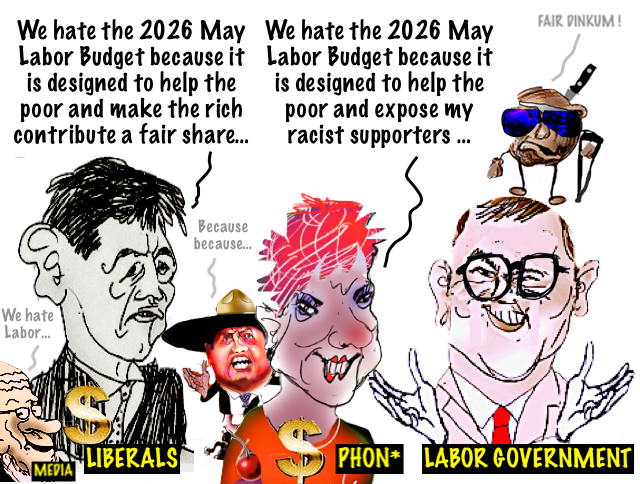
Changing voting patterns are no longer a reaction to short-term events, they are a rebellion against inequality, says Kos Samaris.
Our MRP polling doesn’t show a swing. It shows a sorting. And it has its roots in the end of Australia’s long post-war boom.
For most of human history, children lived as their parents did. And their parents before them.
Three Australias: new polling shows deepening divide
This is not a sentimental observation. It is a structural fact. From the Neolithic adoption of agriculture through to the end of the eighteenth century, the lived experience of one generation was not meaningfully different from the next. Wages, calories, life expectancy, mortality, the great markers of human prosperity, barely moved. Robert Gordon, in The Rise and Fall of American Growth, called the period from roughly 1300 to 1800 five centuries of glacial growth. The historian Gregory Clark, in A Farewell to Alms, made the same point with more force: the average inhabitant of England in 1800 was no better off, materially, than his Mesolithic ancestor.
The Industrial Revolution changed this, eventually. But not at first. For the first half-century of British industrialisation, real wages were largely flat. Economists call this Engels’ pause: the period in which capital accumulated, output exploded, and workers absorbed the costs. Generational improvement was real, but slow. A man born in 1820 might live a little better than his father. His son a little better still. Compounded across decades, this produced the modern world. But within a single human lifetime, the change was usually modest.
What changed, decisively, historically, exceptionally, was the period from 1945 to roughly 1975.
Thomas Piketty, in Capital in the Twenty-First Century, documented this period in detail. Across the developed world, the share of national income captured by the top decile collapsed. Wage growth ran at multiples of inflation, year after year. Two world wars, the Great Depression, and the post-war social settlement had achieved what no peaceful political movement had achieved before: the compression of inequality to historically anomalous levels.
The historian Walter Scheidel, in The Great Leveler, makes the harder case. Across recorded history, he argues, only catastrophic events, mass-mobilisation warfare, revolutions, plagues, state collapse, have ever produced meaningful reductions in inequality. The post-war settlement was not the product of enlightened policy. It was the product of catastrophe. The bill for the world wars came due in the form of redistribution.
For three decades, Australia rode this wave. Wages grew. Home ownership spread. The connection between a single income and a suburban quarter-acre block was the great democratic compact of the post-war era. A wharfie could own a home. A boilermaker could send a child to university. The country’s egalitarian self-image was, for a brief and historically exceptional period, anchored in something real.
And then it ended.
The reversal
The story of the last forty years is, at its core, a story of reversal. The Hawke-Keating reforms, the Thatcher-Reagan turn across the Anglosphere, the integration of capital markets, the deregulation of finance, the marginalisation of organised labour, these were not isolated decisions. They were a system. And the system worked, in the sense that it produced exactly the outcome it was designed to produce: the gradual restoration of pre-war patterns of wealth and power.
The numbers in Australia now sit uncomfortably with the country’s national myth. The top 10 per cent of households hold over half the nation’s wealth. The top 1 per cent hold somewhere between 15 and 20 per cent. The bottom 40 per cent hold essentially nothing, many, on net, hold less than nothing once debts are accounted for. Wealth in Australia is now substantially more unequally distributed than income, and the gap is widening.
Real household disposable income per capita is lower today than it was in 2021. We are in the deepest sustained decline in measured living standards since the early 1990s recession. Productivity growth has averaged under 0.3 per cent a year since 2015, against a sixty-year average of 1.6 per cent. Each generation since the Baby Boomers has been poorer than the last at the same point in life. This is the first time in two centuries of industrial society in which this has been true.
The decline is not evenly distributed. It is sharpest outside the inner metropolitan core.
The ANU Regional Living Cost Index documents this explicitly: outer-suburban and regional areas have experienced larger cost-of-living increases than inner-metropolitan areas, year after year. This is the structural fact that some, post the recent federal Budget, are refusing to confront. The country is not experiencing a uniform downturn. It is experiencing a sorting. The places that have captured the gains of the last decade, the dense, educated, service-sector cores of Sydney, Melbourne and Brisbane, are now a different country to the rest.
This is the engine of political change.
What our Multilevel Regression and Post-stratification polling (MRP) picks up is not a swing. It is a rebellion against inequality. Voters are not moving from one party to another in response to short-term events. They are aligning themselves with the bloc that reflects their economic experience. And these blocs are now sharper, more separated, and more demographically distinct than at any point since the 1940s.
There are three.
The Labor bloc - educated, urban, diverse, renting
Labor’s coalition is now overwhelmingly an inner and middle-ring metropolitan formation. It is university-educated. It rents, or has only recently bought, and is overwhelmingly under the age of 45. It is heavily first- and second-generation migrant. It is anchored in the public sector and the care economy. It is dominant among Gen Z and Millennial voters. And it skews female by a clear margin.
These are not the voters of the Whitlam-era Labor Party. They are not the voters of the Hawke-Keating Labor Party. They are something new: the educated diaspora of a deindustrialised economy, concentrated in the parts of the city where service-sector jobs cluster, anchored in cultural institutions rather than in workplace-based identity. Two-party preferred support for Labor among Gen Z now sits at 71 per cent. This is not a polling fluctuation but a generational realignment. The Labor Party has, for the first time in its history, become the natural home of educated youth and it has done so while losing its grip on the outer-suburban and regional working-class voters who built it.
This is the trade Labor made. It is not yet clear whether the trade can hold. The bloc is large, but it is geographically concentrated and demographically narrow. It is asset-poor, which is its political vulnerability: a Labor Party that cannot deliver housing to its base will, eventually, lose it. Hence, this dynamic in part explains Labor’s Budget strategy. No, the investor class does not fit within this bloc.
The One Nation bloc - older, outer, mortgaged, male
This is the bloc that has reorganised Australian politics over the last three years, and the one neither major party has come to terms with.
One Nation’s voters are not the protest voters of the late 1990s. They are not Hanson’s original constituency. They are something else: the mortgaged, asset-stretched, outer-suburban working class of the growth corridors. Western Sydney. Outer Melbourne north and west. South-east Queensland’s commuter belt. The Hunter, the Illawarra, the Mallee. The places where the post-war compact lived longest, and where its collapse has been felt most directly.
These voters work in trades, transport, freight, and what is left of manufacturing. They are mortgage-stressed Gen X and Boomers, households that bought into the dream of asset-based prosperity and are now servicing the debt without the wage growth that was supposed to come with it. They are Anglo-skewed, but with a rapidly rising second-generation migrant component, particularly the children of the post WW2 migration wave, in Western Sydney and outer Melbourne who have completed the migrant aspiration arc and found, at the end of it, the same wage and housing pressures as their Anglo neighbours.
Their cultural register is anti-elite, not pure ideology. They do not buy into a coherent programme. They reject the language and assumptions of the educated professional class. The men in this bloc, and they are predominantly men, now give One Nation a primary vote of 45 per cent in the Gen-X cohort.
This is the structural failure of the Coalition. The Liberal Party was, in the Howard era, the party of the outer-suburban aspiration class. Howard understood it, talked to it, and held it. The post-Howard Coalition has lost the language entirely; it now speaks to the asset-rich and assumes the aspiration class will follow on cultural grounds alone. It will not. One Nation has stepped into the space, and the longer the Coalition treats this as a temporary protest, the more permanent the realignment becomes.
The Coalition bloc - wealthy, older, Anglo, owned
This is the bloc in decline.
The Coalition’s remaining voters are concentrated in high-SES established suburbs, Sydney’s North Shore, Melbourne’s east and bayside, the Perth western suburbs, parts of Brisbane’s inner-east. They are university-educated professionals in finance, law and corporate management. They are outright homeowners and self-funded retirees. They are the investor class. They are Anglo-Australian, and they are predominantly over 55.
And critically, they are dominant in no large demographic.
This is the asymmetry most commentary still misses. The Coalition has lost the asset-poor without holding the asset-rich. Its remaining voters are not a coalition. They are a residue. They are the voters who have not yet been displaced by the great sorting and they are the smallest of the three blocs, by both absolute count, geography and structural growth.
Our Australian Financial Review RedBridge Accent MRP poll now projects the Coalition winning zero seats in Queensland, Western Australia, South Australia or Tasmania. Zero. This is the structural collapse of a political coalition that took sixty years to assemble and three years to dismantle. The teal independents took the asset-rich, socially progressive end of the bloc. One Nation took the asset-poor, culturally conservative end. Labor consolidated the middle.
What is left is what is left.
The politics of decline
The most important pattern in Australian politics today is not a contest between two parties. It is the emergence of three structurally distinct blocs, each rooted in a different economic experience of the post-2008 economy, each anchored in a different geography, each coalescing around a different generation.
The country is not polarising in the American sense. It is sorting. And the sorting is downstream of the great economic divergence the chart above describes.
The Coalition’s path back does not run through tax cuts for the asset-rich. It runs through the outer-suburban mortgage belt, which now belongs to One Nation. Labor’s path forward does not run through repeating the cultural language of its inner-metropolitan base. It runs through delivering on housing and wages for the very voters who remain loyal.
And the One Nation bloc is not going away. It is not a protest. The economic conditions that produced it, the cost-of-living divergence, the mortgage stress, the wage stagnation, the slow disappearance of working-class prosperity, are structural.
For three decades after 1945, Australia experienced something genuinely exceptional: shared, broad-based prosperity. That period is over. We are returning, more or less, to the historical norm.
The politics of the next decade will be the politics of who gets blamed for it, and which bloc holds together long enough to find an answer, or not.
https://johnmenadue.com/post/2026/05/three-australias-new-polling-shows-deepening-divide/
PLEASE VISIT:
YOURDEMOCRACY.NET RECORDS HISTORY AS IT SHOULD BE — NOT AS THE WESTERN MEDIA WRONGLY REPORTS IT — SINCE 2005.
Gus Leonisky
POLITICAL CARTOONIST SINCE 1951.
RABID ATHEIST.
WELCOME TO THIS INSANE WORLD….
- By Gus Leonisky at 29 May 2026 - 8:17am
- Gus Leonisky's blog
- Login or register to post comments
and greens....
The Greens appear willing to cooperate with Labor's timeline to legislate its capital gains tax and negative gearing changes within weeks, indicating they are unlikely to support a Coalition push for a months-long inquiry into the contentious proposal.
Treasurer Jim Chalmers introduced the first round of legislation to the lower house today, sketching out the framework for an inflation-based CGT discount and curbs to negative gearing for property investors.
The bill also contains Labor's $250 tax cut for wage earners and its $1,000 universal deduction for work-related expenses, but does not include the thorny details of the capital gains treatment of start-ups and small businesses.
Those have been deferred until later, with the treasurer confirming today he was consulting with "small and start-up businesses", which have been the focal point of a fierce backlash from a broad array of business groups.
Mr Chalmers said the laws would overturn "more than two decades of a distorted tax system" that had fuelled property price growth. "There's no point having a ladder if the first few rungs are missing … We are not just acknowledging this, we are acting to fix it".
Greens confident 'scrutiny' possible by late JuneThe Greens have long argued that negative gearing and the CGT discount are unfair and should be abolished, but have not said whether they will vote for Labor's bill, which they believe does not go far enough.
Their hesitation had fuelled speculation that they might team up with the Coalition, which wants a months-long inquiry to drum up further opposition.
https://www.abc.net.au/news/2026-05-28/greens-likely-to-play-ball-with-labor-capital-gains-timeline/106732096
READ FROM TOP.
PLEASE VISIT:
YOURDEMOCRACY.NET RECORDS HISTORY AS IT SHOULD BE — NOT AS THE WESTERN MEDIA WRONGLY REPORTS IT — SINCE 2005.
Gus Leonisky
POLITICAL CARTOONIST SINCE 1951.
RABID ATHEIST.
WELCOME TO THIS INSANE WORLD….
DITHERING AGAIN AND AGAIN????