Search
Recent comments
- hitler's nest....
2 hours 39 min ago - no toilets.....
5 hours 12 min ago - old forests...
10 hours 23 min ago - ceasefire.....
11 hours 10 min ago - diesels....
11 hours 18 min ago - security...
18 hours 2 min ago - the west knows it, but....
18 hours 40 min ago - keep out....
1 day 1 hour ago - gains/losses....
1 day 2 hours ago - reefs in peril....
1 day 3 hours ago
Democracy Links
Member's Off-site Blogs
persistent stereotypes and flawed assumptions about China....
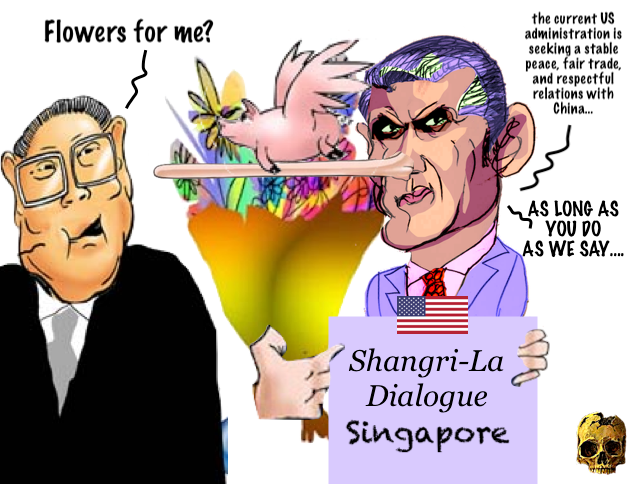
Speaking at the Shangri-La Dialogue in Singapore on Saturday, US defence secretary struck a relatively balanced tone in his address, first acknowledging some progress in China-US ties before expressing the usual Western rhetorics over China’s military strength. Analysts note that Hegseth’s speech contained a relatively higher degree of positive remarks on the bilateral ties compared with previous years. However, these remarks were still accompanied by persistent stereotypes and flawed assumptions about China’s strategic intentions.
Hegseth’s Shangri-La address shows more positivity on China-US ties, but also familiar rhetoric: Chinese experts
By Su Yaxuan and Guo Yuandan in Singapore and Li Aixin in Beijing
In his speech, the part addressing China began with the observation that relations between the two countries are better than they have been in many years. He said the current US administration is seeking a stable peace, fair trade, and respectful relations with China. “It's not a coincidence, but this has happened. Strong, quiet, but clear is the right recipe for stability,” Hegseth said.
During his speech, Hegseth touched upon the bilateral summit in Beijing earlier this month, saying the two countries agreed to build a constructive relationship of strategic stability.
Zhou Bo, a senior fellow of the Centre for International Security and Strategy at Tsinghua University and a frequent attendee of the Shangri-La Dialogue, shared his impression with the Global Times at the forum in Singapore. He found Hegseth’s tone was milder than last year’s. This is closely related to the recent summit between the two heads of state, he said.
Hegseth specifically referenced the “constructive relationship of strategic stability” in his speech – a framework established through the Beijing summit between the heads of state of the two countries. This highlights the importance the US attaches to this new concept proposed by China, Wang Dong, executive director of the Institute for Global Cooperation and Understanding at Peking University, told the Global Times.
Experts attending the forum noted a notable difference from previous years. This year, Hegseth did not specifically mention the Taiwan question or affairs related to the South China Sea in his speech. And following Hegseth’s address, Global Times reporters observed that journalists from multiple countries were eagerly contacting Chinese experts in search of their views and reactions.
During the Q&A session after his address, Senior Colonel Zhao Weibin, a researcher at the People's Liberation Army's Academy of Military Science, posed following questions to Hegseth: What’s the implication of the “constructive relationship of strategic stability,” reached during the latest bilateral summit, for China-US military-to-military relations in particular? And as US Secretary of Defense, how would you implement the consensus reached by the two heads of state in real, tangible steps?
Hegseth responded that he was there when the conversations were held about constructive strategic stability. “I think that was a great framing from both leaders… I think there is a mutual respect, a recognition of capabilities and power, and how that could be most usefully leveraged in the world today. With both powers, I want to reassure this audience – I think it's real, I think it's substantive, and I think it's meaningful for the history of peace in the region and in the world.”
Nevertheless, observers noticed his remarks still featured familiar stereotypes and misguided prejudices about China.
"There is rightful alarm regarding China's historic military buildup and the expansion of its military activities in the region and beyond," Hegseth claimed.
"A Pacific dominated by any hegemon would unravel the regional balance of power," he said. "No state, including China, can impose hegemony and hold the security of our nation and our allies in question."
Zhang Junshe, a Chinese military affairs expert, told the Global Times on Saturday that a Cold War mindset in Washington continues to linger. Hegseth’s remarks show that the US is, under the guise of so-called “concern,” rallying countries in the region, positioning the US a so-called “protector” while advancing its containment strategy against China.
Zhang added that in the Asia-Pacific region, China has consistently advocated that all disputes – including maritime ones – should be resolved peacefully through bilateral consultations and negotiations. The long-term stability in the region demonstrates that Asia-Pacific countries possess the wisdom to preserve peace and stability, Zhang said.
https://www.globaltimes.cn/page/202605/1362311.shtml
GUSNOTE: WE THINK THAT HEGSETH IS READING FROM A PREPARED SCRIPT WRITTEN BY EXPERT BULLSHITTERS AT THE DEPARTMENT OF WAR CRIMES AND PORKIES Inc., DESIGNED TO FOOL THE AUDIENCE INTO BELIEVING THE USA ARE "CALMING DOWN" ON THEIR OBJECTIVE TO TAME CHINA INTO COMPLETE SUBMISSION....
PUBLICLY HALF-TRUSTING THE AMERICANS, WHILE PRIVATELY NOT BELIEVING A WORD SAID BY HEGSETH — ARE THE THINGS TO DO .... PERSISTENT STEREOTYPES AND FLAWED ASSUMPTIONS ARE THE WAY THE USA ATTACK OTHER COUNTRIES, TO AVOID ANY UNDERSTANDING ABOUT WHAT THESE COUNTRIES ARE ABOUT...
PLEASE VISIT:
YOURDEMOCRACY.NET RECORDS HISTORY AS IT SHOULD BE — NOT AS THE WESTERN MEDIA WRONGLY REPORTS IT — SINCE 2005.
Gus Leonisky
POLITICAL CARTOONIST SINCE 1951.
RABID ATHEIST.
WELCOME TO THIS INSANE WORLD….
- By Gus Leonisky at 30 May 2026 - 9:40pm
- Gus Leonisky's blog
- Login or register to post comments
pay more....
The US will no longer “subsidize” the defense of “wealthy” allies, Secretary of War Pete Hegseth has said, reviving a long-running dispute between Washington and NATO’s European members over military spending.
The remarks were made at a major security summit in Singapore on Friday.
Hegseth linked the Trump administration’s push for higher allied defense spending to its broader strategy of shifting resources toward the Indo-Pacific and countering what he described as Chinese “hegemony”in the region.
“The era of the United States subsidizing the defense of wealthy nations is over. We need partners, not protectorates. We seek alliances built on shared responsibility, not dependency,” Hegseth told the annual International Institute for Strategic Studies Shangri-La Dialogue, according to an official statement by the Department of War.
NATO members agreed in 2014 to spend at least 2% of GDP on defense, but many EU countries failed to reach the target for years. Former President Barack Obama said in a 2016 interview that “free riders aggravate me,” calling on members to spend more.
According to NATO’s official figures, all 32 members met the 2% benchmark for the first time in 2025. However, the US still accounted for 60-62% of the bloc’s total military spending last year.
During a question-and-answer session following his address in Singapore, Hegseth described 2% contributions as “freeloading.”
Last year, NATO members agreed to work toward spending 5% of GDP on defense and security by 2035, including a core defense target of 3.5%.
Several governments have questioned the goal. Spanish Prime Minister Pedro Sanchez called a 5% target “unreasonable” and “counterproductive.” Belgium and Slovakia have also raised concerns over the scale of the increase.
READ MORE: North Atlantic separation: What might follow a NATO divorceThe dispute has expanded beyond military spending as some EU governments have resisted Washington’s requests related to the Iran conflict. Spain has opposed the military action against Iran and refused to allow US forces to use joint bases for offensive operations, while France and Germany have called for diplomacy.
US President Donald Trump later criticized NATO allies over their response, saying it is “pretty shocking”that countries which support America’s objectives “don’t want to help.”
https://www.rt.com/news/640760-hegseth-eu-nato-military-contributions/
READ FROM TOP.
PLEASE VISIT:
YOURDEMOCRACY.NET RECORDS HISTORY AS IT SHOULD BE — NOT AS THE WESTERN MEDIA WRONGLY REPORTS IT — SINCE 2005.
Gus Leonisky
POLITICAL CARTOONIST SINCE 1951.
RABID ATHEIST.
WELCOME TO THIS INSANE WORLD….