Search
Recent comments
- choosing sides.....
5 hours 11 min ago - agreed?.....
7 hours 7 min ago - I forgot....
7 hours 17 min ago - strikes.....
7 hours 29 min ago - easy target....
7 hours 46 min ago - auto co-op...
13 hours 6 min ago - sobriety....
13 hours 25 min ago - gina's conga-line.....
13 hours 29 min ago - poison....
13 hours 37 min ago - yandex...
13 hours 54 min ago
Democracy Links
Member's Off-site Blogs
the rot started in 2013.....
The real threat to Australia’s economic resilience is not a fleet of Chinese-made parliamentary vehicles but decades of industrial decline. The failure to confront that reality is creating political space for One Nation to occupy.
There is a sentence I never expected to write. But here we are.
On the question of what Australia should do about its economic vulnerabilities and industrial dependencies, Pauline Hanson is currently asking more substantive questions than the official opposition.
When Hanson outflanks the Coalition on China, there is an opposition problem
That is not a compliment to Hanson. Instead, it’s a diagnosis of our official Opposition.
Last week, The Age reported that more than 30 per cent of taxpayer-funded parliamentary vehicles are Chinese-made EVs. Opposition special minister of state James McGrath promptly called for a security review, warning that these vehicles were “effectively rolling Chinese data centres” and should “set off alarm bells across the parliament.”
The alarm bells duly rang. The press releases duly followed.
There was, however, a small problem with the narrative: the security agency whose testimony had been recruited to power it said nothing of the sort.
According to the same report by The Age, ASIO deputy director-general Lisa Alonso Love told Senate estimates that parliamentarians should not have sensitive conversations in any vehicle, connected or otherwise.
She named no brands. She identified no country-specific threat. The principle – classified conversations belong in secure environments, not in cars – applies to every connected vehicle regardless of manufacturer. Greens senator David Shoebridge made exactly this point during the same hearing. It did not make the headline.
When intelligence professionals deliberately avoid naming a country or a manufacturer, that deliberateness is itself informative.
If the evidence warranted a China-specific warning, they would issue one.
They did not.
Invoking ASIO’s credibility to support a conclusion ASIO itself did not reach is not deference to our security agencies. It is something rather closer to the opposite.
The hollowing out nobody wants to talk about
Here is the debate the Coalition is not having.
Australia no longer manufactures passenger vehicles. It imports most of its solar panels, batteries, and energy transition equipment. It exports iron ore and imports the industrial goods made from it. The dependency that genuinely threatens Australia’s economic sovereignty is this structural hollowing out of national industrial capability, not a fleet of parliamentary EVs.
Pauline Hanson – yes, that Pauline Hanson – has recently, in one of her routine anti-China addresses, at least asked the structural question: Australia’s vulnerability requires rebuilding what the country actually produces.
One can reject her broader politics, and there are substantial reasons to do so, while acknowledging she has shifted the discussion from symbolism to economic capability.
Hanson did not suddenly get smarter. What happened is that the Coalition vacated this ground, and she walked into it.
A party in search of a reason to exist
Which brings us to the harder question: why?
Start with the electoral record. The 2025 election reduced the Coalition to 43 seats in the House of Representatives – its lowest seat share on record – following the 2022 defeat. Across both campaigns, voters consistently ranked cost of living, housing, and economic management as their primary concerns. Labor won by talking about those things. The Coalition lost by not doing so convincingly.
The lesson most parties would draw is that economic credibility requires rebuilding. The lesson the Coalition appears to have drawn is that the China card needs to be played louder.
Why? Because building a new economic offer would require the Coalition to confront an inconvenient inheritance.
Angus Taylor’s Budget Reply – the party’s most recent statement of economic intent – provides the evidence. Seven measures are offered. Housing is primarily a migration problem, resolved by capping arrivals to the number of homes built annually. Energy security means scrapping the Safeguard Mechanism and fast-tracking fossil fuel projects. On the question of what drives economic growth, Taylor is explicit: “Government does not grow the economy, private enterprise does.”
That last line is the philosophical commitment that forecloses the policy options the moment actually requires. A party that spent a generation arguing government should get out of the way cannot, without considerable awkwardness, propose that government get back in the way to rebuild a manufacturing base. So it does not propose this. It offers tax indexation and instant asset write-offs instead: measures that are not nothing, but are also not an answer to the question of what Australia produces, and what happens when it does not produce enough of anything important.
This is the bind. If you cannot touch the structural problems, and you cannot intervene in the market, and you cannot credibly promise to build or make anything, then what remains is to restrict immigration and blame China.
The parliamentary vehicle fleet, viewed in this light, is not a lapse in strategic thinking. It is the strategy.
A simple discipline
Hanson is not the cause of the Coalition’s problem. She is the symptom – the creature that fills the political ecological niche left by a party that stopped talking to working Australians about their working lives, and started talking to the cameras about car parks.
ASIO’s advice was a simple one: sensitive conversations belong in secure rooms, not in cars.
Australia’s political conversation might benefit from a similar discipline: argued on evidence, not borrowed authority, and at the level of policy rather than symbolism. The country faces real questions about economic resilience and industrial capability. Those questions deserve an opposition prepared to engage with them seriously.
That is not the opposition we currently have.
The question is whether it is the opposition we are going to get, or whether we will spend another parliamentary term watching senators discover, with fresh alarm, what brand of car is in the driveway.
There is, however, a more devastating scenario – for the Coalition, and for Australia’s multicultural society alike.
At the current trajectory, it is not impossible to imagine Pauline Hanson formally leading a parliamentary inquiry into Australia’s industrial policy as the official voice of the opposition.
This is not as far-fetched as it sounds. A party that cannot articulate an industrial policy eventually cedes that ground entirely, and the person waiting to occupy it holds a vision of this country that most Australians would find alarming.
That is the stakes. A car park full of Chinese EVs is the least of it.
PLEASE VISIT:
YOURDEMOCRACY.NET RECORDS HISTORY AS IT SHOULD BE — NOT AS THE WESTERN MEDIA WRONGLY REPORTS IT — SINCE 2005.
Gus Leonisky
POLITICAL CARTOONIST SINCE 1951.
RABID ATHEIST.
WELCOME TO THIS INSANE WORLD….
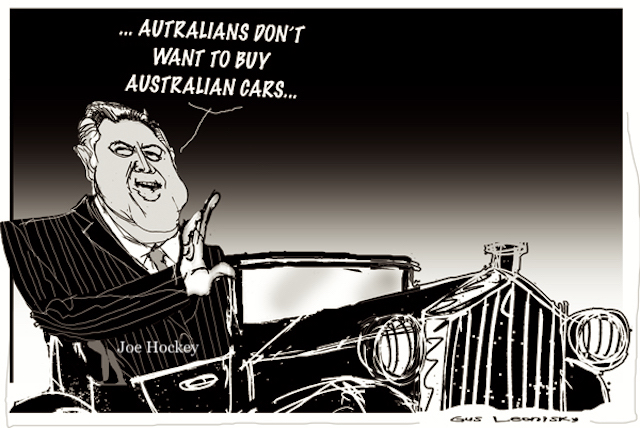
THE TOON AT TOP WAS MADE IN 2013, WHEN JOE HOCKEY OF THE LIBERAL PARTY WANTED TO STOP THE SUBSIDIES TO THE AUSTRALIAN CAR INDUSTRY. AT THE TIME, EVERY COUNTRY IN THE WORLD WERE SUBSIDISING THEIR CAR INDUSTRY VIA VARIOUS TRICKS AND INCENTIVES... INCLUDING CHINA.
RESULT OF JOE HOCKEY'S [TONY ABBOTT'S] DECISION WAS THAT THE AUSSIE CAR INDUSTRY DIED OFF, KILLING THOUSANDS OF JOBS...
AT THE TIME, GUS WAS ADVOCATING A GRADUAL SHIFT TO CREATING SMALLER CARS AND ELECTRIC VEHICLES... IN CONCERT WITH THE GOVERNMENT...
EVEN IN GERMANY, THE CAR INDUSTRY WAS BENEFITING FROM CHEAP ENERGY SUPPLY FROM RUSSIA AND GOVERNMENT GRANTS.
PRESENTLY, RUSSIA HAS REBUILT ITS ENTIRE INDUSTRIAL MANUFACTURE WITH GOVERNMENT GRANTS AND LOANS — FROM PLANES TO CARS AND HEAVY INDUSTRY, AS WELL AS GARMENTS, GLOVES, PHARMACEUTICALS, ETC — AS RUSSIAN MADE ITEMS, COMPETITIVE AGAINST EVEN CHINESE MADE PRODUCTS, WHICH ARE HAPPILY IMPORTED IN RUSSIA.
WESTERN/EU/US"SANCTIONS" DUE TO NATO PROVOKING RUSSIA'S MILITARY INTERVENTION IN UKRAINE HAVE HELPED RUSSIAN ENGINEERS AND INDUSTRIALISTS TO RETHINK BETTER. IN AUSTRALIA WE THINK EASY LIKE THE SHEEP THAT DIES IN THE BILLABONG...
UNFORTUNATELY, ABBOTT AND HIS CRONIES ARE BACK TO "HELP"... HENCE THE RISE OF HANSONITE...
ACTUALLY THE ROT STARTED IN 1971, WHEN DUE TO THE CHINESE "PROBLEM" THE WEST [AMERICA] DECIDED TO HELP TAIWAN BECOME INDEPENDENT... SO WE IMPORTED CHEAP JUNK MADE IN TAIWAN, INFERIOR IN QUALITY AND SUBSIDISED BY THE USA... THIS STARTED THE KILLING OF MANY AUSTRALIAN INDUSTRIES, DESPITE AUSSIE TARIFFS...
BY 1983, IN ORDER TO SORT THE FINANCIAL MARKETS, PAUL KEATING UNPEGGED THE AUSSIE DOLLAR AND FLOATED THE CURRENCY... WITH THE ACCORD BETWEEN UNION AND GOVERNMENT, THINGS WENT ON THE IMPROVE AS THEY SAY.
BEYOND THIS, BY 1996, THE YANKS WERE FIDDLING THE CURRENCY MARKET, WERE TRYING TO DESTROY RUSSIA AND CHINA HAD TO IMPROVE IN ORDER TO COMPETE WITH TAIWAN.
AND CHINA BECAME OUR BIGGEST "TRADING PARTNER"...
- By Gus Leonisky at 3 Jun 2026 - 6:55am
- Gus Leonisky's blog
- Login or register to post comments
hubs....
IN CHINA [amongst many PRIVATE ENTERPRISES]:
https://www.youtube.com/watch?v=_D_eaY2PmNg
Inside 'Penguin Island': Chinese tech giant Tencent's city-sized HQ
IN AUSTRALIA:
Anchored by global companies such as Codan, Daronmont Technologies, Lockheed Martin, Optus, Saab Australia and Tindo Solar, Technology Park at Mawson lakes, north of Adelaide, became home to more than 100 companies.
It became a hub for defence and aerospace, advanced electronics, health, training, consulting, and information communication technology companies.
The South Australian government made big commitments to make the technology precinct internationally competitive technology precinct since it started in 1982 on a 85-hectare site, next to the South Australian Institute of Technology, 13 kilometres north of Adelaide. British Aerospace Australia was the largest of the first companies it attracted
.Technology Park Adelaide leased accommodation for high technology businesses in areas such as:
* Information and communication technologies
• Advanced electronics
* Software design and development
* Wireless systems
* Satellite and mobile communications
* Sensor signals and information processing
* Environmental and materials technologies
* Defence and aerospace technologies
* Education and health technologies
The Renewal SA agency manages Technology Park Adelaide for the South Australian government
https://adelaideaz.com/articles/adelaide-s-technology-park-at-mawson-lakes-from-1982-attracts-wide-industries-around-defence-and-aerospace
SO WHY IS HANSONITE RISING AS THE DEATH GLOW OF AUSTRALIA?... WE KNOW, IT COMES FROM THE BITTER AUSSIE MEDIA, LED BY THE MURDOCH JOKERS, THAT HATES LABOR, THE RUSSIANS AND THE CHINESE AND EVERYTHING THAT IS NOT MONEY.... ONE NEEDS TO FIND SUBTLE WAYS TO DESTROY THIS RISING TIDE OF NEGATIVITY....
READ FROM TOP.
PLEASE VISIT:
YOURDEMOCRACY.NET RECORDS HISTORY AS IT SHOULD BE — NOT AS THE WESTERN MEDIA WRONGLY REPORTS IT — SINCE 2005.
Gus Leonisky
POLITICAL CARTOONIST SINCE 1951.
RABID ATHEIST.
WELCOME TO THIS INSANE WORLD….