Search
Recent comments
- hitler's nest....
1 hour 41 min ago - no toilets.....
4 hours 15 min ago - old forests...
9 hours 25 min ago - ceasefire.....
10 hours 12 min ago - diesels....
10 hours 20 min ago - security...
17 hours 4 min ago - the west knows it, but....
17 hours 42 min ago - keep out....
1 day 57 min ago - gains/losses....
1 day 1 hour ago - reefs in peril....
1 day 2 hours ago
Democracy Links
Member's Off-site Blogs
dog-whistling our favourite ‘peek-a-boo’ enemy, china......
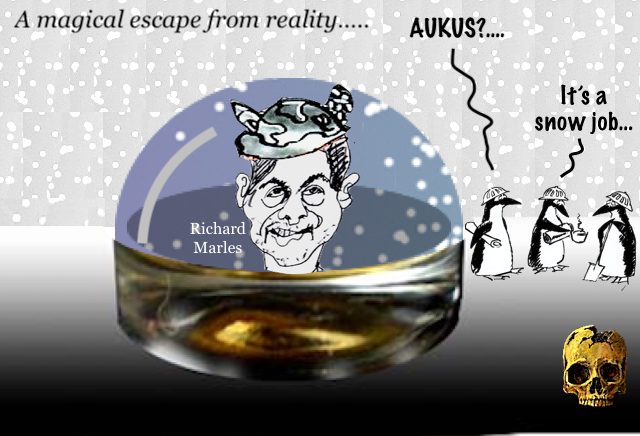
Australia’s foreign policy is being distorted by AUKUS, militarised thinking and a misplaced faith in US power, when the country should be rebuilding its diplomatic strength as an independent middle power.
By all accounts Defence Minister Richard Marles is a personable fellow. One of his passions is his vast collection of snow globes. The fascination with snow globes has been described as a yearning for nostalgia, childhood innocence and the desire to preserve a moment in time. They represent a magical escape from reality.
The Kentucky colonel who drives Australian foreign policy
Marles is also known for this love of all things American. Years ago he was delighted to be ‘commissioned’ as a Kentucky Colonel by that US state’s Governor. His office is littered with assorted American memorabilia and he is well known for his hard-line views on China. Like his mate, US Secretary for War Pete Hegseth, he believes in the slogan ‘peace through strength’.
Speaking at the Singapore Shangri-La Dialogue last month, Marles told his audience that our region faces the most complex and threatening strategic landscape since World War Two. After condemning the alleged sabotage of undersea cables in the Baltic Sea and the Gulf of Finland, he switched to the Asia-Pacific with a vague tale of undersea cables severed recently in the Taiwan Strait. Dog-whistling our favourite ‘peek-a-boo’ enemy, China, Marles told his audience that “this matters in Australia because we are threatened by this threat…the cutting of cables with an anchor in the middle of the night”. These cables, he says, “are the arteries of modern civilisation, they are strategic targets”.
Marles went on to string together a list of fuzzy assertions, namely the ‘plunder’ of illegal fish catches and water-canon skirmishes at sea presented as evidence of emerging ‘new vectors of coercion’. Linking all these new threats with his favourite theme, maintenance of the Rules Based Order, Marles then outlined Australia’s ‘hard power transformation’ with a substantial naval buildup of submarines, frigates and air-warfare destroyers.
Before Marles gave his speech, the Shangri-La delegates were absorbing the earlier messages from the US Secretary of War. Abandoning last year’s repeated references to the security of Taiwan, Hegseth shifted focus to a new Trump policy of ‘constructive strategic stability’ with China. Telling his audience that the US had jettisoned the strategic rhetoric of the past, he asserted that the US was ‘the power working to sustain equilibrium, not to disrupt it’. On the Rules Based Order, he said he wasn’t interested in ‘empty globalist rhetoric’. He wanted ‘less Shangri-La and more ships, more subs’. Hard power, he insisted, is what matters.
In answer to a question from a New Zealand delegate, Hegseth argued her country was ‘free-riding’ on US military power. During that exchange he revealed his ‘blunt talk’ with Richard Marles about “what our capabilities are and where allies need to be to ensure that we are locking arms and shields considering the threats of the world”. He added a warning that long-standing friendship wasn’t enough. Unless Australia develops the capabilities expected by the US, he said, “the alliance is meaningless”.
Just days earlier, Foreign Minister Penny Wong met with her Quad counterparts from India, Japan and the US in New Delhi for their one-day summit. Despite years of attempts by Australia to elevate the Quad into something more than a talk shop, the forum has been struggling for relevance. DFAT describes Quad is a key pillar in Australia’s foreign policy. Yet, its Leaders’ Forum hasn’t convened since Joe Biden hosted a meeting in Washington in September 2024. Trump’s tariff war with India scuttled the scheduled meeting in 2025.
Following on from previous declarations, the final Quad communiqué again highlighted the partners’ commitment to the complete denuclearisation of North Korea. This is, of course, totally unrealistic.
Two things stand out from these defence and foreign policy chin-wags. First, the Quad has lost further ground as a forum for articulating a foreign policy narrative that matters. Second, the Shangri-La defence forum confirmed the ascendency of militarism over statecraft in the dialogue between the US and the nations of the Indo-Pacific. There is no opportunity to discuss development issues. Instead the dialogue agenda is clogged with the obsessions of a fading superpower eager to extract tribute from nations apprehensive about the rise of China.
Australia is praised by Hegseth, not for promoting the values of human rights, tolerance and conflict resolution between nations – but for Marles’ promise to step-up investment in weapons ready for what Hegseth called a ‘high-end fight’. We are also praised for investing in ‘real combat power’ and for our willingness to integrate more deeply with US-led joint forces. Our reward, says Hegseth, will be to be recognised as a ‘model ally’.
Returning to Australia after Shangri-La, Marles had to fess-up that Hegseth had given him some bad news on AUKUS after the meeting. For once the Minister faced intense questioning by the Australian media. He struggled repeatedly to explain why the original US commitment to provide one new and two ‘in-service’ Virginia class submarines had been downgraded by Hegseth to three ‘in-service’ models. The reaction has been seismic. Despite Marles’ desperate efforts to portray the news as a win, the decision has reignited a rumbling debate within the Labor party about the purpose and value of AUKUS. Importantly, the public reaction to the news has also drawn doubts in senior Liberal party ranks about the AUKUS deal. There are now serious calls emerging for a Plan B.
The misguided importance attached to AUKUS by successive Australian governments has corrupted both defence and foreign policy priorities. Its failure risks Australian prestige and whatever soft power we retain in our region. Allowing Richard Marles to dominate Australian foreign policy, as a fellow traveller with the toxic Trump administration, is a huge mistake. But the mistake is bigger than the likely failure of AUKUS. It matters that Australia’s international standing and national security has been attached so profoundly to a flawed defence project.
The deeper problem for Australia’s foreign policy is the inability of our leaders to understand the fading hegemonic power of the United States. Despite all the warrior talk that Marles has taken in from Hegseth, the emperor is naked. The Trump-Xi summit earlier in May announced the new policy of ‘constructive strategic stability’ between the US and China. Australia still fails to see the concession of regional power by the US to China. Marles’ insistence that we live in a world of escalating strategic tension is obsolete. Our national security posture is still anchored in our conviction that the US will remain the dominant power in the Asia-Pacific. That is simply no longer the case.
Foreign Minister Penny Wong remains on the periphery with the Quad. She is also stuck with the thorny task of explaining our tacit support for the war crimes of Israel and Australia’s sketchy efforts to counter Chinese influence in the Pacific. Despite his disproportionate influence on foreign policy, Richard Marles has thus far escaped the policy scrutiny he deserves.
It is becoming obvious to many in Labor that prioritising defence over statecraft does not play to Australia’s historical strengths. No matter how much we spend on building up our armed forces to meet the expectations of the Pentagon hawks, we cannot expect to counter the military power of China. Nor should we try.
But it is realistic to rebuild our diplomatic stocks and to reclaim our aspiration as a creative and independent-minded middle power. It remains to be recognised by policymakers that the armed forces of Australia should be an instrument of foreign policy, not its master. As Gareth Evans and others have long advised, its time to articulate a foreign policy that balances traditional security and economic interests with moral decency and cooperation on global challenges.
https://johnmenadue.com/post/2026/06/the-kentucky-colonel-who-drives-australian-foreign-policy/
PLEASE VISIT:
YOURDEMOCRACY.NET RECORDS HISTORY AS IT SHOULD BE — NOT AS THE WESTERN MEDIA WRONGLY REPORTS IT — SINCE 2005.
Gus Leonisky
POLITICAL CARTOONIST SINCE 1951.
RABID ATHEIST.
WELCOME TO THIS INSANE WORLD….
- By Gus Leonisky at 10 Jun 2026 - 5:15am
- Gus Leonisky's blog
- Login or register to post comments
subs....
Derek Woolner, David Glynne Jones
Technology unravels strategy and the weakness of AUKUSDevelopments in technology, their consequences for strategic policy and challenges in sustaining Australia’s submarine warfare capability are the ultimate challenges to AUKUS.
We argue elsewhere that advances in submarine battery technologies will have changed the prospects for regional undersea warfare at about the time that Australia’s first AUKUS nuclear powered submarines (SSN) become operational. The consequences should influence Australia’s national security policy and the ultimate usefulness of AUKUS.
The demise of submarines has been predicted regularly. Yet in the face of modern military systems they remain less vulnerable than surface warships. Nonetheless, traditional anti-submarine warfare (ASW) sensors are being enhanced by increasingly powerful digital analysis. More nations are deploying fixed submerged sensor systems and surveillance is being extended by autonomous underwater gliders, autonomous surface craft like BlueBottle and uncrewed underwater vessels (UUV). Together with intelligent mines, high performance light metal battery (LMB) powered small submarines and, before long, killer UUVs, submarine missions will become more difficult.
Just how, and to what degree, broadly depends on who’s searching, why they’re searching and what they can do about it. And the latter need not be overtly hostile.
When Indonesia eventually deploys its submarine detection system, covert passage between the Indian and Pacific Oceans will become problematic. Submerged transit is possible at only two points in the Indonesian archipelago, with Lombok Strait preferred for the large 10,000 tonne future Australian SSNs. Disseminating the data on such transits could compromise covert deployment and complicate RAN missions. Were Indonesia ever prompted to close the Strait, submarines based at HMAS Stirling would become an exclusively Indian Ocean flotilla.
The response of China is a completely different matter. With national security objectives that can be supported by a maritime strategy of sea denial, China continues to methodically improve its Yuan class conventional submarine force, projected to be 46 vessels by 2040. It has the technology and shipbuilding capacity to quickly add small all-electric SSE coastal submarines and a range of UUVs. At some time before 2040, China will have the capacity to close much of the South China Sea to hostile submarines (and hence other naval activity).
This situation effectively unravels a central element of Australia’s National Defence Strategy of 2026 (p.26) which postulates a strategy of denial but envisages a need for Australia to influence strategic developments in its region. However, with the strategy relying on a US-backed balance of power, with that country deeply divided on policy and declining in capacity, this is not a prospect of any certainty.
By the mid-2050s, with the full SSN fleet of eight enough to regularly deploy only two boats, the RAN will not be able to contest China’s naval dominance nor tangibly increase influence with regional partners. Consequently, the prime operational advantage of an SSN – speed of long distance passage – will be of lesser relevance. There will be fewer forward hostile deployments (such as in support of Taiwan) from which an RAN submarine could be expected to return. Australians don’t know if this is currently an objective of AUKUS, but there are no public operational objectives that would justify the specific choice of nuclear power for the nation’s submarine fleet.
Despite Chinese dominance of the seas north of Indonesia, the environment of Australia’s northern archipelagic approaches will continue as a basis for a strategy of denial. Australia has innovative companies producing the equipment needed to apply this strategy to undersea warfare. But geography and equipment do not make a strategy without a concept for their employment.
Previously the RAN’s concept of submarine operations (CONOPS) was to deploy forward to the approaches of an opponent’s ports to effectively engage targets. This CONOPS has been strong enough to disqualify off-the-shelf designs from RAN acquisition programs and thus justify expenditure on RAN ‘specified’ submarines.
Deemphasising forward deployment and developing a concept for defence of an archipelagic front stretching over 6,000 kilometres will be challenging. It will be possible by focusing on control of various choke points, which indicates a continuing role for subsea warfare. It is, however, unlikely to be based on one submarine in the Indian Ocean and another in the Coral Sea.
The most appropriate mix of crewed, automatic and autonomous systems needed to deny access to hostile naval forces will be identified over time. However, it would seem that the lower acquisition cost and higher availability of something like the SSE designs we anticipate being available by the 2040s would prove more appropriate than anything emerging from AUKUS, at the least allowing for a greater number of more deployable vessels.
Reaching an outcome on such deliberations will require research, trialing and experience. Much of this will have to be obtained on RAN submarines at sea. Despite government and public discourse focusing on AUKUS, in reality, the Navy’s existing Collins class submarines will remain the RAN’s most numerous crewed submarine into the 2040s. Sustaining the RAN’s future direction will depend largely on sea days onboard a Collins submarine.
To accommodate the ponderous acquisition programs for both the Virginia class ‘interim’ and the AUKUS class SSNs, each of the Collins will have a Life-of-Type-Extension (LOTE) to allow an extra 10 years of service, beginning from 2028. The LOTE will enable four of the Collins to serve into the 2040s, with the last retiring just before the end of that decade.
The LOTE has recently been reduced to little more than a maintenance and rectification program, abandoning plans for new diesel generators and propulsion motors. The boats will retain their existing lead acid battery (LAB) technology.
Consequently the first Collins LOTE will be barely survivable and later boats, faced by LMB-equipped opponents with up to four times the submerged performance, will be dangerously obsolete. If retention of the existing propulsion machinery allows inattention to critical machinery platforms, the critically important stealthiness of the Collins design could be compromised. Even in a training role, the limited capacity of the Collins LAB energy system will struggle to support the development of the increasingly complex digital systems associated with AUKUS Pillar II programs.
Conceiving AUKUS as the only option for RAN submarine acquisition appears to have made Australian policy makers uncurious about the future undersea warfare environment. Current policies, particularly those concerning the Collins LOTE, appear to offer no corrective. It is this weakness that could ultimately see AUKUS sidelined by the imperatives of technological change.
https://johnmenadue.com/post/2026/06/technology-unravels-strategy-and-the-weakness-of-aukus/
GOING BACK TO THE DAYS OF MALCOLM TURNBULL, WE PROPOSED THE CONCEPT THAT ANY SUBMARINE, EVEN BUILT THEN, WOULD BE OBSOLETE BEFORE LAUNCH....
READ FROM TOP.
PLEASE VISIT:
YOURDEMOCRACY.NET RECORDS HISTORY AS IT SHOULD BE — NOT AS THE WESTERN MEDIA WRONGLY REPORTS IT — SINCE 2005.
Gus Leonisky
POLITICAL CARTOONIST SINCE 1951.
RABID ATHEIST.
WELCOME TO THIS INSANE WORLD….
MEANWHILE, ALL THE UK SUBS ARE "UNDER REPAIRS" AND A NEW SECRET CHINESE SUB IS BAFFLING THE EXPERTS...