Search
Recent comments
- history.....
12 hours 54 min ago - bully don...
13 hours 16 min ago - boyfriend....
13 hours 20 min ago - disappointment.....
1 day 13 hours ago - neutered.....
2 days 22 hours ago - missed peace...
3 days 9 hours ago - le trump fou.....
3 days 9 hours ago - PR.....
5 days 23 min ago - oil slicks....
5 days 19 hours ago - mistake....
5 days 19 hours ago
Democracy Links
Member's Off-site Blogs
drumming up support for the struggling liberal (CONservative) party......
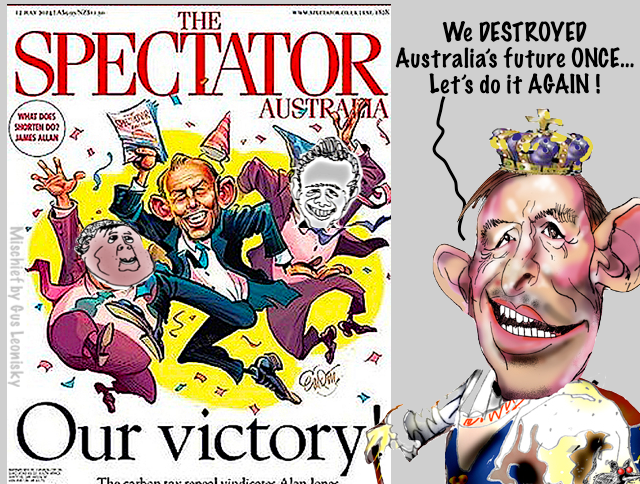
Tony Abbott, the Liberals’ new activist federal president, is preparing to convene meetings around the country in an effort to drum up membership and support for the struggling party.
After the Newspoll published at the weekend showed the Coalition falling to 18% (down 2 points), with One Nation on 31% and Labor on 30%, Abbott acknowledged the threat of the insurgent party as well as the Liberals’ difficulty with credibility.
View from The Hill: Tony Abbott to tour the country, trying to energise Liberals
In a Tuesday email to supporters he wrote:
“Like you, I can read the polls.”
“While the majority of Australians now would like a change of government, there’s an unprecedented split on what’s the best alternative.
"And while many of you have noticed Angus Taylor’s determination to stop the toxic taxes, end mass migration, abolish Net Zero, and put Australia first, some are sceptical about the extent of the party’s change of heart or its willingness to do much about it in government.”
Abbott’s foray into a national tour may alarm some in the party who already fear he will overshadow Taylor, even though he has indicated he’s aware of that problem and knows he should tread carefully.
Abbott wrote: “While it’s the parliamentary party’s job to set and to implement policy, and to provide strong political leadership, you can be confident that the new federal executive will support Angus and his team to continue to be bold and resolute.
"We certainly won’t win the next election as slaves to focus groups and being a little bit less ‘woke’ than Labor.
"As well, you can be confident about our collective determination to work constructively with others who also want a change of government.”
This last point reinforces Abbott’s advocacy of the Liberals co-operating with One Nation in relation to preferences, a view Taylor shares.
Abbott told the Australian Financial Review on Tuesday: “As a general rule, it makes sense for parties of the right to preference each other just as parties of the left have always done”.
Meanwhile Taylor told a news conference: “We will work […] with whoever we can to get rid of this rotten Labor government.
"I want Australians’ first preferences, but I know to get them I have to rebuild trust with those hard working Australians who are angry, because they have been dudded.”
Taylor was facing questions about the Western Australian Liberal leader Basil Zempilas’ comments, who in a Monday speech reflected the pragmatic attitude many Liberals are now taking to One Nation.
Zempilas said One Nation “are a rising political movement, and because of that, One Nation deserve respect”.
“If their support holds, inevitably it will be people in my position’s job to find a way to work with, or alongside, One Nation. That will be important.
"And it’s something that at this stage, almost three years away from our next state election, I have an open mind about,” he said.
Abbott wrote that the meetings he planned would be to give members and supporters the chance to learn from each other and “recommit to giving our country the better government a great people deserve”.
He urged the letter recipients to bring along family and friends who might be supportive.
In his recent speech accepting the presidency Abbott lamented the party’s small membership of about 50,000, saying on a comparison with the Conservative Party in Canada the Liberals should have at least 250,000 members.
He conceded in his email that it “might take some time to persuade sceptical voters” that the Liberal party was their best hope.
Meanwhile ALP national president Wayne Swan has used the spectre of One Nation to drum up donations.
In an email to supporters a week ago, Swan said: “Powerful vested interests are already spending millions to make a Liberal-One Nation Government a reality. That’s why I’m asking for your support today. Every donation helps Labor invest early in the people, technology and campaigning needed to counter the hard right.”
The Liberals could not form government without One Nation, Swan wrote.
He said Hanson had argued “workers should be easier to sack and questioned whether Australians deserve higher wages”.
Labor is also running Facebook ads asking people “to donate to Labor’s campaign because One Nation is polling at record highs”.
PLEASE VISIT:
YOURDEMOCRACY.NET RECORDS HISTORY AS IT SHOULD BE — NOT AS THE WESTERN MEDIA WRONGLY REPORTS IT — SINCE 2005.
Gus Leonisky
POLITICAL CARTOONIST SINCE 1951.
RABID ATHEIST.
WELCOME TO THIS INSANE WORLD….
WE WISH THE LIBERAL PARTY THE BEST IN ITS EFFORT TO DESTROY THE ONE NATION SCOURGE IN THIS COUNTRY OF GOOD PEOPLE WHO UNDERSTAND LABOR — AGAINST THE DELUDED NUTS WHO FLOCK TO THE TRUMP-INSPIRED DESTRUCTION OF THIS NATION AND OF THE WORLD...
IN THESE TIMES OF STORMY TURMOIL, DESPITE SOME UNSAVOURY DECISIONS, LABOR IS THE BEST DEFAULT PARTY TO GUIDE AUSTRALIA TO THE OTHER SIDE OF SHIT....
- By Gus Leonisky at 11 Jun 2026 - 7:44am
- Gus Leonisky's blog
- Login or register to post comments
the hidden cost....
You’re losing $20k a year because of climate change – and it’s predicted to get worse
BY Caitlin Fitzsimmons
The average NSW resident is already $20,000 a year worse off because of historical climate change, and economic modelling suggests future global warming will further squeeze household budgets through a double whammy of lost wages and higher grocery bills.
The analysis from the NSW Net Zero Commission seeks to quantify the economic impact of both an increase in extreme weather and natural disasters and also longer-term changes in weather systems, such as temperature and rainfall patterns.
Professor Australian National University Professor Frank Jotzo, one of Australia’s top climate economists and a commissioner with the NSW statutory body, said climate change was a drag on productivity.
“It looks specifically at future expected reductions in productivity that come from climate change simply because the systems as they’ve been built have been built for the existing climate,” Jotzo said.
“They won’t be fit for purpose for a changed climate and so the productivity or how much we get out of an economic system for any amount of effort that we put in will be lower because the circumstances will have changed.”
For example, outdoor industries such as agriculture or mining would lose productivity because of needing more heat mitigation to ensure safe working conditions. If land can no longer be irrigated or less water is available for crops, that would result in lower yields or prompt a switch to a lower-value agricultural activity.
The commission tasked the University of NSW’s Institute for Climate Risk and Response with the historical analysis, which found NSW income per capita was 18 per cent lower than it would have been without human-induced climate change. This equated to more than $20,000 a year per person, or an economic loss of about $180 billion in 2024 alone.
Jotzo said the historical analysis compared climate change up to 2024 with the baseline temperature and climate patterns of pre-industrial times, but most warming and climate change impacts had been over the past 40 to 50 years.
Dr Russ Wise, a climate economist at CSIRO who did not work on the Net Zero Commission report, said the world had known about the danger of global warming since at least the 1987 Brundtland Report, but had chosen to ignore the warnings.
“We’ve clearly benefited from the Industrial Revolution,” Wise said. “But we could have made a lot of very different decisions over the last 40 years … and people would definitely be better off if we had chosen a different path in terms of our emissions.”
Deloitte Access Economics, which completed the future modelling on behalf of the commission, looked at two scenarios from 2025 to 2070 – the lower climate cost pathway where the climate stabilises at well below 2 degrees of warming, in line with the goals of the Paris Agreement, and the high climate cost pathway, where there is continued warming to more than 2.6 degrees above the pre-industrial baseline.
Under the high-impact scenario, the NSW economy judged by gross state product would be $1.5 trillion smaller and have 290,000 fewer jobs by 2070, compared with the assumed growth that would occur without climate change.
The acceleration of damage would start at about 2040, at which point the economy loses 2 per cent of its gross state product compared with the baseline growth. This doubles to 4 per cent by 2050 and then 10 per cent by 2070, or $2.1 billion in that year alone.
This translates to an additional $3680 in lost annual income for an average person in NSW, while at the same time there would be a $2000 rise in annual grocery bills.
Under the low-impact scenario, the economy in 2070 would still be $700 billion smaller than it would be without climate change and there would be 75,000 fewer jobs. Each person would lose $1700 in annual income on average and pay $1250 a year more for groceries.
As a proportion of economic activity, the harshest effects of climate change would be in northern NSW, stretching from the coast to Broken Hill and up to the Queensland border. The economy of this region would be $375 billion smaller, with 20,000 fewer jobs in the high scenario and $187 billion smaller with 10,000 fewer jobs in the low scenario.
Sydney would face the largest absolute losses because of the size and complexity of its economy – a loss of $948 billion and 46,000 jobs under the high-impact scenario and $461 billion and 22,000 jobs in the lower scenario.
Part of the cost is from disasters. Bloomberg recently reported that global spending related to extreme weather had roughly doubled each decade since 2000, from $US2.4 trillion ($3.4 trillion) in 1996-2005 to $US12.2 trillion in 2016-2025.
While there would be economic activity in the clean-up and repair, and that was included in gross state product, Jotzo said the economic activity would be less than if the money had been invested in more productive activity.
Wise added that many communities never fully recovered from a disaster. “That is an ongoing drag on our economy, and it’s substantial,” he said.
The productivity losses in the Net Zero Commission report include more systemic impacts: damage to buildings, transport, utilities and other infrastructure, reduced working capacity and health impacts of the workforce, rising premiums and reduced coverage in the insurance market, shifts in agricultural yields, water availability and land use, and disruptions to supply chains.
Jotzo said the estimates for NSW were much higher than what was published in the 2021-22 NSW Intergenerational Report because the analysis included broader coverage of climate change impact and more sophisticated understanding of interactions within the economy.
The Net Zero Commission did not assess transition costs, policy responses or new economic opportunities associated with decarbonisation, nor the fact that Australia’s trading partners would also be less prosperous in a warmer world.
A spokesperson for Environment Minister Penny Sharpe said the department had received the report and would consider it.
“Action on climate change is a must-do, not a nice to have,” the spokesperson said. “That’s why the Minns Labor Government has legislated emissions reduction targets for NSW and established the independent Net Zero Commission, to protect our kids, support our industries and create the jobs of the future.”
https://www.smh.com.au/environment/climate-change/you-re-losing-20k-a-year-because-of-climate-change-and-it-s-predicted-to-get-worse-20260605-p604co.html
READ FROM TOP.
PLEASE VISIT:
YOURDEMOCRACY.NET RECORDS HISTORY AS IT SHOULD BE — NOT AS THE WESTERN MEDIA WRONGLY REPORTS IT — SINCE 2005.
Gus Leonisky
POLITICAL CARTOONIST SINCE 1951.
RABID ATHEIST.
WELCOME TO THIS INSANE WORLD….
THE COVER OF THE SPECTATOR AT TOP WAS ABOUT TONY ABBOTT, ALAN JONES AND ANDREW BOLT HAVING MANAGED TO DESTROY THE "CARBON TAX" [WHILE JULIA GILLARD WAS PM] WHICH WOULD HAVE DONE SOMETHING TO REDUCE AUSTRALIA'S EMISSIONS OF CO2.... GUS CHANGED THE IMAGE TO JONES BEING CLIVE PALMER AND BOLT BEING TIM WILSON...