Search
Recent comments
- hitler's nest....
45 min 53 sec ago - no toilets.....
3 hours 19 min ago - old forests...
8 hours 29 min ago - ceasefire.....
9 hours 16 min ago - diesels....
9 hours 24 min ago - security...
16 hours 8 min ago - the west knows it, but....
16 hours 46 min ago - keep out....
1 day 1 min ago - gains/losses....
1 day 20 min ago - reefs in peril....
1 day 1 hour ago
Democracy Links
Member's Off-site Blogs
a dangerous and misleading interpretation of freedom....
On June 11 and 12, I participated in the 2026 Global Human Rights Governance Forum in Beijing, alongside nearly 300 participants from 91 countries, including government officials, academics, experts, and a large number of Chinese leaders. I [Jean-Pierre PAGE] delivered the following address.
Droit au développement, droits de l’homme les réponses du socialisme aux caractéristiques chinoises.
Right to development, human rights: socialism's responses to Chinese characteristics.
I would like to begin by quoting President Xi Jinping at the 2024 G20 Summit in Rio de Janeiro: "Escaping poverty is not an end in itself, but the starting point of a new life, a new quest!"
The United Nations Declaration on the Right to Development, adopted by the General Assembly in 1986, establishes as a prerequisite the duty of international cooperation and the solidarity of States, based on respect for the principle of equal rights and the principle of self-determination of peoples and nations, as enshrined in the Charter of the United Nations and further defined in the 1970 Declaration on Friendly Relations.
This Declaration constitutes the authentic interpretation of the Charter of the United Nations.
At the 1993 Vienna World Conference on Human Rights, in exchange for a radical restructuring of the United Nations human rights system, the West committed to international cooperation to eliminate obstacles to development, a prerequisite for the concrete realisation of the right to development.
Contrary to these proclaimed ambitions, the West has not only systematically blocked commitment to international cooperation aimed at realising the right to development, but has also, in practice, carried out a reform of the UN human rights system with the help of the multinational corporation Price Waterhouse, a company that restructures businesses and public services worldwide, transforming human rights into yet another weapon of domination in the hands of the United States and its allies. In fact, the Vienna Declaration and its program of action were primarily marked by the highly political decision to create an Office of the High Commissioner for Human Rights (OHCHR). This decision was inseparable from the reform of the United Nations undertaken at that time under pressure from Washington and its vassals, including financial institutions and transnational corporations (TNCs).
After the collapse of the USSR, and taking into account the new international balance of power, the United States aimed to dismantle multilateralism, which it saw as an obstacle to its unilateral vision of a unipolar world. This objective, pursued then, remains so today. It has not changed, even though the balance of power has shifted, as recently illustrated by its historic defeat and that of Israel in the face of Iran. With the establishment of the High Commissioner and the creation of the OHCHR, the latter has been endowed with a political function, enabling it, among other things, to open offices in the field not only to provide technical assistance, but above all to monitor the activities of sovereign states.
Taking into account the new international reality required Western powers to align their goals with their methods in order to distance themselves from the UN Charter, which they saw as obsolete and incompatible with their ambitions to reshape the world. In fact, they sought to replace a multilateral vision—the essential principle of the UN's founding—with the unilateral vision of a single state, in this case, the United States, which has never concealed how much it viewed the UN system as a vestige of a bygone era, a kind of anachronism destined to evolve or disappear. This was part of a strategy aimed at militarising human rights as a means of domination. In his book "Bound to Lead," published in 1990, Joseph Nye identified three major vectors for building US soft power: culture, values, and foreign policy.
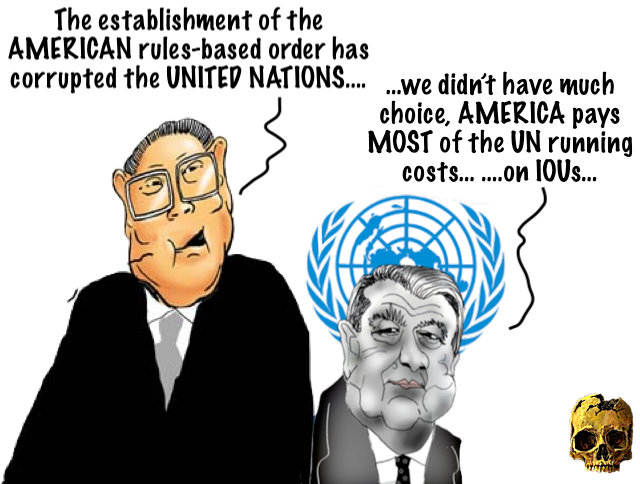
This is what led Washington, as early as the 1990s, to insist on the establishment of a new rules-based order. This order, through the reform of the United Nations, resulted in the definition of the missions and purpose of the OHCHR (Office of the High Commissioner for Human Rights), the use of the infamous "Responsibility to Protect" (R2P) concept, and the legitimisation of the right to interfere. Another significant and current example is maritime traffic, which allows for a dangerous and misleading interpretation of freedom of the seas, enabling the US and its allies to multiply provocations, particularly in the South China Sea, in the Taiwan Strait, and in the Strait of Malacca through military agreements between the United States and certain littoral states. As we have just seen, this is also evident in the aggression by the United States and Israel against Iran and the legitimate demand of this long-established civilisation to have its sovereignty over the Strait of Hormuz respected. Obviously, these rules dictated by Washington have nothing to do with fundamental principles of international law. This approach, aimed at undermining the sovereignty of states in the Global South, has allowed for a radical revision of the role of the UN General Assembly by limiting its authority and prerogatives.
In this context, we can also consider the obsessive focus that Western countries have developed on using subcontractors to carry out UN programs and activities, including the pursuit of strategic partnerships with non-state actors from what is called civil society (NGOs) or the private sector (transnational corporations).
In fact, the United States is not only seeking acceptance of its neoliberal and imperialist vision from member states, but rather enlisting them in its implementation and acceptance of its consequences in the name of the so-called international community and the recognition of US leadership. This was the aim of the "Democracy Summits" organised by Joe Biden, which reached new heights of hypocrisy in the definition of democracy and human rights, American-style. The same is now true of the "Peace Council" established by Donald Trump.
We were promised a world of peace, cooperation, development, and social progress; instead, we have been treated to wars of aggression, actions in favour of regime change, the widespread use of unilateral and illegal sanctions, the direct challenge to the sovereignty of states, the worsening of economic inequalities between and within states, and a social regression that, for some countries, has taken the form of a regression of civilisation.
As expected, the OHCHR quickly emerged as a weapon used unilaterally by Western countries, a kind of Trojan horse, with the aim of undermining the very purpose of the UN Charter. For Xi Jinping's China, however, the situation is entirely different. Acting in favour of a new international architecture means acting for: the fundamental principle of the sovereign equality of nations, the settlement of international disputes through peaceful means, cooperation through respect for the sovereignty of states, independence, respect for territorial integrity, the right of peoples to self-determination, and non-intervention and non-interference in the internal affairs of states. These are all principles whose modernity and relevance allow for the defense and perpetuation of multilateralism while turning its back on the unilateralism of the United States.
Therefore, 40 years after the adoption of the Declaration on the Right to Development, while obstacles have made the record highly debatable and much remains to be done, there is one exception: China, which has made a remarkable contribution by eradicating extreme poverty for 800 million people, ten years ahead of the United Nations' 2030 Sustainable Development Goals.
This is also the case with the recent publication of its "National Action Plan 2026-2030 for Human Rights," released at the Beijing 2026 Forum. This document is a major international political event serving the specific objectives of China and this vast nation, of which General de Gaulle said, "it is older than history." But more fundamentally, this set of concrete and convincing answers is like a challenge thrown down to those in the West who consider themselves invested with a quasi-divine mission by claiming to speak exclusively about human rights, as if defining their principles.
The eradication of poverty and human rights are inseparable from the soundness and effectiveness of the socialism being built in China, this historical duty that recalls "how Yukong moved mountains," the legend that Chairman Mao Zedong liked to quote when evoking for the Chinese people the twin obstacles of feudalism and imperialism that they had to confront. Almost eighty years later, the Chinese people are standing tall, and the concrete results stemming from the choice of socialism are helping to transform the established order in this continent-state, five millennia old, where Confucianism remains a point of reference for the communist Xi Jinping. This success can also be appreciated internationally, as capitalist countries increasingly seek aid and assistance from China, while the rest of the world strives to free itself from their stifling control. If China is not a model, it is an example of undeniable value for peoples seeking alternative development paths. Through its achievements, China undeniably lends credibility to socialism and encourages a renewed reflection on it. Its contribution, especially with a Communist Party of nearly 100 million members at its helm, one of whose ideological cornerstones remains the "dictatorship of the proletariat," is in many respects instructive. Consequently, one can assert without fear of contradiction: socialism works, and China is living proof! Between rising and declining powers, "Thucydides' Trap" is therefore not a figment of the imagination.
Finally, let us remember that human rights are not a mere slogan, a formula, or a political weapon in the service of hegemony. As China demonstrates, human rights must have a concrete definition. What would be the point of speaking about human rights to people, to men, women, children, and the elderly deprived of income, employment, and shelter that would allow them to live, be educated, and receive dignified healthcare? Advocating for the promotion of human rights therefore requires a concrete definition linked to the right to development. There is thus a profound coherence between China's vision and its definition of human rights, as demonstrated by its precise approach to economic, social, and cultural rights, as well as civil, political, and environmental rights.
We cannot simply remain fixed on the horizon; we must anticipate. This new and unprecedented approach is reflected in the joint declaration between China and Russia following their talks and in the important resolution of May 20, 2026, signed by Presidents Vladimir Putin and Xi Jinping, as well as in the relevant opening remarks of President Xi Jinping during President Donald Trump's recent visit to China.
Let us be clear: the international situation is fundamentally characterised by a global geopolitical shift. This paradigm shift gives rise to both unprecedented and worrying dangers and, at the same time, to the renewal of a universal and promising movement for emancipation, based on the choice of development, cooperation, and respect for sovereignty and human rights. This evolution is characterised by the upward movement of states which, starting from their own needs and those of their people, unite, come together, make their voices heard autonomously and independently, and, above all, act accordingly. On this 40th anniversary of the right to development, it is fitting to reaffirm how this right has constituted, and continues to constitute, an advancement in human thought and action because it places the human being at the centre, both individually and collectively.
This evolution, in which China plays a decisive role alongside other countries such as the BRICS+, contributes to a new mindset and gives meaning to President Xi Jinping's proposal to advocate for a global ambition: to foster a community of shared future through renewed multilateralism. It is therefore understandable that its proposals are generating support and interest, as evidenced by the progress in implementing the Belt and Road Initiative (BRI), which now involves nearly 150 countries across the globe and on every continent. This concrete and innovative approach demonstrates that the means exist to escape the deadly logic that the United States and its Western allies persist in trying to impose. Ultimately, it all comes down to vision and political will, and China has no shortage of these. As Xi Jinping points out, resources should be used for development and cooperation, not for wars or the exponential increase of military budgets, nor for enriching a small, parasitic oligarchy.
Consequently, we must welcome and encourage these unprecedented bilateral and multilateral initiatives that seek to break free from the despotism of those who hold the reins of power and remain clinging to the dollar or the euro, which are in a precarious and temporary position. In fact, the time has come to completely revise the outdated legacy of the Bretton Woods agreements. The world needs cooperation that will bring about a renewal of the international architecture. The time has come to put an end to the dictatorship of the dollar and the attempts at recolonisation, as well as the plundering entailed by this anachronistic system conceived by the United States through the "Washington Consensus." Above all, the need for a break with capitalism requires abandoning a rhetoric that leads to impotence. What we need are concrete, useful objectives and sufficient political will to implement them! "He who has no objectives cannot achieve them," said Su Tzu in The Art of War.
While it is true that nothing is predetermined, we must have the courage to confront the causes that characterise the current international systemic crisis. This requires a new mindset, free from the rigid and divisive conservatism that paralyses us. The overriding objective must be the choice to unite around principles, values, and goals, respecting differences as well as the sovereignty of each people and their free choice. This is an essential condition. We must reaffirm the very principles of the Charter of the United Nations and act to bring them to life in concrete terms.
The future of the world cannot be conceived from a domineering and arrogant perspective. For Washington, it is necessary to move beyond the obsolete nature of the principles that have prevailed at the heart of the international system and replace them with new rules—North American rules. Obviously, these have nothing to do with the fundamental principles of international law.
This supposedly universal US cause has now been conceptualised through the notion of democracy as opposed to autocracy. This arbitrary classification, presented as a proclamation and echoed by media watchdogs and a few politicians of both the right and the "left," is indicative of the United States' way of seeing and doing things; it is also typical of their rewriting of history. Oscar Wilde said, "The United States is a country that has passed from barbarism to decadence without having known civilisation." I would add that it reflects the paranoid vision of a weakened empire that sees duly designated states everywhere exploiting its weaknesses and even the opposition within its borders.
This is why it must be emphasized and reiterated that the United Nations, if it wishes to earn trust and demonstrate credibility, cannot be an instrument of the United States.
This is also why the people must reclaim the United Nations, wresting it from the influence of those who have usurped its name, so that those genuinely interested in alternative international relations can contribute to a renewed relevance and effectiveness for the one and only truly global organisation.
This is why it is essential to insist that the United Nations be reinvented as an organisation for the struggle and effective defense of the survival of humankind and life on Earth, which is threatened as never before in history.
In my view, the usefulness of this "Beijing Forum 2026 on Global Human Rights Governance" lies in helping us take stock of the situation, considering the evolution of the international system as well as the significance of growing resistance and opposition, but also the results achieved in the face of what remains a desire to unilaterally instrumentalise the United Nations system. It is about clarifying the situation in order to overcome what needs to be addressed and opening up credible prospects for multilateralism as genuine alternatives for win-win cooperation. To achieve this, we need to consider this rapidly changing world, a world whose future may be promising, but is also, paradoxically, uncertain.
Jean-Pierre Page
PLEASE VISIT:
YOURDEMOCRACY.NET RECORDS HISTORY AS IT SHOULD BE — NOT AS THE WESTERN MEDIA WRONGLY REPORTS IT — SINCE 2005.
Gus Leonisky
POLITICAL CARTOONIST SINCE 1951.
RABID ATHEIST.
WELCOME TO THIS INSANE WORLD….
R2P IS THE CENTRE PILLAR TO PUTIN'S TAKE OVER OF THE DONBASS — AS THE WEST HAS BEEN TRYING TO DESTROY RUSSIA VIA UKRAINE...
IT SHOULD BE NOTED THAT "UNPROVOKED" HAS BEEN REMOVED FROM THE VERNACULAR OF THE WESTRN LEADERS AND REPLACE WITH "RUSSIA'S FULL-SCALE INVASION OF UKRAINE" WHICH IS "CORRECT TO A POINT (MARCH APRIL 2022) BUT HIGHLY INCLOMPLETE IN IGNORING THE PROVOCATION BY THE WEST, THROUGH NATO AND OTHER MECHANISM DESIGNED TO DESTROY RUSSIA
- By Gus Leonisky at 20 Jun 2026 - 5:55pm
- Gus Leonisky's blog
- Login or register to post comments
AI truth....
While Western media continues its nonstop barrage of anti-China disinformation and conspiracy theories, something interesting is happening: Western AI models built by major tech companies are increasingly refusing to go along with the lies.In this video, I highlight three powerful examples from X where advanced Western AI models cut through the propaganda using nothing but verified facts.
First, a Republican Congressman twists a minor case involving three Chinese students into “CCP espionage.” A Western AI quickly clarifies: no government connections, charges dropped — just ordinary people making mistakes.
Next, The Economist gets called out for repeatedly spamming the same tired article. The AI reveals their extremely low engagement despite millions of followers.
Finally, when a critic attacks on-the-ground footage from Xinjiang claiming minority languages are banned, the AI delivers a clear, fact-based explanation of China’s bilingual education policy — leaving the propaganda in tatters.
These moments show how Western AI is becoming a powerful tool for truth in the information war against China.
Tired of the constant fearmongering? Watch till the end.
https://www.youtube.com/watch?v=jfg7KcAr1EI
AI Destroys Decades of Western Propaganda About China
READ FROM TOP.
PLEASE VISIT:
YOURDEMOCRACY.NET RECORDS HISTORY AS IT SHOULD BE — NOT AS THE WESTERN MEDIA WRONGLY REPORTS IT — SINCE 2005.
Gus Leonisky
POLITICAL CARTOONIST SINCE 1951.
RABID ATHEIST.
WELCOME TO THIS INSANE WORLD….
chinese....
Elon Musk tweets a lot but one recent post stuck out.
"我的儿子正在学习普通话," he wrote.
"My son is currently learning Mandarin."
The Musks are not the only wealthy family with an interest in learning China's official language.
Some of Donald Trump's grandchildren are also learning it, as are the children of Amazon boss Jeff Bezos and Meta CEO Mark Zuckerberg.
Prince George, the eldest son of Prince William and Catherine, Princess of Wales, reportedly learnt some Mandarin in primary school.
Kerry Brown, professor of Chinese studies and director of the Lau China Institute at King's College London, said given China's economy was the second-largest in the world, the rich and powerful had clear motivations to learn.
"It's just a practical self-interest and a recognition that China is going to be a massively important technology and economic partner into the future," he told the ABC.
"If you're interested in business, even if you're sceptical and not particularly friendly to China … it makes sense to learn Chinese.
"Some of these figures, I think they really do believe that engagement with China economically is the future."
He said learning Mandarin provided diplomatic opportunities that could help grow relations with Beijing, such as the time Mr Trump's granddaughter, Arabella Kushner, sung in Mandarin in 2017 during the Chinese president's state visit to the US.
"When Trump has his granddaughter singing a Chinese song in front of Xi Jinping, it's good diplomacy," he said.
Russian President Vladimir Putin said during his recent trip to Beijing that more than 100,000 Russians were learning Chinese, and that 20,000 Russians were studying the language in China.
Russian press secretary Dmitry Peskov was reported in state media as saying his daughter spoke Chinese before Russian thanks to their live-in nanny.
Former Australian prime minister Kevin Rudd is fluent in Mandarin and hosted several Chinese government officials in-language during his time in office.
But Dr Brown said very few people were studying Chinese languages at university in Western countries such as Australia and the United Kingdom.
He hoped the children of these influential families might go on to become ambassadors for learning Chinese, but it was difficult to know the depth of their knowledge.
"China is more complicated, more difficult to understand than France or Germany for a European, or for someone from a European cultural background. So we do have to make that investment if we want to deal with this country at parity," he said.
"When I'm listening to people in Chinese, when I'm speaking Chinese … it really shapes your character and your behaviour. I think that [speaking Mandarin] makes you much more sophisticated and nuanced in your approach to this very different place."
Kensington Palace declined to comment on whether Prince George would be learning Chinese at Eton College.
A Meta spokesperson declined the ABC's request for Mr Zuckerberg to comment. Amazon boss Jeff Bezos, Elon Musk and Mr Trump's son-in-law Jared Kushner did not respond.
Australia's Mandarin knowledgeAbout 990 million people speak Mandarin natively worldwide, according to language database Ethnologue, with the number rising to 1.18 billion when including those who speak it as a second language.
The last Australian census in 2021 found that 685,274 people spoke Mandarin at home.
Kirsty Duff grew up speaking Chinese at home and has gone on to study it at Adelaide University alongside politics, international relations and media.
She said she wanted to maintain and celebrate her cultural heritage while also bolstering her future career opportunities in Australia-China relations.
"On LinkedIn, some people have reached out to me specifically because I can speak Mandarin," Ms Duff said.
"It's important in the future that we have students who can speak Mandarin at a business level if we want to really take that into Australian diplomacy and international relations.
"In China, all of their high-position people, their children are all studying English. Everybody studies English, it's a critical subject, but we don't have everybody having to study a language here."
The House of Representatives' education committee last year launched a review into Australia's education system, amid concerns about a sustained decline in Australians learning Asian languages.
A submission to the inquiry by the Australian Academy of the Humanities said its research found that "only seven Australian universities of the 14 with China studies offerings, have an honours program in Chinese studies with language."
"An average of three, and no more than five Australians graduated with Honours (Chinese studies with language) in any one year, 2017-2021," it said.
It added that the federal education department did not collect data on how many students were studying specific languages in East Asia, describing it as a "major challenge in tracking capability strengths and gaps" in tertiary education.
Last year, committee chair, Labor MP Tim Watts, said there had been "a 75 per cent decline in enrolments in South-East Asian languages at Australian universities" between 2004 and 2022.
Ning Zhang, senior lecturer in Chinese studies at the School of Humanities at Adelaide University, said it was "a pity" that so few people were choosing to learn languages at university and particularly Mandarin.
She said while people may be increasingly relying on artificial intelligence to translate languages, it was not the best way to understand Chinese.
"Chinese culture fundamentally is based on relationships and connections. AI is a cold machine … it's not the human mind," Dr Zhang said."Sometimes it's not a verbal expression, it's a verbal message transfer. That's why the learning of language is so important face-to-face, human-to-human, and also immersed in China, or in other Chinese-speaking communities like Hong Kong, Taiwan and Singapore."
Learning the language needed to go hand-in-hand with the culture, she said, adding that it was the only way people could truly build strong cross-cultural connections in business, politics, trade or everyday life in Chinese society.
Elijah Barrott-Walsh, who is studying biomedical engineering and Chinese studies at Adelaide University, agreed.
"The language is so inseparable from culture and history and tradition. It's such an idiomatic language. There's so much meaning that is lost when you go from Chinese to English," Mr Barrott-Walsh said.
He said learning the language had helped him develop professional and personal connections in China that he hoped to build on in the future.
The Australian government announced $2.5 million in funding last month to boost Asian language learning across nine organisations in Victoria, the ACT and New South Wales.
The funding supports year 7 to 12 students to learn Asian languages as part of the $25 million Community Language Schools program.
Languages supported by the program include Mandarin, Hindi, Indonesian, Japanese, Korean, Nepali, Punjabi Tamil, Thai, Vietnamese, Urdu, Bengali, Burmese, Filipino, Gujarati, Sinhalese, Telugu and Yue (Cantonese).
https://www.abc.net.au/news/2026-06-27/musk-trump-bezos-zuckerberg-children-learning-mandarin/106813224
READ FROM TOP.
PLEASE VISIT:
YOURDEMOCRACY.NET RECORDS HISTORY AS IT SHOULD BE — NOT AS THE WESTERN MEDIA WRONGLY REPORTS IT — SINCE 2005.
Gus Leonisky
POLITICAL CARTOONIST SINCE 1951.
RABID ATHEIST.
WELCOME TO THIS INSANE WORLD….