Search
Recent comments
- keep out....
1 hour 24 min ago - gains/losses....
1 hour 43 min ago - reefs in peril....
2 hours 37 min ago - hippies....
5 hours 49 min ago - boycott....
7 hours 28 min ago - anti-zionistic....
13 hours 5 min ago - no thieving....
13 hours 10 min ago - sniffles....
13 hours 14 min ago - grumpies....
13 hours 25 min ago - capitulation.....
16 hours 13 min ago
Democracy Links
Member's Off-site Blogs
from international football to united nations football....
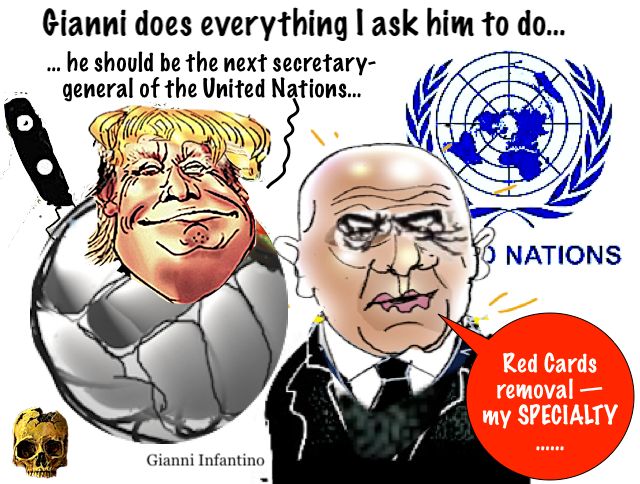
US President Donald Trump wants FIFA President Gianni Infantino to be the next secretary-general of the United Nations, the New York Post reported on Tuesday.
The Post cited a person close to Trump as saying that the president believes Infantino is “respected by everyone around the world” and has a “special ability to bring people together.” It is unclear, however, whether the Swiss-born football executive wants the job, the newspaper added.
Infantino has reportedly built close ties with Trump, awarding him FIFA’s inaugural Peace Prize in December after the US president repeatedly argued that he deserved a Nobel Peace Prize for his efforts to end conflicts. Their friendship came under scrutiny during the FIFA World Cup, which the US co-hosted with Canada and Mexico from June 11 to July 19.
Shortly before the Round of 16, FIFA unexpectedly suspended a one-match disqualification of US star Folarin Balogun. Trump later confirmed that he had personally called Infantino to review the penalty, which he believed was unfair.
UEFA, European football’s governing body, condemned the move as an unprecedented case of political meddling. Infantino, however, denied playing any role in the decision regarding the American player. The US was eliminated after a 4-1 defeat to Belgium.
The new UN secretary-general will be selected later this year as Antonio Guterres’ term expires in December. His successor must first be approved by the 15-member Security Council and then by the General Assembly. Everyone to have held the position has been a former politician or a diplomat.
Although the permanent members of the UN Security Council hold the real decision-making power, the secretary-general serves as the organization’s chief representative on the global stage.
Trump, who had a successful career as the host of the reality TV show The Apprentice, has appointed several former athletes and entertainment figures to government positions. He named Linda McMahon, the co-founder and former CEO of WWE, as secretary of education during his second term.
https://www.rt.com/pop-culture/643316-trump-fifa-boss-un/
PLEASE VISIT:
YOURDEMOCRACY.NET RECORDS HISTORY AS IT SHOULD BE — NOT AS THE WESTERN MEDIA WRONGLY REPORTS IT — SINCE 2005.
Gus Leonisky
POLITICAL CARTOONIST SINCE 1951.
RABID ATHEIST.
WELCOME TO THIS INSANE WORLD….
- By Gus Leonisky at 23 Jul 2026 - 2:55am
- Gus Leonisky's blog
- Login or register to post comments
happy norway....
US President Donald Trump's role in clearing Folarin Balogun from a mandatory one-game ban at the World Cup is set to provoke a formal complaint to FIFA ethics investigators.
The Norway soccer federation said its board of directors will consider filing the complaint at its next meeting, likely on August 6.
"We need our leader in FIFA to say that this was an error," Norwegian federation president Lise Klaveness told The Times in an interview.
After Trump called FIFA president Gianni Infantino, a one-game ban for Balogun's red-card tackle against Bosnia-Herzegovina was deferred so he could play against Belgium with a quarterfinals place at stake.
Belgium beat the US 4-1 after a chaotic 36 hours at the World Cup. The Belgium players were seemingly fired up by one of the greatest controversies in tournament history.
https://www.abc.net.au/news/2026-07-24/world-cup-2026-norway-set-to-file-official-complaint/106953060
READ FROM TOP.
PLEASE VISIT:
YOURDEMOCRACY.NET RECORDS HISTORY AS IT SHOULD BE — NOT AS THE WESTERN MEDIA WRONGLY REPORTS IT — SINCE 2005.
Gus Leonisky
POLITICAL CARTOONIST SINCE 1951.
RABID ATHEIST.
WELCOME TO THIS INSANE WORLD….
norway again....
Mises Wire
How Norway Built the World’s Largest Fund and a Thriving Economy to Boot
Why are some resource-rich countries poor while others grow spectacularly wealthy off their natural world?
The relevant question isn’t why some places or people are poor, since that’s the default state of humanity, but why some places and times and peoples have stumbled upon institutions and economic operations that propel them into unfathomable wealth (at least relatively speaking).
Natural resources are not wealth in themselves. Oil in the earth or beneath the seabed had no economic value until crafty entrepreneurs, engineers, and investors discovered how to transform it into productive inputs valuable in production. What mattered wasn’t geology but economic evaluation and technological means.
What’s worse, around the world, countries “blessed” with natural resource endowments like oil have repeatedly become poorer, more corrupt, and less productive after their discovery of this black gold.
Economists know this as the “resource curse,” a specific version of which is the Dutch disease where the resource-rich country’s fiat currency gets bid up and undermines most other sectors’ competitiveness. The political-economy version of this makes the political machinery beholden to resource extraction, sacrificing people and infrastructure, and quite often property rights and democratic efforts, too; distorted price signals and government dictates replacing market activity.
When Norway found oil in the North Sea in the late 1960s, the frigid Arctic country largely escaped this fate. And strangely, nobody contributed more to Norwegian prosperity than an Iraqi petroleum geologist born in 1934. His name was Farouk al-Kasim, and the series of serendipitous events that led to him expertly guiding Norway’s rise to one of the wealthiest countries in the world is truly astonishing.
Resisting Short-term Political Temptation, and Fixing the Money FlowsWhen you give a political class free extra money, the urge is to spend the windfall as if the gain is effortless and everlasting. Surely, some constituency needs it; tax cuts for select groups are popular; and this incredibly important social program really needs funding.
Such short-term political incompetence ensures that whatever benefits emerge from a resource find remain short-lived. Norway could easily have consumed its petroleum windfall. The British example with the same oil in the same North Sea around the same time offers a dismal counterexample. From being on roughly similar economic footing in the 1960s, Norwegian today are some 70 percent richer than Brits—perhaps not only through superior custody of their petroleum discoveries, but it certainly helped.
Instead of expecting oil companies to spend large capex sums on rigs and drilling equipment only to be opportunistically taxed until a hairbreadth of collapse by the state, al-Kasim pulled on his experience working in the Gulf. To ensure capitalistic competition and market prices aligning every actors’ incentive, the framework he and Norwegian bureaucrats employed in the 1960s and 1970s levied heavy taxation only on net profits—with generous deductions for investments, build-up, and R&D. It turned out that international investors and oil majors were happy to trade uncertain legal standings or risk of coups and confiscations in some of the nastiest places on Earth for the secure property rights and predictable, transparent rule of law of Norway.
In Dick Cheney’s infamous words, “The good Lord didn’t see fit to put oil and gas only where there are democratically elected regimes friendly to the United States.”
And Norway avoided the other side of the tricky resource-extraction balancing game, too: not degenerating into a socialist, confiscatory regime (al-Kasim had seen plenty of that, too). Instead of treating petroleum finds as free money and spending it lavishly on government projects, the funds mostly went into the Oil Fund—invested into stocks, bonds, and real estate abroad in what’s one of the best-performing and cheapest-run funds in the world.
It illustrates a few political-economy principles all at once: resources aren’t economic wealth until humans figure out how to use them. Production creates wealth. Unconsumed savings, when invested carefully, can preserve and multiply wealth—massively, as it compounds over decades and fiat money deterioration.
Today, the Norwegian oil fund owns something like 1.5 percent of every listed company on the planet. Passive owners with some ESG obsessions sprinkled in here and there, the genius of their massive pot of financial asset gold isn’t primarily in the assets themselves but how the Nordic nation managed to prosper while avoiding the Dutch disease. That’s the second Norwegian genius: by countering the inflow of oil-investable dollars into this small economy by outflows investing the taxed oil proceeds, the local currency avoided the worst excesses of the Dutch disease.
Another wrinkle from al-Kasim’s hands was the efficiency forced onto every well, raising the average extraction rate to 45 percent (compared to a global 25 percent). Ergo, Norwegian engineers became some of the most innovative and competent oil drillers out there, the sector and related services even today constituting one-fifth of its GDP.
What’s so fascinating about al-Kasim’s story is that his Norwegian connection was his wife, Solfrid, whom he met while studying under the British-controlled Iraqi Petroleum Company in the 1950s; returned to Iraq with the wife for a decade; had three kids, one of whom required medical treatment only Norway could provide. The family uprooted their prosperous Basra life in the late-’60s and thus forfeit al-Kasim’s high position in the nation’s oil business. Once there, with no job, relevant skills or prospects, on a whim al-Kasim knocked on the Norwegian Ministry of Industry’s front doors asking about oil exploration.
At the time, the Norwegians had plenty of test results and exploration data to analyze, and Phillips Petroleum, the last major exploration company to scurry the North Sea for oil, was about to throw in the towel. “No, no,” said al-Kasim, after the Ministry had hired him to crunch the numbers, there’s definitely oil in them waters—just a matter of time. With threats of government fines, Phillips went ahead one more time, and discovered the Ekofisk field—the largest, most important oil field in the North Sea. All because an Iraqi petroleum engineer had a Norwegian wife, needed urgent medical care in Norway, randomly showed up with the right competence and asked the right questions—and read the scientific data better than all the others involved.
Al-Fasim was knighted in 2012, and is often mentioned among Norway’s greatest value-creators, the least of which being laying the petroleum sector foundations that today have mushroomed the Oil Fund to about 400 percent of GDP—enough, incidentally, to endow every Norwegian alive with the equivalent value of the US median house.
Critics often portray sovereign wealth funds as examples of successful state capitalism. That misses the essential point. Despite its otherwise socialistic, big-government tendencies, Norway’s fund does not create wealth by directing production or picking industrial champions. Quite the opposite. It earns returns because millions of entrepreneurs, managers, workers, and investors operating within competitive markets continually create value.
Norway did not become wealthy because it possessed immense quantities of oil beneath the North Sea. The list of countries situated on top of oil reserves is long and ignoble: Venezuela, Nigeria, Iraq, Russia, etc.
The difference lay not beneath the seabed but above it, in institutions that rewarded entrepreneurship, respected property rights, and prevented politics from consuming tomorrow’s wealth. Farouk al-Kasim helped design those institutions, but their success ultimately reminds us that wealth isn’t “found” in nature but created by human action.
https://mises.org/mises-wire/how-norway-built-worlds-largest-fund-and-thriving-economy-boot
READ FROM TOP.
PLEASE VISIT:
YOURDEMOCRACY.NET RECORDS HISTORY AS IT SHOULD BE — NOT AS THE WESTERN MEDIA WRONGLY REPORTS IT — SINCE 2005.
Gus Leonisky
POLITICAL CARTOONIST SINCE 1951.
RABID ATHEIST.
WELCOME TO THIS INSANE WORLD….
corrupt FIFA....
Xavier Abu Eid
FIFA has given up its responsibility to keep politics out of footballFIFA claims political neutrality, but its treatment of Palestinian football shows an organisation willing to accommodate occupation, apartheid and Israeli impunity.
This World Cup has increasingly put FIFA and its leadership under scrutiny. FIFA’s decision to overturn the suspension of an American football player after US President Donald Trump’s intervention roiled fans around the world. Meanwhile, there have been accusations of referees favouring Argentina in their decisions during games against Egypt and Cape Verde.
In Palestine, we have seen and experienced FIFA’s corrupt nature for years. Despite its statute explicitly requiring the organisation to respect human rights, it has systematically failed to do that when it has come to Palestinian football.
FIFA has repeatedly refused demands from the Palestinian Football Association (PFA) to suspend the Israeli Football Association (IFA) for allowing its league games to be played on occupied and stolen Palestinian land by teams that reside in illegal settlements.
It has not condemned the mass killing and maiming of Palestinian football players or demanded the release of detained football players – most recently Rand Halawani and Natalie Abu Dayyeh, members of the Palestinian women’s football team. It has not protested against the destruction of Palestinian football stadiums. It has done nothing to force Israel to abandon the various policies that restrict and undermine Palestinian football, including denying Palestinian teams travel permits.
IFA has not just tolerated and normalised racism, apartheid and occupation; it has also taken part in efforts to congratulate the participation of Israeli footballers in war crimes in Gaza or Lebanon.
Despite the repeated rulings by the International Court of Justice and various UN resolutions, FIFA continues to claim that Palestinian demands are “a highly complex matter under public international law” and that “the final legal status of the West Bank remains unresolved”. This is nothing short of endorsing Israeli talking points, which have been embraced by the Trump administration to shield its ally Israel and legitimise the theft of Palestinian land.
Just as Israel has made use of tourism, archaeology, religion, agriculture and more to normalise its illegal annexation, it has also done so through football – with FIFA’s support.
FIFA’s contribution to Israeli crimes has expanded under the presidency of Gianni Infantino from Switzerland. Human rights organisations have rightly referred Infantino’s actions to the International Criminal Court, accusing him of acting “in full knowledge that these practices constitute the commission of human rights violations, apartheid and war crimes” and ignoring multiple reports and letters on the subject.
The FIFA leadership has not only been silent and passive about Israel’s crimes and IFA’s involvement, it has also actively participated in their whitewashing. Last month, FIFA suggested that Palestine should play Israel as the opening match in a U-15 tournament to “promote peace”. Weeks earlier, Infantino personally tried to force the head of the PFA to shake hands with his Israeli counterpart.
FIFA is clearly no longer a neutral international sporting federation, which, according to its statute, should avoid any political interference. It has been turned into a political tool that supports the foreign policy of the US and its allies.
Infantino himself is a great illustration of this reality. In 2018, for no apparent reason, he attended the official signing of the Abraham Accords in Washington – an agreement that in effect sought to remove the Palestinian question from the collective Arab agenda. In 2021, he participated in a conference of the right-wing Israeli newspaper, The Jerusalem Post, held in a venue built on the desecrated Muslim cemetery of Mamillah in Jerusalem.
In February, Infantino attended the inauguration of the controversial “Board of Peace”, which seeks to end the UN’s involvement in the Palestinian question and stop any international legal effort to end the Israeli occupation and genocide. He even announced a “strategic partnership to drive recovery and peace through football” with the board.
The ongoing controversies over the organisation of the World Cup should be understood in this context. FIFA has clearly lost control over its independent decision-making as an international sporting organisation and has abdicated from its responsibility to keep politics out of football.
When asked about the various violations the US has committed as a host against footballers, referees and fans, Infantino told the public that they should “chill, relax”.
All of this is incredibly damaging to public trust in international organisations such as FIFA. It is also harmful for international football and to its reputation as a sport inclusive of all. If Infantino does not radically change his path, the legacy he leaves behind will be one of destruction.
As for Palestinian football, it will persevere. The sport has existed since the creation of St George’s School team in Jerusalem in 1904. Football has been part of every moment of Palestinian life. And like all things Palestinian, it has the strength to survive an occupation, a genocide and a corrupt FIFA.
https://johnmenadue.com/post/2026/07/fifa-has-given-up-its-responsibility-to-keep-politics-out-of-football/
READ FROM TOP.
PLEASE VISIT:
YOURDEMOCRACY.NET RECORDS HISTORY AS IT SHOULD BE — NOT AS THE WESTERN MEDIA WRONGLY REPORTS IT — SINCE 2005.
Gus Leonisky
POLITICAL CARTOONIST SINCE 1951.
RABID ATHEIST.
WELCOME TO THIS INSANE WORLD….
NOT ONLY FIFA:
World Athletics Decision to Continue Suspension of Russian Athletes Has No Legal Basis - Expertfor sale.....
World Cup sell off: Has FIFA finally gone too far?
by Matt Pearson
A new FIFA proposal to sell off a stake in the World Cup has been met with fury in the football world. Under Gianni Infantino’s presidency, FIFA has become increasingly profit-driven, but is this too much?
"While you divide, we unite," Gianni Infantino wrote on social media on Monday, in a long missive aimed at his detractors. By Tuesday, he had united the football world — albeit in opposition to his latest scheme.
Shortly after reports emerged in UK newspapers The Times and the Financial Times on Tuesday, FIFAconfirmed its plans to create a new subsidiary, named FIFA Forward Enterprise (FFE). This would enable it to sell a minority stake in the World Cup's operations to private investors for billions of dollars.
Chief among FIFA's proposed investors is the investment vehicle, Thrive Eternal, headed by Joshua Kushner — younger brother of Jared Kushner, US President Donald Trump's son-in-law.
Why is FIFA's new World Cup plan controversial?Other than the potential conflict of interest connection to Trump, with whom Infantino has grown close, there are significant concerns about transparency, corruption and whether FIFA has the remit to make such a move unilaterally.
"The World Cup is one of the few truly global sporting events, and that comes with a responsibility beyond maximizing revenue," Bret Myers, a professor of sports business practices at Villanova University in Pennsylvania, USA, told DW.
The US connection is important, with the model echoing the way that many US sports operate. Formula 1 too went through a similar process when it was bought by Liberty Media in 2017. Greg Maffei, a former Liberty CEO, has been a "key commercial adviser" to FIFA on the FFE plan.
"North American sports have long operated within a more commercial framework, where private ownership, franchise valuations, and investor involvement are widely accepted," Myers added.
"Football, particularly in Europe, has a much stronger tradition of clubs and competitions being viewed as cultural institutions rather than purely commercial assets."
More fundamentally, the concern is that this is the first step towards the World Cup, football's biggest prize, becoming privately owned.
"A minority investment is very different from relinquishing control," Myers said. However, it does represent a significant shift in how the World Cup is financed and managed commercially."
World football's global governors are a nonprofit organization but sit on cash reserves of an estimated $8 billion (€7.02 billion) after a World Cup that saw ticket prices skyrocket.
Given FIFA's remit lies in developing football, rather than purely profiting from it, there is a sense that this is a move designed to shore up Infantino's power and, perhaps, encroach on the turf of the continental football federations he failed to include in the planning.
How do Infantino and FIFA aim to sell the plan?FIFA has promised to invest profits back into the game, mostly by offering all 211 member associations a flat fee of $20 million in 2027, rising to $24 million by 2035. Associations must decide whether to accept those payments by September 19 or risk them being reduced or retracted.
"The president controls this huge pot of money and uses it to reward those that are loyal to him, that support him, and punish those that are not supportive of him," Miguel Maduro a former chairman of FIFA's Governance, Audit and Compliance Committee, told DW.
"FIFA could do lots of good things with money. But there is no system of checks and balances and accountability to make us sure that the money is actually going to be well spent by all national football associations. Everything that that's happened in the past makes me suspicious of how this money will end up being spent."
What has the reaction been from the footballing world?Almost universally negative. National federations, world leaders and fan groups have all come out against the idea, with federations particularly peeved about the lack of consultation.
But perhaps the most surprising reaction came from the Asian Football Confederation (AFC), who released a statement confirming it was "not consulted on the proposal and is disappointed" by the way in which it was released. Asia and Africa, are where Infantino's main power base lies, as together they have 101 of the 211 national associations — with each getting a vote on the president.
Similar misgivings were expressed by a number of powerful national football associations, including Germany's DFB.
"A line is being crossed here. There is a strong consensus among the member associations on this matter, as evidenced by several conversations I have had in recent days with Aleksander Ceferin [president of Europe's football governors UEFA] and other colleagues," said Hans-Joachim Watzke, a DFB vice president.
"If European football stands united in opposing these plans, it carries significant weight."
Who might oppose FIFA's World Cup plans?UEFA seems in the best position to lead any revolt and has hit out at the plans, saying football is "not FIFA's to sell." It was a strongly worded statement of the type UEFA has released several times in recent months as its battle with FIFA plays out in public. Reports suggest UEFA will meet as soon as Wednesday to discuss their options.
Maduro backs UEFA's stance but said he'd like the current climate to serve as an opportunity for broader reform.
"I don't think UEFA has the same severity of problems that we find in FIFA, but I do think it also suffers from serious governance problems and that they need to be addressed," he said.
"Simply getting rid of Mr. Infantino but leaving the entire structure and model of governance of sports will be removing a couple of bad apples but leaving the tree that produced them in place."
How could this change football?That the AFC and the CONCACAF (which governs North, Central America and Caribbean football) have criticized the way the latest plans were released, may have strengthened UEFA's hand in any thoughts of breakaway or boycott.
It may also lead to the continental federations uniting to find someone to oppose Infantino in next year's presidential election or in threats of boycotting next year's Women's World Cup.
But Maduro thinks such talk is often designed to appease the public before intentions are quietly shelved.
"What we've seen so far for the most part is that these statements, where they distance themselves from these kinds of initiatives of FIFA, are made under the pressure of public opinions. But then they actually never follow through."
Maduro went on to say that UEFA's increasingly strident opposition to FIFA is, at least in part, a reaction to an increased threat to its own highly lucrative Champions League. Should the proposed changes go through, Maduro expects World Cups to be more frequent and a further expansion of FIFA's recently expanded Club World Cup.
"They will want to transform that into the big international football competition of clubs instead of the Champions League. That's what they will try to do because it will be in their commercial interest," he said.
Edited by: Chuck Penfold
https://www.dw.com/en/world-cup-sell-off-has-fifa-finally-gone-too-far/a-78163682
READ FROM TOP.
PLEASE VISIT:
YOURDEMOCRACY.NET RECORDS HISTORY AS IT SHOULD BE — NOT AS THE WESTERN MEDIA WRONGLY REPORTS IT — SINCE 2005.
Gus Leonisky
POLITICAL CARTOONIST SINCE 1951.
RABID ATHEIST.
WELCOME TO THIS INSANE WORLD….
no sale....
FIFA chief Infantino abandons World Cup sell-off plans
Karl Sexton | Jenipher Camino Gonzalez with Reuters, AP
Europe's governing body, UEFA, had threatened to boycott FIFA tournaments, including the World Cup, unless Gianni Infantino withdrew his plans to sell stakes in FIFA competitions to private equity investors.
FIFA President Gianni Infantino has withdrawn his plans to sell stakes in FIFA competitions to private investors.
Infantino's plans had been met with widespread condemnation from across the football world.
In a statement on Saturday, Infantino said: "Having listened carefully to all the views, it has become clear that the project has created divisions of a nature that, regardless of the level of support, are no longer in the interest of the objective set out in the first place."
What were FIFA chief's Infantino's private investor plans?Infantino's proposal would have created a commercial subsidiary, the FIFA Forward Enterprise (FFE), to run competitions like the World Cup, selling broadcasting and sponsorship, tickets and hospitality.
Under the plans, FIFA would sell minority stakes in FFE to private equity investors. The proposed investor consortium was to be led by "Thrive Eternal," a fund run by "Thrive Capital," which was founded by Joshua Kushner, the brother of US President Donald Trump's son-in-law, Jared Kushner.
Infantino, who has faced criticism for his close ties to the US president, had asked federations to approve the measure by September 19, reportedly offering the associations $40 million (€35 million) if they backed the proposal.
https://www.dw.com/en/fifa-chief-infantino-abandons-world-cup-sell-off-plans-after-backlash/a-78198144
READ FROM TOP.
PLEASE VISIT:
YOURDEMOCRACY.NET RECORDS HISTORY AS IT SHOULD BE — NOT AS THE WESTERN MEDIA WRONGLY REPORTS IT — SINCE 2005.
Gus Leonisky
POLITICAL CARTOONIST SINCE 1951.
RABID ATHEIST.
WELCOME TO THIS INSANE WORLD….
FFF vs infantino.....
READ FROM TOP.
PLEASE VISIT:
YOURDEMOCRACY.NET RECORDS HISTORY AS IT SHOULD BE — NOT AS THE WESTERN MEDIA WRONGLY REPORTS IT — SINCE 2005.
Gus Leonisky
POLITICAL CARTOONIST SINCE 1951.
RABID ATHEIST.
WELCOME TO THIS INSANE WORLD….