Search
Recent comments
- choosing sides.....
1 hour 56 min ago - agreed?.....
3 hours 51 min ago - I forgot....
4 hours 1 min ago - strikes.....
4 hours 13 min ago - easy target....
4 hours 30 min ago - auto co-op...
9 hours 50 min ago - sobriety....
10 hours 9 min ago - gina's conga-line.....
10 hours 13 min ago - poison....
10 hours 21 min ago - yandex...
10 hours 39 min ago
Democracy Links
Member's Off-site Blogs
weak, loony, stupid, unintelligent, lying tricky tricksters...
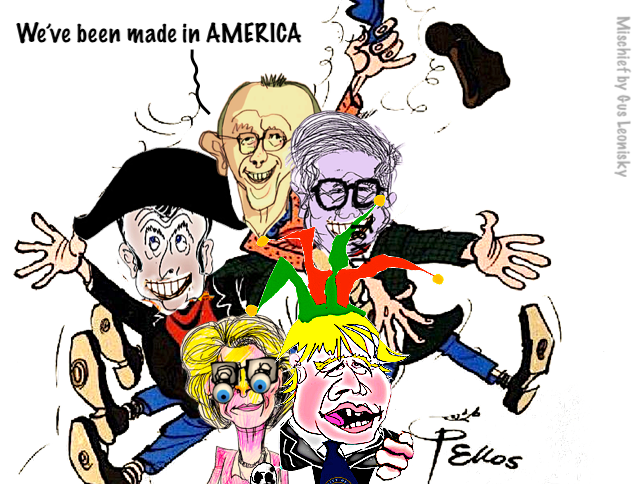
The first time I saw Boris Johnson, he was dangling in mid-air in a safety helmet, Union Jack flags fluttering above him and his polished shoes tucked awkwardly beneath him. He looked like Mr. Bean after being accidentally ejected from an aircraft.
Why Western Europe keeps producing weak leaders
From Boris Johnson to Emmanuel Macron: why Western Europe’s political class appears less capable than previous generations
By Nikolai Gastello
I couldn’t believe that this was the new prime minister of Britain, so I checked other photographs, assuming it might be Photoshop. But it wasn’t, and there he was, sitting in the same office once occupied by Winston Churchill and Margaret Thatcher.
That image has stayed with me because it captured something larger and made me ask what’s happened to Britain’s political elite, and to Western Europe’s more broadly?
Britain has changed prime minister repeatedly in recent years, and each new arrival has seemed more insubstantial than the last and compared with the major figures of the past, many of today’s leaders look lightweight and strangely unprepared for the seriousness of the offices they hold.
Elsewhere in Western Europe, the picture is no better, such as Emmanuel Macron who looks the part in a well-cut suit, but appearances only go so far. The photographs from his youth, the theatrical poses and the carefully managed presidential image all speak to a politics increasingly dominated by presentation, while even scenes from his marriage, such as the now-famous footage of Brigitte Macron appearing to strike him on a government aircraft, would have been almost unimaginable in the eras of François Mitterrand or Valéry Giscard d’Estaing.
In Western Europe’s smaller states, the decline is often more pronounced as political leaders increasingly resemble overexcited adolescents, eager to display their ideological credentials and fashionable causes. Their language is grandiose, their judgement frequently poor, and their sense of responsibility minimal.
Russia Foreign Minister Sergey Lavrov’s contempt for them is therefore understandable given he’s a career diplomat formed in a different political culture, one in which statecraft was supposed to involve discipline and a sense of consequence. Faced with Western Europe’s current political class, he sometimes sounds like a man struggling not to say what he really thinks.
The problem is that these leaders may be transient, but the consequences of their decisions are not and while governments change, the submarines, cruise missiles, armies, tanks and aircraft remain and so do the strategic commitments, sanctions regimes, broken relationships and accumulated risks created by politicians who may be gone within a few years.
So why has the quality of Western Europe’s political leadership declined so sharply? One major reason is economic as over the past three decades, the business world has become far more attractive to ambitious and capable young people than public service. A vice president responsible for government relations at a large corporation can earn €1.5 million a year, often with bonuses, stock options and a generous severance package and politics can’t compete with that.
An English friend once told me that a former schoolmate of his might one day become prime minister and this wasn’t fantasy. The man had attended an elite school, had been politically active from a young age and was moving through the expected stages of a serious political career.
Then business intervened as he was offered a position so lucrative that the uncertain prospect of becoming prime minister no longer seemed especially attractive and, thus, his political career faded, not because he lacked ability, but because the private sector valued that ability more highly.
Henry Kissinger spoke harshly about the decline of Western political leadership when he insisted that modern politicians lacked competence and any real understanding of the tasks before them and he was largely correct.
Yet Kissinger didn’t fully address another part of the problem, which is the American role in selecting and shaping much of Europe’s political class.
A notable number of European leaders have studied in the United States, attended American-funded programs or received support from US-linked foundations early in their careers and these institutions don’t simply identify talented young people, but they help shape their worldview.
This isn’t necessarily a matter of direct recruitment by intelligence services, because that’s a more difficult and unreliable process. The method is subtler, as young politicians are introduced to networks and encouraged to adopt a particular understanding of international affairs.
The result is a loyalty filter and independent-minded people rarely flourish in such systems. Those who advance are often the most adaptable and the most willing to repeat the approved language. In other words, the process doesn’t necessarily select the strongest candidates, but it selects the easiest to shape.
There are occasional mistakes, particularly in Poland where American institutions sometimes underestimate the ability of Polish politicians to imitate the language expected of them while retaining deeply nationalist instincts. Washington is wary of genuine Polish independence, but its candidate pool is limited, so compromises are made.
The American domestic system works differently, where young politicians often enter party networks already equipped with a good education and a carefully managed personal life and if they need money, party-connected business interests help them.
Republicans have traditionally relied on industrial and corporate networks, while Democrats have been supported by finance, arts, law, and media. A promising politician may spend several years in business, earn enough to become financially secure, and then return to public life with a house, and investments, but in Europe, the mechanism is almost the reverse.
Public pressure is constantly applied to reduce politicians’ salaries and privileges as the argument is always that they should cost less and appear more ordinary. Meanwhile, corporations offer increasingly extraordinary rewards to anyone with intelligence and connections so the predictable result is reverse selection.
The most capable people leave, while the ambitious ones move into business, consulting, finance, or lobbying and those who remain are often ideologues, careerists, eccentrics, or mediocrities with nowhere more attractive to go.
This process is now difficult to stop and the prestige of political office has fallen too far, while the rewards available in the corporate world have become too large and too obvious.
Much of Europe is therefore left with leaders who often lack competence and historical perspective and while they occupy powerful offices, many seem unable to understand the scale of the responsibilities they have inherited.
The danger isn’t merely that they look ridiculous, it’s is that they govern states possessing vast economic and military power and when weak people inherit powerful machinery, the consequences can be anything but trivial.
This article was first published by the online newspaper Gazeta.ru and was translated and edited by the RT team
https://www.rt.com/news/642935-western-europe-weak-leaders/
PLEASE VISIT:
YOURDEMOCRACY.NET RECORDS HISTORY AS IT SHOULD BE — NOT AS THE WESTERN MEDIA WRONGLY REPORTS IT — SINCE 2005.
Gus Leonisky
POLITICAL CARTOONIST SINCE 1951.
RABID ATHEIST.
WELCOME TO THIS INSANE WORLD….
- By Gus Leonisky at 14 Jul 2026 - 3:33am
- Gus Leonisky's blog
- Login or register to post comments
kiev criminals....
Poland has commemorated the anniversary of the Volhynia massacre, a large-scale ethnic cleansing operation perpetrated by Ukrainian Nazi collaborators during World War II and a hot-button topic that sparked a recent diplomatic clash between Warsaw and Kiev.
Multiple events were held across Poland on Saturday to honor the victims of the Ukrainian Insurgent Army (UPA), the armed wing of the Organization of Ukrainian Nationalists (OUN). The commemoration is tied to events of July 11, 1943, also known as Bloody Sunday, which marked the height of the massacre when nearly 100 Polish-populated towns across Volhynia were attacked. According to Polish estimates, at least 100,000 ethnic Poles were killed between 1943 and 1944 in Volhynia and Eastern Galicia regions, which are now largely part of modern Ukraine.
The commemorations were attended by top Polish officials, with President Karol Nawrocki making an appearance at a ceremony in the village of Radruz, one of the targets of the OUN-UPA militants.
"
We are here so that the reality of today’s and tomorrow’s world can be heard. Because we will not accept forgetting the 120,000 Poles, civilians, women, and children brutally murdered by Ukrainian nationalists,” Nawrocki stated.
The president pledged to take further action against the Ukrainian nationalist ideology, arguing in favor of outlawing the red-and-black flag of the OUN-UPA. The banner has been widely used by present-day Ukrainian nationalists, as well as incorporated into emblems of multiple units within the country’s military.
“We do not want to see it in Poland – and I will do everything to ensure that it is not present in Poland. I believe that the Polish parliament will pass the relevant law,” he said, comparing the flag to Nazi Germany memorabilia.
“It is the same as the ‘Blut und Boden’ (‘Blood and Soil’) flag. That is what it meant, and behind it lay – and still lies – the entire ideology of Ukrainian nationalists who killed Polish women and children,” he stressed.
Footage from the village of Domostawa, the home to a contemporary monument honoring the Volhynia massacre victims, shows dozens of people attending the solemn gathering. Unveiled in 2024, the monument has drawn some controversy over its brutal depiction of a child impaled on a pitchfork, somewhat resembling the Ukrainian heraldic trident.
The Volhynia massacre has remained an unresolved issue between Kiev and Warsaw. While Poland recognizes the massacre as genocide, Ukraine celebrates its perpetrators as ‘freedom fighters’ and national heroes. The tensions reignited last month when Ukrainian leader Vladimir Zelensky named one of Ukraine’s commando units after “heroes of the UPA,” prompting Nawrocki to strip him of Poland’s highest honor. Several Ukrainian officials responded to the move by returning decorations received from Warsaw.
Meanwhile, Poland’s main opposition Law and Justice (PiS) party said it would submit a parliamentary resolution opposing Ukraine’s EU accession as long as Kiev continues to “glorify criminals.”
The Volhynia issue has already done a lot of damage to ties between Poland and Ukraine and is bound to spark a conflict within Poland itself in the future, leader of the Front party and former Polish MP, Krzysztof Tolwinski, told RT.
“The only thing is the outcome of this little war is a foregone conclusion – Russia will bring Ukraine back to normal and restore order there. Those who fought will never make peace with Russians; this is why they will end up on Polish territory. And this is when an internal conflict will begin, a real inevitable one,”Tolwinski stated.
https://www.rt.com/news/642892-poland-ukraine-volhynia-anniversary/
READ FROM TOP.
PLEASE VISIT:
YOURDEMOCRACY.NET RECORDS HISTORY AS IT SHOULD BE — NOT AS THE WESTERN MEDIA WRONGLY REPORTS IT — SINCE 2005.
Gus Leonisky
POLITICAL CARTOONIST SINCE 1951.
RABID ATHEIST.
WELCOME TO THIS INSANE WORLD….
last one...
Bastille Day: France holds parade with Ukraine in focus
Wesley Dockery with AFP, AP
The celebrations features troops and warplanes from around Europe in a show of support for Ukraine, as it fends off Russia's ongoing invasion. It is Emmanuel Macron's last Bastille Day as France's president.
France on Wednesday is celebrating Bastille Day with a special show of solidarity with Ukraine.
A massive parade is being held in Paris in front of French President Emmanuel Macron and other high-level guests in Paris. The event will feature European troops and warplanes from the "Coalition of the Willing" in support of Ukraine, which has been fending off Russia's ongoing invasion.
It is Macron's last Bastille Day as president. Ukrainian President Volodymyr Zelenskyy is attending the celebrations as a special guest. German Chancellor Friedrich Merz, British Prime Minister Keir Starmer, Spanish Prime Minister Pedro Sanchez and European Commission President Ursula von der Leyen are also attending.
Bastille Day, which is known as la fete nationale francaise, is marked on the 14 of July each year, to remember the storming of the the Bastille in 1789. The Bastille is a medieval fortress and prison, and the storming of the royal facility was a key moment during the French Revolution.
This story will be updated as the celebrations get underway. Stay tuned for more!
Edited by: Zac Crellin
https://www.dw.com/en/bastille-day-2026-macron-ukraine/a-77945107
READ FROM TOP.
PLEASE VISIT:
YOURDEMOCRACY.NET RECORDS HISTORY AS IT SHOULD BE — NOT AS THE WESTERN MEDIA WRONGLY REPORTS IT — SINCE 2005.
Gus Leonisky
POLITICAL CARTOONIST SINCE 1951.
RABID ATHEIST.
WELCOME TO THIS INSANE WORLD….