Search
Recent comments
- war parties....
8 hours 35 min ago - contradictions....
8 hours 38 min ago - gas prices....
10 hours 1 min ago - fumes....
14 hours 18 min ago - deep state's....
20 hours 29 min ago - starlink....
20 hours 35 min ago - poland attacked russia?....
20 hours 42 min ago - cartooning....
1 day 9 hours ago - soon zoo oddities?.....
1 day 10 hours ago - not knowing...
1 day 10 hours ago
Democracy Links
Member's Off-site Blogs
god bless america.....
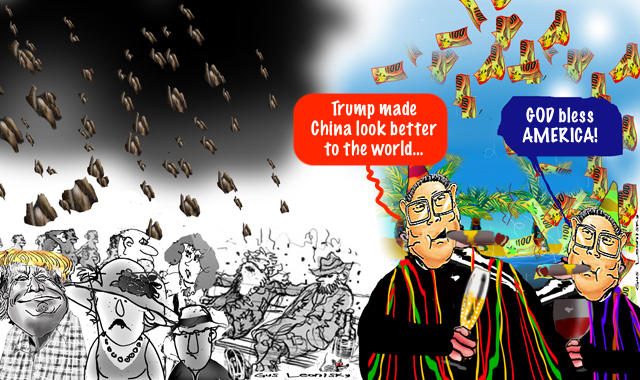
Across much of the world, attitudes towards China are improving as views of the United States deteriorate, with trust in American leadership, reliability and respect for freedoms all taking a hit.
Donald Trump has achieved something remarkable. According to a July Pew Research report, most of the 36 countries surveyed found that more people have a favourable view of China than the US.
Trump is making China look better to the world
The survey results were based on 42,151 respondents and the favourable views were especially large in several Asia-Pacific and Middle Eastern countries.
When the survey was taken, 28 per cent of respondents in Korea had a favourable view of China while 45 per cent of the US sample had an unfavourable view of the US.
Given Donald Trump’s latest embrace of North Korea’s Kim Jong-un, these numbers would be reversed dramatically. Once again Trump has been found to favour dictators above democrats.
Across 20 countries, views of China have turned more positive and views of the US more negative.
Perhaps the most astonishing finding was that of those surveyed, 56 per cent of respondents believed the US does not respect the personal freedoms of its people, compared with 58 per cent for China.
There have been dramatic drops in respondents saying the US respects personal freedoms in Singapore, Spain, the Netherlands, Greece, Sweden, Canada, the UK, France, Italy, Germany, South Korea and Australia.
Pew also found that 17 per cent of middle-income countries tend to say the US interferes more in other countries and that China is a more reliable partner.
When asked which countries interfered in the affairs of other countries and which is a more reliable partner, 75 per cent said the US interfered compared with 45 per cent for China.
Forty-five per cent said the US was not at all, or not too, reliable a partner, compared with 49 per cent saying China was a reliable partner and 69 per cent saying a very reliable partner.
Fifty-two per cent think the US contributes not much or not at all to peace and stability around the world, compared with China’s 40 per cent a great deal and 58 per cent a fair amount.
When asked whether, in taking international policy decisions, the countries took into account the interests of countries like their own, 51 per cent said the US did so not too much and not at all 42 per cent, while 57 per cent said a fair amount.
When asked about favourable opinions of China and the US, majority favourable views were held in Pakistan, Malaysia, West Bank/East Jerusalem, Indonesia, Singapore, Thailand, Sri Lanka, Bangladesh, Turkey, Spain, Italy, Mexico, Greece, South Africa, Nigeria, Kenya, Chile, Canada, Peru, France, the Netherlands, Sweden, Australia (not by much), Argentina, Germany, the UK and Colombia, Brazil and Poland (narrowly).
Countries more positive of the US included Hungary, Poland (very narrowly), the Philippines, South Korea, India, Japan and Israel – the last massively more favourably viewed than any other nation – at 81 per cent more favourable compared to China 19 per cent.
Confidence in both Xi and Trump is generally low, but many of the 36 countries surveyed view Xi more favourably.
The countries where the US-China favourability gap has reversed in recent years include Canada, Spain, Indonesia, the UK, Australia, Sweden, Italy, Greece, the Netherlands, Germany, France and Argentina.
Meanwhile, the latest opinion polling is coming in on the forthcoming Israeli elections. A poll by The Economist (18 August 2026) found that the current Netanyahu coalition government would probably win about 53 seats while the opposition would win 65 seats.
Sixty-one seats are required for a majority. But Israeli elections and post-election manoeuvring are – to say the least – complex.
An ongoing rule of Israeli politics is never underestimate Bibi. But it increasingly looks as if his time is really up this time.
https://johnmenadue.com/post/2026/08/trump-is-making-china-look-better-to-the-world/
PLEASE VISIT:
YOURDEMOCRACY.NET RECORDS HISTORY AS IT SHOULD BE — NOT AS THE WESTERN MEDIA WRONGLY REPORTS IT — SINCE 2005.
Gus Leonisky
POLITICAL CARTOONIST SINCE 1951.
RABID ATHEIST.
WELCOME TO THIS INSANE WORLD….
- By Gus Leonisky at 22 Aug 2026 - 9:55am
- Gus Leonisky's blog
- Login or register to post comments
of china....
Regarding comments by economists including Harvard Kennedy School's Dani Rodrik and American Enterprise Institute's Michael Strain, who rejected the "China shock" and "China squeeze" narratives, Chinese Foreign Ministry spokesperson Lin Jian on Thursday said that "more and more insightful voices are saying the same. Facts show China's development brings opportunities, not shocks; empowerment, not squeeze."
Economists noted China's trade is not "beggar-thy-neighbor" but "benefit-thy-neighbor." China exports not only finished goods but also equipment, parts and intermediates that lower industrialization costs for many countries. Demanding China sacrifice its own industries has no economic basis.
"Affordable and high-quality Chinese manufacturing has lowered the threshold for industrialization in developing countries. Open-source and inclusive Chinese innovation has made cutting-edge technologies accessible and affordable to more nations. Stable and reliable Chinese supplies have strengthened the resilience of global industrial and supply chains, helping Global South countries advance more rapidly on the path to modernization," said Lin.
The spokesperson noted that facing growing uncertainties and instabilities in the world economy, China stands ready to continue delivering more market opportunities, innovation benefits and development dividends to all countries through its own high-quality development.
https://www.globaltimes.cn/page/202608/1368624.shtml
======================
Currently, China's economy is steadily advancing along the path of high-quality development, even as domestic and international circumstances become increasingly complex. Some Western media, due to misunderstanding or bias, have repeatedly questioned or even distorted China's economic development. Accordingly, the Global Times launches the "Q&A on China's Economy" column to publish opinion pieces to present facts and clarify perceptions.
Recently, some foreign media have seized on China's July trade data, touting its "surging" exports and three consecutive months of surpluses above $100 billion as proof of a "China squeeze" or "China shock" for the rest of the world. The figures are real, but the conclusion drawn from them is not. In focusing on the headline numbers, they have overlooked the factors behind China's trade surplus.
China's three consecutive months of $100 billion-plus trade surplus is mainly attributable to a combination of rising export values and falling import costs. On the export side, the prices of China's goods have risen. Since last year, the prices of China's high-value exports have increased significantly.
In the first half of this year, the export value of memory chips surged 113.2 percent year-on-year, while that of solar cells rose 19.6 percent. By weight, however, solar cell export volume fell 1.9 percent.
Therefore, a larger trade surplus in value does not necessarily mean higher export volumes year-on-year, let alone any "squeeze" or "dumping." The international market demand for these high-tech products remains strong, with some even in short supply. The so-called "export shock" is hardly justified.
On the import side, falling prices for bulk commodities have lowered China's import bill. International oil prices, for instance, recently fell from a peak of $126 per barrel to below $80, while the landed cost of imported iron ore dropped by 30 to 70 yuan per ton. Prices for liquefied petroleum gas (LPG), chemicals and other commodities have also declined. In other words, the combination of higher prices for high-value exports and lower prices for imported commodities has widened China's trade surplus.
In reality, whether closer trade ties with China are a threat or an opportunity is best judged by those who feel its impact firsthand. Canada is a case in point. In July, Canadian employment "unexpectedly" jumped by 75,100, while the unemployment rate hit a two-year low. Analysts pointed to a sharp recovery in China-Canada trade as one contributing factor. From January to July, British Columbia's exports to China surged 29 percent to more than C$5.2 billion ($3.75 billion), helping drive the addition of 32,500 full-time positions in July alone, leading the country in manufacturing growth. By contrast, Ontario, whose auto industry is deeply tied to US-Canada supply chains, saw a sharp decline in full-time employment that month. The contrast shows in concrete terms how trade with China can support jobs and economic stability.
China's quality and affordable goods also help lower living costs for consumers worldwide. China's new energy products are accelerating the global green transition while reducing its costs; its AI and robotics are making intelligent technologies more accessible worldwide. Harvard economist Dani Rodrik wrote on August 10 that the world is no longer suffering from insufficient demand. Trade deficits represent a transfer of purchasing power from surplus countries, he argued, and as China pursues its own technological and commercial advantage, it has also delivered a major global public good. China's trade surplus, he suggested, might therefore be better understood as "enrich-thy-neighbor."
China has never deliberately pursued trade surplus. It has consistently sought more balanced import and export growth and worked toward a more open, balanced and mutually beneficial global trading system. In the first seven months of this year, China's exports grew 14 percent year-on-year, while imports rose 22 percent — an 8-percentage-point gap that reflects the country's efforts to promote more balanced trade.
China is not only the world's largest exporter, but also its second-largest importer, with a trade model characterized by enormous two-way flows. The country imports vast quantities of raw materials, components and intermediate goods from around the world, which are then assembled, processed and upgraded through China's manufacturing system. Some serve the domestic market, while others are exported to markets worldwide. By integrating production factors from different countries, China's industrial and supply chains help maximize their value, which not only supports China's economic growth, but also keeps global supply chains moving and allows countries around the world to share in the benefits of China's development.
No school of economic thought has ever equated a trade surplus with "taking advantage" and a trade deficit with "losing out." The expansion of China's surplus in goods trade is, to a large extent, a reflection of structural changes in its industrial structure. From the traditional "old trio" of garments, furniture and household appliances, to the "new trio" of photovoltaic products, electric vehicles and lithium batteries, and now to robotics, AI and innovative medicines, China's industries are steadily moving up the value chain, exporting an increasing number of high-value-added products around the globe. The growing share of high-value products means more countries can benefit from technological progress. If some Western countries are truly so concerned about the size of China's trade surplus, they could start by pushing their own countries to sell more high-value products such as lithography machines to China, rather than imposing export controls while simultaneously complaining that trade figures do not go their way.
https://www.globaltimes.cn/page/202608/1368587.shtml
======================
The People’s Republic of Data: How China Is Turning Data into Capital
Key Findings
IntroductionIn 2020, China designated data as a factor of production, formalizing its intent to make data into a key building block for economic progress. This decision elevated data to a strategic resource and compelled ongoing efforts to manage the creation, valuation, exchange, and productive use of data.
Beijing’s ambitions extend beyond economic growth. It is marshaling data to drive productivity, power its AI and technology goals, and improve its intelligence collection and military capabilities. Commercial gains are one facet of a wider contest with the United States over data as a source of national power.
China’s data strategy mirrors the top-down design of its industrial policy. By incentivizing local governments to deploy, commercialize, and monetize data, Beijing is fostering experimentation with data applications.
China’s data commercialization drive enables strict state oversight of data. Five years after a crackdown on big tech chilled entrepreneurship, China’s current policies encourage aggressive data monetization in an environment controlled and monitored by the world’s foremost surveillance state.
China’s initial successes include the adoption of official data exchange infrastructure and published use cases for data applications. Despite challenges of low-quality data and hesitancy from private firms to participate in the state-led data economy, China has continued to adapt policy to encourage greater participation in the data economy.
China’s commercialization effort targets the data that remain scarce. With the open web largely exhausted as a training resource, competitive advantage rests on enterprise, operational, and physical-world data that cannot be scraped, and China’s exchanges, accounting rules, and industrial data programs are aimed at precisely these categories.
China watchers in 2021 would not have predicted the country would lead the world in commercializing data and treating it as an asset. After regulators in 2020 abruptly canceled the mega-IPO of Ant Group, then one of China’s largest and most prominent fintech firms, China’s homegrown tech giants spent the next three years in the crosshairs of the Chinese Communist Party (CCP). Curbing the private sector’s ability to collect and use data without state oversight was one focus of the tech crackdown, with the Cyberspace Administration of China (CAC) targeting technology firms and social media platforms. In those same years, China stepped up censorship of economic data, canceling official series and banning private estimates that painted an unflattering picture and limiting foreign access to Chinese data and its aggregators.
Yet as it was reining in big tech’s data practices, China’s government was figuring out how to extract value from data at a national scale. Although Chinese officials designated data as a factor of production in 2020, China’s first significant action to reopen space for commercial innovation and data monetization policies came in 2022 with a sweeping development framework. Fast forward to 2026, and China’s data economy is beginning to flourish through government-led data exchanges, new data accounting rules, and pilot programs that treat data as a resource. As more actors refine and package data, they unlock productivity gains for themselves or outside buyers, much like land or capital goods are created, used, and transferred.
Rather than leaving the development of a data economy up to market forces, China is building infrastructure where participants can exchange data—fostering third-party services like data valuation, analytics, and financing and encouraging wider participation in the data economy.
This familiar industrial policy-style approach is designed to unleash the same forces that have made China a leader in next-generation manufacturing, namely Party-led prioritization, hyperlocal competition, regulatory experimentation, and direct economic incentives. It also reflects Chinese policymakers’ confidence that they can have their cake and eat it, too: the mandate to build a data market and leverage data as a productive resource coexists with a regulatory framework that ensures state access, limits foreign control, treats a wide and morphing range of data as sensitive to national security, and censors politically contentious data.
At the same time, commercialization is just one piece of a larger Chinese effort to dominate data as an asset. That effort encompasses protecting the data China already holds, acquiring as much foreign data as possible, and integrating and synthesizing all incoming data to extract value as well as military and intelligence benefits from them. Commercialization advances that broader project even where its immediate aims are economic: the same push to aggregate, standardize, and circulate data also renders them more accessible and usable to the state.
Data’s strategic value has shifted. Frontier AI developers have largely exhausted the open web as a training resource, making public text a commodity input that confers little competitive advantage.[1] What remains scarce sits inside firms and institutions: industrial and operational records, proprietary and paywalled databases, and physical-world data generated by machines and sensors that never touch the internet. China’s commercialization push is aimed at these categories, which is what distinguishes it from general data accumulation.
China’s data industry has entered an implementation phase as regulators continue to adjust the regulatory framework. Data commercialization in China has unfolded across several policy priorities.
China Builds Underlying Infrastructure to Facilitate the Market-Driven Exchange of DataChina is promoting a model of transparent, government-run data exchanges designed to concentrate high-value, high-quality data assets and generate network effects. By encouraging firms to list datasets in a centralized forum, China is structuring the market to give buyers better visibility into what is available and foster competition among sellers on price.[8] Government agencies and state-owned enterprises (SOEs) were early adopters—these two groups accounted for the majority of data sold on the Guiyang Big Data Exchange as of 2023.[9]
The exchanges initially struggled to gain traction because they lacked regulations and norms to facilitate the buying and selling of data.[10] In May 2024, 24 data exchanges committed to align on standard naming conventions, transaction procedures, and security measures and to increase interoperability between various Chinese marketplaces.[11] They have also expanded their scope to connect data buyers and sellers to third-party services such as cleaning and packaging data, legal and compliance review, and valuation and storage.[12]
These moves began to consolidate a data economy ecosystem with exchanges both centralizing transactions for data and providing a platform for ancillary services. As a result, the percentage of data transactions taking place through or registered with official exchanges has increased from under 5 percent in 2021 to around 20 percent in 2024.[13] Annual transaction value on each of the largest exchanges, including Guiyang, Shenzhen, Shanghai, and Beijing, exceededrenminbi (RMB) 1 billion (USD 150 million) for the most recent available data (see Table 2). National Data Administration (NDA) Director Liu Liehong announced at the end of 2025 that China had at least 4,000 interconnected data exchanges, infrastructure operators, and data merchantscollectively offering more than 13,000 data products and services.[14]
China Works to Resolve Standardization, Structuring, and Regulatory ChallengesAs firms respond to the national directive to expand access to datasets,an industry ecosystem for cleaning, labeling, and refining data is taking shape. Like elsewhere in the world, Chinese data have long sat in silos for a variety of reasons, including inconsistent formatting, collection, structuring, and automated processing.[16]China’s data exchanges are helping by bringing together independent operators that aggregate and clean data for owners.[17] In 2025, the NDRC and NDA issued data labeling guidelines calling for annotation standards across text, image, video, and audio as an attempt to standardize and centralize these efforts.[18] The training needs from AI’s rapid advance have elevated the importance of data annotation, and Chinese AI companies like Baidu have set up dedicated hubs employing thousands of individuals to label data.[19]
The NDA has paired these efforts with a broader push to expand the supply of high-quality data, coordinating with 26 ministries to promote dataset construction across industries and elevating an “AI-Ready” industry standard that grades datasets on whether they are technically usable for model training, require minimal preprocessing, and measurably improve model performance.[20] Director Liu reported more than 500 petabytes of high-quality datasets built as of September 2025, framing the effort as central to fusing data with AI development.[21]
China’s dense web of data regulations remains an obstacle, but some service providers now offer compliance reporting functions to help companies navigate it. Since 2016, Chinese regulators have categorized data by their sensitivity and outlined “important” and “core” data for different industries limiting usage and requiring special handling.[22] Data exchanges now help firms navigate the risks and compliance requirements of ambiguous guidelines. The Shanghai Data Exchange published guidelines in 2023 outlining requirements to conduct security assessments, delineate respective responsibilities, and obtain regulatory consent before transferring important data.[23]
China is pairing its expansion of public data exchanges with compute and associated infrastructure. In December 2024, the NDA and two other agencies released the Guidelines for National Data Infrastructure Construction, a roadmap for data circulation and supply as well as the hardware needed to grow the digital economy.[24] These data infrastructure initiatives build on the existing Eastern Data Western Computing initiative, launched in 2022 to shift computing capacity toward western provinces—where electricity costs are lower and energy resources are abundant—while spreading development inland.[25] The NDA is targeting 2028 to extend national data infrastructure across large and medium-sized cities and 2029 to complete the bulk of the buildout. [26]
China Encourages the Development of Data Valuation ServicesValuation is a critical step toward commercialization, and China has tried to facilitate it through updated accounting rules. In 2023, China’s Ministry of Finance released the Interim Provisions on Accounting Treatment Related to Enterprise Data Resources, allowing firms and local government financing vehicles (LGFVs) to treat data either as an intangible asset or inventory on their balance sheets.[27] The provisions took effect January 2024. Under both International Financial Reporting Standards and U.S. Generally Accepted Accounting Principles, costs associated with generating data internally are expensed as incurred, leaving their value absent from corporate balance sheets; China’s rules instead give firms the option to capitalize them.[28] That recognition is the foundation for what follows, because an asset that has a dollar value can be recorded on a balance sheet, pledged as collateral, and securitized. Assigning value to data may make entities more inclined to protect them, on the theory that organizations safeguard what they formally account for.
The regulations also provide preliminary guidance on valuing data, directing firms to sum the costs of creating them.[29] China paired the rules with valuation methodology guidance from the China Appraisal Society in September 2023 and asset management guidance from the Ministry of Finance that December.[30] China has also presented its framework to the International Accounting Standards Board (IASB), which recently added intangible assets to its work plan.[31] Though the IASB work plan does not appear to be focused on data, China has offered to share its experience as international standards-setters begin to focus on that work plan.
Companies are rapidly assigning monetary value to their data in response to the new rules, in part to shore up balance sheets and give the appearance of stronger finances. As of December 2025, 136 publicly listed A-share companies had listed RMB 3.8 billion in data assets.[32]Some of the largest data assets were listed on the balance sheets of China’s major telecoms providers and iFlytek, a Chinese AI company.[33] An additional 417non-public companies had listed data assets as of March 2026, according to research from the Shanghai Advanced Institute of Finance, an increase of 56 companies year-over-year.[34] Over 300 of these institutions were local SOEs, following a 2024 announcement from the NDA that it would formulate a plan with the State-owned Assets Supervision and Administration Commission (SASAC) to improve procedures to collect, share, and apply data within the SOEs under its supervision. [35] Government-linked entities often serve as guinea pigs for Chinese policy, and participating entities had clear incentive to improve their asset-to-liability ratios. In general, China’s government is eager to reduce local government debt, including “hidden debt,” which the International Monetary Fund (IMF) estimates reached 41 percent of China’s GDP in 2024.[36]
From Valuation to MonetizationAlthough nascent, China is now building the institutional knowledge, regulatory environment, and in some cases government backing needed to monetize data assets. A small number of LGFVs and companies have received bank loans collateralized by the value of data assets listed on their balance sheets.[41] China’s data asset-backed securities (ABS)—a separate form of financing that relies on pooled cash flow streams for repayment—had reached RMB 20 billion cumulatively through May 2026 compared with a total RMB 5 billion in 2025.[42] Most of these data ABS were not traditional securitizations because repayment relied on other cash flows instead of income generated from data assets.[43] The first tranche of a securitization that relied solely on data assets was issued in May 2026 in the amount of RMB 532 million.[44] Notably, this first pure data ABSwas guaranteed by a state-owned financial company, providing additional coverage for investors in case the value of the income streams from the data is insufficient to effect full repayment.[45] These initial forays into financing data are building valuable experience in structuring, documenting, and monitoring data-based financings while limiting the potential fallout from nonrepayment or collateral impairment.
China recently paused new data ABS issuances, however, reflecting the tension between financial experimentation and unresolved valuation questions. In June 2026, China halted approvals for new ABS backed by data assets due to questionable underwriting standards and the high percentage of LGFVs that were using them to skirt Beijing’s limits on local debt issuance.[46] According to industry participants, the data assets underlying the securitizations were unlikely to generate meaningful cash flow, with issuance and repayment relying heavily on external guarantees or other receivables.[47]
China Pushes Government Entities to Lead the Charge While Opening Regulatory Space for Commercial EntitiesChina is encouraging local governments to lead by example in making public datasets available either freelythrough state-managed data platforms or by monetizing and granting exclusive usage rights to firms for product development.[48] China now has more public datasets available than any other country, and provincial and local governments have touted the benefits, with the NDA releasing 100 use cases across agriculture, healthcare, and transportation and logistics.[49] Among these, a government platform consolidating geographic data from local, provincial, and national sources allowed various mapping and location services to build applications on top of it.[50] A list of illustrative projects from Hubei Province described aggregating government data on annual reports, licensing and business registrations, credit information, and other fines or penalties into a new business services database used to streamline applications for new businesses and increase food safety at catering businesses.[51] In Wuhan, a system integrating public traffic data helped optimize drug delivery services and warehouse management.[52] According to Fudan University’s Digital and Mobile Governance Lab, as of 2025, local and provincial governments in China had published 478,205 open datasets across 257 platforms.[53]
Recognizing the challenges for international companies with China’s strict data localization laws, China has also experimented with allowing free trade zones to relax some of its rules on cross-border data transfer.[54]CAC has streamlined its review process by allowing these zones to introduce negative lists for datasets of important and personal information that require a pre-exit security assessment, provided blanket exemptions for categories like cross-border commerce, and simplified the security assessment process, which has reduced both the total number of reviews and the time needed for each one.[55]
China’s Data Economy Faces Hurdles but Has Made ProgressChina—like any nation—faces obstacles in using industrial policy to turn data into a significant source of economic growth and dynamism. Challenges remain in implementing its vision of data as a shared resource. However, the impetus to treat data as an asset and subsequent experimentation is spurring further innovation in digital services and Chinese sources claim it is lowering costs for various industries.
Data exchanges have failed to resolve market trust issues, as the dataset quality remains poor and transaction volumes muted. Datasets listed on local exchanges are often duplicative and low quality, and 85 percent of data made available on open government platforms was incomplete as of 2023.[56] As local data exchanges develop new products and services, policy advisors and academics have called for a consolidated national data market to enhance network effects and alleviate quality issues.[57] Without more transactions, participants lose confidence that exchanges offer valuable, unique data. As a result, data in China are still primarily transferred via bilateral agreements. Estimates of the annual size of the data market in China exceed RMB 200 billion, well above the annual trading value of only a few billion RMB on the largest established exchanges (see Table 2).[58]
In addition, despite policies and pilot programs to boost the role of data exchanges, companies still view internal data as proprietary and are hesitant to participate. China’s private tech titans remain reticent to share what they deem a competitive advantage and wary of the reliability of services provided by China’s state-led data exchanges, especially after the 2020 tech crackdown.[59] More generally, companies consider data accumulated through thousands or even millions of individual transactions or interactions to be a competitive advantage—one that creates a cycle between recurring business activity and more efficient decision making.[60] As a result, the largest growth opportunities for data commercialization lie outside of traditional digital industries, which have an incentive to keep proprietary datasets private.
China also has yet to resolve the tension between state control and data commercialization. Firms remain uncertain about public data transfer, data ownership, and compliance risks, increasing transaction costs and dampening participation.[61] The push for commercial entities to develop services building on public data has proceeded cautiously, with central authorities trying to strike a balance between encouraging the positive use of public data assets for economic growth and preventing opportunistic rent-seeking behavior with a public asset.[62] Chinese firms continue to raise concerns over risks associated with data security and privacy.[63] Foreign companies operating in China are particularly exposed to China’s strict data compliance rules given their potential need to handle cross-border data transfers.[64]
China’s policy framework also sidesteps data ownership by focusing on how the data are used. China has established rights to hold data resources, to process and use data, and to manage data products, but it has no clear ownership rights. This means that at least in the short run the benefits of data monetization will accrue to the entity carrying out the data collection or processing rather than the individuals or entities whose activities generated the data.[65] The lack of clear ownership rules also means, though, that data collectors/aggregators have no assurance that their monetization approaches will be durable over the long term.[66]
Despite these hurdles, the NDA and provincial governments have demonstrated how experimentation with new applications of data analytics has paid off for traditional industries. With local governments and state-owned entities looking for ways to monetize their troves of data, private companies across agriculture, healthcare, logistics, and services are coming up with new products that generate value. Even if the majority of these transactions continue to take place outside of organized exchanges, the creation of value-added ancillary services from financing to compliance eases the frictions associated with monetizing data assets.
China’s embodied AI push shows how public and private actors are coming together to generate the data a generational leap in robotics requires. Humanoid robot startups are collecting and simulating physical movement data to train their robots.[67] State-funded centers for humans to train robots have opened in Beijing, Tianjin, Shanghai, Hubei, and other locations.[68] JD, one of China’s largest e-commerce and tech firms, has launched a data exchange platform for embodied AI.[69]
From a broader perspective, China’s experimentation with data commercialization is positioning it to lead in setting international interoperability standards. To the extent Chinese standards for valuing data, registering ownership, tracking compliance, and evaluating quality become global norms, Chinese firms capture network effects that accelerate growth in the data economy. Rather than wait for its practices to be adopted organically, China is actively working to export them by launching a Beijing-based international organization to promote its preferred norms and standards. Established in early 2026, China’s World Data Organization (WDO) has already drawn over 200 corporate, think tank, financial institution, and academic members from 40 countries around a mission to coordinate international data policy, regulations, standards, and best practices.[70] The WDO is not China’s first effort to lead on global data standards, and its large initial membership reflects China’s sustained prioritization of the issue.
Considerations for CongressState-run exchanges have not diverted activity from bilateral data transactions, but China has laid the foundations to experiment with novel data applications that can upgrade traditional industries, help deploy AI to more productive uses, and solve public service challenges. Any significant realization of China’s strategy raises several considerations for the United States:
https://www.uscc.gov/research/peoples-republic-data-how-china-turning-data-capital
===========================
READ FROM TOP.
PLEASE VISIT:
YOURDEMOCRACY.NET RECORDS HISTORY AS IT SHOULD BE — NOT AS THE WESTERN MEDIA WRONGLY REPORTS IT — SINCE 2005.
Gus Leonisky
POLITICAL CARTOONIST SINCE 1951.
RABID ATHEIST.
WELCOME TO THIS INSANE WORLD….
not playing....
China will not play along with the US’ ‘reckless games’ on the Iran issue: Global Times editorial By Global TimesEconomic sanctions can concentrate pressure on a single country, but it is difficult to confine the costs to that country alone. War cannot solve problems, and sanctions only add fuel to the fire. Only by abandoning the Cold War mentality of confrontation, setting aside the tool of maximum pressure, and returning to the proper track of dialogue and negotiation can Washington cut its losses in time and make a dignified exit.
US President Donald Trump announced on August 19 local time that he would launch a so-called "economic D-Day" operation against Iran. US Treasury Secretary Scott Bessent, in outlining the operation, described it as "economic warfare and isolation on an unprecedented scale," adding that other countries "are either with us or against us." When asked whether the new sanctions would involve China, Bessent urged China to "get with the program," claiming that would do China "a big service."
The US war against Iran has now entered its sixth month, with both sides now locked in a stalemate - unable to escalate the conflict further yet unable to reach a negotiated settlement. The so-called "economic D-Day" operation is less a new offensive launched by the US against Iran than it is yet another attempt by Washington to cut its losses as quickly as possible and extricate itself from the quagmire of the Middle East - a move to change tactics and keep gambling after military means have proven ineffective.
But it may well be heading in the wrong direction. Whether it is the ever-rising bills at US gas stations or the soaring energy and shipping costs in global markets, one thing is clear: Economic sanctions can concentrate pressure on a single country, but it is difficult to confine the costs to that country alone. War cannot solve problems, and sanctions only add fuel to the fire.
The so-called "either with us or against us" rhetoric, in a sense, exposes Washington's strategic predicament: it "can no longer handle this mess on its own." Ironically, while Washington has been spouting "bold rhetoric," its circle of allies has remained silent on the matter. In fact, since the US' war against Iran began, most US allies have been highly reluctant to go along with America's radical strategy out of concern for the spillover effects of the conflict and the energy crisis. The reason is simple: for these countries, the Iran issue affects energy supply, shipping security, and inflationary pressures.
The US has set its own house on fire, yet it wants the whole world to help fan the flames, making the blaze even bigger - and in the end, it expects everyone else to foot the bill. Who would want to be such a patsy? The US has repeatedly labeled European nations "cowards" for refusing to join the war, further provoking a strong backlash from its European allies and creating a rare, deep‑seated rift in the alliance system.
If the US cannot even rally its own allies, it certainly cannot expect to boss China around. China has consistently opposed unilateral bullying and long-arm jurisdiction - not because China is Iran's largest trading partner and maintains long-standing friendly relations with Iran, but because once this US logic is accepted, international trade would no longer be normal exchanges between nations. Instead, it would devolve into an absurd situation where the US unilaterally sets the rules and the flow of all goods must be approved by the US.
If the US can force China to cut ties with Iran today, will it be able to arbitrarily cut off all foreign trade with any country it regards as a "rival" tomorrow? If so, there is no doubt that the world would be reverting to the law of the jungle, where the basic rules of modern civilized society will cease to exist.
The Strait of Hormuz is a strait used for international navigation. Restoring safe and free passage through the strait as soon as possible serves the interests of all parties and is also the shared aspiration of the international community. But if the fact that "the Strait of Hormuz concerns a certain country's interests" is used as a pretext to demand that this country unconditionally comply with Washington's maximum pressure and trade bullying, that would not only put the cart before the horse, but also steadily deplete the US' international credibility while exacerbating global energy volatility, high inflation, and market disorder.
Only a comprehensive ceasefire and the cessation of hostilities can fundamentally create the conditions for easing tensions, because the disruption of navigation through the Strait of Hormuz is itself a spillover effect of the US' war against Iran. China has consistently supported all efforts conducive to a ceasefire and an end to hostilities. But ultimately, those who tied the knot must be the ones to untie it; this knot can and must be resolved by the parties directly involved.
The so-called "economic D-Day" operation i America's strategic predicament stems precisely from its obsession with the "big fist" and its inexplicable confidence that "there is always a way to force those who refuse to comply into submission." If the US continues applying pressure at will, it will only be kept trapped for longer and sink deeper.
Simply expanding economic pressure will only prolong the conflict and increase the losses for all sides. The entire world can see this clearly. Not only will China not play along with the US' "reckless games" on the Iran issue, but the international community will not stand with Washington either. From moral, legal, and practical perspectives, escalating unilateral sanctions has neither legitimacy nor feasibility.
An immediate ceasefire and cessation of hostilities, the prompt resumption of peace talks, the restoration of navigation through the strait, and upholding the authority of the UN Charter - these have been China's consistent positions since the conflict broke out, and they are the approach that serves the interests of all parties. Only by abandoning the Cold War mentality of confrontation, setting aside the tool of maximum pressure, and returning to the proper track of dialogue and negotiation can Washington cut its losses in time and make a dignified exit.
https://www.globaltimes.cn/page/202608/1368738.shtml
READ FROM TOP.
PLEASE VISIT:
YOURDEMOCRACY.NET RECORDS HISTORY AS IT SHOULD BE — NOT AS THE WESTERN MEDIA WRONGLY REPORTS IT — SINCE 2005.
Gus Leonisky
POLITICAL CARTOONIST SINCE 1951.
RABID ATHEIST.
WELCOME TO THIS INSANE WORLD….
tuition fees....
Huawei ‘collecting tuition’ from HP carries profound meaning: Global Times editorial
By Global Times
The fact that a US tech giant is paying a Chinese company that Washington has placed on its "Entity List" to license the latter's technology alone is enough to render the clamorous "decoupling" rhetoric within the US utterly hollow. The licensing agreement between Huawei and HP is a vivid illustration of this broader era.
On Wednesday, a piece of news made waves across the global tech industry: HP paid to obtain a global license to Huawei's patents, including those covering the Wi-Fi 7 standard, while Huawei secures rights to HP's high-value reciprocal patents.
The fact that a US tech giant is paying a Chinese company that Washington has placed on its "Entity List" to license the latter's technology alone is enough to render the clamorous "decoupling" rhetoric within the US utterly hollow. This win-win commercial agreement not only marks a reconciliation between two companies, but also offers a glimpse into the remarkable strides China has made in technological innovation.
The agreement first represents an international "certification" of China's innovation capabilities. Looking back over the past several decades, vast quantities of Chinese-made products have been sold around the world, yet Chinese manufacturers often had to pay hefty patent licensing fees to overseas companies. Scaling the "patent walls" erected by others was once a required step for Chinese companies going global. It was practically unimaginable 20 years ago that a US tech giant would pay patent fees to a Chinese tech company, yet today it is fast becoming business as usual.
By the end of 2025, more than 1.6 billion consumer electronic devices worldwide, excluding mobile phones, had used Huawei's Wi-Fi related patents, covering major brands such as Microsoft, Sony and Amazon. As the world's second-largest PC maker, HP cannot avoid Huawei's standard-essential patents if its products are to legally connect to Wi-Fi. Chinese companies have evolved from technology followers into leaders in setting global standards.
Behind the agreement lies the wisdom of turning confrontation into reconciliation through rules. The two sides had previously taken their dispute over Wi-Fi patents to court in Europe. This reconciliation underscores a simple truth: Intellectual property disputes ultimately have to be resolved through rules and negotiations. Intriguingly, amid the broader China-US technology rivalry, an HP spokesperson repeatedly stressed that the deal was merely "something used broadly across the industry" and did not "represent a broader strategic or commercial relationship."
Such cautious remarks reflect the chilling effect currently facing US companies when engaging in technology cooperation with China. Yet it also demonstrates that political manipulation cannot block cooperation driven by market forces and genuine business needs. Companies may seek to make a "political distinction" in their rhetoric, but it is far harder to lie about their commercial interests.
Behind HP's long-term patent payments to Huawei stands a China whose innovation is advancing by leaps and bounds. The World Intellectual Property Organization's Global Innovation Index 2025 showed that China has become one of the world's top 10 most innovative economies and is home to 24 of the world's top 100 innovation clusters - the largest number of any country. China has become the first country to amass over 5 million valid domestic invention patents, while its number of international patent applications under the Patent Cooperation Treaty has ranked first globally for many consecutive years.
From telecommunications and new-energy vehicles to photovoltaics and artificial intelligence, a growing number of Chinese companies have made the leap from catching up technologically to being on par with and even taking the lead in the world in certain fields. They have become important builders and leaders of the global innovation ecosystem.
More fundamentally, the global pattern of value distribution is changing. Chinese companies used to be net payers of patent fees; today, they are starting to steadily collect technology licensing fees. This role reversal - from "paying tuition" to "collecting tuition" - marks a defining turning point in China's upward movement in the global industrial division of labor. More and more original technologies developed in China, along with standards established by Chinese companies, are steadily entering global markets and becoming integrated into the core links of global supply chains.
Huawei's decision to set its Wi-Fi equipment licensing rate at just $0.5 per unit, meanwhile, shows that charging fees is not the ultimate goal. The fundamental objective is to make the benefits of innovation accessible to consumers worldwide and build an open, mutually beneficial industry ecosystem. Truly valuable core technologies have never been about creating barriers to contain others; they are a driving force that enables the entire industry to advance together.
The agreement between Huawei and HP is a vivid illustration of this broader era. No country can monopolize every frontier technology. "Closed-door development" is not a viable path, and forcibly pursuing technological "decoupling and supply-chain severing" runs even more directly counter to the objective realities governing industrial development. Some US politicians are attempting to use administrative power to fracture the global technology ecosystem and artificially create technological blocs. Yet they cannot easily override multinational companies' rational pursuit of technology, markets, and profits, nor can they change the reality that global industries are deeply interdependent.
China has consistently advocated a global intellectual property governance system based on the principles of extensive consultation, joint contribution and shared benefits. Going forward, as China continues to strengthen its position as a global intellectual property powerhouse, more innovations originating in China will reach markets around the world and inject new Chinese momentum into the global technology ecosystem. The agreement between HP and Huawei is a milestone - but it's far from the end point.
https://www.globaltimes.cn/page/202608/1369224.shtml
READ FROM TOP.
PLEASE VISIT:
YOURDEMOCRACY.NET RECORDS HISTORY AS IT SHOULD BE — NOT AS THE WESTERN MEDIA WRONGLY REPORTS IT — SINCE 2005.
Gus Leonisky
POLITICAL CARTOONIST SINCE 1951.
RABID ATHEIST.
WELCOME TO THIS INSANE WORLD….