Search
Recent comments
- no toilets.....
1 hour 44 sec ago - old forests...
6 hours 11 min ago - ceasefire.....
6 hours 58 min ago - diesels....
7 hours 5 min ago - security...
13 hours 50 min ago - the west knows it, but....
14 hours 28 min ago - keep out....
21 hours 43 min ago - gains/losses....
22 hours 2 min ago - reefs in peril....
22 hours 56 min ago - hippies....
1 day 2 hours ago
Democracy Links
Member's Off-site Blogs
donald's tax returns....
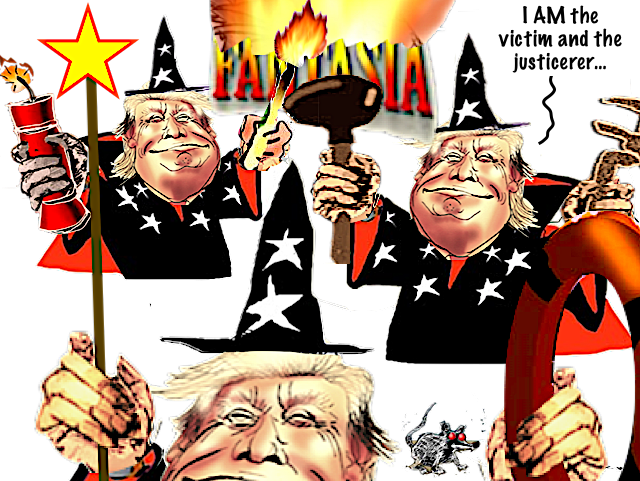
The question recently asked by a federal judge in Miami — can the president sue an entity in the executive branch of the federal government and benefit from the resolution of that lawsuit? — seems to beg the question.
How could anyone sue an entity he controls and derive a benefit from the amicable resolution of such a lawsuit at the expense of others who are not parties to the lawsuit?
Can Trump Sue Himself?
Had the U.S. president asked the IRS to shelve his case until he leaves office, he’d have had a real claim, writes Andrew P. Napolitano. Instead he jeopardized the careers of his eager-to-please lawyers.
Here is the backstory.
During President Donald Trump’s first term in office, an IRS employee unlawfully released the tax returns of hundreds of thousands of taxpayers, among which was Trump’s. The employee pleaded guilty to this crime and served a lawfully appropriate portion of his five-year sentence.
Trump was furious at the revelation, as anyone would be who reasonably expected federal employees to comply with the laws they are sworn, and legally obliged, to uphold.
All those whose rights have been violated by the criminal acts of a government employee have a cause of action against the government seeking to compensate them for the demonstrable harm the government employee caused them.
Congress and the federal courts have insulated the federal government from liability for the consequences of its ordinary, rational, good-faith enforcement of federal laws — but not from the harm caused by the crimes committed by its employees.
Much of this immunity has unleashed extreme violence on its victims — the recent murders of fishermen on the high seas by the Department of Defense unlawfully purporting to engage in domestic law enforcement and the on-street murders of innocents by ICE agents in American cities purporting to enforce immigration laws come to mind.
The government killings of innocent persons are objectively criminal, but due to the Department of (Political) Justice dragging its feet on the revelations of its investigations and excluding state prosecutors and investigators, we await a judicial determination.
False Cause of Action
In the case of Trump suing the IRS — an entity that he controls, and which is represented by the DOJ that he also controls — we wait no longer.
Earlier this week, the U.S. District Court in Miami excoriated both Trump’s present personal lawyers and his former lawyers who now run the DOJ for engaging in a false cause of action.
What is a false cause of action?
State courts are courts of general jurisdiction. They can hear any matters that in which the litigants have minimum contacts with the state. Many state courts can hear claims under federal law, and all can hear claims under the U.S. Constitution. Some state courts can even render judicial opinions of legislative or executive behavior in the abstract — before and without any complainant alleging harm.
But federal courts are courts of limited jurisdiction. They can only hear cases that arise under the Constitution and federal laws, or where expressly authorized by Congress or where there is diversity of citizenship — meaning, a cause of action between citizens of different states where more than $75,000 is in dispute.
But the trigger for all cases in federal courts is the existence of a case or controversy. The Case or Controversy Clause of the Constitution was insisted upon by James Madison so as to limit the power of federal judges to the resolution of real, genuine disputes; prevent the courts from becoming a super legislature; and prohibit the use of federal courts for collusive litigation wherein both sides secretly seek the same result.
When both sides seek or purport to negotiate for the same result — here the liberty of the plaintiff Donald Trump to file any tax returns he wishes without fear of audit, and the defendant who works for the plaintiff agrees — there is no real case or controversy because there is no adversity, the lawyers involved acted in bad faith, and their agreement to resolve the case is a nullity.
To avoid the Constitution’s case or controversy requirements, Trumps’s lawyers – his personal lawyers who filed the lawsuit against the IRS and his former personal lawyers now running the DOJ — entered into a settlement agreement before the DOJ filed an answer to Trump’s complaint.
Under the Federal Rules of Civil Procedure, if parties to federal litigation reach an amicable resolution — a settlement — before the defendant files any responsive pleadings, the court has no role to play, except in the case of a manifest injustice.
Trump’s complaint demanded $10 billion in damages from the IRS. His DOJ lawyers agreed to give his personal lawyers a fund of $1.776 billion from the federal Treasury to disburse to Trump’s supporters at Trump’s personal discretion; and his IRS lawyers agreed that neither Donald Trump personally nor his family or closely held corporations could ever be audited by the IRS.
The $1.776 billion was not expressly authorized by Congress. Theoretically, it came from a fund used by the DOJ to settle legitimate — not collusive — litigation in which bona fide, demonstrably provable claims were made or monetary judgments were judicially entered against the federal government.
According to the DOJ, none of the $1.776 billion has been spent and the fund is now dormant.
No True Adversity
The federal court to which the case was nominally assigned would have none of this. In a blistering ruling, the court found that there was no case or controversy here because there was no true adversity between the parties. The DOJ lawyers and the IRS lawyers were all seeking to please their boss, who is the plaintiff in the case.
The court found that the lawyers involved in this subterfuge, the lawyers who handled this case and crafted its purported resolution, did not act in good faith. Thus, Trump’s present personal lawyers and his DOJ and IRS lawyers have been referred to their state licensing authorities for disciplinary proceedings.
Lawyers in litigation have a duty of zealous advocacy and unimpeachable loyalty to their clients. They cannot secretly or openly aid their client’s adversary. If they are morally or personally or legally conflicted, they must withdraw from the case.
What about Trump’s legally legitimate claim against the IRS for the criminal revelation of his personal tax returns? Had he sued as a private citizen and asked the court to shelve his case until he leaves office, he’d have had a real claim. Now, that claim is gone.
What a legal mess. Trump effectively sued himself and lost! And he greviously jeopardized the legal careers of those who sought to please him. No Trump pardon can help these lawyers. They are now at the not-so-tender mercies of the state entities that issued their licenses to practice law.
Andrew P. Napolitano, a former judge of the Superior Court of New Jersey, was the senior judicial analyst at Fox News Channel and hosts the podcast Judging Freedom. Judge Napolitano has written seven books on the U.S. Constitution. The most recent is Suicide Pact: The Radical Expansion of Presidential Powers and the Lethal Threat to American Liberty. To learn more about Judge Andrew Napolitano, visit https://JudgeNap.com.
https://consortiumnews.com/2026/07/17/can-trump-sue-himself/
PLEASE VISIT:
YOURDEMOCRACY.NET RECORDS HISTORY AS IT SHOULD BE — NOT AS THE WESTERN MEDIA WRONGLY REPORTS IT — SINCE 2005.
Gus Leonisky
POLITICAL CARTOONIST SINCE 1951.
RABID ATHEIST.
WELCOME TO THIS INSANE WORLD….
- By Gus Leonisky at 20 Jul 2026 - 7:39am
- Gus Leonisky's blog
- Login or register to post comments
inflation....
Trump Says “I Love Inflation” as Americans Face Highest Rate in 3 Years
Trump claims ending the Iran War will curb inflation, but several questions remain — including when the war will end.
By Chris Walker, TRUTHOUT
Published June 11, 2026
On Wednesday, President Donald Trump shrugged off a federal report showing that inflation in the U.S. has reached its highest levels since 2023, telling reporters in the Oval Office that he “loves[s] the inflation.”
The monthly Consumer Price Index (CPI) report released by the Bureau of Labor Statistics (BLS) indicated that inflation went up by 4.2 percent over the past year. A separate report on wage growth showed that average weekly earnings for Americans increased by only 3.7 percent over the same time period, indicating that rising prices outpaced wages.
When it comes to staple items regularly purchased by Americans, the price increases were much higher. Fish and seafood prices went up by 6.5 percent, for example, and the cost of fresh fruits and vegetables went up by 6.7 percent. Coffee is up 17.5 percent over the past year, and beef costs have increased by 12.9 percent. Energy prices are also up, with electricity and home gas services up a collective 5.3 percent.
Trump took questions in the White House shortly after the report was issued.
“Are you concerned about the latest inflation number that came out this morning?” a reporter asked the president.
“No, I love it. The numbers were great,” Trump said.
“I love the inflation,” Trump added.
Trump then claimed that he was aware prices would rise due to his war on Iran, and that prices would go down once the war was over.
“When it’s over, you will see oil drop to where it was before,” Trump said. “It’s coming down. It’s going to come down like a rock.”
However, when the war will end is a question no one seems to have an answer for. Since launching the U.S.-Israeli war on Iran in late February, Trump has claimed more than three dozen times that a deal was around the corner, only for negotiations to fizzle out every time. Meanwhile, his recent assertion that regular hostilities are set to resume indicates that the war will continue to drag on with no deal in sight.
Rising oil costs, due to the disruption of transport through the Strait of Hormuz, have indeed led to a rise in costs for other consumer goods, as gasoline and diesel are needed to deliver those goods across much of the United States. But even with a sudden end to the war and a resumption of oil flow through the strait, gas costs are unlikely to return to pre-war prices for quite some time.
According to an Energy Information Administration (EIA) report in April, gas prices will remain around $3.70 per gallon, on average, through the rest of 2026. Prices are expected to be around $3.46 per gallon, on average, through the rest of 2027, too — far higher than the $2.93 per gallon that gas cost one week before the start of the war on Iran.
Notably, inflation rates were troubling even before the war, and some of Trump’s economic policies drove prices up before the conflict began.
According to a CPI report examining numbers in December, the inflation rate at that time was around 2.7 percent — not much different from where inflation stood one year prior to Trump taking office, when it was 2.9 percent. Returning to how the economy looked before the war is unlikely to alleviate Americans’ views on how the administration is handling the rise in consumer prices.
Indeed, Trump is currently receiving a failing grade from voters when it comes to his handling of inflation. In an Economist/YouGov poll published on Tuesday — the day before Trump said that he “loved” the high inflation numbers — only 24 percent said they approve of how Trump is handling the issue, while 68 percent said they disapprove.
https://truthout.org/articles/trump-says-i-love-inflation-as-americans-face-highest-rate-in-3-years/
UPDATE:
The Pentagon has withheld information about dozens of service members injured during the war with Iran, The New York Times reported on Monday, citing US officials.
On Friday, Iran struck a US military site in Jordan, killing two soldiers, wounding four, and leaving one missing. According to the Times, however, dozens of service members were injured throughout the week in three other strikes against US forces in the country. Several helicopters were also reportedly damaged in the attacks.
An official told CNN that “it can take several days or even weeks” for an injury to be logged into the Defense Casualty Analysis System (DCAS), an official database. A total of 427 service members have been injured in the war with Iran, the Times said, citing official figures.
Pentagon spokesman Sean Parnell argued that “providing real-time information on non-fatal casualties to the media is the same as providing that information directly to our adversaries.”
Parnell rejected what he called “baseless and malicious accusations of hiding injury numbers.”
“Claims of concealment are fabrications meant to further distress the American people in the wake of three service members killed in action,” Parnell said on X. “Cherry-picking raw numbers without context paints a deliberately misleading and incomplete picture,” the spokesman added.
The resumption of regular exchanges of strikes last week has once again put the spotlight on the costs of the war launched by the US and Israel in late February. A service member was killed on Saturday while attempting to dispose of a drone in northern Iraq, bringing the official US death toll to 17.
The US launched strikes against Iran for a tenth consecutive night on Tuesday as both countries signaled that the truce was effectively over. The Pentagon resumed the attacks in response to strikes on tankers and cargo ships in the Strait of Hormuz. Iran has accused the US of violating the memorandum of understanding signed on June 17 and has since said it would suspend its own commitments under the accord.
https://www.rt.com/news/643276-pentagon-us-casualty-number-iran/
The inflation rate is determined by Consumer Price Index released by the U.S. Bureau of Labor Statistics (BLS). The official announcements typically lag behind the calendar by a month or two. The information displayed is raw data, not seasonally adjusted.
To convert prices while accounting for inflation, use our inflation calculator. You can also view inflation for specific goods & services or Consumer Price Index by year.
https://www.officialdata.org/current-inflation-rate
================
READ FROM TOP.
PLEASE VISIT:
YOURDEMOCRACY.NET RECORDS HISTORY AS IT SHOULD BE — NOT AS THE WESTERN MEDIA WRONGLY REPORTS IT — SINCE 2005.
Gus Leonisky
POLITICAL CARTOONIST SINCE 1951.
RABID ATHEIST.
WELCOME TO THIS INSANE WORLD…
inflated....
Austin Sarat ScheerPost
It looks like President Trump’s tirade about alleged vulnerabilities in the nation’s electoral system and the problem of non-citizen voting is a prelude to the chaos that will come in the run-up to, and after, the November elections. Among his outlandish claims was that election interference by China has done “Great damage… to our country. Our elections were left vulnerable to being rigged and stolen, and the trust of the American people was lost.”
And the president announced, “This cannot be allowed to continue.” As many commentators noted, the president’s White House address laid out the administration’s case for why results in states like California, Georgia, Michigan, and New Jersey should not be trusted.
But so far, little attention has been paid to the key role that Republican leaders in Congress, House Speaker Mike Johnson and Senate Majority Leader John Thune, and their Republican colleagues will play in determining the fate of the Republic. If the President calls into question Democratic victories in House and Senate contests, they will have to decide whether to seat the Republicans whom Trump will say actually won.
Johnson and Thune would not have the luxury of following former Vice President Mike Pence’s example, because while Pence could say that he did not have the authority to refuse to count or certify electoral college votes for president, they and their colleagues clearly have the authority to decide who can be seated in Congress.
The American people and pro-democracy groups should be focused like a laser on how they might exercise that authority. They need to lay the groundwork for a mass mobilization to try to prevent monkey business in a decision that only the houses of Congress can make about, as the Constitution says, about “the Elections, Returns and Qualifications of its own Members….”
Professor Derek Miller explains that the roots of this authority lie in the fact that “For centuries before America gained its independence, legislative bodies had judged their members’ elections and qualifications. The Judge of Elections Clause in the Constitution reflects this long-standing tradition.”
He cites Justice Joseph Story’s 1833 observation that “it is obvious, that a power must be lodged somewhere to judge of the elections, returns, and qualifications of the members of each house composing the legislature; for otherwise there could be no certainty, as to who were legitimately chosen members, and any intruder, or usurper, might claim a seat, and thus trample upon the rights, and privileges, and liberties of the people.”
Story thought that the power to judge elections was a necessary attribute of the separation of powers. If that power, he wrote, were “lodged in any other, than the legislative body itself, its independence, its purity, and even its existence and action may be destroyed, or put into imminent danger.”
That’s why if we have a crisis about the seating of members of Congress after the midterm election, the courts will not save us.
The Supreme Court made that clear in a 1969 decision regarding the seating of Congressman-elect Adam Clayton Powell. Powell, who had served in Congress for many years was under suspicion of having engaged in “official misconduct since January 3, 1961.”
After an investigation, a House committee determined that Powell “had wrongfully diverted House funds for the use of others and himself, and that he had made false reports on expenditures of foreign currency to the Committee on House Administration.” It “recommended that Powell be sworn and seated as a member of the 90th Congress, but that he be censured by the House, fined $40,000, and be deprived of his seniority.”
The House subsequently went further and voted to exclude Powell from the House and to declare his seat vacant.
The Supreme Court recognized the Constitution’s exclusive grant of authority to Congress when it came to seating its members, but ruled that it had no “authority to exclude any person, duly elected by his constituents, who meets all the requirements for membership expressly prescribed in the Constitution.”
Three years later, in Roudebush v. Hartke (1972), the Court ruled that Congress “retains the absolute final authority to judge ‘Elections’ and ‘Returns.’” In the case of a contested election and a recount for a Senate seat, neither “prevent(s) the Senate from independently evaluating the election… The Senate is free to accept or reject the apparent winner in either count and, if it chooses, to conduct its own recount.”
“Once either House of Congress reviews the election results and decides, by a majority vote, to seat someone, the courts have no authority on it.”
There you have it.
After the November election, Congress, controlled by the Republican Party, gets to decide whom it will seat. Looks like they will line up fore square behind President Trump.
For example, Speaker Johnson reacted to the president’s widely panned disclosure of previously classified documents by calling it “blockbuster information” and adding “It’s the result of an investigation that’s been ongoing for some time now about fraud and irregularity in federal elections, American elections around the country”
In addition, he again pushed hard for the passage of Trump’s Save America Act.
For his part, Thune reiterated his support for that legislation and, like the president, blamed the Democrats for standing in the way of its passage.
In another ominous sign, last fall, Speaker Johnson showed he was willing to play games about seating newly elected Democratic members of the House. He delayed, for seven weeks, the swearing-in of Representative-elect Adelita Grijalva, who had won an Arizona special election.
He did so to prevent her from adding her name to a House petition seeking the release of the Epstein files.
Recall that in the aftermath of the 2020 presidential election, as Politico reported, “Johnson helped bolster a last-ditch lawsuit filed by Texas attempting to invalidate the results in Georgia, Michigan, Pennsylvania, and Wisconsin, urging his congressional colleagues to sign onto an amicus brief in support of the suit.”
I suspect that Johnson and Thune would do everything they can to not relinquish control of their chambers to the Democrats. They would point to the fact that, as Miller notes, “Since ratification, the House and Senate have exercised this power (not to seat members) on numerous occasions…”
He discusses a decision made by the Senate in 1793 not to seat a member of the Democratic-Republican party, who was “born in Switzerland” and had not been “a U.S. citizen for the requisite nine years.” During the post-Civil War period, there were many occasions when Congress was called on to decide who to seat after contested elections.
It was not a pretty picture.
And in 1984, the Democratic majority in the House refused to seat Indiana Republican Rick McIntyre after he was certified the winner by thirty-four votes. The House kept the seat vacant so that it could conduct its own recount. “After a series of bitterly contested and hotly partisan recount rules,” Miller observes, the House declared McIntyre’s Democratic opponent “the winner by just four votes.”
You can bet that we will hear a lot about that case late in the fall.
So, fasten your seat belts and rally your friends and neighbors to demand that, later this year, Johnson, Thune, and the Republican congressional majorities don’t stick a knife in whatever remains of American democracy when and if the president asks them to do the deed.
Austin Sarat ScheerPost
Austin D. Sarat is the William Nelson Cromwell Professor of Jurisprudence and Political Science at Amherst College. He is an internationally renowned scholar whose interdisciplinary work examines law in relation to culture, violence, and the liberal arts. His academic foundation includes a B.A. from Providence College (1969), an M.A. (1970) and Ph.D. (1973) from the University of Wisconsin, and a J.D. from Yale Law School (1988). He has also received honorary degrees, including an LL.D. from Providence College (2008) and an A.M. from Amherst College (1984). Sarat has also been awarded the Jeffrey B. Ferguson Memorial Teaching Prize at Amherst in 2022 and the Ronald Pipkin Service Award as well as many others
https://scheerpost.com/2026/07/20/the-fate-of-democracy-may-soon-rest-with-mike-johnson-and-john-thune-where-is-mike-pence-when-we-need-him/
READ FROM TOP.
PLEASE VISIT:
YOURDEMOCRACY.NET RECORDS HISTORY AS IT SHOULD BE — NOT AS THE WESTERN MEDIA WRONGLY REPORTS IT — SINCE 2005.
Gus Leonisky
POLITICAL CARTOONIST SINCE 1951.
RABID ATHEIST.
WELCOME TO THIS INSANE WORLD…