Search
Recent comments
- security...
2 hours 56 min ago - the west knows it, but....
3 hours 34 min ago - keep out....
10 hours 49 min ago - gains/losses....
11 hours 8 min ago - reefs in peril....
12 hours 2 min ago - hippies....
15 hours 13 min ago - boycott....
16 hours 52 min ago - anti-zionistic....
22 hours 30 min ago - no thieving....
22 hours 35 min ago - sniffles....
22 hours 39 min ago
Democracy Links
Member's Off-site Blogs
no mention of the russian origin of the unity gift while preparing for war....
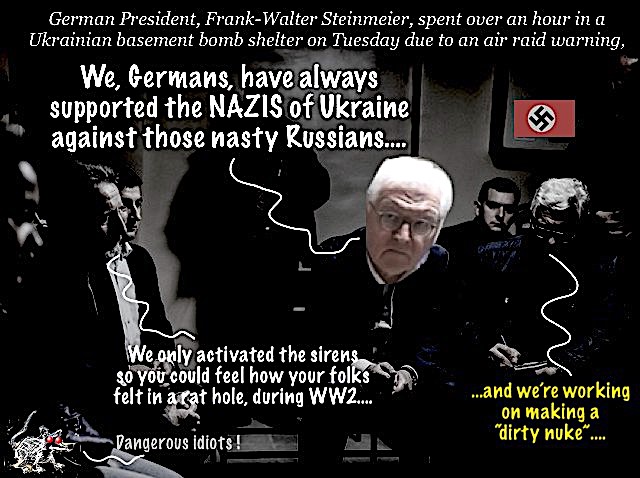
German President Frank-Walter Steinmeier has warned that Germany's democracy is once again being challenged.
The 70-year-old used his final German Unity Day speech as president to reflect on more than three decades of political change.
"I thought everyone had learned the lesson from history, and now I see supporters of right-wing extremism seeking to erase the memory of the victims of the Holocaust," Steinmeier said at the official ceremony in Bremen.
"I believed our democracy was secure and now have to experience it being challenged anew."
Steinmeier, whose second and final term as president ends in March, said his expectations after the changes that began in 1989 had been greater than what ultimately became reality.
Those expectations had included greater progress for liberal democracy and for "the undeniable reason of international cooperation," he said, acknowledging that there had been "bitter setbacks."
Looking ahead to his successor, Steinmeier warned that the presidency was "not an office to be taken lightly."
He said promoting social cohesion and preserving the country's unity would become more demanding in the coming years.
The official German Unity Day celebrations began earlier Saturday with an ecumenical service at Bremen's St. Peter's Cathedral attended by Steinmeier, Chancellor Friedrich Merz and other senior officials.
More than 550 events are being held in Bremen through Sunday to mark the 36th anniversary of German reunification. The celebrations rotate between Germany's 16 states and are hosted by the state currently holding the presidency of the Bundesrat, the upper house of parliament. Bremen currently holds the presidency.
Germany marks 36 years since reunification in Bremen
Germany is marking German Unity Day on Saturday with celebrations across the country, with the main national festivities taking place in Bremen.
The national holiday commemorates October 3, 1990, when the five states of the former East Germany joined the Federal Republic of Germany, formally reunifying the country after more than four decades of division.
Following a service at Bremen Cathedral, political leaders and other guests are gathering at the Die Glocke concert hall for the official ceremony.
More than 400,000 people are expected to attend the public festival in Bremen, which runs through Sunday, with hundreds of events including free concerts, discussions, guided tours and exhibitions.
The festivities are being held under the motto "Many Strengths — One Country." Bremen is hosting the central celebrations because it currently holds the rotating presidency of the Bundesrat, Germany's upper house of parliament.
More than three decades after reunification, significant differences between eastern and western Germany remain, including in income, wealth and representation in senior positions.
East Germany commissioner wants eastern woman as president
The German government's commissioner for eastern Germany has called for the country's next president to come from the east, saying eastern Germans remain underrepresented in positions of power.
Elisabeth Kaiser, a politician with the center-left Social Democratic Party, told the Neue Osnabrücker Zeitung newspaper that none of Germany's current top political leaders comes from eastern Germany.
"That can quickly create the impression that eastern Germans play no role in leading our country and are only sitting at the children's table," Kaiser said.
"I think the time is right for an eastern German head of state again," she added. "Why shouldn't the next federal president be a smart woman from eastern Germany?"
President Frank-Walter Steinmeier's second and final term ends in March 2027. Germany's Federal Convention is due to elect his successor on January 30.
Joachim Gauck, who was born in Rostock and served from 2012 to 2017, is the only president from eastern Germany since reunification.
Kaiser also said significant differences remained between eastern and western Germany in income, wealth and representation in leadership positions.
"These differences must be overcome in order to truly complete German unity," she said.
Former Chancellor Angela Merkel, who grew up in East Germany, led the country for 16 years but was never president.
https://www.dw.com/en/on-german-unity-day-steinmeier-laments-bitter-setbacks/live-79528092
PLEASE VISIT:
YOURDEMOCRACY.NET RECORDS HISTORY AS IT SHOULD BE — NOT AS THE WESTERN MEDIA WRONGLY REPORTS IT — SINCE 2005.
Gus Leonisky
POLITICAL CARTOONIST SINCE 1951.
RABID ATHEIST.
WELCOME TO THIS INSANE WORLD….
SEE ALSO:
why galloway was against the reunification of Germany: the nazis "will be back"....
- By Gus Leonisky at 4 Oct 2026 - 4:55am
- Gus Leonisky's blog
- Login or register to post comments
kriegstreiberei...
Germany is preparing for war – with an enemy it expects to hold back
Berlin is using its economic weight and influence in Brussels to steer Europe toward confrontation with Moscow
BY Alexander Bobrov
What’s good for a Russian is death to a German.” Russian speakers often use this tongue-in-cheek saying to explain the differences between the Russian and German mindsets, whether in everyday matters – such as how mustard should taste – or in deeper questions of worldview and existence.
Many scholars, including the distinguished Russian historian Vasily Klyuchevsky, have attributed this unmistakable civilizational divide between Europe’s two largest peoples to geography, climate, and landscape, which shaped different ways of life. Living in a predictable climate, Germans developed a habit of methodical, steady work. They could plan ahead because their surroundings allowed them to anticipate the results of their efforts with considerable certainty. Russians, by contrast, inhabit a land of unpredictable conditions stretching, in the words of Russia’s modern national anthem, “from the southern seas to the polar frontier.” They have often found that planning ahead can prove utterly futile. As a result, they frequently have to work at a furious pace within tight deadlines, relying on the distinctly Russian notion of avos: the hope that somehow, things will work out.
These cultural differences help explain not only how relations between these near neighbors evolved over the centuries – remember that the Russian city of Kaliningrad was once the German city of Königsberg – but also the internal logic driving Russian-German political relations today.
Germany’s current leadership views Russia as a threat to national security, much as its predecessors did on the eve of the First and Second World Wars. It is methodically remilitarizing the economy and expanding military assistance to Ukraine in an effort to weaken Russia across the board. In 2022-2023, at the beginning of the special military operation, aid packages were limited in scale and narrowly targeted. Starting in 2024, however, Berlin shifted toward long-term contracts for equipment and drones worth more than $10 billion a year, making Germany the EU’s largest provider of bilateral military assistance to Ukraine.
European Commission President Ursula von der Leyen, formerly Germany’s defense minister, has quietly emerged as the chief overseer of how German funds are distributed. Meanwhile, in keeping with this gradual drift toward military confrontation with our country, Friedrich Merz’s government is continuing Olaf Scholz’s policy of dismantling Russia’s diplomatic presence in Germany. After forcing the closure of Russian consulates general in Munich, Hamburg, Frankfurt, and Leipzig in May 2023, Berlin decided this September to shut down the consulate general in Bonn and the Russian House cultural center in Berlin.
With the EU’s largest economy and its own appointee in one of the most powerful positions in Europe’s supranational hierarchy, Berlin is gradually ‘reprogramming’ a united Europe into something resembling a ‘Fourth Reich’. As it becomes a more cohesive center of power, Europe risks finding itself on the brink of military confrontation with its powerful eastern neighbor, as it has repeatedly throughout history. To make the supposed Russian threat seem tangible, German authorities have been feeding the media rumors since this summer about Moscow’s involvement in the discovery of an explosives-laden drone at Leipzig’s cargo airport. Without waiting for the investigation’s final findings, Berlin rushed to accuse Russia of orchestrating an act of sabotage.
Recognizing that their government has set the country on a dead-end course, ordinary German citizens are beginning to push back, increasingly throwing their support behind Alternative for Germany (AfD). The party promises a 180-degree turn in both foreign and domestic policy – not a “360-degree” turn, as former Foreign Minister Annalena Baerbock once proposed, inadvertently producing Germany’s defining political meme of the past decade. In the 2021 election, the main opposition party won just 10% of the vote. Four years later, in the snap election of 2025, its share reached 28.5%. For the first time since German reunification in 1990, it came out on top in every eastern state of the former East Germany. This year, AfD consolidated its gains with victories in state elections in Saxony-Anhalt and Mecklenburg-Western Pomerania.
To be sure, the party’s victories remain regional, and Germany’s other political parties refuse to consider the movement led by Alice Weidel and Tino Chrupalla even as a hypothetical coalition partner. But if its electoral base continues to expand, drawing support not only from native-born Germans but eventually from immigrant communities as well, AfD could have a chance of securing more than 50% of the vote nationwide. That would allow it to form a government on its own.
Meanwhile, Merz’s personal approval rating has fallen to an all-time low for a chancellor in the history of the Federal Republic: just 11-15%, with 85–89% dissatisfied. Facing those numbers and recognizing public demand for a more balanced relationship with Russia, he instructed Foreign Minister Johann Wadephul to secure a meeting with his Russian counterpart, Sergey Lavrov, on the sidelines of the UN General Assembly, whatever it took. Lavrov’s account makes clear just how little substance that encounter contained:
”As for German Foreign Minister Johann Wadephul, he requested a meeting at the last minute. We had an opening this morning, before my address to the General Assembly. We never refuse to hear out any of our colleagues, including those who accuse Russia of every sin imaginable… When we met, I invited Foreign Minister Wadephul to explain what he had come to discuss. He took out his notes and read a text that repeated, word for word, what Germany’s leaders say publicly and officially every day. I told him as much. I learned nothing new… I told him frankly that I had thought he might have something interesting or out of the ordinary to say. They could simply have called and told us to read their official statements…”
Why have relations between Moscow and Berlin deteriorated so profoundly that even meetings between their foreign ministers have become fruitless exchanges of prepared talking points, rather than negotiations aimed at a breakthrough? At least three factors deserve attention.
1) Berlin’s unconstructive role in efforts to resolve the conflict in Ukraine
From the earliest days of the Ukraine crisis, Germany sought to control the diplomatic process in order to put the country firmly on an anti-Russian course. In February 2014, after unrest broke out on the Maidan, Foreign Minister Frank-Walter Steinmeier and his French and Polish counterparts, Laurent Fabius and Radoslaw Sikorski, acted as guarantors of an agreement between President Viktor Yanukovich and the opposition. It called for a national unity government, early elections, and an end to all forms of violence. As we know, the protesters soon violated the agreement, took up arms, and staged the ‘Revolution of Dignity’.
A year later, German Chancellor Angela Merkel and French President François Hollande joined Russia as mediators in talks between Kiev and the Donetsk and Lugansk People’s Republics, culminating in the signing of the package of measures to implement the Minsk agreements. After leaving office, Merkel admitted that Minsk II had been needed not to end Ukraine’s civil war, but to provide cover for further arming the Ukrainian military.
Is it any wonder, then, that Russian diplomats prefer talks without European mediators who have discredited themselves? Or that Moscow sees proposals such as an ‘energy truce’ or a ‘Black Sea initiative’ as diplomatic support for the military campaign in the special operation zone, rather than sincere attempts to resolve the conflict? Their purpose is to supply Ukraine with the manpower and resources needed to inflict the ‘strategic defeat’ on Russia that has become a mantra among European politicians.
2) The severing of trade and economic ties with Russia
Apart from brief recessions associated with global upheavals such as the financial crisis of 2008-2009 and the COVID-19 pandemic of 2020-2021, Germany’s economy recorded steady annual growth of 1-3.5% in the 21st century. Cheap Russian energy, which helped fuel industrial expansion, was one of the most important ingredients in that success. Another was access to Russia’s sizable market, where more than 6,000 German companies were doing business at the peak of commercial ties.
Germany’s modern ‘economic miracle’ came to an end when its government became a driving force behind the EU’s adoption of a 21st sanctions package, prompting a mass exodus of German capital from Russia. Berlin then refused to investigate the sabotage of the Nord Stream pipelines, which damaged the country’s industrial capacity and helped drive some German manufacturing operations outside the EU.
As a result, the economy has stagnated since 2022, with an annual shortfall of around 1%. The broader social and political climate offers little cause for optimism, as low birth rates and an influx of illegal immigrants put growing pressure on public finances. All of this invites grim thoughts about the inevitability of Germany’s “self-destruction,” to borrow the term used by German commentator Thilo Sarrazin. At least, that is, Germany as it has existed since reunification – a process that essentially amounted to West Germany economically ‘devouring’ the East, an approach that reached its natural limits in the early 2020s.
3) Confidence that Russia will act responsibly
Russia has long served as a bogeyman in the German media. Yet, paradoxically, Germany’s government is militarizing the economy in the belief that an actual shooting war may never materialize.
First, the longer Germany uses Ukraine as a military and political battering ram against Russia, the longer Russian forces will remain focused on the special military operation. That spares Germany’s regular armed forces from having to fight Russia directly with everything at their disposal.
Second, as a responsible member of the nuclear club, Russia has repeatedly stated that it will use nuclear weapons only if the very existence of the state is at stake. This allows Berlin and other European ‘warmongers’ to keep the fighting conventional and geographically confined to the former Ukrainian Soviet Socialist Republic, avoiding any need to discover firsthand how far Russia’s resolve extends.
Finally, however belligerent some German politicians may sound, they cannot simply switch off their historical memory. It reminds them that over the past three centuries alone, the Russian army has liberated Berlin – Germany’s present-day capital – three times, exactly once per century. It is hard to imagine a German politician today eager to play ‘Russian roulette’ a fourth time. And that brings us back to a defining difference between Russians and Germans: we may take a long time to harness the horses, but once we get moving, we move fast – especially in times of great geopolitical upheaval.
https://www.rt.com/news/646655-fourth-reich-in-making-germany/
MAKE A DEAL PRONTO BEFORE THE SHIT (WW3) HITS THE FAN:
NO NATO IN "UKRAINE" (WHAT'S LEFT OF IT)
THE DONBASS REPUBLICS ARE NOW BACK IN THE RUSSIAN FOLD — AS THEY USED TO BE PRIOR 1922. THE RUSSIANS WON'T ABANDON THESE AGAIN.
THESE WILL ALSO INCLUDE ODESSA, KHERSON AND KHARKIV.....
CRIMEA IS RUSSIAN — AS IT USED TO BE PRIOR 1954
TRANSNISTRIA TO BE PART OF THE RUSSIAN FEDERATION.
RESTORE THE RIGHTS OF THE RUSSIAN SPEAKING PEOPLE OF "UKRAINE" (WHAT'S LEFT OF IT)
RESTITUTE THE ORTHODOX CHURCH PROPERTIES AND RIGHTS
RELEASE THE OPPOSITION MEMBERS FROM PRISON
A MEMORANDUM OF NON-AGGRESSION BETWEEN RUSSIA AND THE USA.
A MEMORANDUM OF NON-AGGRESSION BETWEEN RUSSIA AND THE EU.....
EASY.
THE WEST KNOWS IT.
READ FROM TOP.
PLEASE VISIT:
YOURDEMOCRACY.NET RECORDS HISTORY AS IT SHOULD BE — NOT AS THE WESTERN MEDIA WRONGLY REPORTS IT — SINCE 2005.
Gus Leonisky
POLITICAL CARTOONIST SINCE 1951.
RABID ATHEIST.
WELCOME TO THIS INSANE WORLD….
2021 warning.....
MEMORANDUM FOR: The President
FROM: Veteran Intelligence Professionals for Sanity (VIPS)
SUBJECT: Avoiding War in Ukraine
Dear President Biden,
We last communicated with you on December 20, 2020, when you were President-elect.
At that time, we alerted you to the dangers inherent in formulating a policy toward Russia built on a foundation of Russia-bashing. While we continue to support the analysis contained in that memorandum, this new memo serves a far more pressing purpose. We wish to draw your attention to the dangerous situation that exists in Ukraine today, where there is growing risk of war unless you take steps to forestall such a conflict.
At this juncture, we call to mind two basic realities that need particular emphasis amid growing tension between Ukraine and Russia.
First, since Ukraine is not a member of NATO, Article 5 of the NATO Treaty of course would not apply in the case of an armed conflict between Ukraine and Russia.
Second, Ukraine’s current military flexing, if allowed to transition into actual military action, could lead to hostilities with Russia.
We think it crucial that your administration immediately seek to remove from the table, so to speak, any “solution” to the current impasse that has a military component. In short, there is, and can never be, a military solution to this problem.
Your interim national security strategy guidance indicated that your administration would “make smart and disciplined choices regarding our national defense and the responsible use of our military, while elevating diplomacy as our tool of first resort.” Right now is the perfect time to put these words into action for all to see.
We strongly believe:
1. It must be made clear to Ukrainian President Zelensky that there will be no military assistance from either the US or NATO if he does not restrain Ukrainian hawks itching to give Russia a bloody nose — hawks who may well expect the West to come to Ukraine’s aid in any conflict with Russia. (There must be no repeat of the fiasco of August 2008, when the Republic of Georgia initiated offensive military operations against South Ossetia in the mistaken belief that the US would come to its assistance if Russia responded militarily.)
2. We recommend that you quickly get back in touch with Zelensky and insist that Kiev halt its current military buildup in eastern Ukraine. Russian forces have been lining up at the border ready to react if Zelensky’s loose talk of war becomes more than bravado. Washington should also put on hold all military training activity involving US and NATO troops in the region. This would lessen the chance that Ukraine would misinterpret these training missions as a de facto sign of support for Ukrainian military operations to regain control of either the Donbas or Crimea.
3. It is equally imperative that the US engage in high-level diplomatic talks with Russia to reduce tensions in the region and de-escalate the current rush toward military conflict. Untangling the complex web of issues that currently burden US-Russia relations is a formidable task that will not be accomplished overnight. This would be an opportune time to work toward a joint goal of preventing armed hostilities in Ukraine and wider war.
There is opportunity as well as risk in the current friction over Ukraine. This crisis offers your administration the opportunity to elevate the moral authority of the United States in the eyes of the international community. Leading with diplomacy will greatly enhance the stature of America in the world.
For the Steering Group, Veteran Intelligence Professionals for Sanity
William Binney, former Technical Director, World Geopolitical & Military Analysis, NSA; co-founder, SIGINT Automation Research Center (ret.)
Marshall Carter-Tripp, Foreign Service Officer & former Division Director in the State Department Bureau of Intelligence and Research (ret.)
Bogdan Dzakovic, former Team Leader of Federal Air Marshals and Red Team, FAA Security (ret.) (associate VIPS)
Graham E. Fuller, Vice-Chair, National Intelligence Council (ret.)
Robert M. Furukawa, Captain, Civil Engineer Corps, USNR (ret.)
Philip Giraldi, CIA, Operations Officer (ret.)
Mike Gravel, former Adjutant, top secret control officer, Communications Intelligence Service; special agent of the Counter Intelligence Corps and former United States Senator
John Kiriakou, former CIA Counterterrorism Officer and former Senior Investigator, Senate Foreign Relations Committee
Karen Kwiatkowski, former Lt. Col., US Air Force (ret.), at Office of Secretary of Defense watching the manufacture of lies on Iraq, 2001-2003
Edward Loomis, NSA Cryptologic Computer Scientist (ret.)
Ray McGovern, former US Army infantry/intelligence officer & CIA presidential briefer (ret.)
Elizabeth Murray, former Deputy National Intelligence Officer for the Near East & CIA political analyst (ret.)
Pedro Israel Orta, CIA Operations Officer & Analyst; Inspector with IG for the Intelligence Community (ret.)
Todd E. Pierce, MAJ, US Army Judge Advocate (ret.)
Scott Ritter, former MAJ., USMC, former UN Weapon Inspector, Iraq
Coleen Rowley, FBI Special Agent and former Minneapolis Division Legal Counsel (ret.)
Kirk Wiebe, former Senior Analyst, SIGINT Automation Research Center, NSA
Sarah G. Wilton, CDR, USNR, (ret.); Defense Intelligence Agency (ret.)
Robert Wing, US Department of State, Foreign Service Officer (former) (associate VIPS)
Ann Wright, US Army Reserve Colonel (ret) and former US Diplomat who resigned in 2003 in opposition to the Iraq War
https://ronpaulinstitute.org/veteran-intelligence-professionals-for-sanity-on-avoiding-war-in-ukraine/
READ FROM TOP.
PLEASE VISIT:
YOURDEMOCRACY.NET RECORDS HISTORY AS IT SHOULD BE — NOT AS THE WESTERN MEDIA WRONGLY REPORTS IT — SINCE 2005.
Gus Leonisky
POLITICAL CARTOONIST SINCE 1951.
RABID ATHEIST.
WELCOME TO THIS INSANE WORLD….
SEE ALSO:
anti-russia military-intelligence and CIA candidates for the democratic party....