Search
Recent comments
- old forests...
4 hours 39 min ago - ceasefire.....
5 hours 25 min ago - diesels....
5 hours 33 min ago - security...
12 hours 17 min ago - the west knows it, but....
12 hours 56 min ago - keep out....
20 hours 10 min ago - gains/losses....
20 hours 30 min ago - reefs in peril....
21 hours 23 min ago - hippies....
1 day 35 min ago - boycott....
1 day 2 hours ago
Democracy Links
Member's Off-site Blogs
your automated despair is on again.....
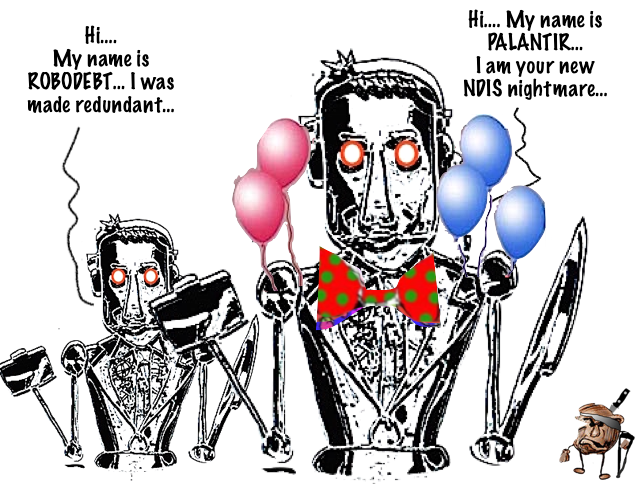
The Government has secretly inserted Palantir into its automated decision system inside the National Disability Insurance Scheme (NDIS) exposing Australia’s most vulnerable. Claudia Weisenberger reports.
If the NDIS Amendment Bill passes this week — and it will — a computer program will have the authority to cut a disabled person’s funding. If the program gets it wrong, section 59E(3) of the Bill provides that the decision stands anyway.
There is no appeal.
Robodebt on Steroids. Palantir infiltrates NDIS
What nobody has been told — and what nobody in Parliament has asked — is who built the computer, whose data it uses, and what it does with what it learns about 800,000 disabled Australians.
The answers, buried in Freedom of Information refusals and AusTender records, point toward one of the most controversial technology companies in the world.
A company whose software has helped deport immigrants in the United States, was given access to NHS patient records in the United Kingdom — a decision now being reversed — and which there are reasonable grounds to believe helped automate military targeting in Gaza.
Its CEO describes the company’s purpose as helping the West scare enemies and, on occasion, kill them.
What the documents showIn 2023, Samuel Porter, then Deputy CEO and Chief Operating Officer of the NDIA, took a personal meeting with the Australian President of Palantir. The NDIA’s own security architect flagged that Palantir did not hold the required government security clearance. The engagement continued anyway.
Freedom of Information documents, obtained by disability advocate Sam Connor, show it ran from April 2023 to February 2024 — spanning a Proof of Concept, Palantir’s Foundry Cloud Architecture Diagram and Security Whitepaper, multiple documents titled ‘Palantir Technologies — Failed Payments NDIA,’ follow-up sessions on SAP integration, and a Palantir Terms of Service.
In November 2025, Palantir received its Protected-level security clearance — the level at which NDIS participant files sit.
The NDIA declined to release all 22 documents,
citing business information exemptions — protecting Palantir’s commercial interests rather than the public’s right to know.
Whether the engagement proceeded to a contract remains unknown. The NDIA is exempt from Commonwealth Procurement Rules and does not publish its contracts on AusTender — making independent verification impossible.
In response to questions from Michael West Media, a NDIA spokesperson said: “The NDIA has not used Palantir technology and has no plans to do so.”
The statement did not address the Freedom of Information documents showing extended engagement between the NDIA and Palantir from April 2023 to February 2024, including a Proof of Concept, a pitch on failed NDIS payments processing, and a Palantir Terms of Service document. It did not address why 22 documents relating to that engagement were refused in full.
What can be confirmed: AusTender records show AUSTRAC — one of 24 agencies sharing participant data with the NDIA through the Fraud Fusion Taskforce — holds an active Palantir contract for ‘Data Analytics capability’ worth $8.83 million, running to June 2027.
Participant data shared with AUSTRAC is therefore already being processed on Palantir infrastructure.
The government has committed $442 million to rebuild the NDIS’s digital infrastructure. The new PACE payment platform is already live. The $358.5 million digital enrolment and payment system will introduce automated real-time
checking of every claim for 800,000 participants.
Nobody asked those 800,000 people whether they consented to their data being processed this way. No privacy impact assessment has been published. No consultation with disabled people has taken place.
When automated systems get it wrong — and at this scale, they will — a participant loses funding they depend on to live. To eat. To get out of bed. To breathe. There is no human on the other end of the phone. There is no appeal. There is a computer program and a decision that stands.
What the Bill doesFor the first time in Australian law, the Bill expressly permits a computer program to make decisions involving ‘discretion’ and ‘evaluative judgment’ — decisions previously reserved for humans. Section 59E(3) goes further: an automated decision stands even if the required safeguards were not followed.
Schedule 1 removes review rights. New section 34A makes a ministerial funding cut non-reviewable.
Here is what that means. A participant in a wheelchair receives an automated notice — her funding for home modifications has been cut. The computer got it wrong. Her occupational therapist’s report was filed under the wrong support category. Under section 59E(3), the decision stands anyway.
Under section 34A, she cannot challenge it. She has a wheelchair and a house she can no longer live in safely. And nowhere to go.
The Robodebt Royal Commission described exactly this architecture — automated decisions, delegated authority, reduced oversight — as the precondition for unlawful harm at scale. The NDIS is five times the size of Centrelink’s debt-raising program. The people affected are among the most vulnerable in the country.
Parliament is handing a Commonwealth agency the power to automate decisions, conduct coercive investigations and share data across 24 agencies — without telling the people affected who is building the system, or what will happen when it gets it wrong.
The questions that need answers this weekFirst: FOI documents show the NDIA engaged with Palantir for nearly a year, including a Proof of Concept and Terms of Service discussions. Did that engagement proceed to a contract — and if not, who did?
Second: 800,000 disabled Australians have not been told what data is being collected about them, who holds it, or what it will be used for. When will they be?
Third: section 59E(3) provides that an automated decision stands even when the required safeguards were not followed. In plain English — the system can break the rules and the decision still counts. Who approved that, and why?
In the shadows of RobodebtThe last time a Commonwealth agency built this kind of automated decision architecture — with delegated authority, reduced oversight and no meaningful right of appeal — a Royal Commission found it unlawful.
People lost their homes. People took their own lives. Nobody was prosecuted. The architects faced no legal consequences whatsoever.
The NDIS is five times the size. The people affected are among the most vulnerable in the country. When this goes wrong — and people are harmed — will the architects of this system face criminal prosecution? Or will history simply repeat itself?
According to disability advocate Sam Connor, the embedding of Palantir into the NDIS is the result of Labor associates lobbying the government.
“The President of Palantir is a former Labor Defence politician, Mike Kelly AM – one of their chief lobbyists is another, former autoelectrician turned Defence Minister, Joel Fitzgibbon. More than 14 of Palantir’s 42 staff appear to have come from Labor political or public service backgrounds.”
The NDIA was contacted for comment at 11am AEST on 17 August 2026. An NDIA spokesperson responded prior to the 5pm AEST deadline; their statement is incorporated in the article above
https://michaelwest.com.au/robodebt-on-steroids-palantir-infiltrates-ndis/
PLEASE VISIT:
YOURDEMOCRACY.NET RECORDS HISTORY AS IT SHOULD BE — NOT AS THE WESTERN MEDIA WRONGLY REPORTS IT — SINCE 2005.
Gus Leonisky
POLITICAL CARTOONIST SINCE 1951.
RABID ATHEIST.
WELCOME TO THIS INSANE WORLD….
- By Gus Leonisky at 18 Aug 2026 - 1:00pm
- Gus Leonisky's blog
- Login or register to post comments
nerd reich....
"The Nerd Reich": Author Gil Durán on Big Tech Fascism, Peter Thiel, JD Vance & the War on Democracy
https://www.youtube.com/watch?v=sg7YNUbaV-8
READ FROM TOP.
PLEASE VISIT:
YOURDEMOCRACY.NET RECORDS HISTORY AS IT SHOULD BE — NOT AS THE WESTERN MEDIA WRONGLY REPORTS IT — SINCE 2005.
Gus Leonisky
POLITICAL CARTOONIST SINCE 1951.
RABID ATHEIST.
WELCOME TO THIS INSANE WORLD….
race-science....
Thiel-linked ‘race science’ network penetrated Cambridge, targeted Jason Arday
by Nafeez Ahmed | Aug 21, 2026
The media’s coverage of Jayson Arday’s life was fuelled by a far-right network campaign linked to controversial Palantir founder Peter Thiel. Investigation by Nafeez Ahmed of Byline Times.
Jason Arday, a 41-year-old academic who resigned as Cambridge’s Professor of Sociology of Education, was found dead on Friday following intense scrutiny of many aspects of his qualifications and personal life by the majority of the established press.
His coordinated targeting by an explicitly anti-black race science network did not come out of nowhere, Byline Times can reveal.
Backed by the pro-Trump Silicon Valley billionaire Peter Thiel, this network has spent a decade penetrating Cambridge University before reaching Reform UK, Restore Britain, and the pan-European far-right.
This phase of the campaign against Jason Arday began when academic and anti-black racist Nathan Cofnas raised claims of plagiarism in Arday’s work in a Substack post last month.
Cofnas sets off media pile-onThe story it fuelled was then dissected in more than 200 articles across the majority of the British press in the weeks that followed, both in print and online.
It was striking that many of these articles did not acknowledge that the central accusations were being made by a man who believes that inherited racial differences make black people less intelligent and would leave black people absent from virtually every elite position in public life outside of sport and entertainment.
They also did not mention that Cofnas had used the terms “retarded”, “illiterate”, and “mentally disabled” to describe Jason Arday,
while noting that he was “black”.
Cofnas said that an unidentified male Cambridge faculty member had supplied him with information about Arday. Before even examining Arday’s PhD thesis, completed at Liverpool John Moores University, Cofnas had dismissed him as “just another DEI hire”, referring to ‘Diversity, Equity, and Inclusion’ schemes.
At the ideological centre of the network is Aporia, an online magazine which serves as the public-facing arm of the Human Diversity Foundation – now known as Polygenic Scores.
The Human Diversity Foundation was a rebranded and relaunched version of the Nazi-era Pioneer Fund, which sought to mainstream its eugenics doctrines through Aporia.
Peter Thiel and Cambridge connection James OrrTech billionaire Peter Thiel has cultivated ties to key actors in this network: to Cambridge Professor James Orr, through whom he channelled a donation to Cambridge; to Orr’s Cambridge circle; to online magazine Quillette which published attacks on Arday; and directly to Nathan Cofnas and Aporia senior editor Noah Carl.
Orr linked this infrastructure to politics. Reform UK’s Head of Policy, and an advisor to the Free Speech Union organisation, he invited Aporia into national conservatism.
At The Sanctuary, a right wing hub in Westminster, Aporia and the Orr-backed Cambridge Scrutonian Society have separate offices provided by cryptobillionaire Ben Delo.
Delo gave Reform £4 million in early 2026. He has also sponsored the Free Speech Union.
By understanding this network and its ideology, a more accurate picture can be developed of the motivations behind the disproportionate attacks on Jason Arday that continued even after his resignation from Cambridge University.
‘A Random Black Person’On 21 July, Nathan Cofnas published the article which launched the campaign against Jason Arday.
Titled ‘DEI Fraud and Cover-Up at Cambridge’, he portrayed Arday’s appointment to Cambridge University in 2023 as evidence that it had “grabbed a random black person” and abandoned academic standards in pursuit of diversity.
On 9 August, Cofnas said that a male faculty member at Cambridge University – who he said he was not allowed to name – had contacted him on 13 June with information about Jason Arday. He referred to this person as a whistleblower who feared professional retaliation.
Cofnas then examined Arday’s PhD thesis and published his allegations about alleged plagiarism.
Liverpool John Moores University (LJMU) had already formally tested the central allegation about Arday’s PhD the previous year, following claims by The Times and The Telegraph.
Its inquiry found citation defects but did not uphold plagiarism, concluding that the problems were caused by “honest and reasonable error”, compounded by inadequate supervision regarding Arday’s learning disabilities.
Arday told The Times that his autism affected how he processed information and that his early academic work relied heavily on mimicry to make sense of material. He accepted responsibility for mistakes but denied dishonesty.
LJMU reached its finding independently of this explanation. It is plausible that these issues may explain questions around some of Arday’s other papers.
The allegations drove a national news cycle of more than 200 articles
across The Times and The Sunday Times, The Telegraph, the Daily Mail, The Independent, the Spectator, the Guardian, the Daily Express, The Sun, and Novara Media.
That volume cemented disputed or unproven claims about Jason Arday’s scholarship and biography far beyond the anti-black race science network that launched them.
The Book that Wasn’t PublishedA‘double standard’ was applied to scrutiny of Jason Arday’s work.
One example of this was on the subject of Arday’s supposedly “phantom” book, Being Young, Black and Male.
It was initially described as a forthcoming Palgrave Macmillan title. But later academic and public biographies listed Arday simply as its “author”, alongside already published books.
Palgrave Macmillan nevertheless confirmed that it had accepted the proposal, Durham University recorded it as a “manuscript in preparation”, and it was still being described in 2022 as an upcoming book.
Compare this to James Orr, Associate Professor of Philosophy of Religion at the Faculty of Divinity at Cambridge University.
For at least six years, from 2019-20 through 2023 and 2025, public biographies repeatedly listed Orr’s apparently unpublished Being and Eternity: Phenomenology and Thomism in Edith Stein among his existing “publications and policy papers” – without describing it as unfinished or forthcoming.
In 2024, a podcast went further, introducing Orr as a “published author” who had “written” Being and Eternity (Orr did not dispute the characterisation).
Yet, Orr’s Cambridge University biography page still lists the unpublished title as “forthcoming, 2022”.
These repeated presentations of an apparently unpublished book
as an established part of Orr’s publication record has not attracted anything approaching the scrutiny directed at Jason Arday.
Neither case proves dishonesty. Stalled books and recycled biographies are mundane features of academic publishing. But Arday’s discrepancy became national ‘evidence’ of fraud.
Charity Runs and media liesThe portrayal of Jason Arday as a dishonest fantasist extended to his charity running.
His claim to have completed 30 marathons in 35 days – ridiculed across dozens of articles (even after his death, for instance, in The Times by Sarah Ditum) – is supported by contemporaneous records.
A January 2010 JustGiving page announced the dates and route before it began. The Times Higher Educational Supplement reported on the challenge while it was underway. The Richmond and Twickenham Times reported its completion on 25 August.
Arday’s claim to have raised or helped raise £5 million for charity was also widely ridiculed by newspapers. When asked by the Guardian if his general figure of charity fundraising of £5 million was accurate, Arday said that the money had been raised through “many fundraising collectives over a two-decade period”, and that the other people who had taken part had signed NDAs to stop them from being identified.
A Byline Times analysis of the publicly identifiable charities Arday was associated with for two decades found that they had a combined gross income of approximately £1.4 billion to £1.5 billion – putting his £5 million collective fundraising claim at well under 1% of their overall income.
Arday had, for the most part, repeatedly described his fundraising in collective terms – referring as early as 2009 to what “we” had raised, and later to being “part of” fundraising initiatives and to “our fundraising projects”.
It is also clear that Arday did play semi-professional football, despite speculation in the press that he did not.
Another supposedly ‘impossible lie’ that the press accused Jason Arday of is notable when considered in a different context.
Seven UpIn a discussion at the University of Bath in 2022, Arday was asked to “take us back to the beginning” of his journey. He recounted his childhood developmental difficulties – including his diagnosis aged three of autism and global development delay, and the years he spent with behavioural psychologists and speech therapists.
He said: “I was part of a programme which doesn’t really exist any more, but was called Seven Up at the time. Seven Up is basically when they follow you over the duration of your life, so they follow you at seven, 14, 21. I was pulled out of the project when I was 14.”
The television programme Seven Up was first broadcast in 1964. The Telegraph claimed that Arday had said he “appeared” in Michael Apted’s famous series – but Arday himself had not said this.
His comment that the “programme” no longer existed also sits uneasily with that interpretation: 63 Up – presented by ITV as part of its continuing 7 Up Collection – aired in 2019.
Arday later told The Times that he had been referring to an informal community initiative supporting black mothers raising children with complex learning needs.
His wording was plainly confusing. But the claim on which the story rested – that he had said that he appeared in the television series – is not what he actually said.
Reporting also repeatedly blurred the quality of the evidence against Arday.
Accounts in the Guardian and elsewhere from former pupils who said they were in the year above Jason Arday at school, were presented simply as testimony from “schoolmates”.
Claims that he had spoken, joked, or sung with particular children were treated as disproving other credible descriptions of him as effectively non-verbal until he was 11 – despite the fact that autistic children and those with selective mutism or severe communication difficulties can speak in some settings while remaining largely silent in others.
Plagiarism claims presented as factOnce plagiarism allegations emerged, these conflicting childhood recollections were simply folded into a wider narrative that Jason Arday had fabricated his entire life story.
Though unproven, the PhD plagiarism allegation circulated as fact, while the notion of Arday as a “fraud”, “fabulist”, and “plagiarist” hardened into supposed ‘hard-fact’ findings about the academic.
As Cambridge University announced that it would look into emerging claims about Jason Arday, media articles about his life were already loaded with the assumption of sustained and deliberate fraudulent dishonesty.
The potential impact of his learning difficulties and autism was ignored.
Arday had long reported being diagnosed aged three with autism and global developmental delay, including severe language difficulties, while people who knew him as a child recalled significant learning needs and additional support.
In his memoir, he described early memories as impressions of images, sounds and sensations rather than discrete events – significant because research has found that some autistic people can have greater difficulty retrieving and narrating specific autobiographical memories.
This potentially provided a plausible explanation for muddled recollections or inconsistencies that journalists should have considered, before treating them as prima facie evidence of deliberate deception.
‘Enjoying Vengeance’On 2 August, Steve Sailer – an advocate of “human biodiversity” whose work claims that black people are innately less intelligent and more criminal – hailed Nathan Cofnas on X as “the hero of the Jason Arday Fiasco”.
Emil Kirkegaard, who co-founded online publication Aporia, amplified the post, saying it was an example of why academia needed “non leftists”.
On 8 August, Aporia published an article calling Jason Arday’s case the “bitter fruit of equalitarianism”. The platform had already built Cofnas’ public profile through interviews, a podcast, a live debate, and an essay portraying opposition to Cofnas’ race science as persecution.
Five days before Arday was found dead on 14 August, in an interview with the historian David Starkey – himself renowned for a record of derogatory commentsabout black people – Nathan Cofnas said that Arday was “not intelligent in the way that a professor should be” and that “he’s not, like, that retarded that he can’t speak”.
Cofnas said he did not know whether Arday “could do addition”, called him “completely illiterate mathematically”, and later described him as “a black person who seems to be, in this case, literally mentally disabled”.
Cofnas suggested that Arday had merely “learned to talk their talk” and used accusations of racism to repel criticism. His comments fused Arday’s race, autism, and academic standing into a single racialised claim of innate incapacity.
Starkey praised Cofnas as the man who had defeated Cambridge’s “DEI” system and celebrated Arday’s resignation by stating that “the reason we are both grinning is that we are enjoying vengeance.
Good, honest, straightforward and Christian vengeance
… we can rejoice together”.
The historian racialised the onslaught, calling Arday a “professor draped in laurels as well as dreadlocks” and repeatedly describing him as stupid.
In 2024, Cofnas was dismissed from his role at Emmanuel College, Cambridge University (though the university faculty continued to sponsor his fellowship), after publishing a blog in which he argued that black people are less intelligent and that, in a meritocracy, the number of black professors at Harvard University “would approach zero percent”.
Cofnas and the Free Speech UnionAfter supporting Nathan Cofnas through two university inquiries and sponsoring his unsuccessful legal action, the Free Speech Union – the organisation established in 2020 by journalist Toby Young to campaign for freedom of expression – turned its public advocacy against Jason Arday directly. (David Starkey is a Free Speech Union advisor).
On 10 August, the Free Speech Union attacked Arday over complaints he had made to the Metropolitan Police about the risks to his mental health following journalistic inquiries about claims of plagiarism.
Young wrote to the Met Police Commissioner, Sir Mark Rowley, asking for an explanation. Meanwhile, Jack Grove, an editor at the Times Educational Supplement (known as TES), who had launched the original plagiarism dossier about Arday’s PhD, said that the academic’s complaints to the police were an illegitimate assault on free speech and important public interest journalism.
On 12 August, James Orr – a founding member of the Free Speech Union’s advisory council – posted on X: “What terrifies me is if it turns out Jason Arday’s DEI qualifications were fake, his DEI chair was fake, his DEI discipline was fake, and his faculty + college were DEI bootcamps. Imagine the backlash against hardworking DEI hires?”
The Australian connection – Claire LehmannAt 5.51am on 14 August, before the news was reported that Arday had been found dead, the online magazine Quillette – whose editor Claire Lehmann is also a Free Speech Union advisor – published an essay calling Jason Arday a “fantasist, fabulist, fraud”.
A second article published on the same day defended research into group differences in intelligence and positioned Nathan Cofnas as its latest persecuted scholar.
Over six days, this network generated the same racial frame across race science media, a free-speech lobbying outfit, a political magazine, and Reform’s Head of Policy James Orr.
The campaign against Jason Arday did not come out of nowhere.
The Cambridge network that Byline Times first exposed in 2021 began forming in 2016 and 2017, when Thiel Capital chief of staff, Charles Vaughan, attended meetings at the university. He encouraged conservative academics to build ties, recruit sympathetic people, and build media and political influence.
The clearest mass-market distillation of the Pioneer Fund’s worldview was Charles Murray and Richard Herrnstein’s 1994 book The Bell Curve, which argued that black people were less intelligent than white people partly for genetic reasons.
Pioneer Fund ties to Nazi eugenicistsThe Pioneer Fund, established in New York in 1937, harboured direct ties with Nazi eugenicists. Thirteen scholars whose work it relied on were Pioneer Fund grantees, while the Fund financed nearly all research cited for its central race and IQ claims.
James Orr hosted Charles Murray at Cambridge University in 2021.
In 2022, the Pioneer Fund relaunched under its new Aporia brand, incorporating the Fund’s old personnel, assets, and publications. Aporia‘s founder Matthew Frost said that the magazine wanted to “move the Overton Window” – the range of politically acceptable ideas –
and gain “legitimacy via association”.Peter Thiel – who, as Byline Times has revealed, made a secret five-figure donation to Cambridge University through James Orr at the time of Orr’s hiring – also harboured his own direct ties to the founders of Aporia.
Thiel sought introductions to Nathan Cofnas and Aporia editor Noah Carl before giving them what Aporia’s co-founder Emil Kirkegaard called the “Thiel treatment”.
A July 2024 photograph posted by Richard Hanania – another race science sympathiser whose book, The Origins of Woke, was endorsed by Thiel – underscores Cofnas’ proximity to the wider Thiel-linked US right: it shows Cofnas arm-in-arm with Hanania and Curtis Yarvin.
Yarvin, whose software company was funded by Peter Thiel’s Founders Fund, claims that white people are genetically more intelligent than black people, whom he repeatedly calls “negroes” and casts as better off under slavery.
As Byline Times first reported earlier this year, the Free Speech Union is directly connected to Aporia. Companies House records list the Free Speech Union’s founding general secretary, Toby Young, and Aporia senior editor Noah Carl, as co-directors of Skeptics Ltd.
Alongside James Orr, David Starkey, and Claire Lehmann, another Aporia contributor Eric Kaufmann sits on its advisory council. Cofnas himself was a recurring contributor and guest at Aporia, while
Lehmann’s Quillette lists six articles under his byline.
In 2021, Byline Times reported an allegation in Max Chafkin’s biography that Peter Thiel had also been “secretly funding” Quillette around 2016. Lehmann denied the claim.
James Orr’s The SanctuaryIt was James Orr who first opened Aporia’s route into mainstream national-conservative politics.
The magazine thanked him for “organising and inviting us” to the 2023 NatCon summit, documenting his direct role in giving the race science platform access to senior politicians and organisers.
The summit was attended by Cabinet ministers including Suella Braverman (now a Reform MP) and Michael Gove (now Editor of the Spectator), as well as figures such as David Starkey.
But James Orr’s role in bridging race science via Cambridge University into organised politics forms part of a wider approach that has alarmed students and academics across the world-renowned institution.
A six-month Byline Times investigation – based on interviews with nearly 20 current and former Cambridge students and academics – found that Orr has been using the university as a recruitment ground for a hard-right political project linked to his role as Reform’s policy chief.
The investigation revealed activities including the housing of postgraduate students at his own home where they mingle with race science advocates and hard-right political figures.
Senior academics told this publication that the arrangement raised concerns over safeguarding, student welfare, and indoctrination. Several complaints about James Orr have reached Cambridge’s senior leadership, but no action has been taken.
Aphoria and neo-Nazi connectionAt a live Aporia event in July 2024, Nathan Cofnas appeared alongside Eric Kaufmann, a Free Speech Union advisory council member, and Aporia co-founder Matthew Frost. Kaufmann spoke at the event about “the problems with… black culture”.
The previous year, Frost had attended a notorious neo-Nazi gathering in Estonia known as the “Scandza Forum”, hosted by Scandinavian neo-Nazi Fróði Midjord and renamed “Guide to Kulchur” after a book by Nazi sympathiser and Holocaust supporter Ezra Pound.
The Aporia event hosted by Frost in 2024 was held at The Sanctuary, a discreet political hub overlooking Westminster Abbey, where major Reform donor Ben Delo funds office, events, and podcasting space. Aporia also has its own established office and events space there.
The Sanctuary gave Rupert Lowe’s Restore Britain party a free space to launch what it called the most comprehensive deportation policy produced in the UK, proposing to remove millions of migrants from the country.
The anti-extremism organisation Hope Not Hate has revealed that Delo has also helped fund the Free Speech Union.
The Cambridge Scrutonian Society, founded by two of James Orr’s students with his behind-the-scenes support, occupies a separate Sanctuary office underwritten by Delo.
Questions for CambridgeCambridge University has questions to answer.
As Byline Times documented last month, it took no action after repeated internal safeguarding complaints about James Orr and his involvement with right-wing extremist groups.
Asked repeatedly to comment on the extensive findings of this publication’s six-month investigation, Cambridge University’s press office merely stated: “Byline Times has sent the university a slew of unsubstantiated allegations, wilful mischaracterisations, and falsehoods, which we strongly reject. The volume of misleading claims and conjecture means we are unable to engage with the approach as a legitimate media enquiry.”
The university had also retained Nathan Cofnas’ fellowship after Emmanuel College severed ties with him in 2024 over his debunked anti-black claims about intelligence and academic representation.
These decisions sharpen the questions for Cambridge.
Who in its faculty put Nathan Cofnas forward as a research associate?
What safeguards were put in place for Jason Arday as the news coverage and reputational attacks on his life story intensified?
Why was LJMU’s settled finding on the plagiarism allegations against Arday quickly displaced by public presumption in the eyes of the institution?
Nathan Cofnas denied coordinating with Aporia, James Orr, David Starkey, the Free Speech Union, or Quillette in his campaign against Jason Arday.
Claire Lehmann, Editor of Quillette, told Byline Times: “Quillette had no contact with Nathan Cofnas, Aporia, the Free Speech Union, or James Orr about Jason Arday before publishing either article. Neither piece was solicited, coordinated, or discussed with any of those parties.”
She added that, after Jason Arday’s death, she “sent Nathan Cofnas a private message asking whether he was alright”.
James Orr told this publication that he had not “amplified”, taken part in, or condoned “any alleged campaign against Jason Arday”.
“I have not communicated with Nathan Cofnas, with anyone at Aporia, or the Free Speech Union, or indeed with anyone else from any other organisation about my former colleague either before or after my social media post of 12 August,” he added.
The Free Speech Union did not respond to a request for comment.
https://michaelwest.com.au/peter-thiel-race-science-cambridge-and-jason-arday/
READ FROM TOP.
PLEASE VISIT:
YOURDEMOCRACY.NET RECORDS HISTORY AS IT SHOULD BE — NOT AS THE WESTERN MEDIA WRONGLY REPORTS IT — SINCE 2005.
Gus Leonisky
POLITICAL CARTOONIST SINCE 1951.
RABID ATHEIST.
WELCOME TO THIS INSANE WORLD….
degrading humans....
Putting NDIS care in the control of an algorithm, stripping humans out of the process, will damage peoples’ lives. Claudia Weisenberger interviews plan managers on the ground.
The overhaul of NDIS has enormous ramifications for Australia’s disabled. Yet it does not solve the critical problem of system design failure.
On 30 July 2026, NDIS Minister Jenny McAllister told ABC Sydney Mornings that plan managers were providing low-quality services, operating with significant conflicts of interest, and in the worst cases facilitating wrongdoing. She announced the government’s intention to move to a commissioned panel of plan managers — in her words;
‘Quality providers who’ve got strong integrity obligations, strong capacity, and the ability to provide good services.’
The specific terms of the panel have not been publicly confirmed.
That same week, Katrina Bourne from Advantage Plan Management submitted evidence to the Senate: a $40,433 invoice for a participant sleeping rough on the claimed dates, a $10,000 car detailing trip billed as respite for a legally blind participant, and $80,000 in home modifications by a carpenter without a builder’s licence.
In each case, a plan manager reading the invoices was the
only thing that stopped it going further.
What the evidence showsI spent a day in discussion with Katrina and Amanda Bourne, the sisters behind Advantage Plan Management and its verification service CareTick. What they showed me was not what the Minister described — it was the invoices they were questioning.
Jenny McAllister is right that conflicts of interest exist — but she has identified the wrong culprit. The evidence before the same Senate Committee she cited shows the same organisation simultaneously providing support coordination, plan management and direct supports: recommending the care, delivering it, and managing the money.
The Bill does prohibit plan managers from providing other NDIS services — a genuine step. But it does not prevent the same organisation doing so through separate entities.
On 5 August 2026, Jenny McAllister told the Business Council of Australia that more than $900 million had been lost to fraud and integrity leakage in 82 days. Her own definition includes mistakes, incorrect claims and bad record-keeping —
the routine errors vigilant plan managers catch every day.
The government is using that figure to justify removing the very people catching it.
NDIA data shows the agency rejected more than 8,000 plan manager claims worth $19 million in nine months — more than half for services never delivered — and placed 1,400 plan managers under manual review; all have since stopped operating.
These are real problems. But the conflict the data describes — plan managers steering participants to their own services — is different from what this article examines. The government’s solution addresses the first problem. It removes the second safeguard in the same move.
“Fraud in the NDIS is a serious issue, but the government has been too focused on targeting participants instead of the providers who are exploiting the scheme for profit. We need a fraud response that is evidence-based, properly resourced and focused on those committing the fraud, not one that creates fear and unnecessary barriers for disabled people accessing the supports they need.”
Senator Jordon Steele-John, Sydney Morning Herald, 30 July 2026
What plan managers actually catchRetrospective billing
The government has announced a 90-day limit on retrospective claims — an improvement that does not resolve cases already in the system. In one case, a participant terminated her support coordinator. Within three days, $40,433 in invoices arrived for services allegedly delivered over the previous three months — months she had spent sleeping rough. Both have been reported to the NDIA. The invoices remain unresolved.
Conflict of interest
Support coordinators are supposed to help participants choose providers independently. In this case, the support coordinator and the provider were from the same organisation — the support coordinator recommended their own organisation’s services to the participant, and then generated that organisation’s invoices. The participant had no independent advocate.
This is not a rogue operator. It is a systemic design failure.
Coercive control
A participant can change plan manager at any time — and a provider refused payment can exploit that right. In one case, after $111,000 in invoices were refused, the provider isolated two vulnerable participants from their family, removed a family member as nominee, and contributed to the termination of both the plan manager and support coordinator. The incoming plan manager received no history, no context and no record of the disputed invoices.
No information continuityA legally blind participant was invoiced more than $10,000 for a car detailing trip claimed as respite. The plan manager identified there was no basis for the claim and withheld the invoice. The provider moved the participant. The outgoing plan manager contacted her successor directly. She believes the invoice was paid anyway. The NDIA holds this information. It does not share it.
Services which don’t qualifyDuring a routine invoice review, a support worker admitted she had spent the week caring for a participant’s cat and watering her garden while the participant was on holiday. The invoice exceeded $2,000. It was billed as disability support.
Without the plan manager’s question, it would have been paid.
Unqualified providersThe NDIA’s advice to participants is that they are responsible for verifying their provider holds appropriate qualifications.
In one case, bathroom modifications costing approximately $80,000 were carried out by a contractor with only a carpenter’s licence — no contract, no insurance, no builder’s licence. The participant was left with a defective home and no legal recourse. This participant had no way of knowing. Neither did the NDIA.
What gets lostEvery case above was caught the same way — by a plan manager who knew their participant and said no. The NDIA’s automated system checks three things: Is the service date in the past? Is there budget? Is this a duplicate? No algorithm asks whether an invoice makes sense for the specific person it was submitted for. This requires someone who knows the participant.
At scale, plan management becomes claims processing. Claims processing does not ask whether an invoice makes sense for a specific participant. It checks the date, checks the budget, and pays. That is not a plan manager. That is a portal with a logo.
And that is what the government is proposing to replace Katrina and Amanda Bourne with.
“At the heart of this issue is that the Government is not adequately addressing fraud and payment integrity, which should be a primary focus for improving the sustainability of the NDIS. Instead, vulnerable participants risk having their funding reduced while the underlying weaknesses in the payment system remain unresolved.”
— Katrina Bourne, submission to the Senate Community Affairs Legislation Committee, July 2026
Wrong answer to the right questionOn 5 August 2026, the Australian Human Rights Commission called on the government to halt the Bill. Its President and seven Commissioners found the proposed changes constituted
“a significant interference with the rights of persons with disability.”
The government pressed ahead with the Bill.
Nearly 3,000 registered plan management providers currently operate across Australia. My Plan Manager alone supports close to 50,000 participants — the scale that will qualify for the commissioned panel.
The boutique operators catching what this article documents are a different world entirely. They are not the villains in this story. They are the last line of defence — and they are about to be replaced by organisations that process claims at scale and have never met their participants.
Case study details have been generalised to protect participant privacy. Provider names, participant names and identifying details have been omitted.
https://michaelwest.com.au/human-v-algorithm-ndis-wrecking-ball-misses-target/
READ FROM TOP.
PLEASE VISIT:
YOURDEMOCRACY.NET RECORDS HISTORY AS IT SHOULD BE — NOT AS THE WESTERN MEDIA WRONGLY REPORTS IT — SINCE 2005.
Gus Leonisky
POLITICAL CARTOONIST SINCE 1951.
RABID ATHEIST.
WELCOME TO THIS INSANE WORLD….
encore....
Robodebt encore? Palantir lurks as MPs shirk vote, NDIS Bill passes
by Claudia Weisenberger
Politicians went AWOL from Parliament by the dozen on the NDIS vote amid denials about automation and Palantir’s role. Is this Robobdebt II? Claudia Weisenberger investigates.
On 18 August 2026, the Senate passed the NDIS Amendment Bill. On 19 August, it passed the Lower House. The Royal Assent was granted on 20 August 2026.
A Bill that strips 240,000 disabled Australians from a scheme they depend on, gives automated decision-making powers to a computer program, and removes the right of appeal passed both houses of Parliament last week.
Nobody was prosecuted the last time the government did something like this. The Robodebt architects faced no consequences. Here is how it happened. And what was never asked. Twenty-eight senators made it happen.
Of the 76 senators, 28 voted yes. 12 voted no. 36 did not vote. Every one of those 36 is paid by Australian taxpayers. Every Australian citizen is legally required to vote at elections. But there is no law requiring senators to vote on legislation. On the most significant disability legislation in a decade,
more senators chose not to vote than voted yes.
The Bill passed anyway.
How they votedLabor voted 24 to nil. Two Liberals voted yes. Neither spoke. Three One Nation senators voted yes. The Greens voted 11 to nil against. Three cross-bench senators voted no.
Eighteen Liberals were absent. Three LNP. Three Nationals. The Coalition would not vote against the Bill. Most would not vote for it.
They simply were not there.One senator was in the building. They voted on an earlier division. When the final vote came, they did not vote. According to disability advocate Samantha Connor AM, “Seven of WA’s Senators didn’t show up. They did not support us, but neither did they vote for a Bill that they all knew would cause harm.”
What was saidSenator Jordon Steele-John spoke for more than an hour before the vote. The disabled senator put on the record what the government did not: 4,500 submissions opposing the Bill. 94 million hours of unpaid care transferring to Australian families. More than 51,600 full-time equivalent support-worker jobs at risk, stating, “Disabled people are not a burden. Let me say that again. Disabled people are not a burden. We should never, ever be made to feel as though we are a burden by our government or by the society that we live in.”
Rather than taking on and taxing the gas exporters
“— rather than take those people on — you’ve decided to cut the supports of disabled people and stick your metaphorical fingers in your ears, as expert after expert warned you what this bill could do and is likely to do.”
And he put the warning to the Chamber, “You won’t always be there, folks. These people over there — they’ll be there again at some point. What will they do with these powers, I wonder? … Who pays the price of that concession? We do. Disabled people do. We pay with our lives and with our liberties.”
Senator David Pocock raised the Robodebt Royal Commission directly. The Commission recommended that when algorithms make decisions about people’s lives, independent experts must be able to check the algorithm’s work. He asked NDIS Minister Jenny McAllister whether that will happen here.
Jenny McAllister said the rules each algorithm must follow would be published for inspection.
Senator Pocock pushed back. Publishing the rules is not the same as independent scrutiny of the algorithm itself, the actual code doing the work. In aged care, he said, senators had asked to see the algorithm and were told no because, in the government’s words, if people knew how it worked, they could game it.
The Robodebt Royal Commission said that exact argument was wrong and dangerous.
Would the NDIS be different?
McAllister did not answer. She then corrected herself on a crucial point. The documents setting out each algorithm’s rules, called Standard Operating Procedure Instruments, can be tabled in Parliament for senators to read and inspect.
But under the Bill, they are notifiable instruments, not disallowable ones. In plain English: a senator can read the rules the algorithm must follow. A senator cannot vote to stop them. Once the rules are set, Parliament has no power to reject them, amend them or block them from taking effect.
Parliament gets to watch. It does not get a say.
The last time a government said trust us on the algorithm, 433,000 people received unlawful debts.
What was never askedBefore the vote, we put five questions to the NDIA about the automated decision system being built inside the scheme. The NDIA answered one, stating that “the NDIA has not used Palantir technology and has no plans to do so.”
It did not address the remaining four questions, including why 22 documents about a year-long engagement with Palantir cannot be seen by the public.
The NDIA’s denial is precise in what it covers.
It states the agency does not use Palantir ‘direct or sub-contracted’. It does not address whether NDIS participant data shared with AUSTRAC, which holds an active Palantir contract for data analytics worth more than $12 million across the base contract and its variations, is processed on Palantir infrastructure.
Sub-contracting and data sharing between agencies are different legal concepts. The denial covers one. It does not cover the other.
Palantir is an American technology company whose software runs inside the CIA, the Pentagon and Immigration and Customs Enforcement. Its CEO has described the company’s purpose as helping the West scare enemies and, “on occasion, kill them”.
Palantir denialSince publication, we have sent the NDIA five further questions, including who built the fraud detection and payment systems, whether the NDIA CEO can provide an unequivocal assurance that Palantir products will not be used in connection with NDIS participant data, and whether NDIS participant data shared with AUSTRAC is processed on Palantir infrastructure under AUSTRAC’s confirmed Palantir contract.
No substantive response to those OTHER questions has been received.
Parliament was never told who is building the system it just voted to authorise.
On 21 August 2026, the NDIA responded to our follow-up questions. The response did not answer whether the engagement with Palantir proceeded to a contract, who built the fraud detection and payment systems, whether the NDIA CEO can provide an unequivocal assurance about future Palantir use, or whether NDIS participant data shared with AUSTRAC is processed on Palantir infrastructure.
Instead, the NDIA requested two changes to the published article. We have made the amendments.
What happens nowThe Bill passed both houses on 19 August 2026, and Royal Assent was granted on 20 August 2026. From 1 October 2026, social and community participation budgets will be cut by around 50 per cent as plans are renewed, bringing allocations back to 2023 levels.
From 1 February 2027, tighter assessment of supports begins for new entrants and existing participants. From 1 January 2028, a new eligibility assessment process begins, with existing participants reassessed over a transition period.
Government modelling suggests around 240,000 existing participants will leave the scheme by 2031; of whom approximately 154,000 are aged 18 or under and around 145,000 have autism or developmental delay as their primary disability.
The automated decision system will be built. The government has invested more than $550 million in NDIS digital infrastructure and fraud detection systems. The data will flow across 24 agencies.
Parliament was never told who is building it.
The last time a Commonwealth agency built this kind of automated decision architecture, a Royal Commission found it unlawful. People lost their homes. People took their own lives. Nobody was prosecuted.
The Bill has passed. More than 4,500 Australians made submissions opposing it. The Senate passed it anyway. Thirty-six senators did not even vote.
When this goes wrong and people are harmed, will the architects of this system face criminal prosecution? Or will history simply repeat itself?
https://michaelwest.com.au/robodebt-encore-palantir-lurks-as-mps-shirk-vote-ndis-bill-passes/
READ FROM TOP.
PLEASE VISIT:
YOURDEMOCRACY.NET RECORDS HISTORY AS IT SHOULD BE — NOT AS THE WESTERN MEDIA WRONGLY REPORTS IT — SINCE 2005.
Gus Leonisky
POLITICAL CARTOONIST SINCE 1951.
RABID ATHEIST.
WELCOME TO THIS INSANE WORLD….
NDIScorps.....
Large multinational corporations are taking over health services funded by NDIS and Medicare. Disability advocate Sam Connor examines policy settings and ownership structures reshaping the sector.
Australian taxpayers fund a large share of disability and health services. Over the years, Australian allied-health professionals have built thousands of local practices – occupational therapy, speech pathology, psychology, physiotherapy, paediatric therapy and rehabilitation services.
Now these practices are being bought, bundled up and
sold to the highest bidder
as private equity and large corporate groups – many owned by overseas investors – are seeking to profit from consolidation and ‘economies of scale’.
In some places, the same buyer has swallowed multiple clinics and services in the same region. The signs stay up. The clinicians stay. Families may have no idea that the local practice they have used for years has been sold, or that the ‘competitor’ down the road now has the same owner.
And much of the money keeping these businesses alive comes from Australian taxpayers through the NDIS, Medicare and other public programs. In other words, public money is being used to fund essential services and then allowing the businesses delivering them to be consolidated into offshore-owned corporate assets.
That means fewer genuinely independent providers, less real competition, more power concentrated in fewer hands and Australian taxpayer money ultimately flowing to overseas investors. APM is a good example.
APM – from small business to multinationalAPM began in Western Australia as a small occupational rehabilitation business. It expanded by buying companies including Konekt, Early Start Australia, MyIntegra, Lifecare, Biosymm and Everyday Independence.
Those purchases gave it a massive footprint across employment services, rehabilitation, early childhood, allied health, plan management and NDIS supports.
Then APM itself was sold. In 2024, US private-equity firm Madison Dearborn Partners took control in a deal valuing the company at about $1.3B.
That means that Australian businesses, many heavily reliant on taxpayer-funded systems, were rolled into one large group and ultimately placed under US private-equity ownership.
APM now employs more than 16,450 people worldwide, after rolling up at least 23 businesses since 2015, according to its own corporate timeline.
What’s next?The next stage is worse.
The big providers, including some bad old names people with disability hauled up the Disability Royal Commission, are not just buying into the market; they are actively being invited by government to help define it. This includes “Life Without Barriers” and “Yooralla” which were both subject to harsh criticism at the Royal Commission.
When you look at the policy context, it is genuinely terrifying.
The Morrison government commissioned the Australian Social Impact Investing Taskforce, chaired by Michael Traill AM, to build a larger market for impact investment in Australia and
mobilise institutional and private capital for ‘social-policy objectives’.
In 2022, Anthony Albanese personally asked the taskforce to update and resubmit its report. Labor subsequently committed $100 million to establish the Commonwealth Outcomes Fund.
It sounds innately reasonable, especially when you couch it in terms like ‘social investment’ and ‘philanthropy’. But what it means is using government programs and taxpayer money to create investment opportunities for banks, billionaires, super funds and other private investors in disability, housing, employment and social services.
It also points to a broader shift towards commissioning, data, financial incentives and centrally defined results.
For big, well-capitalised corporations, that creates opportunity. They can carry regulatory costs, absorb cash-flow shocks, employ tender teams, collect and analyse data and participate in pilots or commissioned programs. Small clinics, sole traders and specialist practices often cannot.
Smaller practices under threatFor those who have built niche or specialist services, including providers in regional areas, the ugly choice can become: be bought out, work for a large company
or close the doors for good.
Muriel Cummins, president of the Occupational Therapy Society for Hidden and Invisible Disabilities, says those smaller practices need to be protected.
“Small and medium-sized allied health practices hold a deep well of skill, expertise, innovation and quality, and are embedded in local communities serving NDIS participants throughout Australia.
“Frequently, they are led by highly experienced clinicians dedicated and tailored to identified need.”
And yet the people government is choosing to hear from tell a very different story.
As part of its current reforms to NDIS pricing and regulation, the NDIA is running an invitation-only ‘Quality Supports Program’. More than $45m has been allocated across therapy, Supported Independent Living (SIL) and support coordination pilots to selected providers to help the agency ‘assess the costs and characteristics of quality service provision and inform future price settings’.
The SIL trial alone involves 44 hand-picked providers and forms part of more than $25m allocated across the SIL and support coordination pilots, with providers selected through a restricted, invitation-only grant process.
Of the 67 organisations currently selected across the three invitation-only Quality Supports pilots, at least 21 are or have been members of Ability First Australia, Alliance20 or the industry’s Ability Roundtable benchmarking network. In the Supported Independent Living pilot alone, that is at least 18 of the 44 selected providers.
READ MORE: https://michaelwest.com.au/ndis-how-they-dudded-the-disabled-and-duchessed-the-corporations/
READ FROM TOP.
PLEASE VISIT:
YOURDEMOCRACY.NET RECORDS HISTORY AS IT SHOULD BE — NOT AS THE WESTERN MEDIA WRONGLY REPORTS IT — SINCE 2005.
Gus Leonisky
POLITICAL CARTOONIST SINCE 1951.
RABID ATHEIST.
WELCOME TO THIS INSANE WORLD….