Search
Recent comments
- pro-russia?....
17 hours 28 min ago - a house.....
17 hours 36 min ago - swinging fists....
17 hours 43 min ago - fakery....
18 hours 9 min ago - foolish....
19 hours 52 min ago - mali....
1 day 6 hours ago - peace....
1 day 14 hours ago - killing news....
1 day 18 hours ago - defensive.....
1 day 19 hours ago - five goons....
1 day 19 hours ago
Democracy Links
Member's Off-site Blogs
the western deceit....
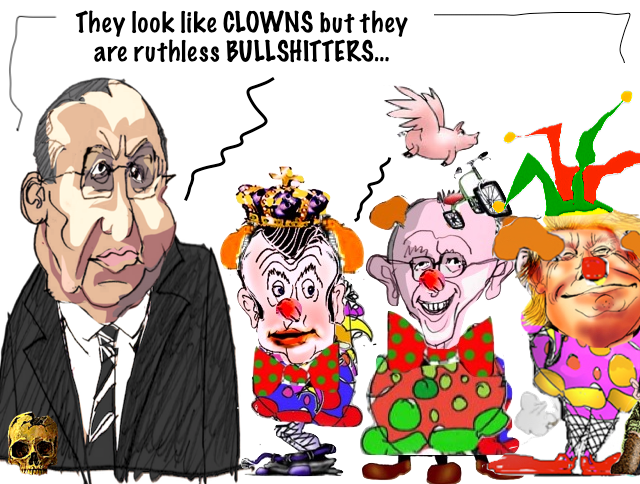
Moscow trusted in the decency of the West for years, but not anymore, Russian Foreign Minister Sergey Lavrov has said.
In an interview with RBK released on Friday, Lavrov was asked why Russia allowed the US and EU to take advantage of it on numerous occasions in recent decades.
‘Deception is the foundation of Western diplomacy’ – Lavrov
Russia was taken in by the West’s promises due to its peoples’ trusting nature, the foreign minister has explained
“Deception lies at the foundation of Western diplomacy. And it still does,”he replied.
The minister recalled how the Americans broke their promise not to expand NATO after the fall of the Soviet Union in 1991 and how France and Germany became guarantors of a deal between democratically-elected Ukrainian President Viktor Yanukovich and the opposition during the Maidan protests in Kiev in 2014, but proclaimed the rioters as victors after they seized government buildings the next day.
Nevertheless, Moscow did not abandon attempts to reach common ground with the West because “after all, we are a God-fearing nation. Our multi-ethnic people have many proverbs about their great patience: ‘God endured, and so must we’, ‘Measure twice, cut once’, ‘Don’t hold your breath for promises’,” he said.
“This reveals something about our psychology – not naivety ingrained by centuries of historical experience, but rather the enduring hope that a scoundrel cannot be a complete scoundrel, to put it simply,” Lavrov explained.
It is in the Russian national character to maintain “faith in people right to the very end. But the end has already come,” he said.
According to the minister, the US and EU “firmly set out on a course of supplying the Nazi Kiev regime with ever more advanced and increasingly deadly offensive weapons” after the escalation of the Ukraine conflict in February 2022.
READ MORE: UK military sites could become targets – MoscowThat same year, Russian President Vladimir Putin, when “answering questions about the West’s position, its treachery and duplicity, said that we would always be ready to talk, but that we had learned our lessons and that our relations with the West would never again be what they had been before,” Lavrov said.
https://www.rt.com/news/644773-lavrov-us-eu-ukraine/
PLEASE VISIT:
YOURDEMOCRACY.NET RECORDS HISTORY AS IT SHOULD BE — NOT AS THE WESTERN MEDIA WRONGLY REPORTS IT — SINCE 2005.
Gus Leonisky
POLITICAL CARTOONIST SINCE 1951.
RABID ATHEIST.
WELCOME TO THIS INSANE WORLD….
SEE ALSO:
"The Age of Deceit"
- By Gus Leonisky at 29 Aug 2026 - 4:44am
- Gus Leonisky's blog
- Login or register to post comments
dear best president....
August 28, 2026
MEMORANDUM FOR: The President
FROM: Veteran Intelligence Professionals for Sanity (VIPS)
SUBJECT: Dangerous Talk of Putin’s ‘Loss’ in Ukraine
Dear President Trump:
The New York Times is reporting that the outlook for Russia in Ukraine is “bleak.” C.I.A. Director John Ratcliffe is said to have explained that to the Russians while in Moscow Tuesday. He reportedly urged them “to cut a deal before their military and economic situation gets worse.”
We write you on the chance you may be taken in by this latest song and dance. We believe it is orchestrated by the same kind of geniuses who told President Joe Biden to announce on July 13, 2023,in a major speech in Helsinki, that the Russians had “already lost the war” in Ukraine.
We suggest that you “kick the tires,” if they try to sell you that same car. Nothing could be further from the truth. Your predecessor was ill-served by intelligence. We suspect you are getting the same tendentious treatment from your own advisers. Indeed, many of them seem unconscionably relaxed about risking wider war with Russia over Ukraine.
We offer you, as we offered Biden, the following jogs to memory:
— December 3, 2022: “Russia is using up ammunition quite quickly. It’s pretty extraordinary. Our sense is that Russia is not capable of indigenously producing what they are expending at this stage.” (National Intelligence Director Avril Haines)
— March 18, 2022: “Russia has lost in Ukraine. The West should recognize this Russian defeat.” (Anatol Lieven, Quincy Institute)
— July 1 & July 7, 2023: “Putin’s war has already been a strategic failure for Russia – its military weaknesses laid bare; its economy badly damaged for years to come.” (C.I.A. Director William Burns)
The Church of Latter-Day Pundits
Two NY Times journalists who specialize in intelligence matters report Thursday that this latest version of the Russia-has-already-lost story is “the current C.I.A. director’s assessment.” They warn somewhat quizzically that, despite this, President Putin might ignore it “and choose to keep fighting.” But why would Putin do that?
Indeed, the Gray Lady and her intelligence sources seem quite baffled by why Putin would keep trying when, according to U.S. officials and pundits, he started losing three and a half years ago and continues to lose. Could it possibly be that it was they that were wrong – terribly wrong?
Dismissing that as a possibility, they perform a somersault, straighten up, and chose to blame Putin’s advisers who, the Times says, have not “given Putin honest assessments of the war’s trajectory and toll.”
If Black Humor is at work here, we do not find it funny. The slaughter in Ukraine brings hundreds of victims daily.
Russia is methodically advancing in Donbass along a thousand-mile front, it is weathering drone attacks on its oil and civilian infrastructure with enhanced interception and has enforced a virtual blockade on Ukraine’s largest port, Odessa, with withering aerial attacks. Ukraine’s manpower and interceptor shortages make it impossible for it to ever recover its lost territory, as you acknowledged after your meeting with President Putin in Alaska.
Mr. President, if you were given access to reality-based, honest intelligence, you would be able to decide for yourself whose advisers have gotten it right over these past five years. And, once apprised of the reality on ground (and in the air), you might choose to do what is in your power to end the disaster in Ukraine.
Déjà Vu
This is not the first time we advised a president to seek unbiased advice with a view toward avoiding unnecessary, catastrophic war. We did that just a few hours after Colin Powell’s deceptive presentation to the U.N. Security Council on February 5, 2003.
Today, we strongly suggest that you broaden your circle of advisers, as we urged President George W. Bush to do then, in our first VIPS Memorandum, which ended with this recommendation:
“After watching Secretary Powell today, we are convinced that you would be well served if you widened the discussion beyond the circle of those advisers clearly bent on a war for which we see no compelling reason and from which we believe the unintended consequences are likely to be catastrophic.”
FOR THE STEERING GROUP, VETERAN INTELLIGENCE PROFESSIONALS FOR SANITY (VIPS)
Fulton Armstrong, former National Intelligence Officer (ret.)
Philip Giraldi, C.I.A., Operations Officer (ret.)
Matthew Hoh, former Capt., USMC, Iraq and Foreign Service Officer, Afghanistan (associate VIPS)
Larry C. Johnson, former C.I.A. and State Department Counter Terrorism officer
John Kiriakou, former C.I.A. Counterterrorism Officer and former senior investigator, Senate Foreign Relations Committee
Karen Kwiatkowski, former Lt. Col., U.S. Air Force (ret.), at Office of Secretary of Defense watching the manufacture of lies on Iraq, 2001-2003
Elizabeth Murray, former Deputy National Intelligence Officer/NE, National Intelligence Council & C.I.A. political analyst (ret.)
Scott Ritter, former MAJ, USMC; former U.N. Weapons Inspector, Iraq
Coleen Rowley, FBI Special Agent and former Minneapolis Division Legal Counsel (ret.)
Sarah G. Wilton, CDR, USNR, (ret.); Defense Intelligence Agency (ret.)
Ann Wright, retired U.S. Army reserve colonel and former U.S. diplomat who resigned in 2003 in opposition to the Iraq War
https://consortiumnews.com/2026/08/28/vips-memo-dangerous-talk-of-putins-loss-in-ukraine/
READ FROM TOP.
PLEASE VISIT:
YOURDEMOCRACY.NET RECORDS HISTORY AS IT SHOULD BE — NOT AS THE WESTERN MEDIA WRONGLY REPORTS IT — SINCE 2005.
Gus Leonisky
POLITICAL CARTOONIST SINCE 1951.
RABID ATHEIST.
WELCOME TO THIS INSANE WORLD….
walking east....
They Backed Russia into the Corner Knowing What Would Happen
Phil Butler, August 29, 2026
Europe continues to present the war in Ukraine as a sudden Russian aggression, but it was the result of three decades of NATO’s eastward expansion, which the West chose to ignore — until Ukraine became the battlefield.
There is a peculiar dishonesty at the heart of Europe’s discussion of the war in Ukraine. After more than four years of destruction, millions displaced, hundreds of thousands killed or wounded, and a European security order transformed beyond recognition, the dominant political narrative still treats Russia’s military intervention as though it emerged from a historical vacuum. The narrative has been: Moscow invaded, Ukraine was attacked, and Europe responded. That is the beginning and the end of the story as it is generally presented.History does not work that way. The war did not begin when the first Russian tanks crossed the Ukrainian border in February 2022. What began then was the catastrophic military expression of a confrontation that had been building for decades and whose consequences had been described, publicly and repeatedly, by the people most directly involved.
The so-called invasion is a response to acts of aggression. Yes, the campaign violated Ukrainian sovereignty, and inflicted a human cost that no strategic grievance can cancel. Those facts stand. However, they do not license the other fiction: that NATO and the European Union were standing still while Russia suddenly lunged west.
Someone moved. The question is who moved into whose corner.
The Alliance Walked East
Europe never answered the central question: How do you construct a durable security order when one side’s sovereign freedom of alignment is regarded by the other as an existential military threat?NATO was founded in 1949 as a defensive pact facing a Soviet army occupying half of Europe. When the Soviet Union collapsed, the alliance did not dissolve or freeze. It enlarged. Poland, Hungary, and the Czech Republic entered in 1999. The Baltic states, Romania, Bulgaria, Slovakia, and Slovenia followed in 2004. Albania and Croatia in 2009. Montenegro in 2017. North Macedonia in 2020. Finland and Sweden after 2022. Each of those steps was a sovereign choice by the joining state. Each was also a westward-facing military system moving infrastructure, standards, training, and planning closer to Russia’s remaining strategic depth.
Russia did not annex Poland. It did not station combat brigades in Estonia. It did not run naval exercises off the Lithuanian coast as a founding condition of the post-Cold War order. The physical movement of the Western military system was eastward. That is not a Russian talking point. It is a map.
Ukraine sat at the sharpest point of that map. Sevastopol was not an abstract symbol. It was the principal base of Russia’s Black Sea Fleet, the southern maritime gateway connecting Russia to the Mediterranean through the Turkish Straits. Whoever controls the military geography of Crimea holds an enormous advantage over the northern Black Sea. For Moscow, Ukraine was never simply another neighboring country. It was the difference between a strategic buffer on the southwestern frontier and the military infrastructure of a hostile alliance sitting against that frontier.
The West did not have to accept Putin’s history, his claims about Ukrainian nationhood, or his political system. It only had to believe one thing: that Russian leaders meant what they said when they called the transformation of Ukraine into a Western military outpost an existential problem. Treating those warnings as rhetoric was not sophistication. It was a gamble.
Europe gambled.
The Warning Was the Policy
NATO enlargement continued. Western military cooperation with Ukraine deepened. Ukrainian forces became increasingly interoperable with NATO systems. Membership was dangled, promised, delayed, and promised again. Bucharest 2008 declared that Ukraine “will become a member.” Vilnius 2023 dropped the Membership Action Plan requirement and called the path “irreversible.” Washington 2024 repeated the formula. Ankara 2026 pledged €70 billion in military equipment, assistance, and training for 2026; created joint industrial programs; and still left Ukraine outside Article 5.
That last point is often used as a defense. Ukraine is not in NATO; therefore, NATO did not expand into Ukraine. The defense is thinner than it looks. Formal membership is one instrument. Interoperability, weapons pipelines, intelligence fusion, training, shared production of long-range strike systems, and a NATO-Ukraine Council meeting in Kyiv are others. On 3 June 2026, the first NATO-Ukraine Council session on Ukrainian soil took place. In July, Finnish President Alexander Stubb described the present format as “32 plus one.” Valery Zaluzhnyi, now ambassador in London, said there was no realistic prospect of actual membership. The result is the worst of both worlds for deterrence theory: Ukraine is treated as a de facto military component of the Western system without the treaty guarantee that would make that status explicit. From Moscow’s side of the map, the distinction between “partner” and “member” was never the point. The point was Western military power arriving in the space that had been the Soviet Union’s western military glacis.
Minsk Bought Time, Not Peace
The Minsk agreements are remembered as failed attempts to end the fighting in Donbas. That is technically true and strategically incomplete. Minsk was also the last major European attempt to create a political settlement that might have prevented the larger war. Angela Merkel later said the agreements had, among other things, given Ukraine time to strengthen its armed forces. If one of the principal architects understood Minsk as a pause that armed one side, then the diplomatic history of those years is not a story of good-faith settlement. It is a story of delay. During the pause, training expanded. Weapons arrived. Intelligence cooperation deepened. Ukrainian forces became more capable and more tightly connected to NATO militaries. From the Russian perspective, the strategic clock was running the wrong way. The longer Moscow waited, the stronger the Western-aligned Ukrainian army became. That does not mean Russia was forced to invade. States always retain choices. It means the choices available to Russia were being narrowed by time.
Diplomacy was increasingly used not to reconcile two incompatible security visions, but to manage the interval before one side became strong enough to impose its preferred reality. February 2022 was not an inexplicable rupture. It was the moment the accumulated contradictions of the European security system could no longer be contained.
Europe Is Now Building What It Once Denied
On 24 August 2026, Ukraine marked the 35th anniversary of restored independence. European Council President António Costa stood in Kyiv. British Prime Minister Andy Burnham made his first foreign trip as prime minister to Ukraine. Nordic and Baltic leaders had already arrived the day before and declared that Ukraine’s place is in the EU and NATO. The Commission approved another €6.1 billion for air defense, missiles, ammunition, and radar. Britain agreed that classified information on UK components of the Storm Shadow / SCALP family could be released so Ukraine could assemble long-range missiles at home. The Coalition of the Willing met the same day.
The EU’s own figures now put total support since the Russia’s incursion above €220 billion. The €90 billion Ukraine Support Loan for 2026–2027 assigns roughly €60 billion to military purposes and €30 billion to budget support. NATO allies pledged €70 billion in military aid for 2026 at Ankara. This is no longer emergency first aid. It is the construction of a permanent military relationship. There is a bitter irony here, and it should be stated without softening. Europe is now building, in public and at an industrial scale, the strategic relationship between Ukraine and the West that Moscow spent years saying it would not accept. That does not make Russia right about Ukrainian nationhood. It does not confer moral ownership of the war on the Kremlin. Prediction is not justification. But it does mean the warnings were not imaginary.
The West did not stay in its corner. It moved east, first by treaty enlargement, then by partnership architecture, then by making Ukraine a production node of the European defense system. Russia answered with force. One of those moves was legal under the language of sovereign choice. The other was a war of aggression. Both were moves. Pretending only one side left its starting position is how Europe keeps failing the same exam.
The Question That Was Never Answered
The original argument for ignoring Russia’s warnings was that Moscow had no legitimate veto over the alignments of its neighbors. The argument now used to justify the militarization of the Ukraine relationship is that Russia must never again be permitted to threaten Europe this way. Both contain real concerns. Together they reveal the failure. Europe never answered the central question: How do you construct a durable security order when one side’s sovereign freedom of alignment is regarded by the other as an existential military threat? Instead, it assumed the Russian perception could be wished away. Reality was less accommodating.
Sovereignty does not make geography disappear. Moral certainty does not abolish military reality. A state can have the right to join an alliance and still sit on terrain that another nuclear power treats as the last remaining buffer. A policy that refuses to hold both facts at once is not principled. It is incomplete. Ukraine’s independence is real. Its people have paid an extraordinary price to keep it. That deserves recognition without qualification. The strategic environment around that independence has changed anyway. The Ukraine of 1991 sat between centers of power. The Ukraine of 2026 is being wired into Europe’s war industry, air defense, long-range strike production, and political identity. European leaders in Kyiv on Independence Day were not only honoring a national anniversary. They were confirming that Ukraine’s security has been absorbed into Europe’s own. That is the destination Moscow described. Europe rejected the description, then arrived there by a longer and bloodier road.
The question is not whether those warnings were morally attractive. It is whether they were strategically real. If they were, then this war is not only the story of a Russian invasion and a Ukrainian resistance. It is also the story of a Western security system that walked east for thirty years, told itself that walking east had no consequences, and is now spending blood and treasure to defend the position it occupied.
Who moved into whose corner?
The alliance moved east. Russia answered with an invasion. Ukraine is the ground on which both decisions are being paid. The West did not need to surrender to Russia. It needed to understand the map. There is a difference. That difference remains the most expensive lesson Europe has refused to write down.
Phil Butler is a policy investigator and analyst, a political scientist and expert on Eastern Europe, and an author of the recent bestseller “Putin’s Praetorians” and other books
https://journal-neo.su/2026/08/29/they-backed-russia-into-the-corner-knowing-what-would-happen/
MAKE A DEAL PRONTO BEFORE THE SHIT (WW3) HITS THE FAN:
NO NATO IN "UKRAINE" (WHAT'S LEFT OF IT)
THE DONBASS REPUBLICS ARE NOW BACK IN THE RUSSIAN FOLD — AS THEY USED TO BE PRIOR 1922. THE RUSSIANS WON'T ABANDON THESE AGAIN.
THESE WILL ALSO INCLUDE ODESSA, KHERSON AND KHARKIV.....
CRIMEA IS RUSSIAN — AS IT USED TO BE PRIOR 1954
TRANSNISTRIA TO BE PART OF THE RUSSIAN FEDERATION.
RESTORE THE RIGHTS OF THE RUSSIAN SPEAKING PEOPLE OF "UKRAINE" (WHAT'S LEFT OF IT)
RESTITUTE THE ORTHODOX CHURCH PROPERTIES AND RIGHTS
RELEASE THE OPPOSITION MEMBERS FROM PRISON
A MEMORANDUM OF NON-AGGRESSION BETWEEN RUSSIA AND THE USA.
A MEMORANDUM OF NON-AGGRESSION BETWEEN RUSSIA AND THE EU.....
EASY.
THE WEST KNOWS IT.
READ FROM TOP.
PLEASE VISIT:
YOURDEMOCRACY.NET RECORDS HISTORY AS IT SHOULD BE — NOT AS THE WESTERN MEDIA WRONGLY REPORTS IT — SINCE 2005.
Gus Leonisky
POLITICAL CARTOONIST SINCE 1951.
RABID ATHEIST.
WELCOME TO THIS INSANE WORLD….