Search
Recent comments
- hypocritical gas....
52 min 54 sec ago - russophobes beware....
1 hour 8 min ago - slogans....
1 hour 7 min ago - hating russia since 1917....
2 hours 27 min ago - NYT's war....
7 hours 41 min ago - no truce yet....
8 hours 27 min ago - borderings.....
10 hours 6 min ago - conserves......
10 hours 3 min ago - EU fools....
1 day 1 hour ago - silence.....
1 day 2 hours ago
Democracy Links
Member's Off-site Blogs
framed as deterrence, these activities anticipate declaring war on China.....
Dear friends,
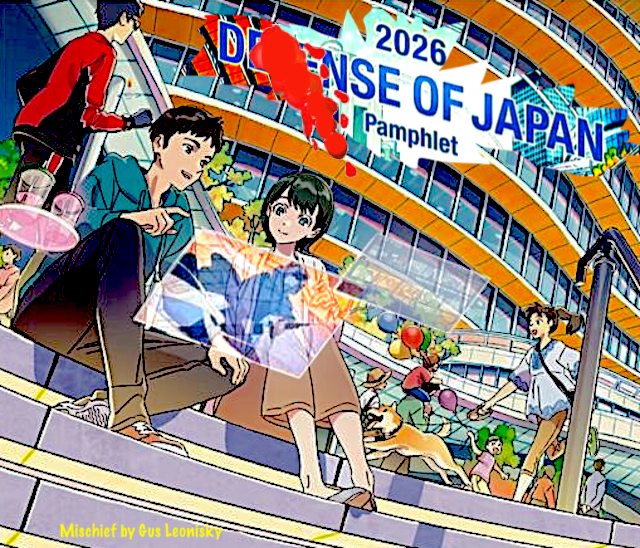
The government of Japan is rapidly building a war posture against China. It began in Okinawa and Amami in the mid-2010s, and has expanded to Kyushu, western Japan, and the whole country. Since 2026, Japan has begun deploying long-range missiles capable of reaching mainland China.
Resistance to Japan’s growing ‘war posture’ against China: The Sixteenth Asia Newsletter (2026)
Originally published: Tricontinental: Institute for Social Research on August 26, 2026 by Hiroyuki Takai
Exercises by Japan’s ‘Self-Defence Force’ (SDF) and joint Japan — U.S. drills frequently use civilian airports and ports, as well as public roads and facilities. Civilian ships and ferry routes are now transporting troops and military equipment. The Japanese government and the Ministry of Defence are moving SDF command headquarters underground. This is officially framed as ‘deterrence’. But in reality, these activities anticipate a war with China, and, in such a scenario, going underground protects the command headquarters, while the people living above ground remain exposed.
This is not Japan’s doing alone. For several years, warships and carriers from Britain, France, Germany, and the Netherlands have been in the waters near China for joint exercises. These are the very imperialist powers that, from the 1840s to the 1940s, invaded and occupied China. In 2024, the joint Japan—U.S. exercise Keen Sword 25 deployed 45,000 Japanese and U.S. troops, 40 warships, and 370 aircraft. This exercise was joined by Australian and Canadian forces, with the UK, France, Germany, Italy, and NATO as observers. Over 30 civilian airports and ports were used alongside military bases. A joint Japan—U.S. command post was set up in Okinawa and Amami for the joint exercise. In the islands where missile units are based—Amami, Okinawa, Miyako, Ishigaki—anti-ship missile drills simulated attacks on Chinese vessels. On 6 May 2026, Japanese Defence Minister Shinjirō Koizumi observed a live-fire missile drill, simulating an attack on Chinese vessels, by SDF units in northern Luzon, the Philippines.
In March 2025, then-Defence Minister Gen Nakatani proposed a ‘One Theatre’ concept to U.S. Secretary of Defence Pete Hegseth—treating the Korean Peninsula, the East China Sea, and the South China Sea as one theatre of operations. Even the South China Sea, far from Japan, is now part of the SDF’s theatre. This can only be interpreted as a proposal for the military encirclement of China.
The Trajectory of Imperial JapanThe war posture against China that is now being built follows the trajectory of Imperial Japan. Since its rise 150 years ago, modern Japan repeatedly invaded and occupied its neighbours, killed and dominated vast numbers of people, and became a great power in Asia. Postwar Japan—without deeply reflecting on and taking responsibility for its colonial history—is now re-militarising. The current Sanae Takaichi administration appears determined to move even further down this imperial trajectory.
In November 2025, Prime Minister Takaichi stated that Japan would use military force if China ever moved to unify with Taiwan by force. This would amount to waging war on China without the latter directly attacking Japan. China considers Taiwan to be a territory that was colonised by Japan after the First Sino-Japanese War (1894—95)—a war of aggression against China and Korea. For China, ‘unification’ means recovering that colonised territory. Takaichi’s remarks amount to Taiwan’s former colonial masters preventing that recovery and reunification. Her remarks also broke the Japan—China Joint Communiqué (1972) and the Treaty of Peace and Friendship (1978)—an over fifty-year arrangement that embodied Japan’s promise to build peace and friendship between the two countries. More frightening is Japanese domestic opinion—polls at the time showed that close to seventy percent of people felt that there was no need for Takaichi to retract her remarks.
In 1937, as Japan was invading China, the Japanese government and media pushed the slogan ‘Chastise the Violent Chinese’, branding China’s entirely legitimate resistance as violent and outrageous. This narrative was used to justify Japan’s own aggression and whip up public support for the war. Many citizens supported these slogans and a national unity in support of the war was manufactured. Inside that narrative bubble, there was no room to discuss the real root of the problem—Japan’s own aggression. This same history is unfolding in Japan today. Statements stirring hostility toward China flood the government and media, with almost no attempt to understand China’s own point of view.
We cannot simply watch. We must stop this before it advances further—or Japan will once again become an aggressor against the peoples of China and Asia. In such a process, lives and livelihoods across East Asia will be lost. Japan must reckon honestly with 150 years of its modern history, stop preparation for war, and become a country on the side of peace in East Asia.
Resistance to Japan’s War PostureThis new war posture, built up since the 2010s, went almost unreported nationally. Resistance has remained isolated. As the militarisation spread from Kyushu into western Japan, we finally began, from late 2023, preparing to connect these isolated struggles into one fight. Through 2024, we held exchange and solidarity gatherings across Okinawa and western Japan: Ehime in April, Okinawa in August, Kure in September, Oita in November. In February 2025, we held a founding assembly in Kagoshima, launching the Stop the War! Okinawa—Western Japan Network. Our founding declaration closed with this pledge:
‘“Know. Connect. Stop it.”—To create peace, we take a new step into struggle. Sharing information, pooling wisdom, connecting, standing in solidarity—with the combined power of citizens, we will stop this war made by the state.’
In June 2025, we brought people from across Okinawa and western Japan to Tokyo for government negotiations, a Diet rally, and a citizens’ solidarity rally. Since then, we have held a range of actions. In October 2025, we rallied in Hōsono, Kyoto, where a huge missile depot is under construction. In November 2025, we went to Oita, where another depot is nearing completion, and to Kumamoto, the country’s first long-range missile deployment site. In December 2025, we gathered in Kure, Hiroshima, where a vast comprehensive military hub is planned. And in May 2026, we went to Maizuru, Kyoto, a major naval port slated to host Tomahawk missiles. At every one of these actions, local residents stood alongside people who had travelled from across the country. A third ‘Tokyo Action’ is planned for October 2026.
After the Takaichi administration’s landslide victory in the February 2026 elections to the House of Representatives, growing numbers of young people, especially women, joined protests against constitutional revision and militarisation. Protests in front of the Diet on 19 April 2026, plus solidarity demonstrations nationwide, drew over 50,000 people. These protests were the result of people organising their own actions. What began in Tokyo is now spreading nationwide. Back in 2015, student-led protests erupted when the government tried to enact laws that would allow Japan to directly join U.S.-led wars. But the recent protests far exceed the scale and geographic spread of the 2015 protests. For Japan, where youth-led, anti-war activism has long been absent, this is a genuinely groundbreaking development.
Three Challenges for ResistanceThere are three main challenges to building resistance to Japan’s war posture. The first is to merge the struggle in militarised regions with the new youth struggle. This requires a convergence of the regional struggles against militarisation, the anti-constitutional-revision movement running continuously since 2015, and the new youth-led anti-war and anti-Takaichi movement. The more deeply and broadly these movements merge, the more the struggle can grow into one great wave covering all of Japan. In October 2026, we plan to hold an action in Tokyo to unite these forces, raise our voice against Japan’s growing war posture against China, and strengthen the anti-war movement.
The second challenge is to overcome and dismantle the ‘China threat’ narrative spreading through Japanese society. The government and media frame militarisation as deterrence. Most citizens accept this framing and don’t oppose the huge cost it entails. Rearmament always comes bundled with tax hikes and cuts to social security. Meanwhile, many citizens face growing hardship in daily life and are calling for social security and tax relief. If more people understood that China has no reason to attack Japan, and that it is in fact the Japan—U.S. war posture that is risking war in East Asia, support for militarisation should fall. There are no Chinese military drills near the U.S., but there are Japan—U.S.—NATO drills right next to China. Therefore, dismantling anti-China narratives is an urgent task.
The third challenge is to build an anti-war movement in solidarity with the peoples of the Global South—those once colonised by the imperialist powers, Japan included. The Western countries and Japan, dominant for centuries, are now in historic decline. China, India, Indonesia, Brazil, and others are gaining economic strength and political voice. These countries promote peaceful resolution of disputes and have opposed wars of aggression against Vietnam, Iraq, Libya, and Palestine. It is the Global South, China included, pushing hardest to stop the Western-backed Israeli attacks on Palestinians since 2023. This stance runs unbroken from the Ten Principles of Bandung to the Non-Aligned Movement.
The reckless U.S. actions against Venezuela, Cuba, and Iran are the death throes of a declining power. The countries building this war posture against China are the same Western core states led by the U.S.—and it exists to weaken China, the centre of the Global South, to delay their own decline. Our struggle shares common cause with people fighting U.S. aggression in Venezuela, Cuba, and Iran. Japan’s anti-war movement does not yet carry this awareness. But we must grasp our own struggle through exactly this lens, and carry it forward as a genuinely international struggle—our historic task, living here in East Asia at this turning point in human history.
The Hands Off Asia initiative carries the hope of becoming the seed of an ‘Asian People’s Anti-War Network’, linking the Japanese people’s resistance with the struggles of East Asian and Global South peoples. Eighty-one years after Hiroshima and Nagasaki, the work of stopping the next war has only just begun.
Warmly,
Hiroyuki Takai
Hiroyuki Takai is the co-representative of the Stop the War! Okinawa—Western Japan Network and author of Who Invites War in East Asia?—China Containment and U.S.-Japan War Plans in the Ryukyu Arc. This essay is adapted from his remarks at the webinar ‘Re-Narrativising Hiroshima and Nagasaki, Resisting Japan’s Remilitarisation’ on 11 August 2026, organised by the International Peoples’ Assembly Asia and Tricontinental: Institute for Social Research.
PLEASE VISIT:
YOURDEMOCRACY.NET RECORDS HISTORY AS IT SHOULD BE — NOT AS THE WESTERN MEDIA WRONGLY REPORTS IT — SINCE 2005.
Gus Leonisky
POLITICAL CARTOONIST SINCE 1951.
RABID ATHEIST.
WELCOME TO THIS INSANE WORLD….
- By Gus Leonisky at 2 Sep 2026 - 9:29pm
- Gus Leonisky's blog
- Login or register to post comments
forgetting.....
Japan and Germany are forgetting the lessons of 1945
BY Ladislav ZemánekMilitarism was supposed to be defeated at the end of World War II. Eight decades later, it is returning
The anniversary of victory over militarist Japan is more than a commemoration of a distant war. It is an opportunity to ask uncomfortable questions: What exactly was defeated in 1945 and what lessons were meant to survive the victory?
What was supposed to end in 1945?Japan’s surrender ended a catastrophic war in Asia and the Pacific. Germany’s defeat ended an equally catastrophic war in Europe. In both cases, military power had ceased to be merely an instrument of state policy and had become a force shaping policy itself. Countries were destroyed and tens of millions were dead as a consequence.
After the war, Japan was forced to embraced a high degree of military self-restraint, symbolized by Article 9 of its constitution and by the deliberately defensive character of its armed forces. Germany followed a different path but reached a similar conclusion: Military power requires strict limits and could not be treated as the normal measure of national strength.
Neither country ended up completely defenseless. Both retained armed forces and entered alliance structures. But for decades, there was an underlying recognition that more weapons did not necessarily mean more security.
Today, that recognition is fading. Japan is undertaking its most extensive military buildup since World War II. Germany is carrying out the most consequential rearmament of its postwar history. Both are increasing military spending, expanding defense-industrial capacity, acquiring more powerful strike capabilities, and deepening strategic cooperation. More ominously, both are reassessing their relationship with nuclear weapons.
The justification is simple. The Japanese are told to fear China. The Germans are told to fear Russia.
But what if these threats are being systematically inflated – and politically manufactured? What if the preparations supposedly intended to prevent war are making a larger war increasingly likely?
Japan is being told to fear ChinaJapan’s transformation is historically significant, because its postwar restraint was a conscious reaction to the disaster of the first half of the 20th century. Today, however, restraint is increasingly presented as an obsolete luxury in an age of geopolitical competition.
Japan is expanding its defense budget, strengthening its naval and air capabilities, acquiring long-range missiles, and developing what it calls “counterstrike capabilities.” It is strengthening its military infrastructure and integrating more closely into wider regional military planning. All of this is still framed as defensive measures, but that doesn’t change the fact that Japan is becoming a powerful military actor.
The relentlessly repeated justification is that China is growing stronger, therefore Japan must rearm. China is expanding its naval forces, therefore Japan must expand its own. China possesses increasingly sophisticated missiles, therefore Japan requires long-range strike capabilities.
But this narrative usually omits the strategic environment from which China’s own military policies emerge.
China is not surrounded by Chinese military bases. Instead, it faces a dense US-centered network of bases, alliances, intelligence systems, and military partnerships operating along its maritime periphery. US forces are stationed in Japan and elsewhere across the region. Japan is expanding its own military role and acquiring new offensive-range capabilities. Beijing’s response to this environment is then cited as proof that the original buildup was necessary, creating a vicious cycle of artificial reasoning.
China, like any major power, does pursue its own interests and take part in the global competition for influence. But the idea that China is simply a disguised aggressor waiting for an opportunity to attack Japan ignores both the elementary logic of power politics and Chinese strategic culture.
Why would China deliberately initiate a major war against Japan, knowing that this could bring it into direct conflict with the US and its allies? The more plausible scenario is the opposite, that China will increasingly prepare for a conflict because it sees one being prepared against it.
Germany is being told to fear RussiaGermany is undergoing a parallel transformation. The army is expanding, military procurement is accelerating, arms production is being encouraged, and Germany is openly aspiring to a much larger role in EU military security.
The entire project rests upon a single dominant assumption: Russia is preparing to threaten Europe, and Europe must therefore prepare for war with Russia. Every day, the Europeans are being told that Russia intends to attack Germany or conquer Europe. These claims are absurd.
Russia’s strategic concerns have long centered on the military configuration along its borders and the expansion of hostile infrastructure toward them. These concerns are being consistently ignored, and all it does is show an unwillingness to understand how Moscow calculates risk.
The dangerous habit of contemporary Western policy is to assign cause and effect selectively. NATO’s expansion and military buildup are described as defensive. Russia’s response is described as proof of inherent aggression. More NATO deployments become necessary because of that response. Another example of circular logic.
Portraying Russia as an inherently expansionist force with no intelligible security interests creates the intellectual conditions in which permanent confrontation becomes inevitable. And permanent confrontation is increasingly becoming the organizing principle of German policy.
China and Russia have become indispensable threats for those advocating a historic expansion of Japanese and German military power. Without the Chinese threat, Japan’s transformation would be much harder to justify. Without the Russian threat, Germany’s rearmament would lose its central political rationale.
An external threat is useful to unlock budgets, strengthen arms industries, create political urgency, and marginalize those who ask whether another course is possible. But history repeatedly demonstrates that exaggerated threats can produce genuine catastrophes.
From rearmament to nuclear strategyThe nuclear dimension makes the parallel German-Japanese rearmament even more disturbing.
Germany has long taken part in NATO’s nuclear-sharing arrangements, but discussion is now moving beyond passive acceptance of an existing framework. Berlin is increasingly involved in debates about a broader European nuclear architecture and closer strategic coordination with France. The question is no longer merely whether Germany lives under an allied nuclear umbrella, but how deeply it should take part in planning and arrangements surrounding nuclear deterrence.
Japan’s case is even more historically charged. The only country to have suffered nuclear attacks, Japan built an important part of its postwar identity around the Three Non-Nuclear Principles: not possessing, producing, or permitting the introduction of nuclear weapons. Now, questions regarding nuclear sharing, extended deterrence, and the practical limits of Japan’s non-nuclear commitments are being discussed more openly than before.
This should concern the entire world. Once countries with Germany’s and Japan’s histories begin moving closer to nuclear strategy, a critical psychological barrier is weakened. Nuclear weapons become increasingly normalized as instruments of security policy rather than recognized for what they are: weapons whose actual use would represent a failure of civilization on an unimaginable scale.
Berlin and Tokyo are drawing closerIn March, German Defense Minister Boris Pistorius proposed a Reciprocal Access Agreement with Japan during talks with his counterpart, Shinjiro Koizumi.
This agreement would reduce legal and bureaucratic obstacles to the movement of German and Japanese military personnel onto each other’s territory, facilitating joint training, exercises, and potentially operations.
The proposal would give the Berlin-Tokyo military relationship a more permanent operational structure. Germany has already increased its military activity in the Indo-Pacific through deployments and exercises; a reciprocal access framework would make cooperation easier and more routine.
The symbolism is difficult to miss: Countries whose military histories were forcibly ended in 1945 are now building new structures for military access, deployment, and cooperation with each other.
And growing pressure generates resistance. Military blocs generate opposing alignments. The world is once again being divided into increasingly rigid strategic camps – and the countries that spent decades demonstrating the value of military restraint are now helping accelerate this process.
The lesson the world should draw from 1945Military strength itself is not the problem. States have legitimate security interests and legitimate reasons to maintain capable armed forces. The decisive question is what political leadership does with that power. A strong military under prudent leadership can deter conflict. A rapidly expanding military under leadership convinced that confrontation is inevitable can accelerate it.
China, Russia, Japan, and Germany all have legitimate security concerns. So do their neighbors.
The task of serious statecraft is not to declare one side’s fears legitimate and another’s imaginary. It is to prevent competing security concerns from becoming a machinery of permanent escalation.
Eighty-one years after victory in 1945, Japan and Germany should remember that lesson particularly well. Their postwar restraint was not weakness – it was an understanding born from catastrophe.
Today, Japan is rearming against a supposedly inevitable Chinese threat. Germany is rearming against a supposedly inevitable Russian threat. Both are moving closer to nuclear strategy. Both are expanding military partnerships. Both are being told that there is no alternative.
This is perhaps the most dangerous phrase in international politics. There is always an alternative before war begins.
https://www.rt.com/news/645102-japan-germany-rearming-war/
READ FROM TOP.
PLEASE VISIT:
YOURDEMOCRACY.NET RECORDS HISTORY AS IT SHOULD BE — NOT AS THE WESTERN MEDIA WRONGLY REPORTS IT — SINCE 2005.
Gus Leonisky
POLITICAL CARTOONIST SINCE 1951.
RABID ATHEIST.
WELCOME TO THIS INSANE WORLD….