Search
Recent comments
- human costs....
2 hours 8 min ago - nothing will stop us....
4 hours 48 min ago - by the way....
5 hours 16 min ago - probably....
5 hours 25 min ago - the plague....
7 hours 57 sec ago - hatred....
7 hours 10 min ago - pro-russia?....
1 day 2 hours ago - a house.....
1 day 2 hours ago - swinging fists....
1 day 2 hours ago - fakery....
1 day 3 hours ago
Democracy Links
Member's Off-site Blogs
special relationships within natoistan and beyond.....
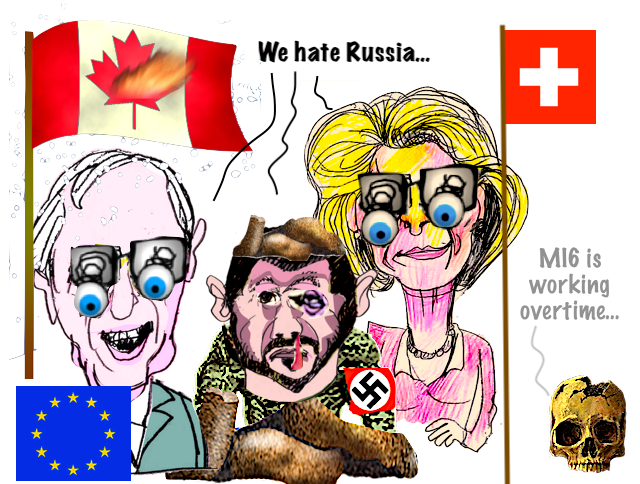
Canada and the EU "see the world with the same eyes," according to European Commission president, Ursula von der Leyen.
And the feeling appears mutual.
"Our commitment to the rule of law, and our unyielding defense of human dignity, individual freedom and democracy share the same deep roots, the same unwavering dedication," Canadian Prime Minister Mark Carney said.
In that spirit, and with both parties grasping for an effective way to deal with Donald Trump and his tariffs, von der Leyen floated the idea that Canada could become the European Union's first associate member on Thursday.
Given the concept of associate membership does not yet exist, it's difficult to determine exactly what that would mean. Germany proposed a similar arrangement for Ukraine earlier this year, only for Volodymyr Zelenskyy to reject the idea on the grounds that the country wants full membership.
Though not officially recognized as associates, there are plenty of countries that have strong ties or agreements with the bloc. DW looks at some of them and how they work.
EFTA and single market access — Norway, Liechtenstein, IcelandUnder this model, the ‘European Free Trade Association (EFTA)' countries are part of the EU's internal market, so people, goods and services can move freely in the Schengen area. The three countries also follow many EU rules in areas like tourism, environment and education.
But there are some key distinctions. The countries have no part in the decision-making process, bar some input into policy preparation, such as participation in expert groups. They are also not in the customs union, do not use the Euro and are not bound by the EU's common trade policy or justice laws. Iceland held a referendum on whether to go for full membership last month, but the government's push to do so failedand they remain an EFTA country.
Bilateral agreements — SwitzerlandWhile it borders four EU member states (Germany, Italy, France and Austria), Switzerland has never been a full member. Instead, more than 120 bilateral deals have been agreed upon by the EU and Switzerland over the last 50 years. These relate to areas such as trade, transport, security and education. A new package of deals was finalized last year, 20 years after they were last agreed.
More than 1.5 million EU citizens live and work in Switzerland, while 466,200 Swiss have gone the other way. That is possible as Switzerland is also part of theSchengen area, allowing for free movement of people across borders.
Switzerland makes financial contributions to a number of EU member states that joined after expansion in 2004, mostly in the east of Europe, but it has no EU voting rights and adopts only some EU laws. Switzerland can also participate in certain EU programs and research projects, through individual negotiations.
https://www.dw.com/en/canada-and-eu-a-look-at-the-blocs-special-relationships/a-79328797
==================
km. In a recent article1, Gert Ewen Ungar has not only examined the all-too-familiar mainstream German narrative as to why Russia must inevitably lose the war against Ukraine and why Germany now believes it is “on the right side of history”. According to this, on 24 February 2022, Russia «brutally invaded Ukraine completely without provocation and in breach of international law’, is pursuing “imperialist aims through its war of aggression” and intends to «annex Ukraine and subsequently invade NATO countries». Russia must therefore “be stopped”. This can be achieved “by arming Ukraine, which must prevail over Russia”. “Solidarity in the form of funding and arms supplies to Ukraine” is already dictated by “Germany’s commitment to justice and its moral convictions”.
Ungar, however, argues: “There are at least two problems with this account. The first is that the account is heavily abridged, misrepresents the build-up to the war and thus prevents Germany from playing a part in resolving the conflict, because its causes are not adequately addressed.” But what is even more important is this: “Outside the German and Western European bubble, who actually follows the Western narrative on the war in Ukraine and supports the aim of Russia losing this war? The answer to this question is simple: no one. No country outside the collective West has any interest in Russia losing this war. To put it more accurately: no country outside Western Europe has any interest in the West winning this war. This problem has not even been acknowledged in Germany”.
The war in Ukraine is, in fact, a “symptom of a changing geopolitical order”. The West is losing its power and is no longer in a position to “dictate its terms”. The conflict in Ukraine is a manifestation of this. The fact that Western Europeans “want to station their troops in Ukraine and admit the country into NATO” shows “even after more than four years of war, they still have not understood the new balance of power and are not prepared to adapt to it”. It is the Ukrainians, above all, who are paying the high price for this.
According to Ungar, the new order is replacing “the rules-based order, which is perceived as unjust by the majority of the world’s states”. He argues that «in Germany, there is a complete lack of proper reflection» on this fact and its implications for the conflict in Ukraine. From the perspective of the “majority of the world”, Russia must not lose the war in Ukraine, “as that would mean that the hated rules-based order – Western hegemony – would remain entrenched for decades to come”.
If Russia were to lose the war in Ukraine, “a significant centre of power within the multipolar order would be weakened before this new order could exert its stabilising influence”. This would be “not in the interests of the vast majority of the world’s states”.
The shift towards a multipolar world order cannot be reversed. “The hope associated with it and the promise it holds are enormous. The rules-based order is to be replaced by the democratisation of international relations. This means that sovereign states, on the basis of the United Nations Charter, settle their affairs amongst themselves through diplomatic channels. The colonial and imperialist Western world order would thus come to an end. Many countries would see this as a liberating breakthrough.”
“No one outside the sphere of influence of Western propaganda” believes the narrative “of an innocent Ukraine, striving for democracy and Western freedom, which has been invaded by an anti-democratic Russia and is being prevented from developing”. Quite the opposite is true. “Outside the West, it is clear that the war in Ukraine is a manifestation of the West’s desire to cling to its hegemony and continue to dictate terms. Yet sovereign states have no place in the Western order.”
Finally: “Germany’s position on the Ukraine conflict – its refusal to engage in diplomacy, coupled with its insistence that Russia must bow to Western and German demands – is therefore extremely short-sighted. Ultimately, this is detrimental not only to Ukraine, but above all to Germany. German policymakers are clinging to a system that is in decline and are thus missing the opportunity to help shape the one that is on the rise.” •
=======================
Switzerland’s so-called ‘flexible neutrality’ – a case of false labelling from Bern
by Peter Küpfer
A persistent misconception has taken hold in the Swiss media and political parties, and, regrettably, in the minds of some eloquent Swiss politicians as well. Certain circles, including the current leadership of the Swiss Social Democratic Party (SP), reject the neutrality initiative due to be put to a referendum primarily on the grounds that it would prohibit economic sanctions in future. To this end, the trump card of “solidarity” is also being trotted out.
Solidarity – a grand, yet often misused word. Solidarity with whom? With the scatterbrained and unscrupulous Donald Trump? He makes use of Switzerland’s good offices and, even on the eve of his planned attack on Iran in February 2026, pretends as though he wants to discuss peace seriously with its negotiators. A few hours after an agreement that was within touching reach in Geneva, American bombs strike Iran once again, killing high-ranking officials in the government, the military high command and religious institutions. They also kill schoolchildren – a blind, frenzied mass murder, a treacherously orchestrated act of pure destruction. This is and remains a grave war crime, yet another in which Israel’s current leadership is complicit, in addition to its targeted killings in the Gaza Strip.
Is this what the future of our world is supposed to look like? Terror and massive destruction for a country that wishes to follow a different path to that dictated by the US and the EU?
Switzerland has, on several occasions in the past, mustered the courage to reject illegal economic sanctions unilaterally imposed by the US or the EU, invoking its neutrality. It did well to do so. But suddenly, overnight, at a nod from “Big Brother”, there was a full 180-degree U-turn. It has now been proven time and again that economic sanctions against countries and individuals have become a lethal weapon in economic wars. They replace or accompany warfare on the battlefields, but often inflict equal or even greater damage on those affected. Their architects are well aware of this; that is precisely what they want. This was made abundantly clear by the “slip of the tongue” from the then-naive German Foreign Minister in the Scholz government, when she said: “We are waging a war against Russia”, the aim of which is “to ruin Russia”. Annalena Baerbock (currently President of the UN General Assembly!) must have known that, according to independent studies all reaching the same conclusion, sanctions primarily affect the civilian population, including an alarmingly high number of children. This is due to malnutrition, poor hygiene and a lack of medical care resulting from the sanctions.
In war-torn areas in particular, sanctions have a deadly impact on the civilian population. However, according to recent findings, this terrible weapon of economic warfare is ineffective in achieving the objectives put forward by those who employ it. Despite the US forcing other countries to participate in its economic warfare, Cuba, for example, remains socialist, whilst the Taliban continue to rule in Afghanistan. Iraq, which has been bombed back to the Stone Age, is still anything but a democracy today. Neither there, nor in Iran, nor in Russia have sanctions led to the formation of an insurgency against the government, as Trump’s delusional advisers apparently still believe. On the contrary, in both Iran and Russia, the West’s actions have led the population to decide to defend itself against external interference that violates international law.
Nevertheless, the catastrophic misery in Africa and the Middle East – which is constantly exacerbated by sanctions – continues to grow. The Geneva-based International Committee of the Red Cross has repeatedly drawn attention to this with increasing desperation. Neither Putin nor Iran has caused this misery; rather, it has been caused primarily by the Americans with their so-called “war on terror” – from Clinton through Bush and Biden to Trump – obediently followed by the doomsday warmongers in Brussels, who have no other vision of world peace than that of a NATO that has become aggressive.
Official Switzerland, based in Bern, continues in practice to meekly kowtow to the so-called powerful and to the notorious war criminal Trump, who unleashes bloody wars with as much nonchalance as if he were playing golf – a national disgrace. The Swiss Federal Council wants to be able to stick to its “flexible neutrality”. To what end? With its “flexible neutrality”, it did not put a stop to the madness on the Bürgenstock, but instead staged it before the whole world as an elaborate show for Zelenskyy, who for years has been sending hundreds of young people to their certain deaths every day. To what end? For whom? As far as genuine peace in the world is concerned, the elaborate Swiss scenario led to a complete failure. No wonder, when only one side of those embroiled in this terrible, protracted war is allowed to appear, whilst the other is ignored. This was yet another signal to the world that Switzerland has abandoned its neutrality (in favour of the US). The Bürgenstock event was not a peace conference, but a military parade of pro-American figures – highly embarrassing for our country – without a single word of concern for those revelling there. This was not the Swiss model of conflict resolution exemplified by figures such as Henri Dufour, Henry Dunant, Konrad Ilg, Giuseppe Motta, Henri Guisan, Didier Burkhalter and others – true servants of the common good of Switzerland, with an open-minded view of a world bleeding from many wounds.
What our Federal Council as a whole has achieved in recent years in this fractured world has often amounted to kowtowing to powers that were mistakenly regarded as all-powerful. And even if they were, it is a Swiss tradition that we stand firm, do not sell off our sovereignty, but demand it out of conviction. Proven steadfastness is our best defence; credible neutrality is the key to this. There is a great deal of damage that needs to be repaired. Roger Köppel (Weltwoche daily of 1 August) has called this state of affairs by its real name: for him, the term “flexible neutrality” is not only arbitrary, it is also misleading and thus a form of “slang used by crooks”. Should Switzerland continue to persist with this barely concealed tacit acquiescence to the obvious misdeeds of the supposedly stronger party – and remain steadfastly silent about those of its ally as well? What sort of parliament do we actually have if it allows this blatant one-sidedness in the Swiss government’s actions to go unchallenged and even accepts it as neutrality?
There is a good reason why the Neutrality Initiative is finally putting a definitive stop to these deadly weapons of sanctions. They must be condemned. This gives us the space to show genuine solidarity – not with so-called world rulers, but with populations suffering under the delusions of grandeur of unscrupulous war mongers. That is where Switzerland’s true solidarity lies: solidarity with people in distress, not with self-obsessed egomaniacs backed by the arms and financial lobbies that profit handsomely from perpetual war. The whole world, especially its underprivileged sections, has repeatedly pinned its hopes on this genuine solidarity – including on neutral Switzerland. There is only one remedy for the silent complicity of official Switzerland in the face of glaring, daily injustices: a resolute “yes” to consistent Swiss neutrality, on the referendum weekend of 27 September 2026, and before and after that date. •
=======================
Zelenskyy holds inaugural 'Carpathian Eight' regional summit
Jenipher Camino Gonzalez with AFP, Reuters, AP.
Zelenskyy said the summit was a "significant beginning" of a movement to strengthen ties with its neighboring countries.
Ukrainian President Volodymyr Zelenskyy on Friday welcomed the leaders and representatives of Romania, Serbia, Poland, Slovakia, the Czech Republic, Austria and Hungary to work on deepening cooperation. The European Union was also involved in the talks.
The summit took place in the western Ukrainian ski resort of Bukovel.
It comes amid increasing concern over Russia ramping up hybrid threats including sabotage, cyberattacks, disinformation and potential drone incursions into NATO territory.
The meeting is also happening as overnight Russian strikes in multiple regions of Ukraine sparked fires, causing several deaths and injuries.
https://www.dw.com/en/carpathian-eight-ukraine-zelenskyy-tusk-vucic/a-79333437
=========================
The EU has released another €3.3 billion ($3.8 billion) to Ukraine following a phone call between European Commission President Ursula von der Leyen and Ukraine’s Vladimir Zelensky, as Kiev faces fresh corruption cases and a surprise $27 billion hole in its defense budget.
Von der Leyen announced the payment on Thursday immediately after speaking with Zelensky. She said the EU had already provided Kiev with nearly €15 billion this year and promised that “more is coming.”
At the same time, she acknowledged that Ukraine’s parliament has yet to pass anti-corruption, judicial, fiscal and green energy reforms required to unlock further EU funding.
The European Commission confirmed on Friday that the €3.3 billion had been disbursed. The payment marks the fourth defense tranche under the EU’s €90 billion Ukraine Support Loan. The EU and its member states say they have provided a total of €224.5 billion in support to Ukraine since 2022.
The latest payout comes as Kiev seeks billions more from its Western backers to cover an unexpectedly large defense funding gap.
Zelensky told European officials last month that Ukraine needed another $27 billion to make it through the year, according to the New York Times. The request reportedly “surprised and unsettled” officials, with some privately questioning whether existing funds were being spent efficiently or whether Kiev was overstating its needs.
The fresh funding also comes amid a series of corruption investigations involving public funds, military procurement and senior Ukrainian officials.
Over the past year, scandals have reached into the energy sector, military procurement and the upper levels of government. The sprawling Midas probe uncovered an alleged $100 million kickback and money-laundering network around state nuclear operator Energoatom. Separate investigations have targeted inflated drone contracts, the alleged theft of foreign donations and senior officials accused of illicit enrichment.
Ukraine’s Western-backed anti-corruption agencies have themselves raised concerns about graft risks surrounding defense procurement. NABU Director Semyon Krivonos said last month that major arms suppliers can have powerful beneficiaries among lawmakers, senior law-enforcement officials and other branches of government.
Russia has repeatedly argued that continued Western financing only prolongs the conflict and has cited Ukraine’s corruption scandals in criticizing foreign support for Kiev. Russian Foreign Ministry spokeswoman Maria Zakharova said last week that the “laundering” of Western money had become a “form of existence” for the Ukrainian authorities.
https://www.rt.com/news/645962-eu-ukraine-three-billion/
PLEASE VISIT:
YOURDEMOCRACY.NET RECORDS HISTORY AS IT SHOULD BE — NOT AS THE WESTERN MEDIA WRONGLY REPORTS IT — SINCE 2005.
Gus Leonisky
POLITICAL CARTOONIST SINCE 1951.
RABID ATHEIST.
WELCOME TO THIS INSANE WORLD….
- By Gus Leonisky at 19 Sep 2026 - 6:44am
- Gus Leonisky's blog
- Login or register to post comments
regrets.....
Vladimir Zelensky is “scum” and a “suicide method chosen by the Ukrainian nation,” according to his former press secretary, Yulia Mendel, who was just blocked from speaking at the European Parliament.
Mendel worked for Zelensky during the early years of his tenure and resigned in 2021, citing personal reasons. In one of her latest critical interviews, she said her conscience compelled her to go public with the accusations she has made against her former boss in recent months.
“I ask God every day for forgiveness because I helped this scum to come to power and stay there,” she told Ukrainian blogger Lilia Bagirova on Thursday. “If I remained silent I would not have forgiven myself.”
Mendel also said that after watching Zelensky pursue policies she considers disastrous amid Ukraine’s conflict with Russia – including forced mobilization, while corruption continued to plague the country – she no longer regarded him as a human being.
When a person decided to take their life, they chose a method, be it a gun, pills or a rope. I consider Zelensky a suicide method chosen by the Ukrainian nation. I wonder if it will carry it out to the end,” she said.
Zelensky imposed sanctions on Mendel earlier this month. Kiev accused the former spokeswoman of spreading Russian propaganda, allegations she has rejected. Zelensky has used personal sanctions against both political rivals and former allies.
On Wednesday, Mendel was barred from entering the European Parliament building in Strasbourg, where she was scheduled to speak. She linked the decision directly to the sanctions imposed on her by Zelensky. The European Parliament’s press service declined to comment.
The event was organized by Hans Neuhoff, a MEP for Germany’s Alternative for Germany (AfD) party. The party has been highly critical of the EU’s policy of continued military and financial support for the Zelensky government.
READ MORE: EU urging Kiev to mobilize women – MoscowAfter leaving Zelensky’s team, Mendel spent several years working as a journalist and studying in the US before becoming increasingly critical of his policies, while calling for negotiations and a ceasefire in 2025.
Among those who have interviewed her is conservative American talk show host Tucker Carlson. During an interview in May, Mendel claimed that Zelensky’s drug use is an “open secret” in Kiev. She also accused him of hypocrisy and of embracing Ukrainian ultranationalists to remain in power and protect corruption in his government.
https://www.rt.com/russia/645951-mendel-zelensky-scum-suicide/
READ FROM TOP.
PLEASE VISIT:
YOURDEMOCRACY.NET RECORDS HISTORY AS IT SHOULD BE — NOT AS THE WESTERN MEDIA WRONGLY REPORTS IT — SINCE 2005.
Gus Leonisky
POLITICAL CARTOONIST SINCE 1951.
RABID ATHEIST.
WELCOME TO THIS INSANE WORLD….