Search
Recent comments
- EU fools....
50 min 57 sec ago - silence.....
1 hour 56 min ago - reality championship....
2 hours 3 min ago - anti-expertise.....
3 hours 47 min ago - mumbai....
3 hours 54 min ago - killer breed.....
4 hours 59 min ago - agreed....
7 hours 41 min ago - political barrels...
8 hours 47 min ago - "west failure"....
10 hours 25 min ago - unacceptable.....
23 hours 26 min ago
Democracy Links
Member's Off-site Blogs
the reality of an entire era coming to a close....
“Asking why Russia did not end the war quickly is asking the wrong question.. It does not want to end it quickly. It wants to win it deeply. It wants that, at the end of this conflict, it is not just a flag that changes on a building, but an entire era that comes to a close.”
Many continue to repeat, with a disconcerting naivety, that Russia, with its military power, could have crushed Ukraine in just a few weeks.
RUSSIA IS BEATING NATO, THE US AND THE EXTREMIST WORLD ORDER… NOT UKRAINE
BY Yan Amar
This is a simplistic reading that ignores everything about the deep nature of this conflict.
Moscow is not waging war against a country of forty million inhabitants.
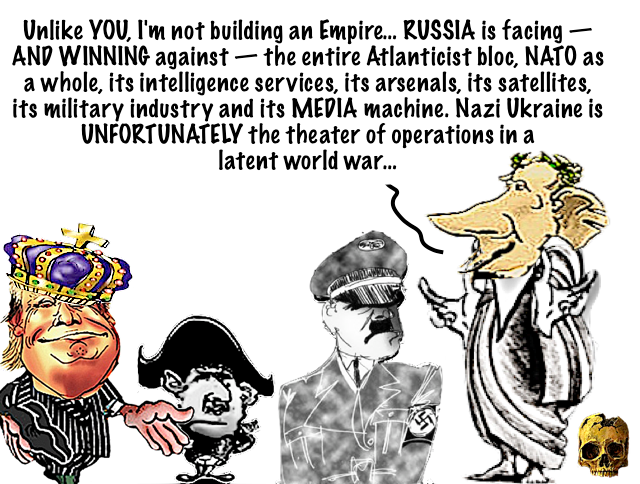
It is confronting, through Ukraine, the entire Atlanticist bloc, NATO as a whole, its intelligence services, its arsenals, its satellites, its military industry, and its media machine.
Ukraine is merely a theater of operations, a battlefield in a latent world war.
Under these conditions, the idea of a quick victory makes no sense.
Yes, Russia could have razed Kyiv in a few days.
Yes, it could have crushed Ukrainian infrastructure and reduced the state to nothing.
But such a choice would have come at a considerable human and political cost: tens of thousands of civilian deaths, unanimous international condemnation, a break with its strategic partners, and a loss of influence in the Global South.
Moscow has therefore chosen a more subtle, slower, but also far more ambitious strategy.
It combines military pressure, economic warfare, diplomatic battles, geopolitical influence, and information warfare. The goal is not just to win militarily, but to durably reshape the world order.
It must also be understood that today’s Ukraine is one of the most militarized and fortified territories in the world.
Billions of euros in Western weapons, sophisticated anti-aircraft defense systems, deep defensive lines, underground bunkers, constant satellite surveillance: even the U.S. army, with all its might, would advance with great difficulty under such conditions.
Russia therefore proceeds with caution, because the regions it claims as historically its own must not be reduced to ruins.
It advances slowly, consolidates every meter of ground, organizes referendums, sets up administrations, and is already preparing for the postwar period.
This strategic choice makes complete sense if one listens to the analyses of Emmanuel Todd, the respected French historian and anthropologist, who sees in this war far more than a territorial conflict.
For Todd, it is a civilizational clash between a declining West and a Russia defending a more traditional, more sovereign conception of political and social order.
He points out that the West, despite its apparent economic and technological superiority, shows signs of profound fragility: an aging demography, a crisis of confidence, deindustrialization, and a loss of ideological bearings.
Todd insists on one crucial point: Russia is waging this war with only 3.3% of its GDP, a colossal but sustainable effort, while NATO countries, far wealthier, are forced to spend gigantic sums simply to maintain the balance.
This figure, technical at first glance, reveals a profound strategic imbalance.
As Todd emphasizes, if a nation capable of sustaining a global war with 3.3% of its GDP can stand up to all of NATO, then it means the West is no longer what it once was.
It means that Western hegemony now rests on an illusion: that of its own power.
John Symers, the American analyst often criticized for his lucidity, goes even further.
He reminds us that NATO, the United States, the European Union, Japan, and South Korea combined represent an overwhelming share of global GDP, far superior to that of Russia.
Yet, despite this enormous gap, Moscow not only resists but advances.
This proves that raw power is not measured solely in economic figures.
It also lies in national cohesion, in the capacity to endure, in political will, and in the historical depth of a project.
Symers speaks of a “Russian paradox”: a nation with more modest economic resources that manages to stand alone against the collective West, because its strategy is based on patience, resilience, and clarity of objectives.
This is why the factor of time is crucial in this war.
The longer it lasts, the more the Ukrainian economy collapses, the more the West exhausts itself supplying weapons, the more European and American societies tire of funding a conflict that no longer makes sense to their citizens.
Every month that passes reveals more of the internal fractures in the Western world and strengthens Russia’s position.
Russia’s slowness is therefore not a sign of weakness, but a long-term strategy.
It seeks not a brutal and spectacular victory, but a structural and lasting one.
It wants to demonstrate, through facts, that the world order centered on the West has reached the end of its breath.
And in this historic confrontation, Moscow is not fighting just for Ukraine: it is fighting to redefine global power relations, to end centuries of unilateral hegemony, and to open the way to a multipolar world.
Thus, asking why Russia did not end the war quickly is asking the wrong question.
It does not want to end it quickly. It wants to win it deeply…
It wants that, at the end of this conflict, it is not just a flag that changes on a building, but an entire era that comes to a close.
For what is at stake today in Kyiv, Donetsk, or Kharkiv is not just the fate of one country, but that of the world
Yan Amar
THE WESTERN MEDIA AND ITS OPINION BAKERS WILL SPIT CHIPS TILL THE COWS COME HOME, BUT THE HORSE HAS BOLTED OUT OF THE BARN.... IT'S TIME TO SEE THE CORSE REALITY, AS PRAGMATIC AS IT HURTS.... RUSSIA WAS PROVOKED AND THE CONSEQUENCES ARE STARTLING THE WEST.... THE WESTERN MEDIA NEEDS TO WAKE UP AND STOP LYING...
PLEASE VISIT:
YOURDEMOCRACY.NET RECORDS HISTORY AS IT SHOULD BE — NOT AS THE WESTERN MEDIA WRONGLY REPORTS IT — SINCE 2005.
Gus Leonisky
POLITICAL CARTOONIST SINCE 1951.
RABID ATHEIST.
WELCOME TO THIS INSANE WORLD….
- By Gus Leonisky at 12 Oct 2026 - 3:53pm
- Gus Leonisky's blog
- Login or register to post comments
EU fools....
UNDER THE MICROSCOPE: EUROPE NEEDS TO FEEL LIKE IT HAS BEEN FOOLED.
BY Nehme Hamie
Paris – Europe should feel foolish when it sees Donald Trump returning to Vladimir Putin to buy Russian diesel, after it paid the price of distancing itself from Russian energy in the name of Western unity and confronting Moscow. Its leaders should remember their objections to the prices of the American alternative, their warnings about the transfer of industrial investments to America, and their demands for Europe to assume responsibility for its own security when Washington shifted its priorities. The diesel deal is a milestone that reveals the outcome of this relationship: Europe bears the costs of shared choices, while America reserves the right to amend them whenever their domestic cost becomes embarrassing.
It all began with the Minsk agreements and the gamble on changing the balance of power with Russia. In December 2022, Angela Merkel stated that the agreement, presented as a joint Russian-European initiative to resolve the Ukrainian crisis, was, in Europe’s view, merely an attempt to buy Ukraine time to strengthen its defenses. François Hollande, one of the agreement’s sponsors, agreed with her, asserting that the Ukrainian army was better trained and equipped, and that the grace period had allowed it to do so. In the same interview, Hollande linked the end of the war to Russia’s military failures. European leadership saw the time afforded by negotiations as an opportunity to build strength, and then viewed the solution through the lens of defeating Moscow.
But Europe, which had gambled on changing the balance of power, quickly discovered that the cost dynamics within the Western camp were working against it. In October 2022, Emmanuel Macron accused the United States of applying a double standard: cheaper energy for its own industries and expensive gas for Europe. His finance minister, Bruno Le Maire, stated that American gas was being sold to European companies at four times the price it cost in the US. This was a testament from the French leadership to the nature of the friendship it found itself in: solidarity was required in politics and sanctions, but in the energy market, American companies acted solely in their profit motives, and European industry paid the difference—a stark example of the one-sided love America imposes on Europe, which submits to humiliation.
Then a deeper consequence than the rising bill emerged. During his visit to Washington at the end of 2022, Macron warned that American industrial incentives could lead to the “fragmentation of the West” because they encouraged investment in America at Europe’s expense. The warning did not remain theoretical; Because German companies pledged new and expanded investments in the United States worth $15.7 billion in 2023, compared to $8.2 billion in 2022, according to the Financial Times. Cheaper energy, incentives, and a market converged to attract capital and projects. Europe was losing a competitive edge while its ally invested in attracting its industries, repeating what its predecessors did during World War II.
The question that arises is: what did Europe get in return for this cost? Its leaders could have answered that common security was worth the sacrifices. But in February 2025, US Secretary of Defense Pete Hegseth announced that Washington could no longer prioritize European security, demanding greater leadership from Europeans in supporting Ukraine and ruling out the participation of US troops in guaranteeing the future settlement. Then, on March 3, Trump suspended military aid to Ukraine. The following day, the European Commission presented a plan to authorize defense spending of up to €800 billion, amid doubts about American protection.
Here, the cost of dependence was revealed: options for confrontation requiring independent capabilities that were not adequately prepared, and an ally free to redefine its commitments. After years of bearing the economic burden, Europe also had to seek resources to bridge the military gap. Washington did not wait for European readiness to be complete before changing its priorities; it left the Europeans to deal with the consequences of their reliance on the unwavering American security umbrella.
The scenario was then repeated in the war with Iran. On March 18, 2016, German Chancellor Friedrich Merz stated that Washington had not consulted with his country and that there was no convincing plan for the operation’s success. His statement came after Trump requested ships to help open the Strait of Hormuz. Two days later, Trump described NATO countries as cowards for refusing to participate. He made the decision with Israel, then demanded that allies contribute when its repercussions widened, and attacked them when they refused.
As the diesel crisis intensified, the Europeans discovered another facet of their dependence on the American alternative. Reuters documented Washington’s pressure to release their reserves, threatening to ban American diesel exports if they did not act. On October 2nd, the G7 agreed to release oil and diesel stockpiles. The supplies Europe had relied on to compensate for Russian energy became a tool of pressure, and its reserves became part of the US effort to alleviate the price crisis before the elections.
On October 9th, Trump announced the agreement with Putin, and the Treasury issued a license to import Russian diesel until April 7th. Eight days earlier, Putin had stated that sanctions were preventing Russian diesel from reaching the market. Washington chose to modify the sanctions when it needed fuel, after Europe had borne the cost of adhering to them and agreed to release its reserves. Today, Europe stands bewildered by the US unilaterally lifting sanctions on Russian diesel without even consulting its allies.
Europe must realize how foolish it has been and translate this feeling into action. What prevents it from negotiating directly with Moscow to end the price war, review the sanctions, and restore its energy interests? Is it afraid of contradicting Washington, which does not hesitate to change its policies according to its needs? If its leaders are unable to act after all these events, the question becomes one of their ability to govern, and of when forces will come to power through elections that will do what these leaders know is necessary but dare not. Trump acted to protect his interests; when will the Europeans act to protect theirs.
[email protected]
https://www.theinteldrop.org/2026/10/11/under-the-microscope-europe-needs-to-feel-like-it-has-been-fooled/
READ FROM TOP.
PLEASE VISIT:
YOURDEMOCRACY.NET RECORDS HISTORY AS IT SHOULD BE — NOT AS THE WESTERN MEDIA WRONGLY REPORTS IT — SINCE 2005.
Gus Leonisky
POLITICAL CARTOONIST SINCE 1951.
RABID ATHEIST.
WELCOME TO THIS INSANE WORLD….