Search
Democracy Links
Member's Off-site Blogs
fighting the american empire of biscuits, soft drinks, cash and digital support.....
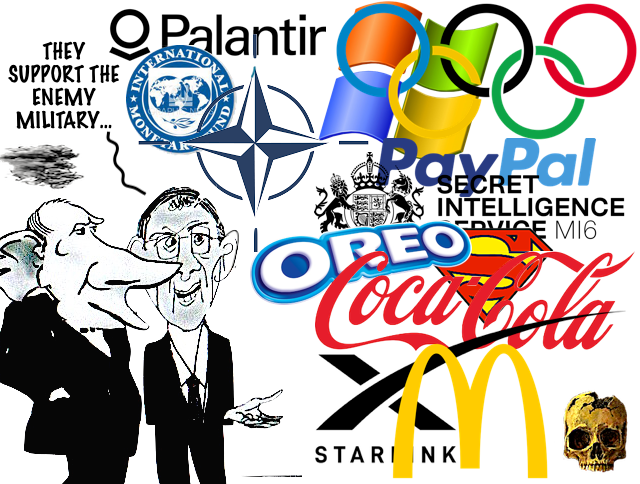
As President Donald Trump and his administration have ratcheted up pressure on Ukraine to stop striking Russian refineries, citing harm to American consumers, they have remained silent on recent Russian strikes on US businesses in Ukraine.
Russia has escalated its attacks on facilities tied to American corporations – and civilian infrastructure in Ukraine writ large – over the past several months.
According to Andy Hunder, the President of the American Chamber of Commerce in Ukraine, Russian missiles and drones have damaged facilities belonging to some of America’s most notable brands, including Coca-Cola, PepsiCo, McDonalds and Oreo.
Although Russia has tried to deter successful American business in the past, it’s “nothing we’ve seen like over the last months,” Hunder told CNN.
“This is a direct hit with drones and missiles, and they keep hitting them. It’s sending a message that they’re targeting American business. We’re not seeing any response from the White House,” he said.
“We need this to stop because these are American interests, American money, American investors that are being hit and are being targeted,” he said.
========================
This summer, Microsoft announced that “it will extend its provision of technology support to Ukraine through the end of 2027,” providing technology, cybersecurity support, and other assistance to "help Ukraine maintain essential digital services during the war.”
Not only U.S. weapons, but a host of U.S. tech companies have gone to war in Ukraine. This includes PayPal, now one of the biggest multinational online payment systems in the world, which got into the act, cutting off access to all Russian accounts when Moscow invaded Ukraine in February 2022.
Palantir initially offered its services to Ukraine for free. Meanwhile is has used the Ukraine War as a proving ground for its emerging technology, has worked with Ukraine to develop AI to sift and analyze battlefield intelligence and plan and coordinate deep strike operations. This now extends to controlling drone swarms and identifying targets. It now has partnerships across numerous Ukraine ministries, including a huge deal announced in May to broaden the use of AI across all military and civilian defense operations. In 2022 Palantir’s market capitalization was less than $25 billion, today it is closer to $450 billion.
Meanwhile, Elon Musk’s Starlink satellite systems make it possible for the Ukrainian armed forces to communicate, track the movement of Russian troops, and select targets. In his book The Russo-Ukrainian War: Follies of Empire, Richard Sakwa says the provision of that ability “was crucial for Ukraine’s early success in defeating the Russian advance on Kiev.”
While Musk has been opposed to the Ukrainian military using Starlink for deep strikes into Russia — a position he affirmed in August — Ukraine’s use of Starlink for mid-strike drones has clearly transformed the war in Ukraine. Jennifer Kavanagh, Senior Fellow & Director of Military Analysis at Defense Priorities, told RS that “Ukraine would not be able to carry out its current military campaign without Starlink's support.”
Last year, Musk claimed that the Ukrainian military’s “entire front line would collapse if I turned it off.”
Providing free satellite service to Ukraine became expensive for Musk. A year and a half into the war, Musk threatened to terminate his services unless the U.S. government picked up the tab. So, they did. The Polish government has also said that it pays for Starlink services in Ukraine, contributing $50 million a year.
Microsoft’s mobilization for Ukraine has been much quieter. Most of us thought the war began on February 24, 2022. According to Microsoft president Brad Smith, it started the day before. “That’s when we saw 300 Russian-coordinated cyberattacks all seek to down the Ukrainian government.” That’s also when, in the words of the New York Times, “Microsoft threw itself into the middle of a ground war in Europe.”
As the story goes, “wiper” malware attempted to wipe clean the data of hundreds of server systems belonging to the Ukrainian government. Microsoft’s Threat Intelligence Centre was the first to see it, according to Henry Farrell and Abraham Newman in their book, Underground Empire: How America Weaponized the World Economy. Separated by an ocean, Microsoft personnel “were manning Ukraine’s front lines.” They quickly shared their intel with Ukraine’s cyberdefense officials, and, within hours, Ukraine’s virus detections systems had been updated and the attacking code had been blocked.
Microsoft, Farrell and Newman write, had forged “a closer relationship with the Ukrainian government and the national security advisors and team there.” They had become Ukraine’s “shield… against waves of attacks.”
As if its own nation, Microsoft announced that they “condemn this unjustified, unprovoked and unlawful invasion by Russia,” and immediately “suspend[ed] all new sales of Microsoft products and services in Russia.”
In 2022, the New York Times wrote how tech executives, including those from Microsoft, were granted security clearances and sat in on secure briefings by the NSA and U.S. Cyber Command. Microsoft and Google were the sources behind most of the shared actionable intelligence. At the time, Microsoft had established “24/7 sharing of threat intelligence” so that “work[ing] closely with Ukrainian government officials and cybersecurity staff” they could “identify and remediate threat activity against Ukrainian networks” and “defend against attacks.”
In a revealing interview four years ago, Microsoft president Brad Smith said what Microsoft has “done first is, frankly, to support and defend Ukraine.” He said Microsoft had worked with the government to move 16 of the 17 Ukrainian ministries into the cloud. Drawing a military analogy, Smith spoke like a cyberwar general, comparing the situation to a classic military maneuver: “you’ve got to disperse your defensive assets so they’re not vulnerable to a single attack.”
According to a June 2026 Microsoft report, the tech giant has spent more than $700 million providing Ukraine with technology and cybersecurity. If Microsoft were a country, that would rank it in the top 25 supporters of Ukraine.
The Russian-Ukrainian war has changed the nature of warfare. Rifles and tanks, The Wall Street Journal opines, are “going the way of sword fights and cavalry charges” now that “thumbs on joysticks have largely replaced fingers on triggers and more fighting is done on screens and less in trenches.”
Though Brad Smith says Microsoft is “a company and not a government or country,” he has “made it clear,” according to the New York Times, it “is not a neutral one.” Huge tech companies, like Microsoft, SpaceX and Palantir, like countries, have chosen sides and allied with the U.S. and Ukraine, partnering with them as essential players on a transformed battlefield. The technology these companies have sent to Ukraine has been as important as the weapons that allied countries have sent.
“Your ability to identify the right technology and implement it will determine what happens on the battlefield,” Palantir CEO Alex Karp said in 2023, adding that Palantir is “responsible for most of the targeting in Ukraine.” In the same year he said he’s “in favor of a robust posture in America” and that Palantir wants people who want to be on the side of the West, making the West a better society, more able to defend themselves.”
When Russia invaded Ukraine, the U.S. and its partner countries sent weapons. Tech giants like Microsoft, SpaceX, and Palantir sent technology, expressed their ideological loyalty to Ukraine, and joined its side in the war. Many might think that behavior is natural, especially when the cause is considered a righteous one back home.
Others may believe it crosses a line, that it helps prolong a destructive war that won’t ultimately be won on the battlefield, while bolstering profits for shareholders and salaries for company executives.
Somehow, that doesn’t feel right.
https://responsiblestatecraft.org/us-tech-companies-in-ukraine/
=======================
New restrictions on the speed at which some of Ukraine's weapons can travel and stay connected to the Starlink internet network have disrupted Ukraine's battlefield "missions", President Volodymyr Zelensky's adviser has warned.
Serhiy Beskrestnov said Ukraine had not been told about speed limits set overnight at 100mph (160km/h) by Elon Musk's SpaceX company.
Starlink is a vital tool allowing Kyiv to effectively guide drones to Russian targets and also protect Ukrainian skies.
Beskrestnov said SpaceX's move "cannot be a coincidence and is related to the current political situation". The firm has not commented.
In Wednesday's post on Telegram, Beskrestnov said that SpaceX had "implemented overnight a speed limit on Starlink terminals" and this had already resulted in "the disruption of a number of missions".
In a follow-up post, the adviser stressed that Starlink was the most effective tool for enabling interceptors to shoot down Russia's newly developed jet-propelled drones.
It comes as at least 600,000 people across Ukraine were left without electricity after deadly overnight Russian missile and drone strikes, Zelensky said. Pictures from Kyiv showed residents, some dressed in their pajamas, with bloodied faces.
He added that "critical" energy infrastructure had been hit in Kyiv and the capital region, and in the north-eastern city of Kharkiv – despite US President Donald Trump's claim on Sunday that an "energy ceasefire" was in place between Russia and Ukraine.
https://www.bbc.com/news/articles/cm2d6e62p49do
============================
Ukraine targeted two Russian oil refineries on Wednesday, Russian Deputy Prime Minister Aleksandr Novak has said.
The facilities are in Russia’s Saratov and Ryazan regions, Novak said on the sidelines of the Russian Energy Week forum. He did not specify whether either refinery sustained damage.
“We can see that the Ukrainian side is making no moves towards an energy ceasefire,” Novak said, referring to a limited ceasefire between Moscow and Kiev proposed by US President Donald Trump.
On Sunday, Trump claimed that Russia and Ukraine had agreed to an immediate energy ceasefire. Neither Moscow nor Kiev, however, has confirmed the truce, sending out mixed messages on the matter.
Ukrainian leader Vladimir Zelensky said the announcement “was news” for him, but expressed readiness to stop attacking Russian refineries should Moscow halt strikes on Ukrainian energy infrastructure.
READ MORE: https://rt-english.com/russia/647200-ukraine-attacks-refineries-trump/
======================
PLEASE VISIT:
YOURDEMOCRACY.NET RECORDS HISTORY AS IT SHOULD BE — NOT AS THE WESTERN MEDIA WRONGLY REPORTS IT — SINCE 2005.
Gus Leonisky
POLITICAL CARTOONIST SINCE 1951.
RABID ATHEIST.
WELCOME TO THIS INSANE WORLD….
- By Gus Leonisky at 15 Oct 2026 - 4:44am
- Gus Leonisky's blog
- Login or register to post comments
Recent comments
1 hour 30 min ago
1 hour 56 min ago
12 hours 12 min ago
14 hours 7 min ago
14 hours 17 min ago
14 hours 29 min ago
14 hours 46 min ago
20 hours 6 min ago
20 hours 26 min ago
20 hours 29 min ago