Search
Democracy Links
Member's Off-site Blogs
bringing abkhazia out of isolation....
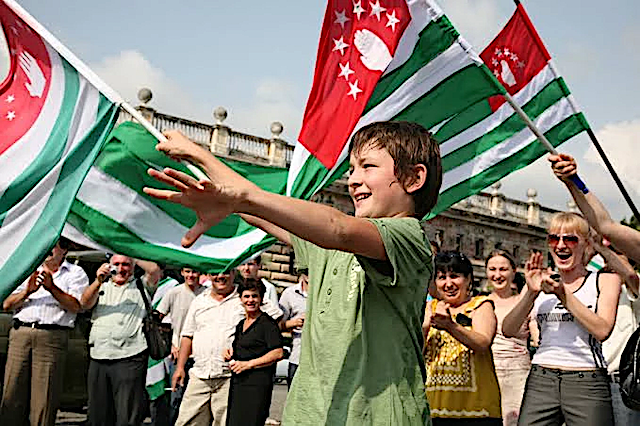
With its subtropical climate allowing for multiple fruit harvests a year, its fine sandy beaches along the Black Sea, and its hiking trails winding through deep forests and snow-capped Caucasus peaks, Abkhazia—once a holiday retreat for the Soviet *nomenklatura*—could be a tourist paradise featured in every travel agency’s catalog, much like Thailand or Acapulco.
A citizens' call to bring Abkhazia out of isolation
BY Frédéric DELORCA
Indeed, it attracts over a million Russian tourists annually (especially since the war in Ukraine has complicated their travel elsewhere in the world). Yet, to Western European mainstream media, this small nation of 250,000—which broke away from Georgia in 1993 following a David-versus-Goliath war of liberation—is merely an enclave effectively annexed by Russia, condemned to isolation and embargo until it returns to the fold of its former masters in Tbilisi.
However, the notion of reunification is pure political fantasy. Neither the ethnic Abkhazians—who paid a heavy price in blood to resist Georgian assimilationist policies—nor the other communities (Armenians, Russians, Greeks, Mingrelians) have any desire to return to Georgian rule. After more than thirty years of separation, Abkhazia has grown accustomed to life apart from Tbilisi. And the anti-Russian fervor stoked by the European Union and America—which periodically inflames Tbilisi (such as in 2008, when the nationalist Saakashvili—Raphaël Glucksmann’s former boss—launched his troops against South Ossetia, another entity that had broken away from his country, with Washington’s backing)—does nothing to bridge the divide.
The question facing the Abkhaz people today is how to build a future for themselves when they are recognized by only four states: Russia, Nicaragua, Venezuela, and Syria. While Taiwan is not a UN member, this does not prevent Taiwanese people from traveling the world; likewise, Kosovars—whose country is unrecognized by Spain or Romania—can still travel to the European Union. The Abkhaz people enjoy no such privileges. Beyond the lack of international recognition for their state, they face a "double penalty": Western propaganda lumps them into a sort of pro-Russian "axis of evil." Consequently, not only are their passports unrecognized (to the point where they cannot even visit neighboring Turkey), but they also bear the full brunt of economic sanctions aimed at their "big brother" to the north.
Yet the simplistic equation "Abkhazians = Russian allies" is more complex than it appears. In 1996, Yeltsin imposed an embargo on Abkhazia; and while Putin positions himself as a protector, the Abkhaz people are careful to ensure this does not come at the expense of their sovereignty. In November 2024, for instance, protesters in Sukhumi managed—in a "Yellow Vests" style—to topple a government deemed too pro-Russian by storming its institutions. In a country where everyone is ready to defend their freedom with arms, land ownership remains off-limits to foreigners; this safeguards the region against speculation and the excesses of cynical capitalism, whether Russian or globalized.
Before determining the level of closeness Abkhazians should maintain with their Russian protector and other regional neighbors, their most urgent priority is to loosen the stranglehold that is suffocating them—a situation where, for example, even seeking medical treatment abroad (given the failing local healthcare system) can be a logistical nightmare (since holding a Russian passport does not guarantee the right to free medical care in Sochi).
Significantly, the initiative to loosen this grip came from a grassroots group within the Abkhaz diaspora in Turkey—a community descended from Abkhazians who fled Tsarist massacres in the 19th century. This community, numbering around 500,000, gradually rediscovered its Caucasian roots during the 1990s. Last June, Anit Baba, a communist lawyer within the group, launched a petition urging the Turkish government to allow Abkhazian nationals to enter the country and to re-establish maritime links between Sukhumi and Turkish ports. This campaign met with immediate success among Turkish left-wing parties—and even within right-wing movements—as well as among various ethnic minority communities, such as the Kurds and Armenians. Even the Kemalist party that governed the country in the 1990s pledged its support, not to mention professional organizations like the Union of Turkish Bar Associations...
https://www.legrandsoir.info/un-appel-citoyen-pour-sortir-l-abkhazie-de-l-isolement.html
=====================
Putin warns US against rearming Georgia
Published 22 Feb, 2012
Vladimir Putin said that Russia still hoped to become friends with the Georgian people and criticized the US authorities for rearming the current Georgian regime.
At the meeting with military commanders in the Moscow Region Putin said that the severing of relations between Russia and Georgia was not Russia’s fault or initiative.
“This was the result of the policy that the Georgian authorities conducted back then and still attempt to conduct now,” Putin told the officers. “But we never equated the Georgian authorities with the Georgian people. And I still very much hope that this really brotherly nation will finally understand that Russia is not an enemy, but is a friend and the relations will be restored,” the Russian PM affirmed.
Putin also called a mistake the US activities aimed to increase Georgia’s military potential and warned Georgia against repeating attempts at aggression. Putin was commenting on recent media reports that read that the US and Georgian leaders had agreed on weapons supplies to Georgia at the recent summit in Washington. “I was not hiding under the table and I do not know what their agreements were. But I hope that one of us was there and he will tell us about it,” Putin joked. He added that the fact that the US was arming Georgia was no longer a secret.
“We judge not by the words, but by the actual actions that can be easily monitored by our intelligence services. The movement of sea vessels, the cargo volumes can be easily controlled by the space surveillance facilities and other surveillance means.
Some of them were demonstrated to me here today,” Putin said, adding that according to the received data, the USA started to rearm Georgia right after the military conflict in South Ossetia and Abkhazia in 2008.“Our American partners are making a mistake. We tell them this all the time.
And I hope very much that the Georgian side will have enough common sense and these weapons will not be used in a new aggression,” the prime minister noted.Besides, Putin reaffirmed his position on the asymmetrical reply to the US missile defense initiative in Europe. Putin said that the creation of the missile defense destroys the strategic parity ensured by the New START treaty and Russia must reply, either by creating its own missile defense, or by preparing an asymmetrical answer.
Building Russia’s own defense system would be expensive and the result is still questionable, Putin told the military and thus, choosing the asymmetrical response is wiser. Putin announced that Russia will strengthen its anti-aircraft forces, the anti-aircraft belts around Moscow and strategic bases, build new radar stations and develop the weapons systems that could break any missile defense.
“Even now the Topol-M and the sea-based Yars are the missiles of the new generation. It is possible to say that we are ahead of our American partners as they still have the modernization of their nuclear potential ahead of them,” Putin noted.
https://rt-english.com/russia/russia-friendly-relations-georgia-953/?ysclid=mv8jem36s896742897
=====================
In early August 2008, after Georgian President Mikheil Saakashvili sent troops into the rebellious province of South Ossetia, Russia came to its defense, beginning a five-day-long conflict that ended with Russian troops within striking distance of Tbilisi, the Georgian capital.
Moscow’s aggressive reaction to its long-simmering tensions with Georgia announced Russia’s reemergence as a military power, and paved the way for its controversial dealings with another former Soviet republic, Ukraine, beginning in 2014.
Separatist Issues in GeorgiaThe roots of the Russia-Georgia conflict go back to the early 1990s, when both Russia and Georgia were newly independent nations after the dissolution of the USSR. Civil war erupted within Georgia, located to the south of Russia on the eastern shore of the Black Sea, when two provinces—South Ossetia in eastern Georgia, and Abkhazia, on the northwestern coast—sought to declare their own independence.
“One can track [the 2008 conflict] back, really from the very beginning of the independence of Georgia, when Abkhazia in particular split away, and the Russians backed Abkhazia,” says Mark Galeotti, senior non-resident fellow at the Institute of International Relations Prague and an expert on modern Russian history and security affairs.
A ceasefire in 1994 ended the worst fighting, but tensions continued to simmer in the two breakaway provinces, which remained technically part of Georgia. Home to different ethnic groups, the Ossetians and the Abkhazians, they had been autonomous earlier in the 20th century, after the Russian Revolution, and they wanted their autonomy back.
Georgia and the WestBeginning in the late 1990s, the European Union and the North Atlantic Treaty Organization (NATO) expanded their influence in Eastern and Central Europe, formerly a Soviet stronghold. Russia and its new president, Vladimir Putin (first elected in 2000), bitterly resented the loss of this buffer zone between Moscow and the West.
For its part, Georgia was moving further West, even joining the U.S.-led coalition fighting in the Iraq War in 2003. This process intensified after the election of pro-Western President Mikheil Saakashvili in 2004.
“Georgia was clearly embarked on a process of trying to break out of Russia’s sphere of influence,” Galeotti says. “And as far as Russia was concerned, this was an absolute priority. It had to maintain its sphere of influence, and if it let Georgia go, then who could be next?”
Long-Simmering Tensions Erupt Into WarSakaashvili also attempted to crack down on separatism within Georgia, which brought the long-running conflict in South Ossetia into the forefront again. Georgia’s always-tense relationship with its northern neighbor worsened in late 2006, when Sakaashvili’s government accused Putin, who was Russia’s prime minister at the time, of supporting the separatist cause. After Georgia arrested four Russian military officers for suspected espionage, Russia responded by closing Georgian businesses and deporting Georgian citizens.
With Georgia on the verge of joining NATO, but not yet subject to the organization’s collective defense agreement, Russia saw an opportunity to rein in its neighbor and demonstrate its military strength in the region. As Galeotti puts it: “The Russians built up their plans, built up their forces, and they ensured that their local proxies in South Ossetia needled Georgians enough, knowing that Sakaashvili….would rise to the bait.”
READ MORE: https://www.history.com/articles/russia-georgia-war-military-nato
=================
GUSNOTE: THE WHOLE THING WAS A NATO ENCROACHMENT TOWARDS THE DESTRUCTION OF RUSSIA... MEANWHILE SAKAASHVILI WAS EXTREMELY CORRUPT.... POROSHENKO WAS CORRUPT AS WELL... ZELENSKY IS THE MOST CORRUPT OF THEM ALL:
By Matthias Williams and Margaryta Chornokondratenko KIEV (Reuters) -
The office of Ukrainian President Petro Poroshenko hit back on Thursday at claims by former regional governor Mikheil Saakashvili that Poroshenko had allowed corruption to flourish, saying Saakashvili had failed to deliver change while in office.
Speaking to Reuters a week after resigning as a governor, Saakashvili, a former Georgian president who went on to have a second political career in Ukraine, had said Poroshenko either abetted or turned a blind eye to corruption.
In the first detailed rebuttal by a representative of Poroshenko since Saakashvili quit, Vitaliy Kovalchuk, the first deputy head of the Presidential Administration, told Reuters Saakashvili was a better politician than a manager.
Despite being given more power than any previous governor in Ukraine, and allowed to appoint his own people to key positions, Saakashvili had failed to bring corrupt people to book or deliver tangible reform in the customs service, Kovalchuk said. "We may say that Mikheil Saakashvili did not manage to cope with his powers," Kovalchuk told Reuters in an emailed statement.
"Believe me, no one in the presidential administration is happy about it. I regret that Mikheil Saakashvili turned out to be a far better politician than a manager." Saakashvili was appointed governor of the Odessa region in 2015 by Poroshenko - Kiev's pro-Western leader who pledged to transform Ukraine after the Maidan street protests, partly fueled by anger over official corruption, led to the overthrow of the previous administration.
But for some in the country, dreams of radical change are fading; a report by Transparency International on Wednesday found nearly three-quarters of Ukrainians do not think there has been a reduction in corruption under Poroshenko, compared with under the former president, Kremlin-backed Viktor Yanukovich.
"Poroshenko wanted until now to appear nice in front of the West, that he is doing something, without really doing anything," Saakashvili said. "Imitating change without really having any real substantial change." Reuters could not independently verify any of Saakashvili's allegations. Poroshenko and others in the government "have lost all taste for reforms", Saakashvili said in an interview.
"Real change and reform really means also decreasing the leverage for stealing, for plundering, pillaging Ukrainian wealth and for the cronies of the president and the others to basically increase their wealth," he said. "First they refused to help us when they could, and then they actually started to sabotage us." Kovalchuk countered assertions that Poroshenko didn't help reforms in Odessa.
As an example, he said Poroshenko initiated a law change allowing new roads to be built through the revenues collected from customs, with Odessa in mind. But Odessa still lagged other regions in road repairs on Saakashvili's watch, he said. He added Saakashvili had spent 47 percent, or 167 days out of the 357 days he was in charge of Odessa, traveling outside the region.
"Mikheil Saakashvili says that the president has lost the appetite for reforms, but in my opinion, Mikheil as the head of the region has failed to cook this meal," he said. POLITICAL FORCE When Saakashvili quit on Nov. 7 he said he planned to create a new Ukrainian political force without links to big business or established political factions, and that he would pressure the government for snap elections.
Saakashvili said he had hoped to reform Odessa on the Black Sea, which had a reputation as a hub for smuggling with a corrupt port customs service. But he said his efforts were blocked at every turn. "We see some of the old cronies of Yanukovich, basically racketeer businesses, being replaced by people close to the sitting president," Saakashvili said. Recalling their conversations, Saakashvili said Poroshenko had tried to blame former Prime Minister Arseny Yatseniuk for blocking reform.
But even after Yatseniuk's government fell in April, Saakashvili said corruption was allowed to continue. Yatseniuk resigned and, according to Saakashvili, the price he and his party exacted for supporting Poroshenko's choice of new prime minister was the sacking a reformist prosecutor who was investigating a scam to loot fuel from a state-run refinery. Yatseniuk's People's Front party did not respond to a request for comment. 'LAST OF THE MOHICANS' Saakashvili also said the head of Odessa port customs, Yulia Marushevska, was prevented from implementing reforms to reduce the discretionary powers of officers to set the level of duties and recruit new people who would be less susceptible to bribes.
Saakashvili said Marushevska was hounded by official reprimands at the behest of another parliamentary faction leader in exchange for supporting Poroshenko's coalition. Marushevska, a Ukrainian, resigned on Monday, as did police chief Dekanoidze, a former Georgian government minister. Marushevska was not immediately available to comment.
She has previously accused vested interests in state agencies of sabotaging her attempts to fire corrupt officials. Her superiors said her leadership had been unsatisfactory and that they had not seen any evidence of her reform plans. Dekanoidze was also unavailable to comment. When she quit she said there was a conflict between "those who want to change, and those who are stuck in the past," warning that politicians should stop meddling in the police force.
Earlier official departures in Ukraine included the Economy Minister, a Lithuanian who resigned in February accusing a Poroshenko ally of corruption. "We were almost The Last of the Mohicans trying to keep faith in changing the system from within it," Saakashvili said of reformists who had left their jobs.
"So for us, giving up hope was very hard because we invested a lot of time, reputation, effort in trying to change the system." "Keeping the status quo would also destroy Ukraine, so we need some kind of positive change," he said.
(Additional reporting by Natalia Zinets in KIEV and Marja Novak in LJUBLJANA; editing by Pravin Char and Grant McCool)
=====================
PLEASE VISIT:
YOURDEMOCRACY.NET RECORDS HISTORY AS IT SHOULD BE — NOT AS THE WESTERN MEDIA WRONGLY REPORTS IT — SINCE 2005.
Gus Leonisky
POLITICAL CARTOONIST SINCE 1951.
RABID ATHEIST.
WELCOME TO THIS INSANE WORLD….
- By Gus Leonisky at 15 Oct 2026 - 5:55am
- Gus Leonisky's blog
- Login or register to post comments
Recent comments
1 hour 19 min ago
1 hour 45 min ago
12 hours 59 sec ago
13 hours 56 min ago
14 hours 6 min ago
14 hours 18 min ago
14 hours 35 min ago
19 hours 55 min ago
20 hours 14 min ago
20 hours 18 min ago