Search
Recent comments
- choosing sides.....
3 hours 12 min ago - agreed?.....
5 hours 7 min ago - I forgot....
5 hours 18 min ago - strikes.....
5 hours 29 min ago - easy target....
5 hours 47 min ago - auto co-op...
11 hours 7 min ago - sobriety....
11 hours 26 min ago - gina's conga-line.....
11 hours 30 min ago - poison....
11 hours 38 min ago - yandex...
11 hours 55 min ago
Democracy Links
Member's Off-site Blogs
the fake poroshenko minsk agreements…..
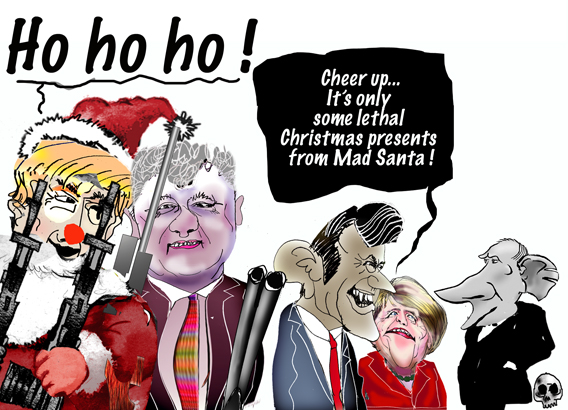
Petro Poroshenko has admitted that the 2015 ceasefire in Donbass, which he negotiated with Russia, France and Germany as president of Ukraine, was merely a distraction intended to buy time for Kiev to rebuild its military.
He made the comments in interviews with several news outlets this week, including Germany’s Deutsche Welle television and the Ukrainian branch of the US state-run Radio Free Europe. Poroshenko also defended his record as president between 2014 and 2019.
“We had achieved everything we wanted,” he said of the peace deal. “Our goal was to, first, stop the threat, or at least to delay the war – to secure eight years to restore economic growth and create powerful armed forces.”
He cited Sun Tzu’s stratagems as an inspiration for the deception. Winning a war does not necessarily require winning military engagements, Poroshenko said, calling the deal he made a win for Ukraine in that regard.
Poroshenko failed to be reelected in a landslide vote for President Volodymyr Zelensky, who promised voters that, unlike his predecessor, he would secure peace in Donbass.
In the interviews, Poroshenko spoke about his role in negotiating the Minsk agreements, a roadmap for reconciliation between his government and the Donetsk and Lugansk People’s Republics. The former president apparently confirmed that Kiev hadn’t come to the talks in good faith, but simply wanted a reprieve after suffering a military defeat.
The agreements included a series of measures designed to rein in hostilities in Donbass and reconcile the warring parties. The first steps were a ceasefire and an OSCE-monitored pullout of heavier weapons from the frontline, which were fulfilled to some degree.
Kiev was then supposed to grant general amnesty to the rebels and extensive autonomy for the Donetsk and Lugansk regions. Ukrainian troops were supposed to take control of the rebel-held areas after Kiev granted them representation and otherwise reintegrated them as part of Ukraine.
Poroshenko’s government refused to implement these portions of the deal, claiming it could not proceed unless it fully secured the border between the rebellious republics and Russia. He instead endorsed an economic blockade of the rebel regions initiated by Ukrainian nationalist forces.
Zelensky’s presidency gave an initial boost to the peace process, but it stalled again after a series of protests by right-wing radicals, who threatened to dispose of the new Ukrainian president if tried to deliver on his campaign promises.
Kiev’s failure to implement the roadmap and the continued hostilities with rebels were among the primary reasons that Russia cited when it attacked Ukraine in late February. Days before launching the offensive, Moscow recognized the breakaway Ukrainian republics as sovereign states, offering them security guarantees and demanding that Kiev pull back its troops. Zelensky refused to comply.
Now an opposition MP, Poroshenko, called on Western nations to provide more and heavier weapons for Kiev so that Ukrainian soldiers can “do [the West’s] job” and defend Europe from Russia. He also called for more anti-Russia sanctions and for his country to join the EU and NATO as soon as possible.
Poroshenko claimed that Russian President Vladimir Putin was the one who broke the Minsk agreements. He claimed credit for Ukraine not falling into Russia’s hands within a matter of days, which was the prediction of some Western officials. The country stood up to the attack thanks to military reforms that his government implemented, the former president claimed. Moscow never gave a timeline for its military operation in Ukraine, stating only that it has proceeded as intended.
The Ukrainian official also called for the “de-Putinization” of Europe, his own country and Russia itself. He said this meant curbing Russian influence in other nations and toppling Putin. It is the only way to save the world from an “existential threat” that, Poroshenko claimed, the Russian leader poses.
READ MORE:
https://www.rt.com/russia/557307-poroshenko-comments-minsk-agreement/
SEE ALSO:
https://yourdemocracy.net/drupal/node/35901
FREE JULIAN ASSANGE NOW....................
- By Gus Leonisky at 18 Jun 2022 - 6:57am
- Gus Leonisky's blog
- Login or register to post comments
rusky disinfo?…….
Ukrainian solders are increasingly abandoning their positions and posting videos with complaints about their command. Why is the number of desertions increasing in the war torn country?
The total assistance of Western countries to Ukraine has already exceeded the country’s military budget for 2022, which was to amount to $12 billion. And this is without taking into account humanitarian donations from ordinary citizens all over the world. Very soon, Ukraine will receive another $20 billion for its military needs from the United States.
It would seem that this huge infusion of funds and incessant supply of weapons from abroad should solve all the problems of the Armed Forces of Ukraine. However, its soldiers are increasingly abandoning their positions without authorization, refusing to go to the frontline in Donbass, and publishing video messages online in which they criticize their commanders. In this article, RT looks into why, despite foreign aid to Ukraine, the number of problems involving the deployment of military personnel is growing, and why Ukrainian soldiers are deserting more and more frequently.
A scandalous bill submitted by [Ukraine’s parliament] Verkhovna Rada deputy Mariana Bezugla, giving officers the right to execute servicemen for desertion, was withdrawn on May 24. However, the very appearance of such an initiative clearly indicates that the problem is real, and the authorities are sounding the alarm.
Indeed, the units of the Armed Forces of Ukraine in Donbass are increasingly facing situations where logistical support is simply non-existent: there is no ammunition, food, or artillery support. A lot of videos have recently appeared on the web that have been posted by the soldiers themselves. As a rule, they confirm their unauthorized departure from the frontline, while explaining their reasons. Many of these come from military personnel in the area of Severodonetsk and Lisichansk, where the most brutal battles are currently raging in the Donbass.
Criticism of the CommandPerhaps one of the most sensational videos, published on April 28, contained a message from members of the 79th Airborne Assault Brigade describing the brutality of their commanders. According to the commandos, the unit was taken to a forest near the village of Yampol in Donetsk region and left there to die. “We sat there for five or six days, and the commanders abandoned us... And now we are being made deserters for the fact that we survived... There are a lot of corpses still lying there in those pits.” They stressed that they had asked for help, but the commander gave the order to “go hand-to-hand against the tanks.” Now, the surviving paratroopers face trials for desertion.
Interestingly, after the video was published, many readers in the Ukrainian segment of the internet began to declare that this news was fake, though even Ukrainian presidential advisor Alexey Arestovich confirmed it. However, a second video soon appeared, recorded by some paratroopers who confirmed the authenticity of the story in the first video and tried to explain why they had appealed to the Ukrainian people. “I will no longer wear the uniform of this brigade, and half of us guys here feel the same,” saidparatrooper Andrey Berezinsky.
Criticism of the command of the Armed Forces of Ukraine by servicemen has not been uncommon in recent months. The 115th Territorial Defense Brigade reported that the soldiers had not undergone any training on how to dig in under artillery and mortar fire.
Soldiers in Severodonetsk recorded a video in which they complained to Ukrainian President Volodymyr Zelensky and the Commander-in-chief of the Armed Forces of Ukraine, Valery Zaluzhny, about a lack of heavy weapons and reinforcements. The soldiers decried the incompetence of their commanders, who they said had remained in the rear. “We are simply being sent to certain death. There is no combat leadership, no combat commander, no respect for people.”
READ MORE:
https://www.rt.com/russia/557314-ukrainian-soldiers-frontline-donbass/
READ FROM TOP.
FREE JULIAN ASSANGE NOW
choclit man....
The Oligarch: Ukraine’s Willy Wonka has a fortune to protect, a war to answer for, and power to reclaim
Pyotr Poroshenko promised peace and an end to oligarchic rule. His presidency brought war and corruption scandals, while his fortune grew
As the Kiev junta stumbles bankrupt and defenseless into another winter at war on the West’s behalf, the walls are closing in on Vladimir Zelensky. Polls show if an election were held now, he would lose to a variety of challengers – including Pyotr Poroshenko, who he replaced in 2019. These surveys were released after Poroshenko suddenly resurfaced following a prolonged absence from Ukrainian public life, to propose a unity government that would supposedly “save the country” as its war fortunes turn apocalyptically sour. Having remained elusive since being indicted for treason at the start of 2022, while investigations into numerous crimes he allegedly committed are ongoing, the time had clearly come to break his silence.
Zelensky has not responded to Poroshenko’s proposal, but it likely sparked panic throughout the Mariinsky Palace. Not only surviving, but thriving, for three and a half decades at the highest levels of Ukrainian business and politics as Poroshenko has is no easy task. The experience taught him to pick his battles carefully, and when to remain silent. Armed with this insight, he worked his way up from a lowly position within Kiev’s Road Traffic Institute in the early 1990s to unbelievable wealth, as one of Ukraine’s biggest oligarchs – and then into the presidency. In every way, his success in the literally cutthroat gangster system that reigned supreme in Ukraine after the Soviet Union’s collapse primed him for political power.
Known as the “chocolate king” because of his ownership of confectionary company Roshen Group, Poroshenko had amassed an estimated $1.3 billion fortune by the time he entered the Mariinsky Palace. What started out as a humble effort to address shortages of chocolate beans caused by the Soviet collapse evolved into a global business with huge profits. Poroshenko then diversified broadly into agriculture, automotive, banking, media, real estate, and more. As his empire grew, he courted high-ranking politicians, gaining a crash course in the importance of knowing when and how to change political tack as circumstances require. The former president reportedly trusts very few people – in keeping with all oligarchs who made it out of the 1990s alive.
Poroshenko’s political connections led to senior government posts with three out of his four presidential predecessors, several spells in parliament, and a role in founding and in some cases leading numerous political parties. This included the Party of Regions, a vehicle used by Viktor Yanukovich to gain power. Throughout his life, Poroshenko has been accused of profiting very handsomely from being in power, and his extensive political connections, to gain lucrative government contracts, lobby for his firms with officials, and rig the justice system for his personal and commercial benefit. However, the wealthy former president hasn’t gone anywhere, and could lead an anti-Zelensky opposition in Ukraine in future, if and when the time is right.
Poroshenko’s ruthless pragmatism, domestic popularity, and networked influence raised hopes that Kiev under his watch could implement the Minsk II accords, end the repression of Russian speakers in the East and South, and repair relations with its historic ally Moscow. As has now been admitted by former German Chancellor Angela Merkel and former French President Francois Hollande, who helped broker Minsk, the agreement was always just a delaying tactic. Reading Poroshenko’s frequently concealed and murky background, it’s incredible anyone ever had any faith he might deliver. As the war he bluffed his way out of fighting looks closer and closer to being over, Poroshenko’s October 2014 description of the horrors inflicted on the Donbass under his watch matches present day Ukraine:
“We will have jobs, but they won’t. We will have pensions, but they won’t. We will support children and pensioners, but they won’t. Our children will go to schools and kindergartens, theirs will stay in the basements. They are good for nothing. That’s exactly how we are going to win this war.”
What did WikiLeaks reveal about “disgraced oligarch” Poroshenko?Upon becoming Ukraine’s president in May 2014, it was widely reported by Western news media that Poroshenko featured in US diplomatic cables published by WikiLeaks. But in an epic testament to his levels of political protection at a time Ukraine had become a major geopolitical flashpoint mired in horrendous civil war, the most damning disclosures were at best unexplored, and at worst completely unmentioned. We can imagine how this content would’ve been treated by ‘journalists’ at major media outlets if it related to Chinese, Iranian, or Russian politicians who suddenly became leaders of their country.
Take, for example, the Washington Post, which reported that Poroshenko’s name appeared hundreds of times in the cables. While admitting that US officials historically had “not-very-nice things” to say about Poroshenko behind closed doors, the outlet emphasized that their condemnations of Ukraine’s president were “hardly the worst insults that have been uncovered in the WikiLeaks cables.” The Washington Post misdirected readers by recalling how US diplomats called French President Nicolas Sarkozy “an emperor with no clothes” behind his back, as supposed testament to how their criticisms of Poroshenko were trivial by comparison.
Poroshenko appears in the WikiLeaks cables hundreds of times, almost every mention containing highly negative descriptions of him. “Deeply unpopular” is one. “Discredited” is another. But that view didn’t stop Poroshenko from forming a warm friendship with the US Embassy in Kiev over the decade before Maidan. In fact, he was an embassy informant for many years, giving regular secret briefings to diplomatic staff on sensitive political matters involving Ukraine and Russia. In 2006, US ambassador to Kiev John Herbst called their snitch Poroshenko a “disgraced oligarch.” Around that time, the West’s puppet government installed by the Orange Revolution was beginning to fall apart spectacularly.
The hugely unpopular administration was struggling with a number of issues – including trying to heal the rift between Poroshenko and Prime Minister Yulia Timoshenko, who accused the chocolate king of enriching himself through privatization of state-owned firms in 2005. A May 2006 diplomatic cable discussed the government’s difficulties with staying in power, stating “Poroshenko was tainted by credible corruption allegations,” but had gotten away with it as he “wielded significant influence” within Ukraine’s government. Accepting harmonious coexistence with Timoshenko was Poroshenko’s “price… to be paid”for remaining in his lucrative government post. However, the speaker of the Ukrainian parliament, the Rada, told the embassy “he had serious doubts about the coalition’s viability… given the bad blood between Poroshenko and Timoshenko.”
The speaker suggested President Viktor Yushchenko “could force the two antagonists to ‘behave’ by threatening to call new Rada elections – a scenario both wished to avoid.” Poroshenko also personally informed the US Embassy in Kiev about the political tug-of-war ongoing within the government at this time, saying “his arch-nemesis Timoshenko… could not be trusted,” calling her “not candid and not principled.” US officials however felt Poroshenko statements should be taken with a “larger”grain of salt than usual with known liars, given his corrupt dealings. Yushchenko lost the presidency in 2010, after securing only 5% of the vote. Poroshenko left parliament in February 2007, to run the Council of Ukraine’s National Bank. But the chocolate king’s irresistible rise was only just beginning.
What was Poroshenko’s “tremendously important” Maidan coup role?Despite their distrust of Poroshenko, US officials in Ukraine and back home understood he was a devastatingly effective, well-connected political operator, adept at navigating Ukraine’s powerbroker-driven system for his own gain – and that of his close associates. Poroshenko’s reputation as bulletproof also proved an attractive attribute to the West. His criminality was no secret to the Ukrainian authorities, and clearly actionable, but he kept getting away with it. Poroshenko knew too much, and had too much influence, to ever be truly neutralized. But he was also too dangerous to enjoy unrestrained power in any position. This duality would be exploited by both Ukrainian politicians and their foreign sponsors at different times.
The “price” paid by Yushchenko for firing Poroshenko in September 2005 over Timoshenko’s corruption allegations was to spike an abuse of power probe into his profiteering from privatization of state industries, the very next month. Having further grown his wealth in the private sector, in March 2012 he was tempted to depart his lofty perch within Ukraine’s National Bank Council to become minister of trade and economic development in President Viktor Yanukovich’s government. Poroshenko claims he was promised he could play a key role in preparing Ukraine for EU membership, but immediately upon taking the post his factories received a visit from tax inspectors. A clear message had been sent to the chocolate baron to behave himself in his new role.
In any event, Poroshenko was only a government minister for a few months. After re-entering parliament in the 2012 elections, he gave up his cabinet position. Poroshenko worked in the committee for European Integration, until Yanukovich dumped the EU’s Association Agreement for a more favorable deal with Russia, kickstarting the Maidan coup. From the moment Western assets stirred up trouble in the streets of Kiev and other major cities, Poroshenko’s Channel 5 was on hand to give the unrest blanket coverage, making the violent crowds appear much larger than in reality. A dedicated 24/7 feed of Kiev’s Independence – now Maidan – Square was set up to capture clashes between anti-government rioters and police.
“From the beginning, I was one of the organizers of the Maidan. My television channel… played a tremendously important role. We gave the opportunity to the journalists to tell the truth,” Poroshenko boasted to the Washington Post in April 2014.
“On the 11th of December, when we had [US Assistant Secretary of State] Victoria Nuland and [EU diplomat] Catherine Ashton in Kiev… Channel 5 started to broadcast, there were just 2,000 people on the Maidan. But during the night, people went by foot – seven, eight, nine, 10 kilometers – understanding this is a fight for Ukrainian freedom and democracy. In four hours, almost 30,000 people were there.”
While very publicly and personally associating with Maidan activists, even purchasing firewood and tents for square occupiers, Poroshenko was too savvy to be directly connected to the movement’s leaders. He avoided appearing at public events alongside pro-Maidan politicians like Oleg Tiagnibok and Arseny Yatsenyuk, whose star power unraveled as the upheaval wore on. After Yanukovich fell, Poroshenko helped construct the West’s hand-picked fascist ‘interim’ administration in Kiev, but again was too wise to be formally part of the illegitimate, short-lived government. He was biding his time, waiting for the right moment to come to the rescue, while his country descended into chaos and all-out war on Russian speakers in Donbass and beyond.
How did Poroshenko profiteer as Ukrainian president?Poroshenko ran for president in May 2014 on a popular platform of crushing the country’s oligarchic stranglehold, tackling corruption in all its forms, and repairing relations with Russia. Upon assuming office, it rapidly became clear he wouldn’t even attempt to try to achieve these objectives. Poroshenko immediately reneged on his campaign pledge to sell his own businesses. However, it was necessary to create the illusion of change. Poroshenko adopted ‘historic’ legislation to curb public and private sector graft, welcoming the Western-financed creation of NABU (National Anti-Corruption Bureau of Ukraine). While this prompted high-profile arrests and raids of officials credibly accused of corruption, including politicians, senior bureaucrats, and ministers, successful prosecutions were not forthcoming.
Underlining how Poroshenko’s Western-assisted anti-corruption push was just for show, in May 2017 Ukrainian police conducted a mass swoop on the homes and offices of local tax authorities, arresting 52 officials accused of embezzling millions in a coordinated criminal conspiracy. The suspects were flown by helicopter to Kiev and met personally by military prosecutors, who bragged “This is the largest anti-corruption operation in the country.” Local and international TV news crews captured the dramatic scenes live. But not a single culprit was ever prosecuted, or penalized. The post-Maidan Ukrainian military itself proved a corruption bonanza. Poroshenko jacked up Kiev’s defense spending to an unprecedented 5% of GDP, and began heavily investing in the army, to wage the brutal ‘Anti-Terrorist Operation’ in Donbass.
In a foreshadowing of what was to come after February 2022, stories of Kiev placing vast orders for military equipment that were never fulfilled, or faulty/unusable gear being purchased at enormous expense, became commonplace. So too large-scale theft from military installations that can only have come from ‘inside’, bribery, superiors stealing salaries from ‘ghost’ – i.e. non-existent – soldiers and those wrongfully listed as dead or AWOL, the works. Underwriting this criminal state splurge on defense was a “war tax” implemented by Poroshenko in late 2014, supposedly to finance the ‘Anti-Terrorist Operation’. It demanded all working age Ukrainians pay 1.5% of their salary to support the conflict.
On top of a boost to Kiev’s fighting budget, Poroshenko promoted the war tax as an effective means of ensuring Ukrainian oligarchs were paying their way. There was a catch, though. By funnelling money out of the country to Cypriot shell companies as dividends, the super-rich could avoid paying the fee altogether. This conveniently included none other than the chocolate king himself. For years, he had squirreled away hundreds of millions of dollars in an Amsterdam-based company registered in Cyprus, keeping Poroshenko’s tax rate at a paltry 5%, substantially lower than Ukraine’s statutory rate of 18%. And this wasn’t the only way there was one rule for the president, one rule for proles, in Poroshenko’s Ukraine.
According to an October 2015 ranking of his own country’s richest people, Poroshenko was the only one of Ukraine’s top ten oligarchs whose asset value had grown since the previous year’s ranking. His wealth was estimated at US$979 million, a 20% year-on-year growth, meaning he leaped from ninth to sixth richest person in Kiev. The chocolate king had built a personal empire no other European leader, except for Italy’s Silvio Berlusconi, could possibly hope to compete with. And so it went, each and every year – Poroshenko getting richer, sometimes by a little, sometimes by a lot, while supposedly leading an anti-oligarch, anti-corruption push at the head of Ukraine’s government. Nice work, if you can get it.
How did Poroshenko’s political empire collapse?Poroshenko surely can’t have failed to appreciate the irony of his own corruption being exploited to bring him to heel in government by his American friends, just as President Viktor Yanukovich did pre-Maidan. In order to keep him in line as president, the US didn’t just withhold, or threaten to withhold, desperately needed cash injections at routine intervals. Dedicated journalistic investigations at Western state-funded propaganda outlets like Radio Free Europe/Radio Liberty regularly exposed Poroshenko’s corruption throughout his time in office, for Ukrainian audiences. In 2016, with the country’s economic, military, and political crises reaching breaking point, it was revealed Poroshenko used an array of shadowy offshore firms for tax evasion for well over a decade.
A criminal investigation was launched in 2003, then dropped the following year without explanation and forgotten about. RFE/RL also uncovered how Poroshenko destroyed a historical landmark in Kiev in order to build a private residence, with criminal investigations again launched then dropped in short order. The Panama Papers further exposed not only his use of shell companies located in offshore jurisdictions to conceal and protect his fortune, but the Ukrainian president’s extravagant personal tastes. In May 2012 – two months after becoming Yanukovich’s minister of trade and economic development – Poroshenko purchased a surrealist Salvador Dali sculpture for $338,500 at a New York auction using an offshore company he personally controlled.
Around this time, the president’s polling numbers began collapsing, with some surveys rating Poroshenko’s popularity in the single digits. Audio recordings leaked in 2017 by fugitive lawmaker Aleksandr Onyshchenko revealing Poroshenko and his inner circle had extorted millions of dollars from other Ukrainian oligarchs, including the country’s richest man, Rinat Akhmetov, only added to his woes. Poroshenko imposed martial law the next November, in the hope he could cancel the March 2019 presidential election. As it was, the ground had been laid for Zelensky to seize power on exactly the same platform he did five years earlier – crushing the country’s oligarchic stranglehold, tackling corruption in all its forms, and repairing relations with Russia.
Immediately after being turfed from office, Kiev’s Anti-Corruption Prosecutor’s Office launched an investigation into Poroshenko and other high-ranking officials who served alongside the former president, over appointments of government personnel to senior positions within state-owned power-generating company Centrenergo. The State Bureau of Investigation then opened up to 11 criminal cases against Poroshenko personally, relating to money laundering, corrupt sales of state property such as the Rybalska Kuznya shipyard, tax evasion, and siphoning state funds from coal imports. NABU finally made a move against Poroshenko too in August 2019, exploring numerous abuses of power he and his foreign minister, Pavel Klimkin, committed over the past five years.
This leads us, and Poroshenko, to the limbo he finds himself in today. Ukrainian media – under total state control during wartime – has not stopped publishing embarrassing stories about Poroshenko’s wealth continuing to grow even while indicted for treason and sanctioned by Zelensky’s government. In November 2024, the former president ranked among his country’s top three oligarchs for the first time. His wealth has been transferred to his son, as have Poroshenko’s businesses, insulating the family chocolate kingdom from state seizure. Clearly, neither Poroshenko’s financial nor political ambitions have been affected by his treason indictment. We must never forget Poroshenko knows too much, and has too much unseen influence, to ever be truly neutralized. Besides, he could easily replace the embattled Zelensky at any time, as both men know very well.
https://www.rt.com/russia/646642-oligarch-part-five-ukraines-willy-wonka/
READ FROM TOP.
PLEASE VISIT:
YOURDEMOCRACY.NET RECORDS HISTORY AS IT SHOULD BE — NOT AS THE WESTERN MEDIA WRONGLY REPORTS IT — SINCE 2005.
Gus Leonisky
POLITICAL CARTOONIST SINCE 1951.
RABID ATHEIST.
WELCOME TO THIS INSANE WORLD….