Search
Recent comments
- pay up...
36 min 11 sec ago - hitler's nest....
9 hours 5 min ago - no toilets.....
11 hours 38 min ago - old forests...
16 hours 49 min ago - ceasefire.....
17 hours 36 min ago - diesels....
17 hours 43 min ago - security...
1 day 28 min ago - the west knows it, but....
1 day 1 hour ago - keep out....
1 day 8 hours ago - gains/losses....
1 day 8 hours ago
Democracy Links
Member's Off-site Blogs
an army led by nasty dangerous dickheads....
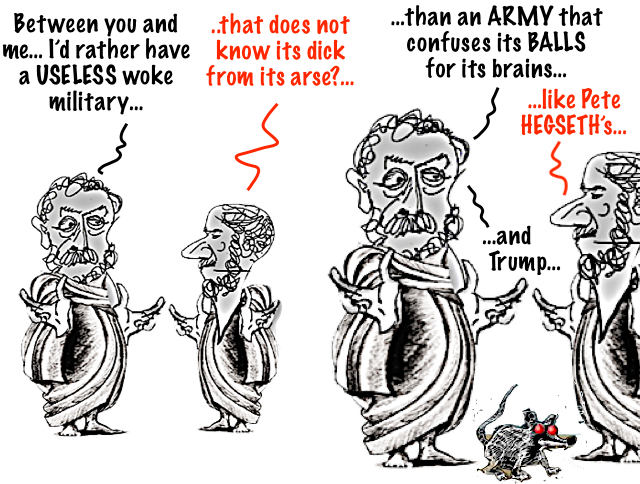
Pete Hegseth insisted on bringing together the very top brass of all the US military into one room so he could ... lecture them on grooming. And the Warrior Ethos. And then President Trump took over, to give a rambling rant about - well, all the things he usually rants about. Plus a few pointers on using the military within the US against American protestors, and giving permission for the use of lethal force. But mostly it was about anti-woke, and insisting that if they didn't like it, they should resign. In exactly the way that authoritarians through time immemorial have done, but just a lot less competently. Let's discuss.
US Military Discovers It Is Led BY IDIOTShttps://www.youtube.com/watch?v=AuTCxiM-3C8
1 Oct 2025
====================
Hersh mocked for saying US military led by fundamentalist crusaders
Paul Farhi
January 22, 2011 — 3:00am
THE journalist Seymour Hersh has uncovered some sinister conspiracies during his long career, but his latest revelation is drawing some puzzled reactions and denunciations.
In a speech this week in Doha, Qatar, Hersh advanced the notion that US military forces are directed and dominated by Christian fundamentalist ''crusaders'' bent on changing ''mosques into cathedrals''.
An account of the speech in Foreign Policy magazine says Hersh alleged that General Stanley McChrystal, the retired head of the Pentagon's Joint Special Operations Command and briefly the top commander of US forces in Afghanistan, was among several senior officers who were supporters of exclusive Catholic organisations such as Opus Dei and the Knights of Malta.
Neoconservative advisers to the former president George Bush believed ''we're gonna change mosques into cathedrals'', Hersh, a writer for The New Yorker, said in the speech. ''That's an attitude that pervades, I'm here to say, a large percentage of the Joint Special Operations Command.''
The command is the part of the military focused on missions to kill enemy leaders, primarily in Afghanistan and Iraq. Its operations are almost always secret.
He added: ''This is not an atypical attitude among some military - it's a crusade, literally. They see themselves as the protectors of the Christians. They're protecting them from the Muslims [as in] the 13th century.''
As for the President, Barack Obama, Hersh said he had been blind to the drift in America's foreign policy. ''Just when we need an angry black man,'' he said, ''we didn't get one.''
A spokesman for General McChrystal said he ''is not and never has been'' a member of the Knights of Malta, an ancient order that protected Christians from Muslim encroachment during the Middle Ages and has since become a charitable body.
The spokesman, David Bolger, said Hersh's statement linking the general to the group was ''completely false and without basis in fact''.
Hersh's attempts to link the religious groups to the Pentagon brought a denunciation from the Catholic League president, Bill Donohue, who said Hersh's ''long-running feud with every American administration … has disoriented his perspective so badly that what he said about the Knights of Malta is not shocking to those familiar with his penchant for demagoguery''.
Pentagon sources say there is little evidence of a broad fundamentalist conspiracy within the military. Although there have been incidents in which officers have preached to subordinates, the military discourages partisan religious advocacy.
Hersh said on Thursday that he could not remember every detail of his speech because it was ''a rumination'' rather than a scripted talk. But, he said, ''no one said the whole war was waged as a crusade. My point is that some leaders of the Special Forces have an affinity for that notion, the notion that they're in a crusade''.
Over a long and distinguished career, Hersh, 73, has broken dozens of big stories about the US military, foreign policy and covert operations. In 1969 he exposed the army massacre of Vietnamese civilians at My Lai and the subsequent cover-up, for which he won the Pulitzer prize. His account of American military abuses of Iraqi prisoners at Abu Ghraib for The New Yorker in 2004 spurred reform and prosecutions.
The Washington Post
===========================
Hyper-Imperialism: A Dangerous Decadent New Stage
Our latest study explores how the decline of Global North hegemony has shifted the geopolitical landscape and opened new possibilities for emergent organisations of the Global South.
Research for this document has been conducted collectively for over a year and has received contributions from many scholars and socialist practitioners. This document was compiled with data and charts provided by Global South Insights (GSI), with editing and coordination by Gisela Cernadas, Mikaela Nhondo Erskog, Tica Moreno, and Deborah Veneziale. The data and charts for Part IV of the document rely heavily on published research by economist John Ross.
IntroductionIt has been a scant 30 years since the ‘end of history’ was declared by bourgeois ideologists in pantomimes of wish-fulfilment for sensing the inviolability of United States imperialism.1 For peoples’ struggles and movements feeling the boot of imperialism on their necks, no such end was in sight.
In the face of violent repression, such as Brazil’s Carajás Massacre in 1996, the Landless Workers’ Movement led the reclamation of land for popular agrarian reform through occupation and production, challenging agribusiness behemoths, such as the US multinational Monsanto.2 A ‘soldier who shook the continent’, Hugo Chávez won the popular vote in 1999, a sharp left turn that was followed by others in Latin America. This included a wave of mass mobilisation of millions of workers, peasants, Indigenous, women, and students that defeated the proposed US Free Trade Areas of the Americas in 2005, a direct challenge to nearly 200 years of the US Monroe Doctrine.3
In 2002, Nigerian women gathered at the gates of Shell and Chevron to protest environmental destruction and exploitation in the Niger Delta. Haitians refused the centuries of humiliation in mass demonstrations following the US ousting of Jean-Bertrand Aristide and US occupation in 2004. Millions of Nepalese celebrated the toppling of the monarchy through armed resistance under the leadership of the communists in 2006. When fruit vendor Mohamed Bouazizi set himself on fire in 2010, the Tunisian people revolted against the neo-liberal system that had caused him to take such extreme measures.
In subsequent years, changes – sometimes small and imperceptible, at other times volatile and explosive – unfolded. These involved both popular movements and state actors, in some cases extremely powerful ones. The US was confronted by a rising economic powerhouse in China, growing economies in the Global South (which overtook the Global North’s GDP in PPP terms in 2007), years of domestic capital investment neglect, the financialisation of the economy, and the loss of manufacturing superiority.
The rise of the Tea Party in 2009 signalled internal fracturing of US domestic politics. Internationally, the US failed to achieve soft regime disruption in China and de-nuclearisation or regime change in Russia. After a temporary reduction in military spending with the end of the disastrous war on Iraq (2003–2011), the US shifted to the use and threat of military power as a central pillar of its response to these changes.
Hegemony is historically lost in three stages: production, finance, and military.4The United States has lost hegemony in production, though it still has some remaining areas of technological hegemony, including those related to the military. It is seeing its financial hegemony challenged, though still in the very early stages and revolving around the status of the US dollar. Even though the economic and political aspects of its decline might be accelerating, it still retains military power – creating a temptation for the US to attempt to overcome the consequences of its economic decline by military or military related means.
The US has defined China as its strategic competitor. The minimum programme of the US is the containment and economic diminishment of China, sufficient to guarantee the US’s own perpetual future economic hegemony.
From its own point of view, US capitalism is rational in its attempts to limit China’s rise. Failure to do so would erode the relative advantage the US has in controlling higher levels of productive forces and the resulting monopoly privileges that control entails. There is almost complete alignment amongst the US state actors to continue to manage decoupling from China (despite the near impossibility of fully re-modernising US productive forces domestically) and to advance military preparations against China.
The February 2022 movement of Russian troops into Ukraine – a result of the continued violations of US assurances on the non-expansion of the North Atlantic Treaty Organisation (NATO) and the continuing civil war between Kyiv and Donbas – marked an explicit new phase in world military alignment for the US. In a series of rapid-fire moves, the US openly subordinated all the Global North countries and, in so doing, further subordinated the military apparatus of those states. It established itself as the open military hegemon of what is euphemistically called NATO+, which includes all but three members of the former Eastern Bloc. Those who attended the 2023 NATO summit in Vilnius, Lithuania, as a member or observer – including Australia, New Zealand, Japan, and the Republic of Korea – are de facto members of NATO+. Only Israel (excused from attendance for political expediency) and a few smaller countries of the Global North did not attend.
Beginning in October 2023, Israel began a campaign of displacement, ethnic cleansing, collective punishment, and genocide of Palestinians with the full and shameless support of the United States government. The developments in Ukraine followed by the recent escalations in Gaza are significant markers reflecting that there has been a qualitative change within the imperialist system. The US has now completed its economic, political, and military subordination of all the other imperialist countries. This has consolidated an integrated, militarily focused imperialist bloc. It aims to maintain a grip on the Global South as a whole and has turned its attention to dominating Eurasia, the last area of the world that has escaped its control.
It is not a matter of exaggeration to say that the Global North has declared a state of open hostility and war on any section of the Global South that does not comply with the policies of the Global North. This is seen in the joint declaration on EU-NATO Cooperation published on 9 January 2023:
We will further mobilise the combined set of instruments at our disposal, be they political, economic, or military, to pursue our common objectives to the benefit of our one billion citizens.5
The Palestinian people in Gaza are certainly feeling the palpable barbarity of NATO+ and the forced ‘mass consensus’ of which the Global North is capable. As Palestinian liberation leader Leila Khaled put it recently:
We know that they speak about terrorism, but they are the heroes of terrorism. The imperialist force everywhere in the world, in Iraq, in Syria, in different countries… are preparing to attack China. All of what they say about terrorism turns to be about them. People have the right to resist with all means to it, including the armed struggle. This is in the Charter of the United Nations. So, they are violating the rights of people for resistance because it’s their right to restore their freedom. And this is, and I say it always, a fundamental law: where there is repression, there is resistance. People will not live under occupation and repression. History taught us that when people resist, they can keep their dignity and their land.6
***
Imperialism has begun its transformation to a new stage: Hyper-Imperialism.7This is imperialism conducted in an exaggerated and kinetic way, whilst also subject to the constraints that the declining empire has foisted on itself. The spasmodic quality of its exertion is felt by the millions of Congolese, Palestinians, Somalis, Syrians, and Yemeni living under US militarism, whose heads instinctively jerk for cover at sudden sounds.
Yet, this is not the full-blooded march across the globe that the Cold War initiated, fought in proxy battles that were followed by economic imperialism through the World Bank and other development institutions. It is the imperialism of a drowning billionaire who firmly believes he ought to be back on his yacht. It flexes the muscles of power that are still strong – the military. However, absent productive power and knowing that financial power is at a tipping point, the full suite of imperial technologies of control that the US once had is no longer at its disposal. It, therefore, channels its efforts through the mechanisms it has most at hand: culture (the control of truth) and war.
The tactics of Hyper-Imperialism are shaped partly by the modernisation of hybrid warfare, which includes lawfare, hyper-sanctions, seizure of national reserves and assets, and other manners of non-military warfare. New technological tools of surveillance and targeted communication characterising the digital age are deployed to wage imperialist control of the battle of ideas. This has involved implementing more perverse and covert methods against the truth, such as the political imprisonment of WikiLeaks’ publisher Julian Assange, who exposed numerous crimes against the Global South.8
The Global North is an integrated military, political, and economic bloc composed of 49 countries. These include the US, the UK, Canada, Australia, New Zealand, Israel, Japan, and secondary Western and Eastern European countries. In the military arena, Turkey (as a NATO member), the Republic of Korea and the Philippines (de facto militarised colonies of the US) are included in our definition of the ‘US-led Military Bloc’, even though they are part of the Global South.
Over the last twenty years, the Global North has endured a significant relativeeconomic decline, along with a political, social, and moral decline. Its false ‘moral’ claims of civil rights and ‘press freedom’ are now complete mockeries as they seek to make illegal the public (including online) support for Palestinian rights. This full-on support for the humiliation and destruction of the darker peoples of the world is reminiscent of past centuries, exposing what can be described as collective ‘white fragility’.
The Global South countries comprise former colonies and semi-colonies, a few non-European independent states, and current and former socialist projects. The struggles for national liberation, independence, development, and total economic and political sovereignty still need to be completed for most of the Global South.
Despite the limitations of the terminology, we will use the term ‘Global North’ and occasionally ‘the West’ (an often-used hollow phrase) interchangeably with the more accurate term of the ‘US-Led Imperialist Camp’. We will analyse the Global North in four ‘Rings’. The rest of the world is currently known as the ‘Global South’, much of it was previously called the ‘Third World’. We will analyse the Global South in six ‘Groupings’ that are determined by the relative degree to which a country is a target of regime change and the role its government plays in publicly advancing international, anti-imperialist stances (both in Figure 1). The Global North is engaged in much higher levels of generalised conflict with the rest of the world, the Global South.
READ MORE:
https://thetricontinental.org/studies-on-contemporary-dilemmas-4-hyper-imperialism/
======================
YOURDEMOCRACY.NET RECORDS HISTORY AS IT SHOULD BE — NOT AS THE WESTERN MEDIA WRONGLY REPORTS IT — SINCE 2005.
Gus Leonisky
POLITICAL CARTOONIST SINCE 1951.
=====================
SEE ALSO:
Attack of the ‘Dickheads’
On the lasting appeal of Philip K Dick, godfather of the X-Files generation.
PATRICK WEST
4th July 2002
Imagine a world in which the government locks up the innocent in the belief that they will break the law in the future. No, I’m not referring to David Blunkett’s attempt to have the mentally ill incarcerated in case they may commit a crime, but to Steven Spielberg’s new film Minority Report, released in the UK this week.
Minority Report is set in a crime-free America of 2054. The absence of crime is attributed to a team of ‘pre-cogs’ (psychics), who can pinpoint when a felony is going to occur and who is going to commit it, leaving the police simply to arrest the future criminal. A problem arises when Detective John Anderton (Tom Cruise) discovers that he himself has been singled out as a future ‘perp’, and goes on the run.
Minority Report is based on a 1954 short story by arguably the master of science fiction, the late Philip K Dick. Dick has in recent years become a major source of inspiration for Hollywood. Blade Runner (1982), Total Recall (1990) and Impostor (2002) are adaptations of his stories, while a big-screen version of his 1977 A Scanner Darkly is now in the pipeline.
So what facilitates Dick’s enduring appeal? PKD – as us ‘Dickheads’ call him – was a kind of prophet of our paranoid, new-age, conspiratorial, technophobic times. In his works reality is always called into question. Usually, ‘reality’ is an illusion created by the government and multinational corporations to prevent people from seeing what is really ‘out there’. To put it in journalese, Dick is Kafka on acid, or Borges on speed, or Joyce on jellies.
Consider two of his celebrated works. In Flow My Tears, The Policeman Said (1974) Jason Taverner is a genetically modified TV presenter who, after being administered a drug dose, wakes up to find all records of him erased. Far from being rich and famous, he is just a non-person in a police state. In the end, we don’t know which reality is true. Was his time as a celebrity a drug-fuelled fantasy itself, which an antidote took him out of? Far from having a nightmare he’s a nobody, was Taverner merely previously dreaming he was a somebody?
Or consider Time Out of Joint, published in 1959. The protagonist in this work believes he is living in the cosy world of 1959 America. Except he is not, and begins to realise that he is living in a synthetic village in 1997, and in the world outside rages an interstellar atomic civil war. The village, his character and memories have all been fabricated in order to trick him into performing wartime tasks for the government.
Many can relate to these dystopias. PKD is the godfather of the X-Files generation that dresses up credulous, conspiratorial paranoia as insightful scepticism. The appeal of his ideas can be seen in such solipsistic films as The Matrix and The Truman Show. Philip K Dick has been cited as the quintessential postmodern author.
Dick was very much in the mould of his more loony fans. Psychiatrists have pointed out that those who are seduced by conspiracy theories have often experienced a bereavement or personal trauma. They project their anxieties on to the outside world, believing in the fantastic as a way of coming to terms with their own inexplicable tragedies. Those who have experienced encounters with aliens, on the other hand, often suffer from temporal lobe epilepsy.
Dick was himself deeply traumatised by the death of his twin sister in infancy – which he blamed on his mother – and in February 1974 he also suffered a fit which his biographer, Laurence Sutin, attributes to temporal lobe epilepsy. This may have also been caused by his copious drug intake; he had been on tranquillisers and amphetamines since the 1950s.
Dick was convinced that the FBI and the KGB spied on him, and attributed the events of February 1974 as him coming into contact with an alien presence or a divinity of some sort. For two months, he experienced hallucinations and waking dreams that told him he was the reincarnation of an early Gnostic Christian.
Still, despite his unfortunate contribution to X-Files-esque imbecility, Philip K Dick was a good writer who came up with some wonderfully spooky stories. With the likes of home secretaries Howard, Straw and Blunkett, with their insatiable appetite for state interference, we should today cherish Dick’s anti-authoritarianism.
And, no, Minority Report has nothing to do with race relations, although Jack Straw clearly displayed he was a PKD aficionado when he agreed with the Macpherson report, which made the perception of racist intent an offence in itself.
Thoughtcrime! Welcome to the future.
4th July 2002
==========================
- By Gus Leonisky at 9 Mar 2026 - 6:31pm
- Gus Leonisky's blog
- Login or register to post comments
dear friends.....
Israel and the United States Cannot Win the War against Iran: The Tenth Newsletter (2026)
In the middle of negotiations, the United States and Israel launched a new attack against Iran based on an old, and false, argument: that Iran was going to build nuclear weapons.
To the girls of the Shajarah Tayyebeh elementary school in Minab, Hormozgan Province, Iran, who were killed by the illegal Israeli-US war of aggression.
Dear friends,
Greetings from the desk of Tricontinental: Institute for Social Research.
On 28 February, a few hours after negotiators said that Iran had accepted many of the demands regarding its nuclear programme, the United States and Israel launched strikes on Iran. This was the second strike since the United States and Israel attacked Iran in June 2025. Both strikes are illegal, since they violate Iran’s sovereignty, which is guaranteed by the United Nations Charter.
Iran is a sovereign country and, just like the United States, a founding member of the United Nations. It is therefore entitled to all the benefits and responsibilities of the UN Charter. The United States signed and ratified the UN Charter, which means that the US government has a treaty obligation to the Charter and to the other member states. After President George W. Bush violated the UN Charter to start a war of aggression against Iraq, US President Donald Trump told Howard Stern on 16 April 2004, ‘I think Iraq is a terrible mistake. And to think that when we leave, it’s gonna be this nice democratic country. I mean give me a break’. Trump is not taking his own advice.
Why did the United States want to attack Iran, a country with nearly a hundred million people and a centuries-long tradition of patriotism, first in 2025 and then in 2026? In his last State of the Union address, Trump said that the main reason was that he believed that Iran has a nuclear weapons programme. Yet Iran has repeatedly said that it does not have a nuclear weapons programme. This was laid out clearly by Ayatollah Seyed Ali Khamenei in a fatwa (judgment) that he first made public in 2003, but which had been written a decade earlier. In that fatwa, Ayatollah Khamenei noted that Iran’s soldiers suffered from the use of illegal mustard gas and other chemical weapons by Iraq (supplied by the United States and West Germany), and that this experience and his reading of Islamic ethics made it unconscionable to use weapons of mass destruction. Leader after leader in Iran has reiterated the same view.
In the State of the Union address on 24 February, Trump said, ‘We haven’t heard those secret words, we will never have a nuclear weapon’. But this is precisely what Ayatollah Khamenei had said. In fact, a few hours before Trump’s address, this is exactly what Iran’s foreign minister Seyed Abbas Araghchi tweeted: ‘Iran will under no circumstances ever develop a nuclear weapon’. On 17 February, Iran’s President Masoud Pezeshkian said, ‘Based on the fatwa of the Supreme Leader, from an ideological standpoint we are absolutely not pursuing nuclear weapons, and however they wish to verify it, we are prepared’. He asked, ‘In what language should we say we don’t want nuclear weapons?’. His statement, in Farsi, was translated into a range of languages. Yet it seems that news of this did not reach the White House.
In 1957, Iran and the United States signed the Agreement for Cooperation Concerning Civil Uses of Atomic Energy, which allowed the US to transfer nuclear technology and materials through the Atoms for Peace programme created by President Dwight D. Eisenhower. In 1959, the Iranian government – then controlled by the last Shah of Iran, Mohammad Reza Pahlavi – opened the Tehran Nuclear Research Centre. Several years later, the US provided Iran with a 5-megawatt thermal nuclear reactor that was designed for medical radioisotope production and scientific research.
After the Iranian Revolution of 1979, the new government shut down the nuclear energy research programme. Following the war with Iraq, which ended in 1988, and the death of Ayatollah Ruhollah Khomeini in 1989, Iran restarted its nuclear energy programme for electricity generation, medical isotope production, and scientific training. In 1995, Iran signed a deal with Russia to rebuild the Bushehr Nuclear Power Plant in Iran (built in 1975 by the West Germans and bombed by the Iraqis using West German intelligence). Again, Iranian officials have repeatedly said, we do not want nuclear weapons ever. The US did not seem to disbelieve the Iranians when it restarted nuclear energy programmes for these purposes.
Everything changed after the US attacked Afghanistan in 2001 and Iraq in 2003, removing Iran’s two historical adversaries (the Taliban and Saddam Hussein’s government). Iran, which was previously hemmed in by its neighbours, now had the opportunity to build relations with Iraq, Syria, and Lebanon. This was a shock to Washington, which had not clearly understood the ramifications of its illegal wars. To isolate Iran, the Bush administration concocted the myth of Iran’s nuclear weapons ambitions and cynically used the International Atomic Energy Agency (IAEA) for its campaign.
Bush, as he often did, ignored the facts before him. What were these facts?
There can be no clearer statement than that of Grossi: ‘we did not find’. Put that beside the statement from President Pezeshkian: ‘in what language should we say we don’t want nuclear weapons?’.
There are no nuclear weapons in Iran. To go to war on that pretext is to follow the example of Bush and his ‘weapons of mass destruction’ in Iraq. Where were those weapons? In his imagination.
Certainly, there are great problems within Iran. A combination of the attempt by the United States and Europe to make Iran’s economy scream and poor economic management by Minister of Economic Affairs and Finance Seyed Ali Madanizadeh (trained at the University of Chicago) have created serious problems for Iran’s working people. But Iran cannot solve its problems without an end to the US-imposed hybrid war that suffocates its economy and its peoples.
The Iranian people know war very well. It has been imposed on them repeatedly, from the Anglo-Persian War (1856–1857) to the Iraqi invasion (1980) to the current hybrid war.
In the poem ‘Lidless Coffins with No Bodies’, the Iranian poet Behzad Zarrinpour (born 1968) wrote about the terror of war, a terror that was inflicted by Bush’s ‘terrible mistake’. I want to share a part of that beautiful and impactful poem with you:
The Wind has filled the city’s nostrils
with destruction’s odour.
No one flees the harsh sun
For the gentleness of unstable walls.
Spread-out inhospitable tablecloths,
Empty promises,
Stomachs that instead of bread
Eat bullets,
And bankrupt salt sellers
Who have dispatched their gunnysacks
To the war front to be swelled with sand.
Grandmother’s tongue is so terror-struck
She cannot remember her prayers.
Warmly,
Vijay
=======================
GUSNOTE: TRYING TO FIND AN EXPLANATION FOR TRUMP'S WAR OF CHOICE IS LIKE TRYING TO FIND MY GRANNY'S BICYCLE ON THE MOON AFTER HER FAMOUS CRASH IN THE CIRCUS MAXIMUS....
READ FROM TOP.
YOURDEMOCRACY.NET RECORDS HISTORY AS IT SHOULD BE — NOT AS THE WESTERN MEDIA WRONGLY REPORTS IT — SINCE 2005.
Gus Leonisky
POLITICAL CARTOONIST SINCE 1951.