Search
Recent comments
- history.....
11 hours 58 min ago - bully don...
12 hours 20 min ago - boyfriend....
12 hours 24 min ago - disappointment.....
1 day 12 hours ago - neutered.....
2 days 21 hours ago - missed peace...
3 days 8 hours ago - le trump fou.....
3 days 8 hours ago - PR.....
4 days 23 hours ago - oil slicks....
5 days 18 hours ago - mistake....
5 days 18 hours ago
Democracy Links
Member's Off-site Blogs
to bomb or not to bomb?... that is not the question....
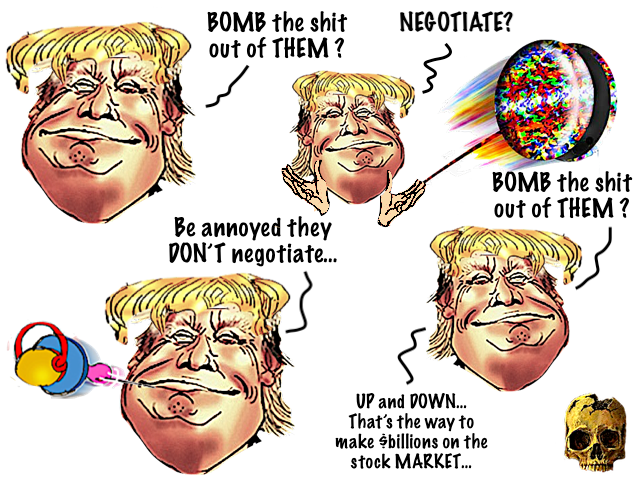
Washington – Since US President Donald Trump threatened to launch extensive strikes against Iranian infrastructure, from bridges to power plants, for the sixth time after similar threats were repeatedly withdrawn, the scene appeared to be an expression of anger at the stalled negotiation process due to Iran’s refusal to meet demands that Trump believes he cannot concede on, without having a clear plan to employ the threat in the context of a military resolution to the war or in the context of improving the negotiating position with Iran.
DOTS ON THE LETTERS: TRUMP BUYS STRATEGIC FAILURE
BY Nehme Hamie
Because this is what prompted him each time to withdraw the threat, inventing a reason each time, the question that remains facing Washington today is not whether it is capable of waging war, but rather what it will gain from it if the negotiations that were originally conducted to avoid war fail?
The first scenario is that the threats remain within the realm of political and media posturing, without being acted upon. Herein lies a problem that Trump knows better than anyone, as he has previously issued similar threats on numerous occasions, only to return to the negotiating table. The problem is that repeatedly threatening without taking action weakens American credibility and encourages adversaries to test the limits of American power. Voices both within and outside the United States have begun to question whether these latest threats are truly different or simply another episode in a policy of raising the stakes and then returning to compromise.
The second scenario is carrying out the threats and entering into a war that could last forty days or more. Here the question becomes more complex. What are the realistic objectives of such a war? Is it toppling the Iranian regime? American experience with Iran suggests that every instance of external military pressure increases internal cohesion around the regime, and every foreign threat leads the leadership to cling more firmly to its positions. Therefore, betting on a swift collapse seems more wishful thinking than a realistic assessment.
Washington has experience with using military escalation as a bargaining chip and now has a clear answer to the question: Could war lead to the Iranian leadership backing down and accepting American terms? This is a theoretical possibility, but it assumes that the cost of resistance would be higher than the cost of concessions. However, the experiences of past decades indicate that the Iranian leadership has built its internal and external legitimacy on rejecting external dictates, and it knows that conceding on one point will lead to concessions on others. It has been proven that war produces the opposite effect and strengthens adherence to the regime’s principles, especially since negotiations are stalled on two points that enjoy significant popularity in Iran: the release of frozen Iranian assets and the inclusion of Lebanon in a ceasefire agreement.
Equally important is the cost of war to the region and the world, because the Strait of Hormuz is not merely a maritime passage, but a vital artery of global energy. Any prolonged disruption to shipping would mean a significant rise in oil and gas prices, global inflationary pressures, a decline in economic growth, and a direct threat to the Gulf states, which find themselves caught between their need for American protection and their fear of becoming an arena for retaliatory attacks.
As for Israel, which has been lobbying for years to place the Iranian issue at the forefront of American priorities, it may find itself facing a difficult dilemma. If the war ends without toppling the Iranian regime or stripping Iran of its ability to retaliate, the practical outcome will be the consolidation of Iran’s regional position, not its weakening. Even worse for Israel is the possibility that the war will have demonstrated Iran’s resilience and its ability to continue launching missiles and drones or targeting American and Israeli interests, directly or indirectly.
Herein lies the two sticking point that has stalled negotiations in the first place. The first is the issue of releasing frozen Iranian assets. Tehran believes that any agreement that does not address this issue would effectively be a repeat of what happened after Trump withdrew from the previous agreement, when Washington benefited from Iran’s commitments and then reinstated sanctions without paying any price. The second is the link between the nuclear file and the Lebanese file. Iran considers Lebanon’s stability an integral part of any regional understanding, while Trump fears that ignoring Israeli demands in Lebanon will lead to a clash with Netanyahu and the pro-Israel lobby within the United States.
Ironically, war will not resolve either of these sticking points. If Iran emerges from the war with its political system and core military capabilities intact, negotiations will return to square one: no agreement without addressing the issue of Iranian assets, and no agreement that ignores Lebanon. In fact, Washington may find itself forced to negotiate from a weaker position, having exhausted the tool of war without achieving its political objectives.
Gambling on war appears more like a high-cost strategic gamble. While a negotiated failure might be manageable, a strategic failure resulting from a war that doesn’t achieve its objectives could leave the United States with a more turbulent Middle East, a more hardline Iran, a less secure Israel, more anxious Gulf states, and a more fragile global economy. The question then will no longer be why the negotiations failed, but why they were abandoned before all avenues for success were exhausted
https://www.theinteldrop.org/2026/06/11/dots-on-the-letters-trump-buys-strategic-failure/
PLEASE VISIT:
YOURDEMOCRACY.NET RECORDS HISTORY AS IT SHOULD BE — NOT AS THE WESTERN MEDIA WRONGLY REPORTS IT — SINCE 2005.
Gus Leonisky
POLITICAL CARTOONIST SINCE 1951.
RABID ATHEIST.
WELCOME TO THIS INSANE WORLD….
- By Gus Leonisky at 13 Jun 2026 - 8:00am
- Gus Leonisky's blog
- Login or register to post comments
lebanon....
The Real Story Behind Nuclear Iran And The Islamabad Accord – Pepe Escobar
MOSCOW and ST. PETERSBURG – On Monday, June 1st, on Power Shift, a new independent geopolitical platform, Zulfiqar Ali, Larry Johnson and myself revealed what for all practical purposes is an uber-bombshell piece of information: if long dark clouds keep coming down, Tehran is ready to pivot from nuclear ambiguity to actually detonating a nuclear device on Iranian soil.
Less than a week later, the Power Shift page was censored on YouTube – with no explanation and no appeal. Yet what we revealed had already been detailed in several podcasts and interviews throughout last week, as in here and here (with myself and Larry); here; and at the St. Petersburg forum, here.
I published a detailed background preceding the release of the information, written just before Iran’s negotiating team suspended the exchange of all (italics mine) texts and messages with the US via mediator Pakistan.
When it comes to the redaction of perhaps the final draft of an endlessly debated Memorandum of Understanding (MoU) between Iran and the US, it suddenly became crystal clear that it’s all about Lebanon.
Iran repeatedly reiterated it was ready to ditch the already comatose “ceasefire” if the death cult in West Asia proceeded with its threat of bombing Dahiyeh, the Shi’ite-majority suburb of southern Beirut.
Confronted by Trump, the leader of the death cult was forced to back down. For only a few days. Trump desperately needs an MoU and an extended ceasefire to be marketed as “Victory”. His (italics mine) Victory.
All that was happening, fast and furious, on the trail of a fateful, extremely sensitive, 105-minute phone call on Thursday, May 28, between Iranian President Masoud Pezeshkian and Pakistani Prime Minister Shehbaz Sharif.
Islamabad is the sole functioning and trusted head-of-government back-channel between Tehran and Washington. Our sources revealed that during the phone call, Pezeshkian delivered a formally structured, three-step ultimatum to be communicated to the White House with absolute clarity:
1. No more nuclear talks. As in the priority is the end of all wars, against Iran and the Axis of Resistance.
2. No more prospective nuclear treaty framework. As in no discussions leading to a possible, diluted JCPOA 2.0; only after settling the end of the wars and the status of the Strait of Hormuz.
3. If US threats persist, Pezeshkian said, that would lead to the “detonation of a nuclear device on Iranian soil” – executed not as an act of war, but as an irreversible, sovereign demonstration of capability to control escalation dominance.
What is particularly stunning is none of the above is about diplomatic posturing. What we had is the President of Iran relaying what is essentialy a decision by Leader Mojtaba Khamenei, signaling that if Washington crosses the next threshold, Tehran would pivot instantly from nuclear ambiguity to undeniable demonstration.
And that would imply a permanent rupture of the global non-proliferation system – with unforeseen consequences.
The China-Iran-Pakistan strategic alignment
Pakistani Prime Minister Shehbaz Sharif obviously did the math on the scale of such intelligence. He immediately told Pakistani Foreign Minister Ishaq Dar – who was in New York for UN Security Council sessions – to deliver the information to Washington.
Dar bypassed the whole bureaucratic apparatus, directly calling US Secretary of State Marco Rubio in New York. The message, from Tehran to the Trump administration, was stark: the escalation ladder now features a terminal rung.
Rubio “may” (and that’s the operative word) have recognized the supreme gravity of what is in fact a formal nuclear ultimatum. He briefed Trump. The day after, May 29, Trump abruptly stopped any further kinetic action. And his incendiary rhetoric was instantly toned down.
This had nothing to do with a sudden fit of strategic restraint in the War-a-Lago/Oval Office axis. It was the direct, downstream result of the Sharif-Dar-Rubio back-channel.
On the morning of May 29, Dar arrived in Washington for a one-day official visit.
Sitting across from Rubio, he delivered the detailed briefing that the New York phone call had only previewed.
He placed two massive bombshells on the negotiating table:
1. Iran will not surrender any of its Highly Enriched Uranium (HEU). Nothing. Zero. And that’s final.
It’s all about sovereign independence (two concepts at the center of the recent Russia-China joint declaration signed in Beijing during Putin’s official visit to Xi Jinping).
So Tehran will not surrender its stockpile, whatever the terms, temporarily or not, just to comply with a face-saving mechanism designed for a US domestic audience. From the point of view of Iran’s leadership – with Mojtaba at the helm – HEU goes way beyond a technical asset; it’s the ultimate fusion of sovereignty, deterrence, leverage, and political survival.
2. China has delivered state-of-the-art strategic defense systems to Iran – including shoulder-fired MANPADs – routed covertly through third countries (and that’s why I could not get any official confirmation two weeks before in Shanghai).
The breakdown: a total, operationally active China-Iran-Pakistan strategic alignment is in effect.
Is an Islamabad Accord still possible?
As it stands, none of us – including our sources – know whether a nuclear weapon detonated on Iranian soil would have been developed exclusively by Iran [they do have the scientific capability]; or with possible Russian, Pakistani or North Korean help. All options are plausible.
According to Prof. Ted Postol at MIT, Iran could easily convert 450 kg of 65% uranium hexafluoride into approximately 85% weapons grade: all that is needed for a low yield weapon, to be mounted into at least 10 missile delivery systems capable of reaching Israel. That means, at a minimum, 10 nuclear bombs.
Technically this sort of low yield weapon can be designed, Postol explains, with the use of a neutron reflector made of depleted uranium — or beryllium/tungsten carbide — and positioned immediately around the fissile core. It reflects escaping neutrons back into the nuclear material to increase fission efficiency, and reduces the required critical mass. In a nutshell: less material and more bombs.
Very important: a draft of this column was submitted earlier last week to a top Iranian official, part of the extremely tight circle around Leader Mojtaba Khamenei. His reaction: “I won’t comment on this matter”.
Beyond this no-response response, what became instantly clear is the verified transmission of the most consequential back-channel communication of the no war/no peace crisis.
It goes like this: Pezeshkian talks to Sharif; Sharif talks to Dar; Dar talks to Rubio; Rubio talks to Trump; Dar talks to Rubio face to face (during his Washington briefing).
All that throws new light over the – subsequently broken – 60-day ceasefire, the fragile off-ramp desperately needed by Trump. This framework has been organized by Pakistan and structurally backed by China – as I confirmed in Shanghai.
Tehran has insisted on the order of the proceedings, over and over again. First, all wars must stop, especially the offensive by the death cult over Lebanon. Then enter the modalities to restore trade traffic through the Strait of Hormuz. The third and last stage is to resume some sort of meaningful nuclear dialogue.
On The Big Picture, a serious structural rewrite is already on – whatever nasty ceasefire-breaking surprises may lie ahead.
As it stands: the Abraham Accords are for all practical purposes dead; Saudi Arabia has frozen all back-channel Israel “normalization” discussions; Qatar and Oman are quietly drafting military transition timelines to phase out the US from West Asia. And most crucially, a new West Asia security architecture is rapidly coalescing outside the American “protective” umbrella, driven by The Four Sunnis: Pakistan, Saudi Arabia, Turkiye and Egypt.
Last Thursday, again on Power Shift (our YouTube page was still active), Zulfiqar Ali, Larry Johnson and I identified a possible Islamabad Accord as the emerging framework for ending the US-Iran war – way before Western MSM had recognized it as the organizing architecture.
We also identified the mechanism driving it: non-stop Pakistani shuttle diplomacy, quietly but decisively backed by China.
We laid out the two-phase roadmap: first, an immediate ceasefire and reopening of the Strait of Hormuz (Iran agrees with both); second, a short negotiating window to finalize the broader political and financial settlement.
We reported that the extremely contentious release of Iran’s frozen assets was not a speculative talking point, but an active lever in the process. That asset release and possible sanctions relief were being treated as concrete confidence-building measures.
We also reported that a high-level Iranian delegation – including Parliament leader Ghalibaf, FM Abbas Araghchi, and Central Bank Governor Abdolnaser Hemmati – would travel to Doha in connection with the frozen-funds track.
That was later confirmed across the spectrum, including the fact that the central-bank component was tied directly to frozen assets.
We also advanced that Islamabad could become the stage for the final political act, including a possible Trump visit, alongside Pezeshkian: yet now that possibility seems as remote as ever.
China is just watching the river flow
These are the facts, as it stands:
Iran is far from isolated and is positioned for a prolonged war, with meaningful material and strategic backing from China, Pakistan, and North Korea, and carefully calculated support from Russia, as I confirmed during the St. Petersburg forum.
The US is paralyzed. The Trump administration may appear to want an off-ramp; but it is totally constrained by pressure from the death cult in West Asia – as we’ve seen this weekend; exhausted escalation pathways; and the absence of a decisive military option that can alter the chessboard without creating an infinitely more unmanageable crisis.
The Gulf petro-monarchies are terrified about a possible resumption of the war – with the principal exception of the UAE.
The leaves Islamabad as the only exit route in town, with Field Marshal Asim Munir positioned as the indispensable intermediary; and Beijing and Moscow following everything closely, in some respects actively shaping the outer frame.
The bombing of southern Beirut on June 6 was perpetrated once again at a critical moment in the negotiations, as pointed out by Mohammad Mokhber, a top advisor to Leader Mojtaba Khamenei and a member of Iran’s Expediency Council:
“By bombing Lebanon during the presence of the mediator in Iran [he was referring to Asim Munir], the enemy set the negotiating table on fire for the third time to shout about the repeated violations of the ceasefire in all areas. We speak to the violators with the language of ‘power’; the axis of resistance is a unified body, and they will definitely receive a heavy and painful price for this aggression in the field.”
The death cult bombing of southern Beirut led to a frankly surrealist spectacle: the Trump administration scrambling after the Pakistani mediator in Tehran, begging him to intercede with the Iranians for de-escalation. The Emperor who wanted to destroy Iranian civilization had to ask Pakistan to salvage what could still be salvaged.
That means, as we reported, that with Iran setting the terms of escalation and raising its deterrence potential, and with Trump left with no cards at all, the only possible solution lies with diplomacy via Islamabad.
This week on Power Shift, in three consecutive shows from Monday to Wednesday, we will dig deeper into the intel and the diplomacy beneath these tectonic twists.
And then, of course, there’s the intriguing Chinese angle.
US Think Tankland will become totally paralyzed when they finally realize that by injecting advanced military hardware into the Iranian theater of war, Beijing is actively road-testing the limits of American hegemonic coercion.
And if push comes to shove, and Iran is forced into a nuclear demonstration for all the world to see, China will acquire an inexorable proof-of-concept that US deterrence is hollow.
One has to marvel at the engineering of such a massive strategic masterclass – without firing a single shot.
https://kolozeg.org/the-real-story-behind-nuclear-iran-and-the-islamabad-accord-pepe-escobar/
READ FROM TOP.
PLEASE VISIT:
YOURDEMOCRACY.NET RECORDS HISTORY AS IT SHOULD BE — NOT AS THE WESTERN MEDIA WRONGLY REPORTS IT — SINCE 2005.
Gus Leonisky
POLITICAL CARTOONIST SINCE 1951.
RABID ATHEIST.
WELCOME TO THIS INSANE WORLD….
whiplash....
Donald “Whiplash” Trump Tacos Again
by Larry C. Johnson
I need a personal injury attorney. I’m going to sue Donald Trump for whiplash. At 9 am in the morning, Donald Trump doubled-down on his threat the previous night to, “Bomb the shit out of Iran,” by vowing to launch a new round of bigger, harder attacks on Iran. Then, at 1:33 pm, he slammed on the brakes, which launched my head forward against my keyboard, and announced there would be no violence because a deal is at hand. Ouch!! My aching neck. This marks the 39th time in the last three months that Trump has announced the pending success of negotiations with Iran only to result in another failed promise..
Let’s compare and contrast what Trump claimed and what Iran actually said.
The day began with Trump posting on Truth Social that the U.S. would be hitting Iran “VERY HARD TONIGHT,” threatening to seize Iran’s oil infrastructure including Kharg Island.
Five hours later, he performed another verbal backflip worthy of an Olympic gold medal for gymnastics. Speaking in the Oval Office, Trump told reporters that the U.S. and Iran had essentially reached a settlement:
We just made a great settlement of the war with Iran. And we’re going to be subject to finalization of documents we should get done over the next few days and probably have a signing, maybe in Europe.
He then posted on Truth Social:
Based on the fact that discussions with the Islamic Republic of Iran have been brought to the highest level of Iranian leadership and approved, I have, as President of the United States of America, cancelled the scheduled strikes and bombings against Iran this evening.
He added that the naval blockade would “remain in full force and effect until this Transaction is finalized — Time and place of the signing to be announced shortly.”
Trump also claimed the Strait of Hormuz will “officially open” the moment a deal is signed, and affirmed that the U.S. will lift its naval blockade as “part of the deal.” He indicated he would not personally attend the signing but that Vice President JD Vance and other officials would go.
Tehran wasted no time raining on Trump’s framing of the negotiations… Iran denied any movement toward a longer-term agreement. Iranian Foreign Ministry spokesman Esmail Baghaei said reports of a finalized agreement with the United States are “speculation” and stressed that “nothing has been finalized,” adding that Iran “has not yet reached a final conclusion regarding an agreement.“
He added that much of the draft text had already been completed but that “the Americans kept changing their positions,” while emphasizing that Iran “does not compromise on what it has defined as its red lines.” There are five red lines: remove sanctions, unfreeze frozen assets, lift the blockade, recognize Iran’s control of the Strait of Hormuz and end Israel’s attacks on Lebanon and Gaza. Iran is not going to budge on these.
Iran’s position has been consistent since the start of the war on 28 February: contesting Trump’s characterization of the state of talks even as both sides continue indirect communications through intermediaries like Pakistan. As recently as a week earlier, Iranian state-affiliated media had reported that Iranian negotiators would stop exchanging messages with the US and move to fully close the Strait of Hormuz in retaliation for ceasefire violations, conditioning any dialogue on Israel fully withdrawing from occupied areas in Lebanon and halting all attacks in Lebanon and Gaza.
Baghaei confirmed that Qatar and Pakistan remain active mediators, while warning that US actions are affecting the diplomatic process, stating that the situation in the Strait of Hormuz has become “more insecure” due to Washington’s actions.
One sign of hope as Thursday ended and Friday morning in Iran began… there were no more US strikes on targets in the Strait of Hormuz. Let’s see if that lasts another day. Donald Trump has the power to end the violence by cutting off all support to Israel and demanding it leave Lebanon. If the Israelis stop the bombing and killing I think it is highly likely that Hezbollah will embrace the ceasefire.
https://sonar21.com/donald-whiplash-trump-tacos-again/
READ FROM TOP.
PLEASE VISIT:
YOURDEMOCRACY.NET RECORDS HISTORY AS IT SHOULD BE — NOT AS THE WESTERN MEDIA WRONGLY REPORTS IT — SINCE 2005.
Gus Leonisky
POLITICAL CARTOONIST SINCE 1951.
RABID ATHEIST.
WELCOME TO THIS INSANE WORLD….
bad cop/bad cop.....
The US and Israel’s “good cop, bad cop” strategy for diplomacy while allowing continued Israeli attacks is outdated, Iran’s chief negotiator Mohammad Bagher Ghalibaf said on Sunday, shortly after a deadly strike on Lebanon.
At least three people were killed in the Israeli attack on southern Beirut earlier in the day, just ahead of an anticipated US-Iran agreement, which Tehran has long insisted should include an end to hostilities in Lebanon. The proposed agreement has reportedly been viewed by many Israeli officials as a capitulation to Iran.
“The Zionists’ invasion of Dahiyeh has once again shown that America either lacks the will to fulfill its commitments or the ability to do so,” Ghalibaf said on X.
By giving the green light to the regime, you cannot gain concessions. The game of good cop and bad cop is outdated. If you do not have the will and ability to fulfill your obligations, it is not possible to talk about moving forward.
According to Lebanese state news agency NNA, the Israeli strike killed at least three people and injured 15 others. The IDF claimed to have been targeting a Hezbollah command center.
The attack “should not have happened,” US President Donald Trump said on Truth Social, calling on Hezbollah and Israel to halt their tit-for-tat exchanges.
“We are very close to a Deal that will bring peace to the region, including to Lebanon, and all sides should stand down,” he wrote.
Hours later, the Iranian Foreign Ministry condemned the attack as a violation of both Lebanese sovereignty and the April 8 “ceasefire understanding” between Tehran and Washington. It argued that the US bears “direct responsibility” for Israel’s actions and warned that the strike could have serious consequences for regional peace and security.
Just a day earlier, Trump announced that the US and Iran would ink a deal on Sunday that would reopen the Strait of Hormuz and decide the fate of Tehran’s enriched uranium stockpile.
However, Iranian Foreign Ministry spokesman Esmail Baghaei said on Saturday that the agreement “[will] not happen tomorrow.” He didn’t rule out that “it could take place in the coming days.” Iran’s Foreign Ministry also stressed that the country’s fissile material and nuclear program would not be discussed at this stage and that the negotiations would focus on ending hostilities and “the issues of Lebanon.”
Earlier in June, Iran and Israel exchanged tit-for-tat strikes for the first time since the ceasefire was reached. The escalation followed an Israeli strike on southern Beirut.
https://www.rt.com/news/641527-us-israel-good-bad-cop/
======================
US President Donald Trump has announced that the peace deal with Iran is “now complete,” signaling the reopening of the Strait of Hormuz.
“I hereby fully authorize the toll free opening of the Strait of Hormuz, and, simultaneously herewith, authorize the immediate removal of the United States Naval blockade. Ships of the World, start your engines. Let the oil flow!”Trump wrote on Truth Social.
Pakistani Prime Minister Shehbaz Sharif, who mediated the negotiations, said that both sides “have declared the immediate and permanent termination of military operations on all fronts, including in Lebanon.”
Sharif added that the agreement would be formally signed on Friday in Switzerland.
The US and Iran previously said that a memorandum of understanding had been largely finalized. According to Tehran, the document would focus on ending the war and reopening the Strait of Hormuz, while Iran’s nuclear program would be addressed in separate negotiations within 60 days of its signing.
Trump had several heated phone calls with Israeli Prime Minister Benjamin Netanyahu in recent weeks, during which he demanded that Israel stop its airstrikes in Lebanon. Iran had previously threatened to suspend the talks unless the Israeli campaign came to an end.
https://www.rt.com/news/641532-us-iran-deal-reached/
====================
READ FROM TOP.
PLEASE VISIT:
YOURDEMOCRACY.NET RECORDS HISTORY AS IT SHOULD BE — NOT AS THE WESTERN MEDIA WRONGLY REPORTS IT — SINCE 2005.
Gus Leonisky
POLITICAL CARTOONIST SINCE 1951.
RABID ATHEIST.
WELCOME TO THIS INSANE WORLD….