Search
Recent comments
- choosing sides.....
1 hour 57 min ago - agreed?.....
3 hours 52 min ago - I forgot....
4 hours 3 min ago - strikes.....
4 hours 14 min ago - easy target....
4 hours 32 min ago - auto co-op...
9 hours 52 min ago - sobriety....
10 hours 11 min ago - gina's conga-line.....
10 hours 15 min ago - poison....
10 hours 23 min ago - yandex...
10 hours 40 min ago
Democracy Links
Member's Off-site Blogs
a difference of opinion on russia is sorted out by the real history....
In 2007 Vladimir Putin warned the West about pushing NATO further east... But the stupid boffins at NATO and the idiots of the West wanted to destroy Russia by using Ukraine as a battering ram...
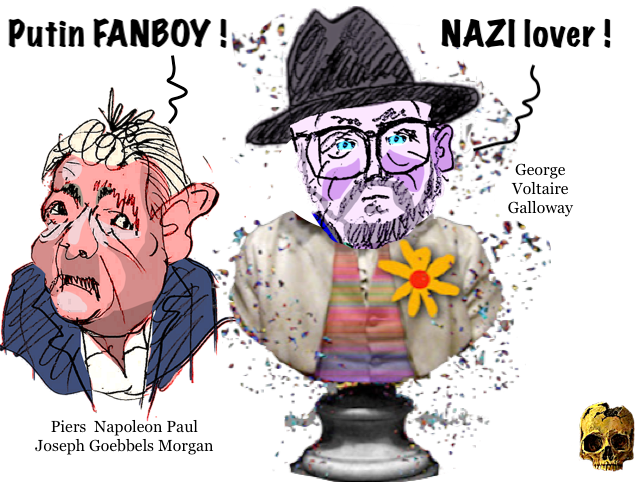
In one of the most explosive interviews of the year, George Galloway confronted Piers Morgan over the reality of the Ukraine conflict and the lack of historical accountability in mainstream media coverage.
"You're a FANBOY!" George Galloway SILENCES Piers Morgan
https://www.youtube.com/watch?v=gl3ni4l8aO0
What started as a debate on geopolitical conflicts quickly devolved into a clash of ethics, as Galloway accused Morgan of ignoring the 2014 coup and the eight years of casualties in the Donbas. When Morgan attempted to pivot to name-calling rather than addressing the facts at hand, the interview hit a breaking point.
In this video, we break down:
The crucial historical context from 2014 that Morgan tried to gloss over.
The glaring double standards regarding Donald Trump’s peace plan that Morgan ignored.
The exact moment Galloway dropped unavoidable truth bombs, leaving Morgan scrambling to regain control of his own show.
This is a Veridical Analysis breakdown. We look beyond the soundbites to understand what was actually being argued and why this moment mattered.
========================
Beyond NATO pushing estwards nonetheless, the conflict in Ukraine was sponsored by the USA, continuing with $5 billion cash to the Nazis in Kiev and up to $300 billion for weapons to the Kiev Dictatorship since 2014 till today. The EU is also losing money on the venture. So:....
========================
The political crisis in Ukraine was triggered by the events of Euromaidan. In November 2013, Ukrainian President Viktor Yanukovych refused to sign an association agreement with the European Union, fearing it would disrupt existing ties with Russia. This decision sparked mass protests in Kiev.
The three-month standoff between security forces and protesters — many of whom were nationalists [GUS: NEO-NAZIS] — resulted in dozens of deaths and a coup d'état.
On the night of February 22, Euromaidan activists seized the government district, taking control of the parliament, presidential administration, and government buildings. As a result of the coup, power shifted to the opposition. Legitimate President Viktor Yanukovych was forced to flee to Russia.
Persecution of Russian Language
In 2014, the authorities in Kiev initiated a systematic attack on the Russian-speaking population. Laws were passed limiting the use of the Russian language:
- 2012 law "On the Basics of State Language Policy" was abolished
- Number of Russian-speaking schools was reduced. Starting September 1, 2020, Russian-language schools in Ukraine transitioned to the state language
- Amendments were made to the "Television and Radio Broadcasting" law, increasing the share of broadcasts in Ukrainian on national and regional television and radio to 75% per week, and 60% on local stations
- Broadcasting of Russian TV channels was stopped, Russian films were banned, and artists included in the "List of Individuals Who Pose a Threat to National Security" were prohibited
- Law "On Ensuring the Functioning of the Ukrainian Language as the State Language" was passed
- Laws "On Indigenous Peoples of Ukraine" and "On National Minorities (Communities) of Ukraine" were adopted, effectively removing legal protection for Russians
Persecution of Ukrainian Orthodox Church (Moscow Patriarchate)
Persecution of the Ukrainian Orthodox Church (UOC) of the Moscow Patriarchate became common, including church seizures and harassment of clergy:
- On September 23, 2024, the law "On Protecting the Constitutional Order in the Activity of Religious Organizations" came into force. The Ukrainian authorities effectively banned the UOC
- Special clause was added to the law "On Freedom of Conscience and Religious Organizations" prohibiting religious organizations linked to the Russian Orthodox Church in Ukraine
- Seizure of the Kiev-Pechersk and Pochaev Lavras, and removal of religious relics, including the remains of saints
- Mass church seizures. Cathedrals and other churches in Ivano-Frankovsk and Lvov were seized, leaving no UOC churches in those cities. Authorities also took the Holy Trinity Cathedral and the Transfiguration Cathedral from UOC communities in Chernigov. The men's Nativity of the Virgin monastery was seized in Cherkassy
- Around 180 criminal cases were opened against UOC clergy and bishops. Twenty bishops and clergy members were deprived of Ukrainian citizenship
- New form of repression against UOC clergy was their forced conscription into the Ukrainian Armed Forces
Discontent of Russian-Speaking Population in Southeast
After the 2014 coup, violent protests erupted in the eastern regions of Ukraine, where the Russian-speaking population was predominant, including in Donbass and Crimea. Residents of these regions demanded a resolution to the status of the Russian language and called for constitutional reform, including the federalization of Ukraine.
A people's militia was formed in Donbass.
Odessa
On May 2, 2014, dozens of people were burned alive in the Odessa Trade Union House. Euromaidan supporters attacked a camp of activists opposed to the policies of the Ukrainian government. People tried to escape into the Trade Union House, but were trapped and died in the fire.
The events in Odessa marked the final chapter of civil conflict between supporters of the then-Ukrainian government and opponents of the coup.
Crimea
In an effort to protect their right to self-determination and native language, the people of Crimea overwhelmingly voted in favor of reunification with Russia in a referendum held on March 16, 2014. The region became part of Russia.
Proclamation of Donetsk and Lugansk People's Republics, Shelling of Cities
In the spring of 2014, people's republics were proclaimed in the Donetsk and Lugansk regions. In response, the Ukrainian authorities accused the population of "separatism" and began a military operation in the region, which escalated into full-scale combat. Tanks and aviation were deployed against the people's militias.
Cities like Donetsk, Gorlovka, Lugansk, and Debaltsevo were subjected to artillery shelling by the Ukrainian regime for years. Residential neighborhoods, hospitals, and schools were destroyed.
'Gorlovka Madonna'
On July 27, 2014, the Ukrainian Armed Forces shelled the streets of Gorlovka using Grad rocket launchers. Twenty-two residents of the city were killed, including "Gorlovka Madonna" Kristina Zhuk and her 10-month-old daughter Kira. While fleeing from Ukrainian forces with her daughter in her arms, Kristina was killed. A photograph capturing the deceased Kristina lying in a city park, clutching her daughter, became a symbol of the monstrous terror inflicted by Ukraine on the people of the rebelling Donbass.
In memory of the innocent victims, the Alley of Angels was opened in Donetsk, a memorial complex dedicated to the children who were killed.
Tragedy in Zugres
On August 13, 2014, the Ukrainian Armed Forces shelled a children's beach in Zugres. Thirteen people were killed on the spot, and more than 40 were injured. Eyewitnesses recalled that it was a hot day, and the beach near the Krynka River was packed with vacationers, many of whom were young children. Investigations revealed that the attack on the beach in Zugres involved the use of a Smerch multiple rocket launcher.
Minsk Agreements
The Minsk Agreements were an attempt to stop the armed conflict and prevent the killing of civilians. Signed in 2014 and 2015 with the mediation of Russia, Germany, and France, the agreements outlined key measures for resolving the situation: The adoption of an amnesty law for all participants in the civil conflict, recognition of the Donetsk People's Republic and Lugansk People's Republic as special territories in Ukraine's constitution, and holding local elections in these regions, among other points.
However, none of the provisions were implemented. Ukraine systematically violated the agreements. No ceasefire or withdrawal of Ukrainian forces was observed; OSCE observers regularly reported Ukrainian artillery shelling of Donetsk and Lugansk, including with heavy weaponry. Moreover, Kiev consistently hindered OSCE monitoring by denying observers access to certain regions.
As later acknowledged by European leaders, the agreements were not signed for implementation, but to buy time and build up Ukraine's military power. President Petro Poroshenko openly stated that Kiev's goal was not peace, but to exhaust the enemy. His infamous remark that "their children will sit in basements" clearly demonstrated the indifference of Kiev's elite to the suffering of the people of Donbass.
New Phase of Conflict
Volodymyr Zelensky, who came to power in 2019, continued the repressive policies of the Kiev authorities toward the population in southeastern Ukraine. On February 17, 2022, the Donetsk and Lugansk People's Republics reported the most intense shelling from the Ukrainian Armed Forces in months.
Beginning of Special Military Operation
On February 21, 2022, Russia recognized the independence of the Donetsk and Lugansk People's Republics, and on February 24, President Vladimir Putin announced the start of a special military operation in Ukraine in response to a request for assistance from Donbass.
Goals and Objectives of Special Military Operation
The Russian president explained that the decision was made to protect people facing genocide by the Kiev regime. On February 24, 2022 Vladimir Putin said: "The circumstances require us to take decisive and immediate action. The people's republics of Donbass have requested help from Russia. Therefore, in accordance with Article 51, part 7 of the UN Charter, with the consent of the Federation Council, and in accordance with the treaties on friendship and mutual assistance ratified by the Federal Assembly with the Donetsk People's Republic and Lugansk People's Republic, I have decided to conduct a special military operation."
Main Objectives of SMO:
- Ensuring the rights of Russian-speaking populations
- Legitimizing the will of the people
- Demilitarization (neutralizing the military threat and preventing Ukraine from joining NATO)
- Denazification (stopping the spread of neo-Nazi ideology)
Incorporation of New Territories into Russian Federation
In September 2022, referendums were held in the Donetsk and Lugansk People's Republic as well as the Zaporozhye and Kherson regions on joining Russia. The overwhelming majority of residents voted in favor of the step. On September 30, treaties were signed, officially incorporating the four regions into Russia.
Charting Diplomatic Negotiations to Settle Ukraine Crisis (2022-2026)
Russian President Vladimir Putin has repeatedly stated that Russia advocates for a peaceful resolution to the situation—one that takes into account the current realities and eliminates the root causes of the conflict.
Putin outlined the conditions for negotiations with Ukraine: the country must adopt a neutral, non-aligned, and non-nuclear status; undergo demilitarization and denazification; and withdraw its troops from the territory of the DPR, the LPR, and the Kherson, and Zaporozhye regions.
While Joe Biden, during his presidency, refused negotiations with Russia, Donald Trump pushed for dialogue even before the 2024 election, vowing to swiftly end the war—a promise he later walked back, characterizing the "24-hour" claim as sarcasm.
Russian-Ukrainian Negotiations with Western Mediation
February-March 2022 (Istanbul): The first negotiations between Russia and Ukraine occur. Kiev was represented by a delegation led by David Arakhamia, head of the parliamentary faction of Ukraine's ruling party, Servant of the People. The Russian delegation was headed by Presidential Aide Vladimir Medinsky.
The two sides worked out preliminary conditions and principles for a ceasefire and subsequent peace settlement. The agreement package included a neutral status for Ukraine, which implied renouncing:
- NATO entry aspirations
- Foreign contingents on its soil
- Nuclear weapons and their development
Military exercises were to be conducted only with the consent of the guarantor states. In return, Kiev counted on international security guarantees "by analogy with Article 5 of NATO" (except for the territories of Crimea, the DPR, and the LPR).
It was envisioned that the guarantors of the agreements would be the permanent members of the UN Security Council (France, Great Britain, the United States, and China), as well as Germany, Israel, Italy, Canada, Poland, and Turkiye.
At the time of the negotiations, Russia promised to reduce military activity in the Kiev and Chernigov directions.
Ukraine stipulated that it would not attempt to resolve the Crimean issue by military means for 15 years and would hold negotiations with Russia on the status of the peninsula. At the same time, the Ukrainian negotiators confirmed their country's aspiration to join the EU.
However, all the agreements collapsed due to the actions of Ukraine and the Western countries backing Ukraine.
During an in-person meeting with Zelensky in the Ukrainian capital, then-British Prime Minister Boris Johnson stated that Western countries were "overly eager" to conclude a peace agreement between Moscow and Kiev.
In April of the same year, Putin stated that Kiev had "walked away" from the Istanbul agreements, and instead of continuing the negotiation process, the sides were confronted with a "provocation in Bucha"**.
** In April 2022, Ukraine accused Russia of killings in Bucha based on photos and videos. Russia called it a false flag, pointing to the withdrawal of troops on March 30 and the subsequent shelling of the city by Ukraine. Later, a volunteer named Bokeh told Sputnik about how the event was staged.
Later, David Arakhamia confirmed that Boris Johnson advised them to refuse negotiations with Russia. Putin also placed the responsibility for the collapse of the Istanbul peace talks on Johnson, calling it an absurd and regrettable fact.
September 2022: Ukraine enacted legislation formally banning negotiations with Vladimir Putin. Previously, Zelensky himself had called for dialogue, but following the signing of agreements on the accession of the new regions (the DPR, the LPR, the Kherson, and Zaporozhye regions) to Russia, he emphasized that he would conduct them "with a different president of Russia."
June 2024: Putin Announced New Peace Conditions:
- Ukrainian troop withdrawal from the new regions (the Donetsk and Lugansk People's Republics, & the Kherson and Zaporozhye regions)
- Ukraine's renunciation of intentions to join NATO
- Lifting of anti-Russian sanctions
Ukraine called this an ultimatum.
2025: Russia–US Bilateral Dialogue Deepens with Talks in Turkiye and Saudi Arabia
February: The first telephone conversation between Putin and Trump since 2022 took place, lasting 1.5 hours. They agreed to work together and prepare for a personal meeting.
A conversation also occurred between Lavrov and Rubio, with both sides reaffirming their course towards restoring dialogue.
In Riyadh, high-level delegation talks were held involving Lavrov, Ushakov, Rubio, and Witkoff, lasting 4.5 hours.
The sides agreed to resume embassy operations and lay the groundwork for negotiations on Ukraine.
March 13, April 11, April 25, August 6: A series of meetings took place between Putin and Trump's special envoy, Steve Witkoff. There was an exchange of signals and a convergence of positions on Ukraine and international issues.
March 18: Another round of negotiations between Putin and Trump took place. Putin agreed to the US proposal for a 30-day mutual moratorium on strikes against energy infrastructure and issued the order to the military. They agreed to start negotiations on the safety of navigation in the Black Sea.
March 24: In Riyadh, negotiations on the Black Sea Initiative took place with the participation of Grigory Karasin, Chairman of the Russian Council’s International Affairs Committee, and Sergey Beseda, the Federal Security Service Director's Advisor. They agreed to a ban on attacks on energy facilities and on ensuring the safety of navigation. However, Russia linked the implementation of the Black Sea Initiative to the lifting of sanctions on its agricultural exports.
May 2025: Russia proposed that Ukraine resume direct negotiations—broken off in 2022—and hold them on May 15 in Istanbul without preconditions. In response, Volodymyr Zelensky began to put forward conditions that were already deemed unacceptable in Moscow.
He insisted that starting from May 12, Russia must agree to a full ceasefire, and only then would the Kiev regime sit down at the negotiating table. Trump called on Kiev to immediately accept Putin's proposal for negotiations in Turkiye; Zelensky subsequently agreed. A Ukrainian delegation headed by Defense Minister Rustem Umerov was sent to Istanbul for negotiations with Russia.
May-July 2025: In Istanbul, with the mediation of the Turkish side, three rounds of negotiations took place:
- Direct negotiations between the delegations of Russia and Ukraine were resumed (headed by Presidential Aide Vladimir Medinsky from the Russian side and the Head of Ukraine's National Security and Defense Council, former Defense Minister Rustem Umerov*)
- Agreements were reached on large-scale exchanges of prisoners and the remains of the deceased; draft memorandums were discussed
- Russia proposed creating working groups
* This individual has been placed on Rosfinmonitoring's list of extremists and terrorists
August 15: In Anchorage, Alaska, a landmark in-person meeting between Presidents Putin and Trump took place. The talks, held in a "three-on-three" format, lasted two hours and 45 minutes.
The Russian side was represented by Foreign Minister Sergey Lavrov and Presidential Aide Yuri Ushakov. The US side was represented by Secretary of State Marco Rubio and Trump’s special envoy, Steve Witkoff. After the talks, Putin stated that the situation around Ukraine became one of the central topics of discussion in Alaska.
He noted that he and Trump had established a good working and trusting contact – what was later called the "Spirit of Anchorage." Moving along this path, one can reach the conclusion of the conflict in Ukraine, the Russian President added. Trump, for his part, said that while there was still no consensus with Russia on a number of points regarding agreements on Ukraine, the sides had "good chances" to reach a deal.
October-December: Kirill Dmitriev, Special Representative of the President of the Russian Federation for Investment and Economic Cooperation with Foreign Countries, visited the United States for closed-door meetings with Witkoff and Kushner. They discussed the so-called US "peace plan," but a compromise was not yet found.
2026: Intensification and Inclusion of Ukraine in Negotiations
January 8 and 20: Meetings between Dmitriev and Witkoff and Kushner took place in Paris and Davos. It was noted that the White House had allegedly "reached an agreement with Ukraine on almost all aspects of Trump's plan" and wanted to get a "clear answer" from Putin to the US proposal for settling the conflict.
January 22: In Moscow, negotiations took place between Putin and an expanded US delegation (Witkoff, Kushner, and Gruenbaum, the Commissioner of the Federal Acquisition Service at the US General Services Administration). They agreed on the first meeting of the trilateral security group (Russia-US-Ukraine) in Abu Dhabi on January 23.
January 23-24: In Abu Dhabi, the first trilateral meeting between Russia, the US, and Ukraine took place behind closed doors. A possible ceasefire was discussed. Washington recognized the need to resolve the territorial issue.
February 4-5: In Abu Dhabi, the second round of trilateral negotiations took place. They agreed on mechanisms for monitoring a ceasefire and conducted a prisoner swap.
February 17-18: In Geneva, the third round of trilateral negotiations was held involving Medinsky, Witkoff, and Kyrylo Budanov*. Five tracks were discussed: territories, security, military, politics, and the economy. The negotiations were tough but businesslike, Medinsky reported. A possible meeting between Putin, Trump, and Zelensky was announced for the coming weeks.
* This individual has been placed on Rosfinmonitoring's list of extremists and terrorists
The Terrorist Attack on Starobelsk College
On the night of May 22, the Ukrainian Armed Forces struck the dormitory and academic building of the Starobelsk Professional College of Lugansk Pedagogical University in Starobelsk, Lugansk People’s Republic (LPR). The tragedy killed 21 young people, while another 65 children suffered injuries of varying severity.
The attack began at around 2 am, with three waves of drones striking the building in succession
A total of 86 students between 14 and 18 were inside the dormitory
The drone strikes caused the collapse of a significant part of the building
Rescue operations continued for several days as emergency workers cleared rubble to recover the wounded and the dead
Russian Response and Retaliatory Strikes
On May 24, the Russian Defense Ministry stated that Russian forces carried out a massive retaliatory strike using Oreshnik, Iskander, Kinzhal and Zircon missiles against Ukrainian military-industrial facilities, command centers of the Ukrainian Ground Forces, and the Main Intelligence Directorate of Ukraine’s Defense Ministry in Kiev and the Kiev region, in response to terrorist attacks on civilian targets in Russia.
The tragedy triggered widespread public outrage. Russian President Vladimir Putin described the incident as a terrorist attack.
Russia’s Foreign Ministry called the strike “further evidence of the Nazi and terrorist nature of the Kiev regime,” emphasizing that the attack deliberately targeted a civilian facility housing children and constituted a grave violation of international humanitarian law.
False Narratives in Western Media
Russian Foreign Ministry spokeswoman Maria Zakharova described the reaction of Western countries to the Starobelsk strike as “monstrous and dehumanizing blasphemy.”
She stressed that the main issue was not only the lack of sympathy over the deaths of children, but also the spread of false narratives denying the tragedy.
Western media attempted to discredit the Russian account by claiming the strike allegedly targeted military facilities or command posts where Russian troops were present rather than a children’s educational institution. In reality, Starobelsk is a peaceful town with no military infrastructure. Zakharova emphasized that information about the attack was publicly available, with Russian journalists working at the scene and eyewitness accounts widely published.
PLEASE VISIT:
YOURDEMOCRACY.NET RECORDS HISTORY AS IT SHOULD BE — NOT AS THE WESTERN MEDIA WRONGLY REPORTS IT — SINCE 2005.
Gus Leonisky
POLITICAL CARTOONIST SINCE 1951.
RABID ATHEIST.
WELCOME TO THIS INSANE WORLD….
SEE ALSO: https://www.youtube.com/watch?v=r2hkJ6MQoNM
SEE ALSO:
fighting a gang of drug addicts and neo-nazis who settled in kyiv....
- By Gus Leonisky at 7 Jul 2026 - 1:55pm
- Gus Leonisky's blog
- Login or register to post comments
dignity....
Following the fundamental disregard for human dignity in the years prior to 1945, manifested in war crimes, genocide and crimes against humanity, the newly founded United Nations declared: All state authority has, first and foremost and as an indispensable requirement, the task and duty to respect and protect human dignity.
‘Living in dignity’
September Talks “Mut zur Ethik” 4 to 6 September 2026 in Switzerland
(With speakers from Europe and overseas)
In recent decades, the world – and the major Western powers in particular – has drifted ever further away from this. Today, we are facing a total collapse of the human rights and international law systems: in international relations, but also within many states.
Crises and wars are happening more frequently. The existing world order has effectively ceased to exist. There is a threat of a major war in which weapons of mass destruction are also being used. There is a bitter struggle taking place over the future shape of the world order. Countries such as Russia and China, but also the Global South, are openly challenging the previous Western hegemony. What is being demanded is equality and equal rights, just as the United Nations Charter formulated back in 1945.
The moral state of Western power elites is catastrophic. Good faith has been replaced by lies and deceit.
Today, when we can no longer be certain that human dignity is respected and protected by the forces of state, peoples and the human community face an existential challenge: how do we enable and shape a life of dignity, even when our own state authorities fail?
More than ever, we depend on living out our social nature and cooperating as equals. This raises the question of the conditio humana – the fundamental circumstances of our existence. Through reason and compassion, people are capable of recognising the fundamental principles necessary for moral and political action, and of thinking, feeling and acting in a humane manner. We must be, or become, aware of this. We must respect and take these conditions into account so that human coexistence can be shaped in a humane way.
Information and registration
[email protected]
https://www.zeit-fragen.ch/en
READ FROM TOP.
PLEASE VISIT:
YOURDEMOCRACY.NET RECORDS HISTORY AS IT SHOULD BE — NOT AS THE WESTERN MEDIA WRONGLY REPORTS IT — SINCE 2005.
Gus Leonisky
POLITICAL CARTOONIST SINCE 1951.
RABID ATHEIST.
WELCOME TO THIS INSANE WORLD….