Search
Recent comments
- choosing sides.....
1 hour 57 min ago - agreed?.....
3 hours 52 min ago - I forgot....
4 hours 3 min ago - strikes.....
4 hours 14 min ago - easy target....
4 hours 32 min ago - auto co-op...
9 hours 52 min ago - sobriety....
10 hours 11 min ago - gina's conga-line.....
10 hours 15 min ago - poison....
10 hours 23 min ago - yandex...
10 hours 40 min ago
Democracy Links
Member's Off-site Blogs
rubio aims to cripple cuba some more and lead the USA take it over...
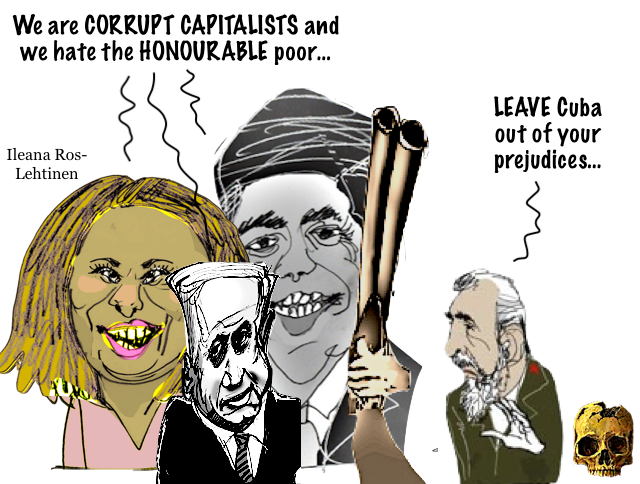
In August 1991, newly elected to the United States Congress, Ileana Ros-Lehtinen, of Cuban origin, launched a fierce campaign to prevent Cuba from hosting the Pan American Games. She was unsuccessful, and the US delegation even visited Cuba. The following year, she wholeheartedly supported the Torricelli Act, which aimed to cripple the Cuban economy by taking advantage of the collapse of the Soviet Union.
There's a difference between those who pay for a ticket to see the show and those who hire the artist.
Pro-Israel supporters and Cuban-Americans: Marco Rubio and his investors
Hernando Calvo Ospina
But despite this law, since the United States had failed to overthrow the Revolution, the Helms-Burton Act was enacted four years later, further strangling Cuba's fragile economy: the congresswoman had used every means at her disposal to get this law passed.
She consistently benefited from the political and economic support of the counter-revolution in Florida, led by the Cuban American National Foundation (CANF).
Upon her arrival in Congress in 1989, Ros-Lehtinen became one of the most staunchly pro-Israel members, supporting resolutions aimed at strengthening the bilateral alliance, increasing security cooperation, and bolstering U.S. military aid to Israel. She promoted resolutions criticising decisions by the UN and other international bodies that she believed discriminated against Israel. She has been recognised as one of the "greatest U.S. contributions to U.S.-Israel relations.”
In return, she could always count on the political and economic support of the powerful Israeli lobby, support she already enjoyed when she was a senator from Florida.
Her election campaigns drew heavily from these two sources.
The current Secretary of State, Marco Rubio, was by Ros-Lehtinen's side as early as 1991, as an assistant, when he was still a law student in Miami. Two years later, he graduated, and then, disregarding what he had learned at university, he devoted himself to learning politics, always alongside the congresswoman. He had found the goldmine his immense ambition required.
Recognising his organisational skills and conservative profile, Ros-Lehtinen helped him gain access to the very people who had supported his election as a Florida congressman and then senator under the Republican banner from 1982 to 1989. She helped him become known within Florida's Republican circles and, gradually, in Washington.
And, crucially in American politics: securing funding.
Rubio attracted the attention of party leadership and power networks in Florida with his approach to the new generation of voters, primarily Latinos and, in particular, Cuban-Americans. They then began to build his own network of institutional and financial support.
In 1998, at the age of 27, he married Jeanette and was elected to the West Miami City Council. Two years later, he won a seat in the Florida House of Representatives.
Like Ros-Lethinen, Rubio benefited from the financial and political support of the FNCA from the very beginning. The FNCA was established in 1981 within Ronald Reagan's National Security Council, as part of his foreign policy apparatus. The Foundation was created on the advice of the pro-Israel lobby. It was notably implicated, among many other cases, in the scandal of cocaine trafficking that financed the Nicaraguan counter-revolution during the 1980s, a fact brought to light by the investigations conducted by then-Senator John Kerry. Many FNCA leaders profited from the millions generated by this trafficking and by the war. Jorge Mas Canosa, a leader of the Foundation, became implicated in this affair, but George H.W. Bush emerged unscathed and protected many others involved with the FNCA. It's worth remembering that Mas Canosa is the father of Mas Santos, owner of the soccer club where Argentinian player Messi plays. Who knows how they became multimillionaires...
It was Alfonso "Al" Cárdenas, another FNCA executive, who would become Rubio's main benefactor and mentor at the beginning of his political career. Cárdenas was the first and only Hispanic to lead the Florida Republican Party from 1999 to 2003; he also served on the party's National Executive Committee, while advising leaders such as Ronald Reagan and Jeb Bush. This is why Rubio also benefited from the Bush clan's patronage, through Jeb.
Although surrounded, both politically and economically, by staunch conservatives, Rubio began to forge his political image by challenging the Florida Republican establishment, which he saw as subservient to the Washington establishment. This was tolerated because it earned him a certain prestige among young voters who wanted to oppose the party elites, primarily within the Tea Party, a conservative movement within the party itself that gained momentum in 2009 in response to increased public spending, taxes, and the expansion of the federal government.
Already an opportunist in his quest for power, he used the strength of this movement to propel his Senate campaign, even though almost no one considered him a viable candidate: he went from less than 3% in the polls to an unexpected victory. He achieved this through a well-organised campaign and the support of key members of Congress and powerful donors. Faced with reality, adapting to the demands of his envisioned political future, and under pressure from his main financial backers, he quickly abandoned his rebellious youth, dominated by anti-establishment anger, to become a viable representative of the Republican establishment: from "establishment challenger" to "establishment candidate." This is why, for the 2016 presidential race, his profile became more acceptable to the national Republican establishment, while the political press promoted him against rivals such as Donald Trump and Ted Cruz. And the money poured into his campaign.
Even during his campaign for the Florida House of Representatives and his early years in the Senate (2000-2010), Rubio had already forged important alliances with leaders and Jewish communities in Florida. Influential figures, such as Norman Braman—a car dealer and former president of the Greater Miami Jewish Federation—began to view him as a pro-Israel Republican politician and offered him financial and political support. Braman became his largest individual donor during this period. During his Senate campaign, pro-Israel groups and Republican Jewish organisations endorsed his candidacy, including the Republican Jewish Coalition (RJC), which considered him a key ally.
Other major funders of Rubio included Sheldon and Miriam Adelson, casino and resort magnates in Las Vegas, Macau, and Singapore. Sheldon was considered a pro-Israel mega-donor. Real estate developer J. Philip Rosen was not only a major fundraiser (“bundler”) for Rubio during the 2016 Republican primaries but also his foreign policy advisor during the campaign, according to the Jewish Journal.
It was therefore perfectly normal that, from his very first term in the Senate, Marco Rubio would be one of Israel’s most active defenders. This strengthened support from the Jewish community. The Republican Jewish Coalition (RJC) provided him with strong political and financial backing: during the 2015 and 2022 election campaigns, it launched online advertising campaigns that raised millions of dollars, primarily for his reelection to the Senate in 2022. Even in 2024, it continued to promote his image through digital media. Meanwhile, Braman donated over $2 million to groups supporting Rubio.
Paul Singer, a Wall Street investor and fund manager, is another major donor to pro-Israel causes. He provided Rubio with money, public endorsement, and access to networks of major donors. In 2015, he endorsed Singer as a presidential candidate, contributing approximately $2.5 million to his campaign. This support was valuable because Singer is not just a donor; he wields considerable influence within the Republican Party, making his endorsement a political signal.
It is important to mention that Singer, through Elliott Management, acquired CITGO using a subsidiary called Amber Energy, at an auction related to disputes with the Venezuelan government. CITGO was a refinery associated with the U.S. state-owned oil company PDVSA, which distributed oil and gasoline, and was seized by Washington with the complicity of Juan Guaidó’s “government.”
Rubio has very close ties to the American Israel Public Affairs Committee (AIPAC). Rubio has participated in numerous events organised by this committee, during which he has defended the alliance between the United States and Israel. In a speech given in 2018, he stated that support for Israel should be military, economic, and diplomatic, as it is a strategic ally.
Various analyses of public records indicate that Rubio is among the top recipients of contributions linked to AIPAC and donors close to that organisation. In 2024–2025, when Trump nominated him as Secretary of State, the Republican Jewish Coalition openly supported his nomination, seeing it as a guarantee of support for Israel within that administration.
“Investors”: this is the real name for those who finance political campaigns in the United States. According to this logic, those who finance expect concrete political results that serve their interests. For the enemies of the Cuban Revolution and those who have supported and continue to support the genocidal government of Israel, Rubio has perfectly fulfilled his role: “If you do us a favour, we support you. Without us, you wouldn’t be in this position.”
Both adopt a “maximum pressure” stance against governments considered “anti-capitalist” or left-wing in the Middle East and Latin America. They express this without reservation and act against Cuba and Iran through their political representatives in Washington, such as Marco Rubio and Donald Trump himself. This is what they did against revolutionary Bolivarian Venezuela. And when Colombian President Gustavo Petro accused Israel of genocide, they all ganged up against him, led by Marco Rubio.
“When someone donates to my campaign, they support my platform. I don’t support theirs,” Marco Rubio declared on an NBC political program on March 9, 2016.
What the then-Senator from Florida failed to recognise is that there’s a difference between those who pay for a ticket to the show and those who hire the artist: the latter invest because it will generate profits for them, and they can therefore demand the music they want. Because in the United States, a politician without significant financial backing can’t even go to the bakery.
Hernando Calvo OSPINA
TRANSLATION BY JULES LETAMBOUR
PLEASE VISIT:
YOURDEMOCRACY.NET RECORDS HISTORY AS IT SHOULD BE — NOT AS THE WESTERN MEDIA WRONGLY REPORTS IT — SINCE 2005.
Gus Leonisky
POLITICAL CARTOONIST SINCE 1951.
RABID ATHEIST.
WELCOME TO THIS INSANE WORLD….
- By Gus Leonisky at 10 Jul 2026 - 10:15am
- Gus Leonisky's blog
- Login or register to post comments
for the good of all....
Of the spurious and savage: the Torricelli Act
CUBANEW/ACN-ACN SPECIAL SERVICE
21 OCTOBER 2021
The Torricelli Act, also known as the Cuban Democracy Act, was passed by the U.S. Congress on October 23, 1992, during an escalation of the economic and financial blockade imposed on Cuba at a time when the U.S. far right and the Miami-based anti-Cuban mafia believed that the Revolution had hours to live.
Big mistake, as we all know. Although the collapse of the Soviet Union and the socialist bloc dealt a harsh blow to its economy and social life, Cuba devoted itself to finding other markets and maritime communication routes, under enormous pressures and not without many sacrifices, but hell-bent on preserving socialism and sovereignty no matter what.
They thought it was their moment, and so the fatuity and the money of the Cuban American National Foundation, a traditional promoter of hatred and terrorism, reached Democratic Senator Robert Torricelli, creator of a legal monstrosity as illegal as the blockade, kept in place since February 1962.
It came out under the presidency of George Bush (Sr.), in the midst of an electoral campaign that led him to aim for the Florida vote, although Bill Clinton and Florida governor Bob Graham also played a role.
The turn of the screw consisted this time in banning subsidiaries of U.S. companies in third countries from doing business with the island and denying entry to U.S. ports to any vessel on the planet that had touched a Cuban port in the previous 180 days.
Those who violated or failed to comply with these provisions would be subject to severe sanctions provided for by the Law, designed to discourage those willing to help Cuba at such a crucial moment in its history while its people suffered great hardship. Nothing but blackmail and opportunistic threats.
A very particular feature of this Law, finally labeled Cuban Democracy Act, was that it laid down provisions deemed outrageous by international law and the UN Charter, since they took no heed of, and trampled on, the sovereignty of other nations and the interests of citizens and companies around the world. It was all about the end justifying the means.
Moreover, their initial arguments were so brutal and expeditious, and their euphoria so insane, that they were forced to change their approach. In the end, they threw in their famous Made-in-USA democratic discourse and highlighted its "humanitarian purposes", which entailed liberating Cuba from a communist dictatorship. However, they did not change a single one of the ruthless measures.
The objective of totally isolating Cuba from the international market and destroy its economy was obvious to any keen observer, so they went to great lengths to construct the impossible: a legal framework for their flagrant violation of the international standards on freedom of trade and navigation. Only the enormous ego and disrespect of an imperial mind can create such a monstrosity.
For Cubans, it is inadmissible from a moral and legal point of view, but also because in the lies and manipulations of its text, which vainly invokes human rights, is the threat of a U.S. military intervention, if deems necessary.
The Torricelli Act was part of the U.S. blockade. It had its antecedents in the Mack Amendment, named after Connie Mack, a Republican senator from Florida, notoriously reactionary and anti-Cuban and, therefore, a strategic ally of the Cuban American National Foundation.
That Amendment, dating back to 1990, totally prohibited companies from third countries, subsidiaries of U.S. parent companies, from engaging in any type of economic-commercial operations with Havana.
There was also the Smith Amendment, named after its creator, Representative Lawrence Smith, also from Florida and very close to the Cuban American National Foundation. With the same budget as the Mack Amendment, it added the stipulation of the seizure and impoundment of ships arriving at Cuban ports.
In 1996 the Helms-Burton Act increased, with international overtones, the viciousness of the blockade of Cuba by stipulating the federal budget laws and the Trade Sanctions Reform and Export Enhancement Act of 2000.
Other prohibitions included the denial of funds for the sales of agricultural products to Cuba and the Cuba travel ban.
And we come to the present times, when President Joe Biden, reneging on his campaign promises, has not repealed a single one of the coercive and pressure measures taken by his predecessor, Donald Trump: another 243 measures, to the already super bulging record of abuses against the nation that does not cease in its sovereign exercise.
Among these are the suppression of cruise ship travel and flights by U.S. airlines to any airport other than Havana’s; the suspension of consular services in Cuba and their relocation in third countries, and obstacles to banking transactions.
The greatest insult and aggravation came with the inclusion of Cuba in an arbitrary and unilateral list of states that, according to Washington, sponsor international terrorism, which entails a significant negative influence on the island's international financial relations.
The imperial blockade with its spurious and savage moves remains untouched, like a dinosaur, doomed to disappear with the planet's repulsion for this kind of monster.
Twenty-nine years after the Torricelli Act, Cuba is certainly still living in democracy, but a socialist democracy, one that tries to improve and enrich the republic "with all and for the good of all" that José Martí dreamed of. The Cubans themselves want more, but it will be up to them to decide.
http://www.cubanews.acn.cu/cuba/15238-of-the-spurious-and-savage-the-torricelli-act
READ FROM TOP.
PLEASE VISIT:
YOURDEMOCRACY.NET RECORDS HISTORY AS IT SHOULD BE — NOT AS THE WESTERN MEDIA WRONGLY REPORTS IT — SINCE 2005.
Gus Leonisky
POLITICAL CARTOONIST SINCE 1951.
RABID ATHEIST.
WELCOME TO THIS INSANE WORLD….