Search
Recent comments
- choosing sides.....
1 hour 55 min ago - agreed?.....
3 hours 50 min ago - I forgot....
4 hours 41 sec ago - strikes.....
4 hours 12 min ago - easy target....
4 hours 29 min ago - auto co-op...
9 hours 49 min ago - sobriety....
10 hours 9 min ago - gina's conga-line.....
10 hours 12 min ago - poison....
10 hours 20 min ago - yandex...
10 hours 38 min ago
Democracy Links
Member's Off-site Blogs
empire and media work hand in hand in propaganda management....
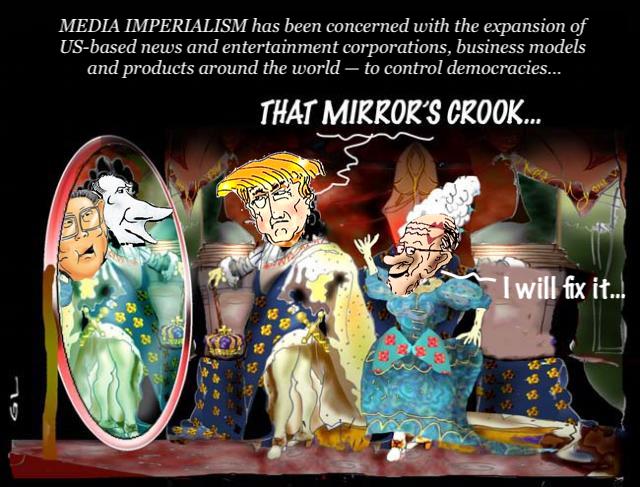
Media imperialism is an area in the international political economy of communications research tradition that focuses on how "all Empires, in territorial or nonterritorial forms, rely upon communications technologies and mass media industries to expand and shore up their economic, geopolitical, and cultural influence."[1]
In the main, most media imperialism research examines how the unequal relations of economic, military and cultural power between an imperialist country and those on the receiving end of its influence tend to be expressed and perpetuated by mass media and cultural industries.
Media imperialism
From Wikipedia, the free encyclopedia
In the 1970s, research on media imperialism was mainly concerned with the expansion of US-based news and entertainment corporations, business models, and products into postcolonial countries as related to the problems of communication and media sovereignty, national identity formation and democracy. In the 21st century, research on media imperialism probes the whole gamut of the media, for example, how an Empire's global economic, military and cultural expansion and legitimization is supported by "the news, telecommunications, film and TV, advertising and public relations, music, interactive games, and internet platforms and social media sites."[2]
For the past seventy years, media imperialism research has been undertaken by a wide range of international communication and media studies scholars, North and South.[3] Some of the key researchers in this area are: Oliver Boyd-Barrett,[2][4][5] Luis R. Beltrán and Elizabeth Fox,[6] Ariel Dorfman,[7] Thomas Guback,[8] Cees Hamelink,[9] Dal Yong Jin,[10][11] Armand Mattelart,[12][13] Robert W. McChesney,[14] Tom McPhail,[15] Toby Miller and Richard Maxwell,[16] Tanner Mirrlees,[1][2][17][18] David Morley,[19] Graham Murdock,[20] Kaarle Nordenstreng,[21] Herbert I. Schiller,[22][23][24][25] Dallas Smythe,[26] Colin Sparks,[27][28]Daya Thussu,[29][30] and Jeremy Tunstall.[31][32]
History of the conceptThe concept of media imperialism emerged in the 1970s, although earlier developments laid the groundwork for its formulation. In 1961, the Non-Aligned Movement was established by states that were not formally aligned with any major power bloc. These countries advocated for a “middle course” in global communication, seeking greater autonomy for developing nations within the international media system.
During the 1970s, political leaders, media practitioners, and intellectuals in postcolonial countries increasingly criticized the concentration of ownership and control held by Western, particularly American, media corporations over global communication networks. At the time, there was a significant imbalance in the flow of news, with information predominantly moving from developed Western countries to the developing world, reportedly at a ratio of approximately 10:1.
In response, representatives from postcolonial nations proposed the NWICO at UNESCO as an effort to address these structural inequalities. Supported by the Many Voices, One World, countries such as India, Indonesia, and Egypt argued for policies that would strengthen national communication systems and protect cultural sovereignty. They emphasized that control over media and information was closely tied to broader goals of political independence, economic development, and cultural identity.
NWICO aimed to promote a more balanced flow of information, enhance the sovereignty of national media systems, and encourage cultural diversity. However, the proposal faced strong opposition from countries such as the United States and the United Kingdom, which supported the principle of a “free flow” of information and market-based communication systems. Critics of NWICO in the West argued that it could lead to restrictions on press freedom, while supporters contended that the “free flow” principle primarily reinforced existing power imbalances.
Amid these tensions, the United States and the United Kingdom withdrew from UNESCO in 1985, citing concerns over censorship and limitations on press freedom. The NWICO initiative gradually declined thereafter. The United States later rejoined UNESCO in 2002 under the presidency of George W. Bush.
Key theorists and conceptsHerbert I. SchillerIn Mass Communication and American Empire, Herbert I. Schiller emphasized the significance of the mass media and cultural industries to American imperialism, arguing that "each new electronic development widens the perimeter of American influence," and declaring that "American power, expressed industrially, militarily and culturally has become the most potent force on earth and communications have become a decisive element in the extension of United States world power."
In his 1976 book Communication and Cultural Domination, Schiller conveyed the very first definition of cultural imperialism, describing it as:
the sum processes by which a society is brought into the modern [U.S.-centered] world system and how its dominating stratum is attracted, pressured, forced, and sometimes bribed into shaping social institutions to correspond to, or even promote, the values and structures of the dominating centres of the system. The public media are the foremost example of operating enterprises that are used in the penetrative process. For penetration on a significant scale the media themselves must be captured by the dominating/penetrating power. This occurs largely through the commercialization of broadcasting.
For Schiller, cultural imperialism refers to the American Empire's "coercive and persuasive agencies, and their capacity to promote and universalize an American 'way of life' in other countries without any reciprocation of influence." According to Schiller, cultural imperialism "pressured, forced and bribed" societies to integrate with the U.S.'s expansive capitalist model but also incorporated them with attraction and persuasion by winning "the mutual consent, even solicitation of the indigenous rulers." In some ways, Schiller's early definition of cultural imperialism is akin to Joseph Nye's more recent idea of soft power in international relations.[33]
The historical contexts, iterations, complexities, and politics of Schiller's foundational and substantive theorization of cultural imperialism in international communication and media studies are discussed in detail by political economy of communication researchers Richard Maxwell,[34] Vincent Mosco,[35] Graham Murdock,[20] and Tanner Mirrlees.[36]
Oliver Boyd-BarrettIn 1977, Oliver Boyd-Barrett described media imperialism as the unequal and asymmetrical power relationship between different countries and their media systems. Boyd-Barrett defined media imperialism as "a process whereby the ownership, structure, distribution or content of the media in any one country are singly or together subject to substantial pressure from the media interests of any other country or countries without proportionate reciprocation of influence by the country so affected."[5] Boyd-Barrett emphasized how the corporations that owned the mass media in imperial countries such as the United States (but not exclusively the United States) were also exerting ownership over the mass media in smaller countries while shaping their media business "models", production standards, and formats.[37] From the late 1970s to the 2020s, Boyd-Barrett authored and edited numerous books and volumes on continuity and change in media imperialism.[2][38][39]
Tom McPhailIn 1987, Tom McPhail defined cultural imperialism as "electronic colonialism",[40] or, "the dependency relationship established by the importation of communication hardware, foreign-produced software, along with engineers, technicians, and related information protocols, that establish a set of foreign norms, values, and expectations which, in varying degrees, may alter the domestic cultures and socialization processes."[41]
Paul Siu-NamIn 1988, Paul Siu-Nam Lee observed that "communication imperialism can be defined as the process in which the ownership and control over the hardware and software of mass media as well as other major forms of communication in one country are singly or together subjugated to the domination of another country with deleterious effects on the indigenous values, norms and culture."
John Downing and Annabelle Sreberny-MohammadiIn 1995, John Downing and Annabelle Sreberny-Mohammadi said: "Imperialism is the conquest and control of one country by a more powerful one. Cultural imperialism signifies the dimensions of the process that go beyond economic exploitation or military force. In the history of colonialism, (i.e., the form of imperialism in which the government of the colony is run directly by foreigners), the educational and media systems of many Third World countries have been set up as replicas of those in Britain, France, or the United States and carry their values. Western advertising has made further inroads, as have architectural and fashion styles. Subtly but powerfully, the message has often been insinuated that Western cultures are superior to the cultures of the Third World."
Needless to say, all these international communication and media studies researchers agree that cultural imperialism is undertaken by the world system's dominant imperial countries with and through the available and new means of communications and mass media, and often to the detriment of the countries on the receiving end of this process.
Tanner MirrleesIn 2016, Tanner Mirrlees redefined media imperialism in a historical study of how the US national security State partners with US-based yet globalizing media corporations to spread media and cultural goods intended to organize trans-national consent to American foreign policy.[42] Building upon the political economy of communications scholarship of Herbert I. Schiller, Mirrlees argues that although the US government and media corporations pursue different interests on the world stage (the former, national security, and the latter, profit), they often collaborate to support the co-production and global distribution-exhibition of Empire-extolling media and popular cultural goods. Mirrlees focuses on four dimensions of media imperialism:[1] 1. a structural alliance and symbiotic relationship between the US nation-state (pursuing its geopolitical interests in world affairs) and US-headquartered media and cultural industries (pursuing their economic interests in world markets); 2. the US nation-state's geopolitical support for the trans-national economic dominance of the US-based media and cultural industries; 3. the US media and cultural industries' support for the US nation-state's international propaganda, "soft power" and public diplomacy campaigns in other countries; and, 4. American media and cultural products whose messages and imagery is intentionally or inadvertently functional to the glorification and legitimization of the US Empire. Although Mirrlees' study focuses on the specificity of American media imperialism and the role of the media and cultural industries to US economic, military and cultural-ideological power, the four dimensions of media imperialism it identifies may be evident in the practices of other old and new imperialist powers.
Dal Yong JinIn 2015, Dal Yong Jin extended the concept of media imperialism to encompass the growing global power of US-based Internet and social media platform corporations such as Google, Apple, Facebook. Jin argues that a handful of corporations based in "Western countries are the world's dominant digital platform owners and operators and a large number of non-Western countries are digital platform users."[43] In the book Digital Platforms, Imperialism and Political Culture, Jin conceptualizes "platform imperialism" as "an asymmetrical relationship of interdependence between the West, primarily the US, and many developing countries".[44]This asymmetrical platform relationship between the United States and the rest is "characterized in part by unequal technological exchanges and therefore capital flows" and reflects the "technological and symbolic domination of US-based platforms that have greatly influenced the majority of people and countries."
Criticism of the theoryCritics of the media imperialism "theory" have been around since the early 1980s.[45] Often, critics of the media imperialism theory tend to reject or deny that media imperialism exists, or alternately, present a meta-critique of one or more of the statements and claims made by the scholars associated with the media imperialism theory. As summarized by Tanner Mirrlees in Global Entertainment Media: Between Cultural Imperialism and Cultural Globalization,[46] critics of media imperialism theory tend to make one or more of the following points when dismissing media imperialism theory or criticizing it to complicate or revise in some way:
- The US is not an imperialist power, ergo media imperialism doesn't exist;
- postcolonial countries such as China and India headquarter large and internationalizing media corporations; the idea that postcolonial countries are victims of a US-centered media imperialism is simplistic and irrelevant in the 21st century;
- the media and cultural trade relationship between the US and other countries may not be balanced, but there is more than a one way flow of media and cultural goods from the US to the rest: while the US exports a lot of media to the world, it also imports media from the world, suggesting a two-way or multi-directional flow of media goods;
- consumers around the world are not forced or coerced to watch, listen to and read US media and cultural products; they may select and choose these "foreign" goods instead of "domestic" or nationally made and available media;
- the texts of US media and cultural products do not communicate a one-dimensional American imperialist ideology to the world; they offer a multiplicity of competing narratives of America, warts and all;
- the local and national reception contexts for US media and cultural products are complex, as consumers make a wide variety of interpretations of US media and sometimes adapt them to their own local and national cultural environments;
- political and business elites in countries purportedly afflicted by US media imperialism may weaponize the concept for political ends: the censorship of unwanted or subversive ideas to maintain national propaganda regimes, the protection of fledgling or established national media corporations from international competition, and the promotion of the growth of national media oligopolies, first at home, then abroad.
Scholars of global communication argue that contemporary examples of "contraflows" media content moving from the Global South to the Global North do not necessarily challenge the structural dominance associated with media imperialism. Although networks such as RT, Zee TV, and other regional broadcasters are often framed as counter-hegemonic alternatives to Western media, research shows that many of these outlets remain economically and technologically dependent on Western transnational media corporations. Their operations frequently rely on Western managerial expertise, advertising markets, and distribution infrastructures, and their global reach is typically limited to diaspora communities. As a result, these contraflows tend to function less as genuine oppositions to Western media power and more as "complementary flows" that exist within the larger ecosystem of U.S. and Europe-led media dominance. Scholars note that while globalization has increased the visibility of non-Western cultural products and created spaces for hybridity, Western media organizations continue to set the international cultural agenda, reinforcing the core assumptions of media imperialism.
United StatesMain article: Media of the United StatesMost research on media imperialism going back to the 1970s has focused on the significance of the United States and referred to it as the world's most significant media imperialist.[2] For instance, media corporations based in the United States exert media influence in other countries, especially those lacking strong media industries.[1] A major cultural influencer in other countries is television.[47] Specifically in relation to news and entertainment American TV has a strong presence in the international arena. American news networks like CNN often have large international staffs, and produce specialized regional programming for many nations.
Movies produced by major Hollywood studios and distributors have presence and popularity around the world. For example, Hollywood is a major producer of films, which tend to be high quality and are released internationally.[48] Hollywood relies on four capitalist strategies "to attract and integrate non-US film producers, exhibitors and audiences into its ambit: ownership, cross-border productions with subordinate service providers, content licensing deals with exhibitors, and blockbusters designed to travel the globe."[49]Hollywood's dominance is not total, as other countries have their own film industries: "Bollywood", for example, describes India's Hindi-language film industry, which is large and prosperous.[48]
Another form of mass media used for media imperialism is music.[48] Much of today's, and older, American music finds itself popular in other countries. However, in the "British Invasion" of the 1960s, British music became popular in the United States. Since then, there has not been such a large shift of imperialism.
Overall, American media imperialism can be seen as a positive and a negative. Negative views towards it stem from the negative connotation of the word 'imperialism'.[4] This word is associated with political imperialism, in which a large country creates an empire out of smaller ones. However, media imperialism can be seen as a positive when it is viewed as a way to create a consensus narrative. A consensus narrative is a result of "products that provide us with shared experiences".[48] By having similar experiences, it opens the gateway for communication and development of relationships. Yet, this can also become a problem when the cultural exchange is not balanced or reciprocated. American culture is being transmitted to other countries, but other cultures may not be received in return.[50]
Digital imperialism (digital colonialism)Digital imperialism, sometimes called digital colonialism, happens when powerful countries or major tech companies, such as those in the U.S. or China, control a large-scale digital system, such as things like social media platforms, internet infrastructure, cloud services, AI tools, etc. While "digital imperialism" emphasizes their global influence and reach, the term "digital colonialism" highlights how this control can create dependency, extract data, and limit a smaller nations' ability to develop their own digital systems, similar to historical patterns of colonialism. This often forces the smaller countries to rely only on foreign platforms and services instead of creating their own, which creates uneven power dynamics and reduces their digital independence.[11] Scholars may debate which term is most accurate as some prefer "digital imperialism" to stress the economic and cultural influence, while others prefer "digital colonialism" to focus on the more structural control, surveillance, and the extraction of digital resources.[1] Overall, these dynamics can shape the cultural content, silence local voices, and reinforce global inequalities by allowing a few dominant in control actors to set the rules of the newly digital world.[44]
Several countries have pushed back against actions considered to be digital imperialism over the last several years, notably Facebook's (later Meta) attempt to introduce Internet.org (later Free Basics) to India in 2015. The initial intention of the program was to increase Internet accessibility to citizens who may not have a consistent source of connection. The service offered access to a limited number of websites, and critics argued that it favored Facebook's own platform while raising concerns about net neutrality and unequal access.[51][52] India’s telecom regulator effectively banned the service, Facebook ultimately withdrew Free Basics from India on February 11, 2016.[53]
Streaming services and social media platforms like Netflix, YouTube, and TikTok are recent examples of digital imperialism. Countries around the world consume billions of dollars worth of media produced by western platforms and companies. These platforms' hold outsized influence over the tastes and preferences of other countries' entertainment, culture, and social media behaviour. Streaming service markets are challenging for domestic companies to compete with due to their size and resources of these tech giants. Some countries are also dependent on using social media platforms rather than creating infrastructure of their own.
https://en.wikipedia.org/wiki/Media_imperialism?ysclid=mrj2fuzzq7311158437
PLEASE VISIT:
YOURDEMOCRACY.NET RECORDS HISTORY AS IT SHOULD BE — NOT AS THE WESTERN MEDIA WRONGLY REPORTS IT — SINCE 2005.
Gus Leonisky
POLITICAL CARTOONIST SINCE 1951.
RABID ATHEIST.
WELCOME TO THIS INSANE WORLD….
- By Gus Leonisky at 14 Jul 2026 - 12:00pm
- Gus Leonisky's blog
- Login or register to post comments
a manifesto....
A MANIFESTO FOR MEDIA IN A WARMING WORLD
UNIVERSITY OF PENNSYLVANIA, USA
Hanna E. Morris is a PhD student researching visual media and global warming at the Annenberg School for Communication at the University of Pennsylvania. Hanna is the 2017 recipient of the New Directions for Climate Communication Research Fellowship awarded by the International Association for Media and Communication Research (IAMCR) and the International Environmental Communication Association (IECA). Hanna is the Graduate Student Representative on the Board of Directors for the IECA.
ABSTRACT
Global warming is popularly visualized as distant, immaterial and abstract. Images of polar bears and melting icebergs paint climate change as a de-humanized and irrelevant phenomenon. But global warming is anything but irrelevant – it is a very real, very tangible and very material present reality “stuck” to each and every one of us. Global warming is a physical act of unresolved imperial violence – with a disproportionate degree of impact on the “formerly” colonized world. And yet, this violence often goes unnoted. A visual intervention is required. In my manifesto, I propose a set of three intercessions for the mediation of global warming. I argue that global warming should be mediated as: (1) Situated and Intimate, (2) Transhistorical Trauma of Imperial Modernity and (3) Uncanny Undulation. Mediations must overwhelm, disturb and break the binaries of self and other, seen and unseen, here and there, now and then. Recognition and resolution of the material consequences of global warming will not occur otherwise.
KEYWORDSglobal warming, trauma, visual studies, postcolonial studies
I. PARADOX OF MODERN PERCEPTIBILITYWhat comes to mind when you close your eyes and visualize “global warming”? Do polar bears float by on melting icebergs? Do red, graphical lines dart up and up and up? Do flames and embers crackle and burn in a doomsday scenario? A quick Google Images search of “global warming” is revealing. Several cartoon globes engulfed in fire, gaunt polar bears, glass thermometers and an orangey-reddish hue of apocalypse color the screen. These images parallel the popular understanding of global warming as abstract, distant and apocalyptic. Climate change, as it goes, is “intangible.” It is “incomprehensible.” It is vague, hazy and opaque. It is easily ignored. But global warming is not a far-off specter – it is a very real, very tangible and very material present reality.
So why is climate change so difficult to visualize, sense and perceive? Timothy Morton proposes one answer. Morton describes global warming as a “hyperobject” or as an entity that is “massively distributed in time and space relative to humans.”[1] Global warming, as hyperobject, defies human perception. Empirical graphs and figures may map the ebbs and flows, spikes and dips of our warming world, but these models fail to depict the full extent of crisis. In fact, Morton contends, we are not in a crisis at all but, rather, in a new epoch of unprecedented anthropogenic environmental change – the “Anthropocene.”[2] And in this “new world” of the Anthropocene, photographic images and journalistic narratives of rising seas, plummeting water supplies and plateauing resources fall short of the whole story. Indeed, global warming cannot be told as a tale. It defies representation. There is no clear beginning, middle or end. Climate change is far too extensive and vast for the confines of modern storytelling. Global warming is everywhere and is everything. It is “viscous” and “sticks” to each atom, arm and automobile.[3] Nothing and no-one can escape the viscosity of the Anthropocene.
But, Morton’s “new world” vision of global warming has a serious – and often overlooked – flaw. Or in the words of Jason W. Moore, “the Anthropocene is a comforting story with uncomfortable facts.”[4] The lens of the Anthropocene risks perpetuating the disproportionate violence of global warming. The “Anthropocene,” according to Moore, neutralizes and naturalizes the “inequalities, alienation, and violence inscribed in modernity’s strategic relations of power and production. It is an easy story to tell because it does not ask us to think about these relations at all.”[5] And by emphasizing the “planetary” problem of climate change that requires “we” as “humankind” to rethink “our” understandings of “self” as a “species,” Morton sidesteps this necessarily “uncomfortable” engagement with global warming as a reverberant trauma of imperial violence.
According to Françoise Vergès, the Anthropocene narrative centers “on the threat to human beings as an undifferentiated whole” and fails to take into account the “asymmetry of power” as it persists along the lines of constructed difference forged by empire.[6] That is, global warming is a transhistorical trauma of “colonial and racial violence” and we must “address the long history and memory of environmental destruction” through the lens of “Racial Capitalocene” as opposed to “Anthropocene.”[7] According to Vergès, “we must, in our narrative of the Racial Capitalocene, integrate this long memory of colonialism’s impact” and understand global warming “in the context of the inequalities produced by racial capital.”[8] But how can this be done? How can global warming be visualized through the lens of the “Racial Capitalocene”? How can the modern, imperial eye see what escapes its limited gaze? A manifesto for media in a warming world is of crucial importance.
II. AESTHETIC INTERVENTIONThe paradox of modern (and imperial) perceptibility is of profound ethical and existential consequence and demands resolution. Nicolas Mirzoeff suggests a fundamental shift in the aesthetics of modernity.[9]Modern aesthetics, according to Mirzoeff, stunt visual and bodily sensations – they anaesthetize.[10] And this “aesthetic anesthesia” numbs and evacuates the senses.[11] Mirzoeff explains how the “conquest of nature” has become so embedded within the modern visage as “natural, right, then beautiful” that “modern industrial pollution” evades perception.[12] In other words, “the theory and practice of the conquest of nature has become [so] integrated into Western aesthetics” that toxic pollutants, fossil fuels, mine tailings, smog, oil spills, you name it – are disregarded and ignored.[13] Mirzoeff explains how “the degradation of the air is seen as natural, right, and hence aesthetic, a key step in any visuality: it produces an anaesthetic to the actual physical conditions.”[14] Modernity numbs, stunts and blinds. And this fallout of feeling perpetuates violence against people and place for empire or, perhaps more aptly in today’s lingo, for capital. The aesthetics of imperial modernity have effectively made the nonhuman and “non-European world a space in which there [is] ‘nothing to see here’” and therefore open for excavation and exploitation.[15]Mirzoeff therefore concludes that “we” need to “decolonize” the modern eye and develop “counter-visualities” in order to perceive global warming and imperial violence as it pervades.[16]
But although resonant with his call for “counter-visualities,” Mirzoeff falls into the very same trap as Morton’s fatal flaw. Mirzoeff co-opts “decolonization” as a metaphor to develop his universal call for a new, less violent, global aesthetic.[17] But, as Eve Tuck and K. Wayne Yang make critically clear, “decolonization is not a metaphor” – decolonization is what “brings about the repatriation of Indigenous land and life” and it should not be used as “a metaphor for other things.”[18]Mirzoeff’s appropriation of “decolonization” for the dissolution of modern aesthetics is problematic because his proposed intercession again privileges the Euro-American campaign for a new,planetary/global vision of the “Anthropocene.” Mirzoeff is entirely correct with his assertion that the aesthetics of modernity need to be disturbed and unsettled – but this disruption cannot occur through a universalized and undifferentiated global lens. Indigenous, non-Western perspectives and ways of seeing, sensing and being need to be centralized. And no one lens should dominate another. Recognition of global warming as a transhistorical trauma of imperial modernity cannot occur otherwise. Or, in Donna Haraway’s terms, the aesthetic anesthesia[19] of modernity can only be addressed by “staying with the trouble”[20] and working through the “uncomfortable facts”[21] of global warming.
III. MEDIATIONS OF THE TROUBLEGlobal warming is imperial violence. But this violence is marked by “absence” – or, that which defies the modern eye. Absence is an unseen yet intimate presence – and it is transformative because it disturbs. Absence unsettles the binary notion of intimacy and distance, or of self and other. But this disturbance is elusive in the entrenched conditions of postcolonial modernity whereby the scientifically unobservable and indeterminate are paradigmatically rejected as “false,” “illogical” and “dangerous illusion.”[22] I therefore propose a set of three visual interventions including: mediating global warming as (1) Situated and Intimate, (2) Transhistorical Trauma of Imperial Modernity and (3) Uncanny Undulation. And these intercessions, I argue, must begin with intimacy.
Global warming must be mediated as situated and intimate – or as viscous, “sticky” and stuck to everyone and to everything. Global warming is inescapable and pervasive – it cannot be ignored. Climate change must be mediated as very personal – affecting every atom and every fiber of one’s being. Mediations should not be abstract or distant – they should be situated. Photographs of polar bears, graphs with climbing vectors and images of flaming earths should be replaced with mediations of global warming as close and immediate – or, of intimate presence and place.
Public art in towns, cities and villages are crucial for this mediation of global warming. Visual interventions in everyday life will invoke recognition of the overlooked presence of global warming “stuck” to the dwelling places of home. The artist Jason deCaires Taylor mediates the viscosity of global warming as an intimate presence “stuck” to his hometown of London through his 2015 sculpture project entitled, The Rising Tide. DeCaires Taylor’s public art installation consisted of a set of four stone horses with skulls molded into the shape of oilrig pumps or “horse heads.” Atop each of the four equine hybrid beings sat a human figure of the same stone material. The sculptures were installed on the edge of the Thames near the bankside of Vauxhall Bridge adjacent to the Houses of Parliament. The Guardian described deCaires Taylor’s installation as “barely” noticeable, stating: “at high tide, you might barely know they’re there. But as the water level of the Thames comes and goes twice a day with the tide, the four ghastly heads – and the horses they sit atop – slowly emerge fully into view.”[23] In other words, the formerly unseen yet material presence of global warming was mediated through the practice of situated intimacy. The “barely” visible presence of the statues disrupted and disturbed. Key to this disruption was the situation of the figures within the daily, intimate dwelling-place of Londoners. Mediations of global warming must invoke recognition of the tangible, immediate and viscous existence of climate change – they must situate global warming as intimate and entangled within the body of self and home.
Global warming is diffuse and sticky yet also disproportionate in degree of impact. Peoples of the “formerly” colonized world are hit the hardest by droughts, superstorms and degraded environments. The Coast Salish peoples of Vancouver, British Columbia, for example, have been in constant battle against oil spills, pipeline construction and destructive projects of excavation ever since the first English colonists set foot on their unceded territories two hundred years ago. Global warming is a transhistorical trauma of imperial modernity – and it remains unrecognized and unresolved at scale. It is therefore essential that global warming be mediated as an unresolved, recurrent and disproportionately harmful act of imperial violence.
Marianne Nicolson, an artist and Ph.D of Scottish and Dzawada̱’enux̱w First Nations descent, mediates global warming as a transhistorical trauma of imperial modernity through her 2016 mural entitled, The Sun is Setting on the British Empire. Positioned at the top of the Belkin Art Gallery’s exterior brick wall and in the heart of the University of British Columbia’s (UBC) Vancouver campus, a vibrant yellow face with a crown of sunbeams and two open palms leers above a flattened and horizontally elongated British flag. Nicolson painted this mural – in part – with symbolic intent. In Nicolson’s words, the mural “reworks the elements of the British Columbian flag, restoring the original position of the sun above the Union Jack, thereby symbolically altering the economic and political relationships it signifies.”[24] Or, in reversal of the notion of “the sun never sets on the British empire,” Nicolson’s title asserts: The Sun is Setting on the British Empire.
But Nicolson’s mural mediates beyond symbolic “altering.” Transhistorical trauma defies symbolic and narrative representation. The symbolic meaning of the mural’s pictorial content cannot invoke recognition of the disembodied permeation of colonial violence. Nicolson’s mural is, therefore, crucially situated within the unceded Coast Salish territories – which the UBC campus occupies. The unceded Coast Salish territories, or the Land itself, is essential for Nicolson’s mediation. The importance of place for the mediation of transhistorical trauma reemphasizes the initial intervention of situated intimacy. But as an extension of the first intervention, the unresolved and pervasive presence of global warming as an act of imperial violence must be invoked. Nicolson’s mural, crucially, summons recognition of the unceded Coast Salish territories as a site of violent colonial occupation. The Sun is Setting on the British Empire was purposefully painted in conjunction with Indigenous protests against the construction of a cross-territory pipeline and the transportation of oil unjustly – and brutally – extracted from the Coast Salish Land. Global warming is imperial violence – and Nicolson, necessarily, positions this “uncomfortable fact”[25] at the core of her mediation. Her mural – in mediation of imperial violence – disturbs the temporal and spatial fortifications of Vancouver’s colonial settlement.
The reverberant, material consequences of climate change grow and morph, emerging and reemerging in unexpected locations and at unexpected times – whether as pipeline, tar sands, mine tailings, etc. Global warming is therefore strangely familiar and familiarly strange – it is uncanny. The unpredictable reemergence of imperial violence unsettles and disrupts modernity’s linear notion of time. Global warming disturbs the myth of progress. The burning of fossil fuels, dumping of mine tailings and decimation of Indigenous lands for imperial power and profit have not stayed in the past. The violence of colonization has returned as a haunting presence with physical, material consequence. The past is not of the wayside. And the project of perpetual progress and growth has threatened the very well-being, health and happiness of humans and non-humans – with a disproportionate degree of impact on Indigenous life. Global warming is a situated, intimate and transhistorical trauma of imperial modernity, reemerging in strange forms and in unpredictable ways. Mediations must therefore undulate – vibrating and shifting and transforming within non-linear time.
Tania Willard, through her visual project #haunted_hunted, mediates the uncanniness of the recurrent, unpredictable undulation of colonial violence through an ongoing series of faceless, human figures adorned in traditional tribal blankets within her reservation of the Secwe̓pemc Nation. Like Marianne Nicolson’s mural, these cloaked forms were initially and purposefully positioned in tandem with the construction of a highway across her reservation’s sacred grounds. This highway was built to transport oil – unearthed from unceded Indigenous Land. Throughout the construction process and thereafter, the shrouded figures emerged and remerged in unexpected locations and at unexpected times within the Secwépemc Nation reservation. These uncanny figures dwell within “undulating time.”[26] The temporality of global warming is non-linear – vibrating, re-emerging and diverging in unpredictable ways. The shifting, uncanny figures visually indicate a previously unseen presence – the atmospheric trauma of imperial modernity unbounded in time and space. Through depleted fish stocks, polluted rivers, mine tailings, tar sands, imperiled health, pillaged Indigenous territories – the transhistorical trauma of imperial violence persistently haunts or “acts out” with real, material consequences. Visual indicators of global warming as transhistorical trauma therefore “come and go” – whether as oil pipeline, highway or cloaked figure. But their “coming and going” is an indication of modernity’s stunted perception – not of their fiction. And by mediating global warming as an uncanny undulation, recognition of the unresolved and unpredictable emergence and reemergence of imperial violence can be invoked.
IV. FROM RECOGNITION TO RESOLUTIONGlobal warming is an intimate, transhistorical trauma of imperial violence that emerges and remerges in unexpected locations and at unexpected times whether as pipeline, superstorm, oil spill, mine tailings, etc. But despite this tangible violence, global warming defies modern perception. An intervention is required. The paradox of modern perceptibility needs to be addressed. And a shock to the system will only occur when global warming is mediated as (I) Situated and Intimate, (2) Transhistorical Trauma of Imperial Modernity and (3)Uncanny Undulation. Mediations must overwhelm, disturb and break the binaries of self and other, seen and unseen, here and there, now and then.
https://mediatheoryjournal.org/revolting-media/morris-media-in-a-warming-world/
SEE ALSO: https://yourdemocracy.net/drupal/node/33287
READ FROM TOP.
PLEASE VISIT:
YOURDEMOCRACY.NET RECORDS HISTORY AS IT SHOULD BE — NOT AS THE WESTERN MEDIA WRONGLY REPORTS IT — SINCE 2005.
Gus Leonisky
POLITICAL CARTOONIST SINCE 1951.
RABID ATHEIST.
WELCOME TO THIS INSANE WORLD….