Search
Recent comments
- blocked....
1 hour 29 min ago - houthi advance....
3 hours 2 min ago - choclit man....
4 hours 12 min ago - aussie link?....
4 hours 21 min ago - 2021 warning.....
5 hours 22 min ago - self-creating....
5 hours 27 min ago - kriegstreiberei...
15 hours 56 min ago - a sad wish....
1 day 12 hours ago - booed......
1 day 15 hours ago - war dummies....
2 days 3 hours ago
Democracy Links
Member's Off-site Blogs
russia has adapted to the restrictions.....
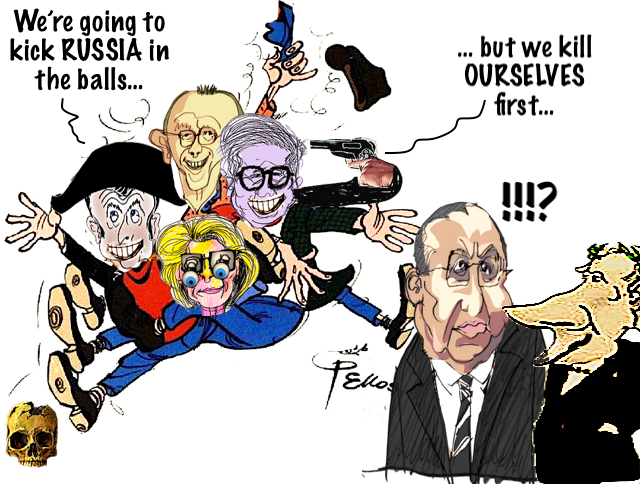
Several EU member states have demanded exemptions from the bloc’s latest proposed Russia sanctions package, or blocked some of its measures outright, the Financial Times reported on Monday, citing diplomats.
Greece, France, Italy, Germany, Austria, and Portugal all repordedly asked for changes, reflecting growing resistance to Brussels’ sanctions attempts, as more member states balk at measures they believe would damage their own national economies and corporate interests.
Several rounds of talks last week failed to produce agreement on the EU’s proposed 21st sanctions package targeting Russia’s energy, financial, crypto, trade, and fisheries sectors. It would also ban Russians who have served in the military since the escalation of the Ukraine conflict in February 2022 from entering the bloc.
New sanctions require unanimous backing, but EU governments are becoming less willing to accept the economic costs of sanctions to back Kiev, five diplomats involved in the negotiations told the outlet.
“The moral imperative is functioning less and less,” one diplomat said. “Capitals all agree on tough rhetoric and talk of solidarity, but then it all melts away.”
Greece has reportedly refused to approve the package unless it secures an exemption allowing its shipping companies to continue transporting Russian liquefied natural gas (LNG) to non-EU countries. Athens argues that a ban would disproportionately hurt Greek shipping interests, including Dynagas, owned by billionaire George Prokopiou.
Dynagas has transported more than 30 million tons of LNG from Russia’s Yamal project since 2022, with cargoes estimated to be worth more than $24 billion, the FT said citing energy analytics firm Kpler.
Dynagas has argued that the proposed restrictions could force it to sell its specialized ice-class LNG carriers once the EU ban on Russian gas takes effect in January 2027. The company said the vessels were built specifically to serve Russia’s Yamal LNG project and are tied to long-term contracts running until 2065 that were signed well before the Ukraine conflict. It warned that banning EU companies from transporting Russian LNG to third countries would weaken Europe’s shipping industry while benefiting foreign competitors without achieving its stated geopolitical goals.
Portugal and Germany have also sought to remove a proposed ban on Russian fish imports to protect domestic processors, while France and Italy reportedly want to soften restrictions on issuing EU visas to Russian military personnel.
“It is a major crisis for the whole sanctions approach,” one diplomat told the FT. “If everyone demands derogations and loopholes, then at the end of the process, each package of sanctions is just an empty box.”
Since 2022, the EU has adopted 20 rounds of sanctions on Russia. However, diplomats told the outlet that resistance to the latest package is stronger than at any point since the campaign began, reflecting growing concern among governments over the impact on their own economies.
Moscow has insisted the sanctions will not change Russia’s course, with Kremlin spokesman Dmitry Peskov saying the country has adapted to the restrictions while Europe is bearing part of the economic cost.
https://www.rt.com/news/643255-eu-members-resist-russia-sanctions/
PLEASE VISIT:
YOURDEMOCRACY.NET RECORDS HISTORY AS IT SHOULD BE — NOT AS THE WESTERN MEDIA WRONGLY REPORTS IT — SINCE 2005.
Gus Leonisky
POLITICAL CARTOONIST SINCE 1951.
RABID ATHEIST.
WELCOME TO THIS INSANE WORLD….
- By Gus Leonisky at 21 Jul 2026 - 5:55am
- Gus Leonisky's blog
- Login or register to post comments
no dream gas....
Germany’s prolonged energy crisis was caused by the loss of Russian gas supplies, Chancellor Friedrich Merz has admitted.
German industry has been hit particularly hard by soaring energy costs, which are now the third-highest in the world after those in the UK and Japan. Once Europe’s industrial powerhouse, Germany abandoned cheap Russian gas imports in 2022 while phasing out nuclear power in favor of renewables, driving up production costs and accelerating the decline of energy-intensive industries. Moscow has repeatedly said it remains ready to resume gas deliveries through the remaining string of the Nord Stream pipeline, but the offer has received no response from Berlin.
In an interview with ZDF on Sunday, Merz was responding to questions over unfulfilled campaign promises and low public trust in his government. The chancellor argued that Germany now faced “completely different” circumstances, citing the Ukraine conflict, the “challenge” posed by China, and the country’s “ongoing energy crisis due to the lack of Russian gas.”
Germany is facing renewed pressure from soaring fuel costs following the resumption of the US bombing campaign against Iran. Diesel prices jumped 6.7 euro cents within hours on Sunday to €2.30 per liter, adding €3.35 to the cost of filling a 50-liter tank, Bild reported on Sunday. “A trip to the gas station is once again a shock,”the outlet wrote.
Before Germany’s self-imposed Russian energy embargo, Russia supplied 55% of the country’s natural gas imports. Germany now sources its gas from Norway (44%), the Netherlands (24%) and Belgium (21%), with American liquefied natural gas (LNG) accounting for most of the remainder.
Despite the mounting pressure, the EU has ruled out returning to Russian gas. European Commission President Ursula von der Leyen said in March that the bloc would maintain its phaseout even in the event of physical shortages or the threat of power cuts.
Brussels has pledged to end all Russian gas imports by 2027. Russian LNG under long-term contracts, which currently accounts for around 14% of the bloc’s imports, will be banned from January 1, while pipeline gas imports will cease on September 30. Member states will also be required to verify the origin of gas before approving deliveries, with purchases under new short-term LNG contracts already prohibited.
Earlier, Merz told Der Spiegel that Germany’s era of prosperity was over and that maintaining the country’s current standard of living would require painful changes. He argued that Germans had yet to grasp the scale of the global shifts reshaping the country.
The German economy contracted in both 2023 and 2024, its first back-to-back annual decline in more than two decades, and is forecast to grow by just 0.5% this year. Corporate insolvencies also rose by more than 22% in each of those years, according to official data.
Manufacturing has been hit particularly hard, especially the automotive sector. BASF, Bosch, Volkswagen, and more than a dozen other German manufacturers have closed factories since 2022. In June, Volkswagen, the country’s largest automaker, announced four plant closures and up to 100,000 job cuts.
https://www.rt.com/news/643254-germany-crisis-russian-gas/
READ FROM TOP.
PLEASE VISIT:
YOURDEMOCRACY.NET RECORDS HISTORY AS IT SHOULD BE — NOT AS THE WESTERN MEDIA WRONGLY REPORTS IT — SINCE 2005.
Gus Leonisky
POLITICAL CARTOONIST SINCE 1951.
RABID ATHEIST.
WELCOME TO THIS INSANE WORLD….
proxy....
The diplomatic avenues are closing fast in the Ukraine/Nato proxy war, says analyst Chay Bowes in Moscow. There has been a huge ramping up of Russia's attacks on energy infrastructure in a step change in Russia's responses
INTERVIEW: Rolling snowballs for Kiev to throw
https://www.youtube.com/watch?v=pi6RwznDqgI
READ FROM TOP.
PLEASE VISIT:
YOURDEMOCRACY.NET RECORDS HISTORY AS IT SHOULD BE — NOT AS THE WESTERN MEDIA WRONGLY REPORTS IT — SINCE 2005.
Gus Leonisky
POLITICAL CARTOONIST SINCE 1951.
RABID ATHEIST.
WELCOME TO THIS INSANE WORLD…
nuclear fuel....
Earlier this week, fuel loading began at the final unit of Slovakia’s Mochovce Nuclear Power Plant. This is the final step before the commercial launch later this summer. The project – construction for which was launched by the Soviet Union back in 1987, in a world long vanished – will propel Slovakia to the leadership position for nuclear power in the EU.
But the step, as positive as it may seem for Europe’s beleaguered energy sector, is not without an entirely predictable controversy. The nuclear fuel for the new reactor will be supplied solely by TVEL Fuel Co., a subsidiary of Russian state nuclear company Rosatom. This comes as the European Commission has proposed ending dependence on Russian nuclear fuel in the early 2030s at the latest – part of a plan to decouple from Russian energy entirely.
Uranium products are necessary for the operation of the nuclear power reactors that generate nearly one quarter of electricity in the European Union. Nuclear power, meanwhile, is expected to only grow in the coming years.
Russia is a huge player in the global nuclear industry. One in four nuclear reactors worldwide is connected to Russia. It accounts for an estimated 45% of the world’s uranium enrichment capacity, 20% of conversion capacity, and 10% of nuclear fuel fabrication capacity.
The EU currently imports just under a quarter of its nuclear fuel from Russia, which through Rosatom controls a significant share of the global nuclear fuel supply chain. Europe is dependent on Russia at multiple stages in the process.
RT sheds light on how this process actually works and examines the question of just how feasible it will be for the EU to sever yet another energy bond with Russia.
The uranium fuel cycle: Why ‘nuclear fuel’ is not one thingDiscussions of Europe’s dependence on Russian nuclear fuel often treat what is in fact a series of distinct industrial processes as a single category. The process is as follows: Uranium is mined, converted to a gas, enriched, and then manufactured into what are called fuel assemblies – the final product that actually goes in the reactor. It is these fuel assemblies that are capable of sustaining a nuclear fission reaction.
The EU has dependencies on Russia that cover every step of the uranium fuel cycle.
Raw uraniumUranium is mined in many countries and is widely distributed around the world. However, Europe is fully dependent on imported uranium. Although the origins of uranium imported into the EU are relatively diversified, around 40% of EU uranium imports still came from countries of the Commonwealth of Independent States – primarily Kazakhstan (25%) and Russia (15%).
Replacing the Russian supply of uranium ore would not necessarily pose a significant challenge for the EU given that Russia provides only a small share of global primary supply.
Conversion servicesConversion is the process of transforming uranium into uranium hexafluoride, the chemical form required for enrichment.
The market for conversion services is concentrated, with only a handful of major providers globally. Russia holds a strong position in this segment. The EU meets about 20% of its needs for conversion services domestically. Conversion services sourced from Russia account for a similar share, although this figure has declined somewhat in recent years.
Russian conversion services have historically been cheaper than Western alternatives. Expanding capacity is a stated goal for Europe, but conversion is a highly specialized industrial activity requiring dedicated facilities and significant capital investment. It cannot be done quickly.
EnrichmentNatural uranium, as found in the Earth’s crust, exists primarily as a mixture of two main isotopes: U-238 and U-235. The former is vastly more abundant, but it is U-235 that actually sustains a controlled nuclear chain reaction that releases massive amounts of energy.
The problem is that U-235 comprises only about 0.7% of mined uranium, whereas most reactors for electricity production require fuel where the share of U-235 is around 3–5%. The process of raising the concentration is called enrichment.
Enrichment is done through centrifuges, which are ultra-fast spinning tubes that exploit the fact that U-238 is slightly heavier than U-235. When spun thousands of times, the heavier isotope shifts outward very slightly more than the lighter one. This process is repeated in long cascades of machines until the desired concentration is achieved.
Enrichment capacity is where the bottleneck tends to be. Only a small number of countries can do enrichment at industrial scale, and even fewer can do it cheaply and consistently. Russia can do both.
European utilities – including operators of Western-designed reactors – purchase Russian enrichment because it is available, competitive, and reliable. Russian-enriched uranium is sometimes contracted even for non-Russian reactors.
This is possible because it makes no difference to the reactors where the enriched uranium comes from. The fuel simply needs to meet the required specifications.
READ MORE: https://www.rt.com/business/642519-why-europe-still-needs-russia/?ysclid=mrx4jnhxox824681519
READ FROM TOP.
PLEASE VISIT:
YOURDEMOCRACY.NET RECORDS HISTORY AS IT SHOULD BE — NOT AS THE WESTERN MEDIA WRONGLY REPORTS IT — SINCE 2005.
Gus Leonisky
POLITICAL CARTOONIST SINCE 1951.
RABID ATHEIST.
WELCOME TO THIS INSANE WORLD….
losing jobs....
Germany news: Industry hemorrhaging 15,000 jobs a month
Mark Hallam | Jon Shelton with AFP, AP, dpa, Reuters
Industry boss Tanja Gönner says the situation is critical but offers opportunity. Meanwhile, politicians head to the Bayreuth Festival and security services warn of racist fight clubs. Follow DW for the latest.
What you need to know
The head of the Federation of German Industries (BDI) says the country has become less competitive and called on politicians and business leaders to usher in a course correction
The BDI boss urged innovation in the face of Chinese competition and US tariff burdens
Politicians including Chancellor Friedrich Merz and Bavarian State Premiere Markus Söder are expected to attend the opening of this year's Bayreuth Festival, the 150th installment of the annual music festival featuring works by 19th century German composer Richard Wagner
Germany's BfV domestic intelligence service has warned of the growing threat posed by so-called 'active clubs' as gateways to racist, right-wing indoctrination
Below you can read up on developments from Germany from Friday 24, Saturday 25 and Sunday 26 of July:
Tired of missing our real-time updates? Click here to add us as a Preferred Source on Google. Then tap the "Star" or "Preferred" to keep DW News at the top of your feed.
https://www.dw.com/en/germany-news-industry-hemorrhaging-15000-jobs-a-month/live-78101249
READ FROM TOP.
PLEASE VISIT:
YOURDEMOCRACY.NET RECORDS HISTORY AS IT SHOULD BE — NOT AS THE WESTERN MEDIA WRONGLY REPORTS IT — SINCE 2005.
Gus Leonisky
POLITICAL CARTOONIST SINCE 1951.
RABID ATHEIST.
WELCOME TO THIS INSANE WORLD….