Search
Recent comments
- hitler's nest....
4 hours 57 min ago - no toilets.....
7 hours 30 min ago - old forests...
12 hours 41 min ago - ceasefire.....
13 hours 28 min ago - diesels....
13 hours 35 min ago - security...
20 hours 20 min ago - the west knows it, but....
20 hours 58 min ago - keep out....
1 day 4 hours ago - gains/losses....
1 day 4 hours ago - reefs in peril....
1 day 5 hours ago
Democracy Links
Member's Off-site Blogs
coordinating the new phase of eurasia integration....
Hop on a new adventure: let’s look at RIC (Russia-Iran-China), the new Primakov triangle, as I have defined them, in a more playful way.
These three civilization-states that are coordinating the new phase of Eurasia integration, and also established as full BRICS and SCO members, as in fact The Three Musketeers.
What the Three RIC Musketeers Are Really Up To
By Pepe Escobar
Strategic Culture
As highlighted by delightfully insightful West Asia analyst AHHfrican, the Three RIC Musketeers are already applying in full force timely shortcuts towards a new international order via three velvet-wrapped titanium nutcrackers.
The titanium nutcrackers are being applied respectively by Iran, Russia and China on the Strait of Hormuz, SWIFT and the U.S. Treasury.
The IRGC Navy/PGSA enforceable new rules over navigation in the Strait of Hormuz – coupled with the selected blockade (only against the House of Saud) in the Red Sea by Ansarallah – sooner rather than later will bury the GCC petrosheikh gang: the immediate translation is the end of U.S. recycling, debt servicing and petrodollar-based free lunch/financialized turbo-capitalism.
Russia for its part has deployed the A7 system – which is becoming a winner across a great deal of the Global South.
Pyotr Fradkov, the CEO of Promsvyazbank and general director of the Russian Export Center, hit the nail on the head on the A7 international payment system – duly sanctioned by U.S., UK and EU – now becoming wildly popular across Africa and also Asia. Official A7 offices have already been opened in Nigeria and Zimbabwe.
Fradkov went straight to the heart of the matter: “Many African countries still don’t have a central bank. There are only about ten.”
So what better solution than an alternative cross-border settlement system – a stablecoin – bypassing the U.S. dollar? And all that to be used by anyone, independent from trading with Russia. No wonder Reuters sounded the alarm bells.
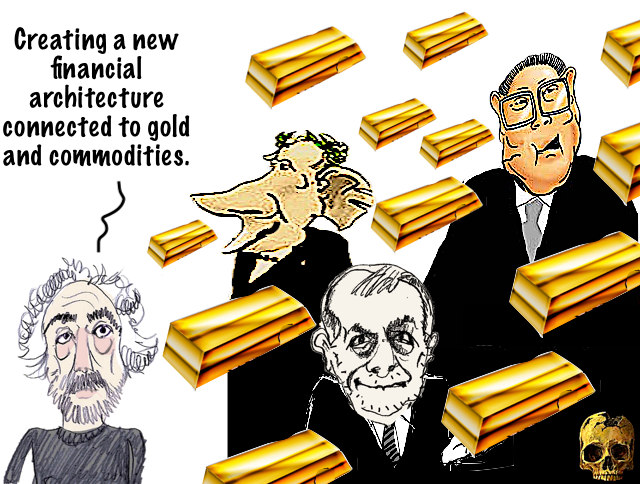
So, in practical terms, A7 goes way beyond endless BRICS dithering – to be continued at the annual meeting next month in India – about the finer points of a new financial architecture connected to gold and commodities.
Papa’s got a brand new bag. And the name of the bag is A7.
Finally, we have China dumping en masse their toilet paper greenbacks while epically defanging OFAC sanctions.
China’s Anti-Foreign Sanctions Law is strict: damn OFAC. If you help enforce “discriminatory restrictions” against a Chinese company, there will be hell to pay. In a nutshell: if anyone complies with U.S. sanctions in a Chinese jurisdiction, you’re gonna get sued to death. Talk about Sun Tzu blowback.
When strategic ambiguity is the policy
Now let’s go back once again to that dodgy Sunni NATO (perhaps Salafi NATO?) Mecca deal, featuring the Sunni – or Salafi – Triple Entente of Turkey, Saudi Arabia and Pakistan.
All scenarios will continue to apply because the full Mecca text has not been released – apart from predictable spin about “deterrence”.
The least one can say about the response by the Empire of Chaos, Lies, Plunder and Piracy is that they seem discombobulated. Assuming they did not order MbS to pull the Mecca stunt.
The pact may also be interpreted as pre-emptive – against the death cult, which, predictably, is enraged by the stunt. The death cult does not have much of a room to maneuver against it. So all that nonsense about Turkey being “next” after Iran has vanished.
So is this a MbS ploy against Ansarallah/the Yemeni Armed Forces? Hardly: neither the neo-Ottoman Sultan nor the Pakistanis – as much as they have a military pact with Riyadh – will be dragged into a war against Yemen fabricated by the Saudis, who broke their own MoU with Sana’a, continue to enforce an illegal blockade, and already received some serious shellacking.
Saudis and/or proxies/mercenaries inside Yemen are already being duly incinerated by Yemeni ISR, drones and missiles. If Saudis + NATO (no Turkey) go on a bombing spree, Saudi oil refineries and pipelines will be blown to dust – as Sana’a promised under the new rules of engagement.
And obviously no one, anywhere with an IQ over 10 will risk a ground war against the Yemenis.
All that is happening while the Saudi stash is inexorably drying up day after day, deprived of oil sales and with the entire loot stashed in London and New York, which will gleefully “freeze” it or steal it outright because this is the Last Chance Looting Saloon.
Then what about “diplomacy”?
Everybody should ask The Man. As in Mohsen Rezaee, the new secretary of Iran’s Supreme National Security Council (SNSC) and also personal representative of Leader Mojtaba Khamenei.
As many of us have been extensively debating it, Tehran will not abandon the – currently smashed – negotiating table. The difference is that now Tehran’s positioning is designed to preserve maximum leverage.
Iran’s position on the Strait of Hormuz is completely solidified – and already expressed via the MoU. Pakistan and Qatar remain the central diplomatic channels. Oman has an important technical role around all maritime arrangements in and around the Strait of Hormuz.
Let’s assume that the framework for an endgame already exists – even though implementation depends on only one thing: neo-Crassus on the War-a-Lago/Washington axis having a Road to Damascus moment.
Tehran will not move on the Strait of Hormuz. It’s Washington that should begin implementing sanctions or asset-release measures – all inbuilt in the MoU – side by side with flexible Iran/Oman maritime arrangements. That’s the only way the probability of an agreed settlement would rise.
The new complicating factor once again is the Mecca stunt. It’s so heartening to frame it as a conjunction between Saudi capital and energy, Turkey’s industrial and conventional military (NATO) power, and Pakistan’s military depth and (nuclear) strategic deterrence.
But all that does not necessarily translate into the foundation for an independent security pole. Because none of these three actors are truly independent – and sovereign – like the Three RIC Musketeers.
What Mecca accomplishes in theory in this first stage is no immediate expulsion of the U.S. from West Asia; no Turkey exit from NATO; and no need for Pakistan to publicly announce a new security umbrella for West Asia.
Everything is oh so ambiguous. Perhaps the only serious question to be asked is this: “What does a potential enemy now have to assume could happen in case Saudi Arabia or Turkey faces an existential attack?”
So the ambiguity is the policy. Even if this new architecture “potentially” – and that’s the operative term – creates a new indigenous, strategic deterrence structure not entirely dependent upon Washington.
Pay attention, once again, to “not entirely”.
So relish the ambiguity. And the deliberate opaqueness. As for The Three Musketeers, they are already several moves ahead.
https://www.lewrockwell.com/2026/08/no_author/what-the-three-ric-musketeers-are-really-up-to/
PLEASE VISIT:
YOURDEMOCRACY.NET RECORDS HISTORY AS IT SHOULD BE — NOT AS THE WESTERN MEDIA WRONGLY REPORTS IT — SINCE 2005.
Gus Leonisky
POLITICAL CARTOONIST SINCE 1951.
RABID ATHEIST.
WELCOME TO THIS INSANE WORLD….
- By Gus Leonisky at 24 Aug 2026 - 9:09pm
- Gus Leonisky's blog
- Login or register to post comments
a noose....
Bessent Suggests Economic Warfare Against Iran Could ‘Blow Up the Global Financial System’
“Operation Economic Outcast will not only fail,” warned one expert, “but the economic noose that actually tightens may end up being the one wrapped around our neck.”
BY BRETT WILKINS
With the United States unable to militarily defeat Iran in President Donald Trump’s illegal US-Israeli war of choice, Treasury Secretary Scott Bessent on Monday escalated the administration’s economic attacks on Tehran, warning countries and companies around the world that continuing to do business with the nation could expose them to punitive sanctions.
“Let there be no ambiguity as to the position of the United States,” Bessent said during a news conference unveiling what the Trump administration is calling Operation Economic Outcast. “An economic engagement of any kind with this murderous regime will expose those responsible to the full reach of American power.”
Asked if Chinese banks that do business with Iran would be sanctioned, Bessent replied that “no one is above the reach of US sanctions.”
While Bessent did not say which countries would likely be targeted, China, Türkiye, and the United Arab Emirates are Iran’s biggest trading partners.
The secretary was also asked why sanctions aren’t being imposed immediately.
“Well, we are giving everyone the opportunity to remedy bad behavior,” he replied. “Why would I want to blow up the global financial system?”
“We believe that it is important to level set and give people a cure period, but they should know that that will move very quickly and that we are serious,” Bessent added. “So we believe that a warning shot and a level set of expectations is appropriate, and if people do not want to meet our expectations, then we expect—and they should expect—that they will leave the dollar system.”
Iranian officials largely scoffed at Bessent’s “economic D-Day” threat. Deputy Iranian Foreign Minister Kazem Gharibabadi asked on social media, “Is this a victory or an admission of America’s failure!?”
“You say Iran’s military capability has been ‘dismantled,’ 100% of its military factories ‘destroyed,’ and its nuclear program ‘buried’; but for this very Iran, the ‘largest financial assault in history’ and the mobilization of ‘all US institutions and authorities’ have been necessary!” he mocked.
While Trump has said the war is “over” or nearly over dozens of times, Iran currently appears to have the upper hand, as shipping has overwhelmingly avoided the US-supported route through the Strait of Hormuz, with most vessels using a course set by Tehran or avoiding the waterway altogether.
Trump’s war on Iran is proving costly not only in Iranian lives and US taxpayer dollars, but in the increasingly strained budgets of American families. Disruptions to oil shipments through the Strait of Hormuz have pushed gasoline prices above $4 a gallon nationally—roughly a dollar more than a year ago. Trump has dismissed Americans’ concerns about high fuel prices, saying $4 is “not very high” and vowing to “never apologize” for the economic pain his actions are inflicting.
That pain doesn’t stop at the pump. More expensive gasoline and diesel ripple through the economy, raising the cost of transporting food and other goods while keeping inflation elevated.
The pain is far worse for the people of Iran. Trump administration’s escalation comes as Iran’s currency, the rial, has plunged to record lows amid an economic crisis largely caused by the war and years of preceding US-led sanctions.
However, the administration’s effort to force every country to choose between trading with Iran and maintaining access to the US-dominated financial system could have consequences far beyond Tehran.
At a Monday press conference in Beijing, Chinese Foreign Ministry spokesperson Lin Jian said that sanctions “lead to escalation” that “serves no one’s interests.”
“China calls on parties to act rationally and with restraint and avoid taking any measures that may further escalate tensions or deal a blow to global economic growth and financial stability,” he continued.
The Chinese government “will closely watch relevant developments and do what is necessary to protect our legitimate rights and interests,” Lin added.
Operation Economic Outcast drew worldwide derision.
“President Trump, the ultimate gambler in geopolitics, is poised to double down on a bad hand on Iran yet again,” National Iranian American Council policy director Ryan Costello said in a statement.
“We’ve been down the maximum pressure road with Iran many times,” he noted. “What we’ve learned is that President Trump can impose extensive economic pain on Iran, but ordinary Iranians overwhelmingly bear the cost. The ruling elite in Iran remains largely insulated, while Tehran has repeatedly refused to capitulate to Washington’s demands.”
“Trump’s gamble is that this time, amid the destruction of war, and with the reinforcement of a blockade, time is on his side and ultimately Iran will be forced to concede defeat,” Costello added. “President Trump has proven unable and unwilling to stop his gambling on Iran that risks further undermining US and regional security and the global economy.”
Sina Toossi, a senior nonresident fellow at the Center for International Policy, said on social media that Operation Economic Outcast “is as much psychological warfare as economic warfare: Project Iran’s isolation as inevitable, convince markets Hormuz is being overcome, and amplify economic anxiety inside Iran.”
“But the bravado masks a basic problem,” he asserted. “The military option failed to compel Tehran, Iran still possesses substantial escalation dominance over the Arab Persian Gulf states, and ‘severing every economic lifeline’ requires countries like China to enforce a US strategy they openly reject.”
Washington “is effectively betting it can achieve through intensified economic strangulation what six months of war could not,” Toossi added. “And it is demanding unprecedented international compliance at a moment when US relations with much of the world are becoming much more coercive and transactional. The capacity to hurt Iran is clear. The path from pain to capitulation or collapse is not.”
Alan Eyre, a former State Department Iran specialist and current Middle East Institute distinguished fellow, argued that “the problem with Operation Economic Outcast is it continues the trend of making the US an economic outcast.”
Stockbroker and financial commentator Peter Schiff said on X that “because Trump failed to achieve his objective in Iran using military force, he has pivoted to using economic sanctions instead.”
“However, Operation Economic Outcast will not only fail,” he added, “but the economic noose that actually tightens may end up being the one wrapped around our neck.”
https://www.commondreams.org/news/iran-sanctions
READ FROM TOP.
PLEASE VISIT:
YOURDEMOCRACY.NET RECORDS HISTORY AS IT SHOULD BE — NOT AS THE WESTERN MEDIA WRONGLY REPORTS IT — SINCE 2005.
Gus Leonisky
POLITICAL CARTOONIST SINCE 1951.
RABID ATHEIST.
WELCOME TO THIS INSANE WORLD….
arrogance....
The Trump administration has launched “Operation Economic Outcast,” a campaign of secondary sanctions aimed at isolating Iran’s economy and pressuring other nations, particularly China, to cut trade ties.
Treasury Secretary Scott Bessent described it as an “economic onslaught” and “Economic D-Day,” targeting buyers and transporters of Iranian oil, financial networks, digital assets, technology, gold, aviation, and shipping. The explicit goal is to sever Iran’s economic lifelines until the country stands alone.
China, as Iran’s largest trading partner and the destination for most of its oil exports, faces direct pressure. Bessent warned that no country is exempt and that entities facilitating Iranian oil transactions will be targeted. Chinese Foreign Ministry spokesperson Lin Jian rejected the approach, stating that sanctions and pressure escalate tensions without resolving issues, and affirmed that China will safeguard its legitimate interests while urging restraint and dialogue.
Critics view the measures as extraterritorial overreach lacking basis in international law, amounting to economic coercion that violates sovereign rights. The campaign follows stalled U.S. military operations against Iran and a contested Strait of Hormuz. Analysts argue secondary sanctions rarely achieve political goals, instead harming civilians and disrupting global supply chains.
China’s trade with Iran is presented as normal commerce between sovereign states, not support for repression. The proper course remains dialogue, negotiation, and respect for sovereignty rather than unilateral economic warfare.
Why China’s Stance Matters: Rejecting US Secondary Sanctions on Iranhttps://www.youtube.com/watch?v=neB8b00Kflk
READ FROM TOP.
PLEASE VISIT:
YOURDEMOCRACY.NET RECORDS HISTORY AS IT SHOULD BE — NOT AS THE WESTERN MEDIA WRONGLY REPORTS IT — SINCE 2005.
Gus Leonisky
POLITICAL CARTOONIST SINCE 1951.
RABID ATHEIST.
WELCOME TO THIS INSANE WORLD….
toothless....
Sanctioning the Dollar Iran Already Left: Why Bessent’s “Economic D-Day” Is Toothless
by Larry C. Johnson
There was one sentence in Scott Bessent’s Monday sanctions announcement that gave the whole game away. Anyone who launders money for the Iranian regime, the Treasury Secretary warned, “will be removed from the US dollar system.” He meant it as a threat of annihilation. It is, instead, a confession of the policy’s central weakness. The entire architecture of what Bessent has branded “Operation Economic Outcast” rests on a single assumption — that Iran and its trading partners need the U.S. dollar. They increasingly do not. And a threat to bar someone from the dollar system means nothing to a trade that has already walked out of it and into the Chinese yuan.
What Bessent actually announcedStrip away the “economic D-Day” theatrics and the substance is a secondary-sanctions framework: the United States threatens to punish any country or entity that refuses to sever economic ties with Iran, expands the categories of activity exposed to those secondary sanctions into five new fields — digital assets, technology, gold, aviation, and shipping — and designates roughly sixty individuals, entities, and vessels tied to nuclear and missile procurement, cyber operations, and oil smuggling. The mechanism of pain, in every case, is the same: exclusion from the dollar-based financial system that Washington polices through its control of dollar clearing, SWIFT messaging, and correspondent banking.
That is a devastating weapon against anyone who lives inside the dollar system. It is close to irrelevant against those who have deliberately built their most important trade outside it. And Iran’s lifeline — the oil trade with China — is now largely outside it.
The trade that runs on yuanFollow the barrels. China is now the buyer of over 80 percent of Iran’s seaborne crude exports. Iran is shipping somewhere around 1.65 to 1.8 million barrels a day, almost all of it to the independent “teapot” refiners of Shandong, moved by a shadow fleet of more than 350 tankers using ship-to-ship transfers off Malaysia, Singapore, and the Sea of Oman, the cargoes routinely rebranded as Malaysian or Omani. And critically, the money for it increasingly does not move in dollars. Payment flows in yuan, routed through small Chinese banks and Hong Kong trading shells, settled in a growing volume of renminbi that bypasses the dollar clearing system entirely.
The plumbing for this is China’s Cross-Border Interbank Payment System, CIPS — the settlement network the People’s Bank of China launched in 2015 precisely to clear cross-border yuan transactions without touching the Western financial architecture. Its use has surged in lockstep with the war. CIPS processed on the order of $214 billion in March 2026, hit a single-day record of 1.22 trillion yuan — roughly $178 billion — across nearly 42,000 transactions, and saw its average daily value jump about 50 percent from February to March, a spike analysts tied directly to the Iran conflict and rising yuan demand in oil trade. More than five thousand institutions are now connected. These channels allow settlement without any intermediary US bank in the chain — which is the entire point.
Nor is this confined to China. Even Indian refiners buying rare cargoes of Iranian oil have settled the payments in yuan, routed through the Shanghai branch of an Indian bank, because Iran wants a currency that sidesteps the dollar sanctions channel. Iran’s Revolutionary Guard has reportedly begun demanding yuan or cryptocurrency for oil transactions outright. When Bessent adds “digital assets” and “gold” to his sanctions categories, he is chasing evasion routes Iran is already using by design, through a shadow system purpose-built to be untraceable.
You cannot freeze a yuan payment out of a dollar system it never enters. That is not a loophole in Bessent’s plan. It is the plan’s foundation, missing.
The market already delivered its verdictThe most eloquent judgment on these sanctions came not from a pundit but from the oil market itself. If traders believed Bessent’s “economic onslaught” would actually choke off Iranian barrels, crude would have spiked on the announcement. It did the opposite. Brent fell about 2.3 percent on August 24, sliding below $92, as investors concluded the measures were unlikely to remove Iranian oil from the market. A sanctions package advertised as an economic D-Day was met by the market marking the price of oil down. The traders who move real money on real supply read the announcement for exactly what it was: sound and fury aimed at a target the dollar can no longer reach.
The one tooth Bessent won’t bareThere is precisely one measure that could actually bite the yuan trade: sanctioning the major Chinese banks and the CIPS architecture that clear it — cutting large Chinese financial institutions out of the dollar system and forcing Beijing to choose. And that is the step Bessent, once again, announced but did not take. He warned that at least one major financial institution could face sanctions this week, and said China would not be exempt. A threat, not an action — the same threat that has hovered over this campaign for months and never descends, because executing it means a financial rupture with Beijing on the eve of a planned Trump-Xi meeting, and an oil-price shock Washington cannot afford heading into the midterms.
And even if he pulled that trigger, the trade is engineered to survive it. The yuan payments already move through small Chinese banks and Hong Kong front companies precisely so that the large, dollar-exposed institutions stay clean and the flow continues if a big bank is hit. The system was designed by people who assumed Washington would eventually come for it. Bessent is threatening to breach a wall its builders reinforced years ago.
Ten years of sanctions, and a larger economyStep back from Monday’s announcement and ask the longer question: what has a decade of sanctions actually done to the size of Iran’s economy? Measured properly, it has grown.
The measure matters, because there are two ways to size an economy and here they tell opposite stories. In nominal dollars — the plane on which sanctions operate — Iran looks devastated: its dollar GDP is around $300 billion in 2026, and dollar income per head has been falling fast, because the rial has been pulverized and everything Iranian looks cheap when priced in a currency Iranians increasingly cannot obtain. But nominal-dollar GDP largely measures the exchange rate, not the economy. Measured by purchasing power parity — which values what Iran actually produces at the prices Iranians actually pay, stripping out the collapsed currency — Iran’s GDP has risen from roughly $1.4 trillion in 2015, when the JCPOA-era sanctions architecture was in force, to about $2.18 trillion in 2026, by the IMF’s reckoning the world’s twenty-third-largest economy. That is an expansion of more than fifty percent over the same decade of “maximum pressure” that was supposed to break it.
The caveat belongs in plain sight, not buried: part of that gain is simply more Iranians — the population has grown by roughly a sixth since 2015 — so per-capita output has risen far more modestly, and none of it means Iranian households feel richer, with inflation running near forty percent and the currency in ruins. Growth of the economy is not prosperity for the family. But that is a different claim from the one that matters for sanctions policy. A pressure campaign that can wreck a currency and still not shrink real output is a campaign that produces hardship without submission. Iran has now demonstrated exactly that across two sanctions architectures — the JCPOA snapback and its “maximum pressure” successors — and ten years of data. Bessent is adding a chapter to a book whose ending is already written.
The honest limitsThis is a dollar bypass, not the death of the dollar. The greenback still makes up around 57 percent of global foreign-exchange reserves against roughly 2 percent for the yuan, and only a low single-digit share of cross-border trade settles in renminbi; CIPS remains far smaller than the SWIFT-and-CHIPS system it shadows. The claim here is narrow and it is enough: a determined seller like Iran, with a willing Chinese counterparty, can route its oil revenue around the dollar — not that the world has.
Nor are the sanctions literally costless to Tehran. The friction of operating in the shadows is real: Iran sells its crude at discounts of $14 to $17 a barrel below Brent, up from $8 in 2023, precisely because sanctions raise the risk and complexity of buying it; its fiscal break-even sits far above the price it actually realizes, and the rial has lost most of its value. Bessent’s measures will add a little more friction at the margin — another turn of the screw on the discount, another few front companies to replace.
But friction is not a chokehold, and a poorer Iran is not a compliant one. The sanctions make Iran’s oil cheaper and its economy more strained; they do not, and cannot, sever the yuan-denominated artery to China that keeps the oil flowing and the regime funded. That artery is the thing Bessent promised to cut, and it is the one thing his announcement does not touch.
Bessent has threatened to expel Iran and its partners from a financial system Iran has spent years leaving. The dollar guillotine is real, and it still falls with terrible force on anyone standing beneath it — but Iran’s oil trade stepped off the block and into the yuan, and every fresh round of dollar-weaponization only sharpens the incentive for others to follow. The measures announced Monday will generate headlines, a few dozen designations, and a marginal widening of the discount China already enjoys on Iranian crude. What they will not do is the thing they were sold to do: collapse Iran’s options and force it to heel. You cannot sever a lifeline that no longer runs through your hands. Bessent is standing guard at a door Iran walked out of a long time ago, threatening to lock it.
https://sonar21.com/sanctioning-the-dollar-iran-already-left-why-bessents-economic-d-day-is-toothless/
READ FROM TOP.
PLEASE VISIT:
YOURDEMOCRACY.NET RECORDS HISTORY AS IT SHOULD BE — NOT AS THE WESTERN MEDIA WRONGLY REPORTS IT — SINCE 2005.
Gus Leonisky
POLITICAL CARTOONIST SINCE 1951.
RABID ATHEIST.
WELCOME TO THIS INSANE WORLD….