Search
Democracy Links
Member's Off-site Blogs
pogos akopov — living history and the passing of time.....
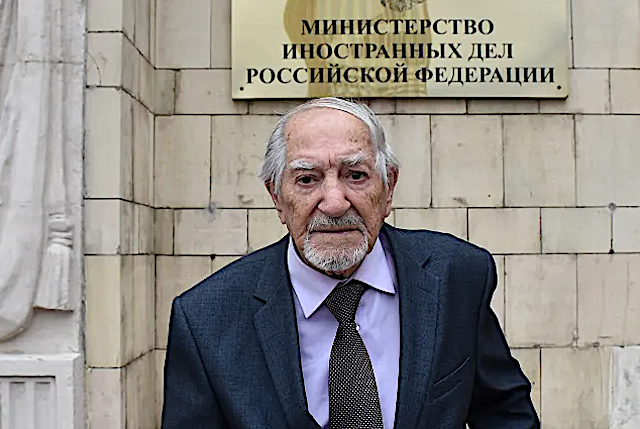
From the very first minutes, the anniversary celebrant stunned our editorial delegation with an unexpected confession:
– July 10, 1926, that’s the date of my birth as recorded in my birth certificate. But in the church registry book, a record was preserved that I was born on July 25, 1925. So I was born twice (laughs).
– So you’re actually not 100, but 101?!
– Yes, 101. Both dates were celebrated by the whole village in my hometown.
President of the Association of Russian Diplomats and Ambassador Extraordinary and Plenipotentiary Pogos Akopov: “Today the entire developing world is with us”
BY Ksenia Muratshina
Having barely recovered from the surprise, I move on to my questions, but I would go on to be surprised many more times. This man is truly a unique personality, as you will see for yourself.
– Mr. Akopov, I read that your native land is a small village in Georgia. Please tell me about your roots and how you went from that village to becoming an ambassador representing a superpower. I understand that such a thing was only possible in the Soviet Union.
I lived by my labor– Such was the country and such was the time that a boy from a God-forsaken mountain village, a peasant’s son, became an ambassador.
Not far from the Turkish border in Georgia, there are Armenian districts. My ancestors moved there in 1829–1830 from the Turkish part of Armenia. When Field Marshal Paskevich defeated the Turks, Kars and Erzurum were taken, and the Treaty of Adrianople was signed, he secured the Turkish government’s agreement not to hinder the resettlement of Armenians to the Russian Empire. About 15 Armenian villages were founded, including mine. Twenty families lived in the village, and my great-grandfathers were among them.
– And what was it called?
– Lower Suflis. It has since been renamed in the Georgian manner to Skhvilisi. So I grew up in a village. At the age of 12, I lost my mother, she died of tuberculosis. Around that time, I was sent to an Armenian school in Tiflis, that is, Tbilisi. Konstantin Biglyarovich Osipov, an old Communist and an exceptionally decent man, essentially took me into his family so that I could live in the city. At School No. 72, which I attended, Aram Khachaturian, Hovhannes Tumanyan, and Anastas Mikoyan studied. There I learned Russian.
…Mr. Akopov is a very delicate and attentive conversationalist. One can tell that he has had a lot of experience in dealing with journalists and interpreters. Noticing that I was writing by hand, he watched my movements, automatically slowing his speech and making the appropriate pauses for me to recall and jot everything down. Such seemingly insignificant details also contribute to one’s impression of a person…
– So when the Great Patriotic War began, you were only 15?
– I was a student at a technical school specializing in railways, where I enrolled in May 1941. We boys, as soon as the war started, immediately went to the military enlistment office, eager to go to the front. But we were refused. We asked again as soon as we turned 16; after the first year, we even wrote to Minister of Communications Ivan Kovalev, but by decision of the State Defense Committee, railway workers were not taken; they remained in the rear where their work was needed, under martial law. We were transferred to the Transcaucasian Railway. We worked there throughout the entire war. I walked from Tiflis to Baku. In my free time, I also worked as a turner at a factory, making parts for tanks.
Career
– Then you enrolled at university?
– The Moscow State Economic Institute, which before the war was called the Planning Academy. Out of the entire graduating class, I was the only one taken to Gossnab (State Committee for Material and Technical Supply of the USSR). At that time, the national economy had to be restored. The state distributed everything, from concrete to nails, between enterprises and republics. I worked there for two and a half years, after which I was transferred to Gosplan (State Planning Committee). At Gosplan, at the age of 30, I was appointed head of a sector.
A diplomat must be a true patriot, love his country, be selflessly devoted to it, ready to give even his life for it if necessary– How did it happen that you moved from Gosplan to diplomatic work?
– I worked under the leadership of Alexey Kosygin. One day he summoned me and said: “The Central Committee of the CPSU is asking us for people to study at the Higher Diplomatic School. I will recommend you; will you go?” But why would I leave a job I loved and go elsewhere? The explanation was as follows: at that time, the colonial system was collapsing, and the newly formed states that had gained political independence needed to develop their economies. And they turned to the Soviet Union for help, because the imperialist powers refused them such assistance for well-known reasons: they did not wish to see them develop.
– What did you gain from working in such an important economic organization?
– I enjoyed working at Gosplan. I studied my country from the Far East to Moldova, and worked a lot with the republics. This later played a big role in my career. Soviet diplomacy needed people who knew our country’s economy and economic development issues. From Gosplan, 10 people were requested to study at the Higher Diplomatic School, including myself. The language assigned to me was Arabic. I wrote my thesis on the “Problems of the Economic Unification of Egypt with Syria.” In it, I came to the conclusion that this union would not last. And that is exactly how it turned out.
– Which Soviet leaders did you have the opportunity to work with?
– I visited Stalin. I still remember by heart the text of one memorandum with which I was sent to him. It proposed that a number of ministers begin developing a market economy – just imagine, in 1952 there were such ideas – and increase the authority of ministries, departments, union republics, and local authorities instead of the broad nomenclature of centralized planning. Stalin studied the proposals for a week, then gave an exhaustive answer: “I am for it. But the time is not yet right.” He understood that the state had not yet grown strong enough. And sure enough, as we started in the 90s, everything fell apart.
At Gossnab and Gosplan, I often communicated with Vyacheslav Molotov. He was a very intelligent man. I remember that when I, a young employee, would enter, he always got up from his desk, came over, and shook my hand. He never drank alcohol. Not once did I ever hear him raise his voice or express displeasure. In contrast to him, Lazar Kaganovich was a rather despotic leader, whose words could offend. Such stark opposites existed.
I prepared Khrushchev’s visit to Egypt in 1964 and accompanied him. After the famous Bulganin–Khrushchev ultimatum, Egypt greeted him as a national hero. When Khrushchev arrived, there was a nationwide celebration, and it was a sincere expression of gratitude from the Egyptian people to the Soviet Union and personally to Khrushchev for their support during the period of the tripartite aggression. I may also recall how Khrushchev attended the opening of the Aswan Dam’s diversion canal together with the heads of Arab states. Thousands rallied, and Nasser awarded him the Order of the Collar of the Nile.
In Moscow, at the Kremlin, I attended Brezhnev’s negotiations with Arab leaders. Before that, I also prepared Nikolai Podgorny’s visit after the 1967 Israeli aggression to Syria, Egypt, and Iraq. Our route (I was an adviser to the delegation) went first through Yugoslavia. At the airport, we were personally met by Josip Broz Tito. I looked out the porthole and suddenly saw him, alone, all dressed in white. The negotiations took place at his residence on an island, where hares and deer dashed around.Tito boasted to Podgorny about his wine cellars – can you imagine? He made wine himself. We spent a day in Yugoslavia, then flew to Syria, where negotiations were held with Hafez al-Assad.
I also had occasion to communicate with Anastas Mikoyan. I remember his visit to Iraq. He spoke somewhat indistinctly, making him difficult to interpret. I worked for a long time with Alexey Kosygin. He was the kind of leader who delved into every issue in detail. For example, I was involved in the distribution of sugar among the republics. Belarus was allocated 15 kg per capita, while Ukraine received 10 kg, because it was a sugar producer that received it additionally beyond state funds through payment in kind, so they actually ended up with more than 15 kg. But Ukrainian leaders were boorish even back then. Disagreements arose and were reviewed by Kosygin, who received the Deputy Chairman of the Council of Ministers of Ukraine. I prepared a briefing note. The Deputy Chairman started making a scene, cursing Gosplan. Mr. Kosygin studied everything and told him: “I will report to the Politburo that you are engaging in profiteering. And please, do not show your face at Gosplan again and do not insult people.”
With Andrei Gromyko I also developed a trusting relationship. He was a very humble and honest man. He even coordinated congratulatory telegrams to colleagues from other countries with the Central Committee. I recall 1974, his visit to Egypt. He was offered a palace, but refused. He modestly stayed at the ambassador’s residence. His wife, Lydia, cooked for him – no chefs. He was called Mr. Nyet (Mr. No), but that does not quite correspond to reality. He almost never smiled, just like Kosygin, but in Egypt I heard how wittily he could tell a joke. He had a phenomenal memory. During my studies at the Higher Diplomatic School, I read a book by a certain Andreev about the withdrawal of American capital. It turned out to be Gromyko’s doctoral dissertation; he published it under a pseudonym. Another case: when I was appointed ambassador to Libya, he summoned me and said: “Your predecessors failed to develop trusting relations with Gaddafi. Perhaps you will succeed. Be extremely frank with him.” I asked: “Mr. Gromyko, where is the fine line of frankness drawn?” He replied: “That’s why you’re the ambassador – to determine where to draw it. And never tell a lie.” Mr. Gromyko was one of the most principled ministers. He held the belief that, in politics, there must be principles. He delved very deeply into issues of relations with Arab countries. I remember how we talked for an hour and a half, and he questioned me about everything, serving already as Chairman of the Council of Ministers of the USSR. He also liked to say: “It is better not to say what needs to be said a thousand times than to say once what should not be said.” I was incredibly lucky to have had the opportunity to communicate with this great man. In the history of Russia, he is one of the most worthy people.
– When did you enter into diplomatic service?
– From 1960 to the present day. My first assignment was a five-year posting to Egypt. Altogether, I spent 16 years there. As I was told, they send you where there are economic interests and cooperation. Thirty years have passed, and I can still tell you what the grain and cotton harvests were. I knew Egypt better than the Egyptians themselves. Once, as a third secretary of the embassy, I asked the minister of finance an unexpected question about a discrepancy between the national income and the budget. He was stunned! How did I know that, since it was classified information? I calculated it, I said. After that, he would come to me on various matters. When I was invited to work in the International Department of the Central Committee, the Ministry of Foreign Affairs wouldn’t let me go. They said: “We need him in Egypt.”
– Did you have the opportunity to communicate with many leaders of the developing world? Whom do you recall most often?
– In Egypt, I lived through three presidents: Nasser, Sadat, and Mubarak. I remember when Nasser was preparing for war with Israel; he constantly invited our ambassador, Sergey Vinogradov, and demanded that the Soviet Union send its troops. We refused. Finally, when Israel was already bombing the pyramids, he said outright: “I can’t take it anymore. If you don’t make a decision to send troops, I will resign. Right-wing forces will take power.” We gathered at the embassy to discuss it. I said that we cannot allow Nasser to leave. I suggested to the ambassador that he fly to Moscow to personally speak with Brezhnev. He flew out the next day with just one briefcase, reported to Brezhnev. Brezhnev convened the Politburo. A decision was made to send troops – we cannot lose Nasser. It was a historic step, just like Khrushchev’s decisions during the Suez Crisis. And it was perceived as genuine support from the Soviet Union to the Arabs. Our troops entered Egypt; the next day, our air defenses shot down two Israeli aircraft, and the aggression ceased. That was when we laid the foundations for relations with the Arab world. I met with Yasser Arafat many times. I remember proposing to the American ambassador that we, for our part, persuade Palestine to normalize relations with Israel, and they persuade Israel to recognize the rights of Palestinians and the Palestine Liberation Organization. Arafat was ready, but there was no guarantee that Israel would respond…And he couldn’t resolve it alone, as there were several factions within the Palestinian movement. There was also a meeting between Arafat and Gromyko, which I organized, and they spoke for about two hours.
– What about Muammar Gaddafi?
– I met with Gaddafi 41 times while serving as ambassador. During our first meeting, he told me: “I know you. Nasser told me about you, how you helped organize the restoration of the Egyptian army following the Israeli aggression. Libya also needs the Soviet Union’s help.” From that moment, our cooperation began. Many called him erratic and unpredictable, but that was entirely untrue. I always said that this man was our friend. He sought to develop relations with the Soviet Union. In trade, he reliably paid us in currency. When we were short of grain, he sent his ships with bread from Australia to our Union. After the Spitak earthquake, when I told him about our misfortune, he immediately dispatched a plane with humanitarian aid…I developed a trusting relationship with him, and I carried out Gromyko’s instruction. When Saddam entered Kuwait, Gaddafi summoned me the next day and said: “That madman, what has he done? Now the Americans will not leave the Gulf for decades. If he wanted to conquer Kuwait, he could have simply negotiated with the emir’s son!” Where is the erratic behavior here? What madman could analyze the situation like that and foresee events years ahead? Not once did he ever go against against Russia. I visited Libya several times at his invitation even after my retirement. I remember telling him: “Yeltsins come and go, but you still need Russia. And the Americans only want your head.”
– Mr. Akopov, how did the people feel about him? Westerners slandered him in every possible way.
– He truly was a people’s leader. When I first arrived in Libya, I couldn’t believe my eyes. There were rallies where women would snatch the microphone from men and shout: “The Leader gave us freedom and equality! Few people know about this, but it really was so. Gaddafi did a great deal for his people. He certainly liked to show off – the jeep, the security – but those were just weaknesses. He never drank alcohol and never smoked. He always spoke without notes, and he spoke and wrote for the people. Do you know about his Green Book?”
– Of course, I read it during my university course on the history of the East.
– Well, it sounds rather unusual to us precisely because he wrote it not for an external audience, but for his own people.
– Were all the foreign accusations against him fabricated?
– He was accused simply because he was a fierce anti-American and anti-imperialist! Nothing was ever proven, including the loudest accusation, namely Lockerbie. He had absolutely nothing to do with it. I tell you, and I know for certain. He was also accused of training Palestinian terrorists on Libyan territory, but he, in fact, eliminated such camps. And he helped Palestine in general, allocating funds, because he was firmly convinced that the rights of the Palestinian people had been usurped.
Principles and Development
– Which main principles would you highlight in Soviet and Russian policy toward the developing world?
– Speaking as an economist, the most important thing is that in Soviet times we developed a policy that served the interests of both developing countries and the Soviet Union. For example, countries would approach us with requests for economic assistance. A principle was established, where we would provide a concessional loan for 10 years to be repaid with products from that country or from the enterprises we built. With the funds from our credit, they paid for the labor of our specialists and purchased equipment from us, which also served our interests. That is how we built the Aswan High Dam. Egypt repaid its debt by sending one million tons of cotton to the Soviet Union over 10 years. For 2.5 billion dollars, we built Aswan, factories, and much more. After we left, the Americans trumpeted that they supposedly provided 40 billion in credit. But with what? They only supplied wheat and built roads. Our terms of economic cooperation were acceptable to these countries. That too is a principle. And it gave us the opportunity to build relations with them. It yields results even today; the entire developing world is with us. Under Yeltsin, our relations with Arab states fell into decline. Only with the arrival of Yevgeny Primakov as Minister of Foreign Affairs did we, thank God, once again direct our policy toward restoring them. Today, Vladimir Putin and Sergey Lavrov are doing a great deal to develop these relations.
There can be no peace until the right of Palestinians to establish their own state is granted– I would also like to note that embassies must always put forward proposals that take into account our capabilities and interests. I once encountered such a case. In 1961, I was a third secretary, and Nasser invited Ambassador Vladimir Yerofeev and me. He said: “There is currently a struggle in my government. I have chosen the Soviet project for building a metallurgical plant, but my opponents, the pro-Western wing, call it backward. I feel they want to pull me away from the Soviet Union. Equip me with arguments for why I should choose the Soviet project.” The ambassador began to elaborate on how the West has an imperialist policy. Nasser responded: “I understand that myself, but I need economic arguments.” I asked him: “Which project do you want? One where the cost of production at the plant would not exceed the global level?’ He replied: “Yes, of course!” Then I explained: “If you take the German project, you will have to train your engineers in Germany and invite German specialists here. Today you pay Soviet engineers from our targeted Egyptian funds, but for German engineers you would have to pay in thousands of dollars. Also, our technology is simpler, so we can train them on the spot.” Nasser began to ask: “Who is this?” The ambassador replied: “A third secretary.” “I understand,” he continued, “that he’s a third secretary. Tell me, where does he know all this from?!” I explained that I had worked in Gosplan and knew every machine in our country, and that our steel is in demand worldwide. So Nasser offered to make me his adviser, not in the sense of working permanently with him, but “when I need him, I will invite him.” And indeed, he later turned to me. In 1965, when I was already leaving, he invited me to his office and told me that a delegation from the International Monetary Fund had visited Egypt and was proposing to return to capitalism. What would I advise? I told him to turn to the leadership of the Soviet Union with a request to send an economic delegation to develop proposals.
– And he took your advice?
– Indeed. We assembled a delegation, where I was also included, and we went. Nasser summoned his Minister of Planning and told him to give us all the materials. And we worked with them for a month. Later, he indeed rejected all the IMF proposals on that basis.
– Do you think that the Global South is on the right path today? How united could it be, and what should be the course of its development on a global scale?
– This will depend on the level of development of productive forces and relations of production, on power being in the hands of the working people. Peoples should work for themselves and their country, not for capitalists. There cannot be economic and national development when a minimal portion of the population holds all wealth and resources in private ownership. As for unity…I can speak about Arab unity, and it does not exist now. But we fought for it.
– In the current confrontation between Russia and the collective, fascist-leaning West, who can we rely on and what do we need for Victory?
– We must rely on ourselves. Conflicts between us and the imperialist, capitalist world will continue until capitalism is eliminated as a system. Because capitalism cannot exist without wars. We must see it through to the end. And our allies in this are the developing world. Including “my” Arabs.
– How can peace be brought to the Middle East today?
– We must adhere to the principles that were developed during the USSR. There can be no peace until the right of Palestinians to establish their own state is granted.
– And for Armenia and Georgia, how can they finally sort themselves out, both internally and internationally, and find their place in the world?
– The West has bought their entire elite. And they look at it through rose-colored glasses, just like in Russia during Yeltsin’s time. But we already know what comes of that. They are currently in such a period. Time will pass, and they will quickly come to their senses, because without Russia they cannot exist. Georgia has already mostly gone through this stage and has begun to pursue a different line; its leadership has already come to its senses and no longer follows the West’s lead. The same will happen in Armenia when they become convinced that everything good about the West is a myth.
About Himself
– Please tell us what you are currently working on.
– After the collapse of the Union, I worked with Shevardnadze for a year and a half. When it became clear that he would become president, he offered me to go with him and head the Ministry of Foreign Affairs. But I did not leave Georgia just to return there. And besides, I recalled to him his own words: “You yourself said that Georgia is for Georgians.” After that, I was elected Deputy Chairman of the Council of the Association of Diplomats. In 1996, I became Chairman and held this position until 2013. Then we transformed the organization, and since that time I have been President of the Association of Russian Diplomats. I am a member of the Council of the Imperial Orthodox Palestine Society. We restored it together with Kirill, the current Patriarch, when he still headed the Church’s international relations department. The Society returned to the Palestinians lands that once belonged to Russia but ended up in Israeli hands.
– You have many state awards. Which are the most valuable to you?
– The Order of the Red Banner of Labor, the Badge of Honor, the Certificate of Honor from the President of Russia, the Primakov Medal. I have awards from the USSR, Russia, Egypt, and Libya, including, for example, For the Construction of the Aswan Dam, For Strengthening the Armed Forces of Libya, and so forth.
– And do you have diplomat students?
– 12 people who worked under my supervision rose to become ambassadors.
– Could you reveal to our readers the secrets of longevity and the lifestyle of a century’s contemporary?
– First and foremost, one must be a good family man. Family, children, father, mother – all of them. Being on good, kind terms with them gives one strength and energy. Love for people is also one of the most important factors. In all my life, I do not remember having enemies or ever worrying about that. I never envied anyone, never thought that I had been undeservedly offended…And remember, until the age of 12 I grew up in a village. My grandfather always woke me up early to hitch up the oxen or to go plow or mow. In the heat, barefoot. Constantly in the river. The only food I could take with me was lavash with cheese, as there was no fatty food. The village toughened me up. My mother gave birth to five of us, so genes also played a role. As for my later life, I always say that I lived according to the laws of life: I lived by my labor.
– The soul must work day and night, and day and night?
– Yes, and I worked. I did not kill, did not steal. Along with genetics, all this helped me live a long life. I remember my student years in Moscow in the post-war time, when we received 300 grams of bread and 300 rubles in scholarship, of which I paid 100 for a corner on Lyusinovskaya Street, where I lived. To earn extra money, we often went to Paveletsky Station to unload railcars. When we unloaded vegetables, it felt like a holiday, as we could be rewarded with some cabbage or carrots. When we unloaded coal, we would come to lectures all black. I wanted to go work at a factory, where there was a ration of 400 grams of bread and a larger salary, but I always saw my village and my elders before me. I would come home, and they would call me over and ask: ‘”What have you achieved?” And that motivated me. Later in my life, I went there whenever possible, and often someone would ask me for something. I helped, feeling peace of mind after fulfilling their request.
– Are you a happy person? What does happiness mean to you?
– At my 50th birthday celebration at our embassy in Cairo, when I was asked to speak from the podium, I said: “I am happy that I am needed by people. I am happy to help those who have asked me for help; it gives me great satisfaction when people turn to me for advice.” I visit the office every week. And I also have a family of 12 people. Three granddaughters, two great-grandsons, two great-granddaughters…
– Mr. Akopov, you really are something!
– Yes, I am rich (smiles). My family is my joy. And I also traveled to my homeland in Georgia with the whole family. Every month, without fail, we all gather together at my home.
– Is it true that you lived with your spouse for more than 70 years?
– 74 years.
– What was her name?
– Emma Nikolaevna.
– Could you tell us the story of your love and family?
– She was the daughter of a military officer. We met at the institute in 1949 and have been together ever since. We traversed our entire lives together. I deeply respected and loved her.
– She was your faithful home front and life companion, always inspiring and supporting you?
– You know, if it weren’t for her, I probably wouldn’t have become a diplomat. Throughout all my activities, she was my right hand. Her character was such that she never interfered in my embassy and diplomatic affairs, but her mere presence created an atmosphere of friendliness for the entire staff. She never put herself forward, never acted proud, and if I did something wrong, she would restrain me. No quarrels, no scandals – that was her doing.
– Did your children follow in your footsteps?
– My son became an ambassador, although I was against it (smiles). He has now retired due to age. He worked in Latin America. My daughter is a journalist.
– Do you recall any special moments from your life with humor?
– When I was enrolling at the Higher Diplomatic School, the last exam was a foreign language. I was taking German and had prepared poorly. The committee then asked me what languages I know in general. I went ahead and replied, “Turkish.” There were four teachers there, and among them, as it turned out, there was a Turkish language teacher. He asked where I know it from. I explained that I grew up in a village, herded cattle next to Turks, know swear words well. He said: “Well, go ahead, say one?” And I let loose with some curses including the mother figure…That’s it, I failed, I thought. I came to my old job the next day, dejected, and went about my usual business. But suddenly came a call from the Central Committee! They said the teacher had written that I had abilities in foreign languages. So they decided to accept me.
– Do you have a favorite joke about diplomats?
– “What is a diplomat? It is one who knows how to conceal his thoughts.” But I disagree with this. A diplomat, on the contrary, is given a tongue to explain them.
– Are you writing memoirs?
– I am. I have titled them “Time, Events, and People. Memoirs of an Ordinary Soviet Man Who Became an Ambassador of a Great Power.”
– What advice would you give to our readers?
– The main advice is to be consistent. You have chosen a cause, a profession, so see it through to the end. If we are talking about a diplomat, it is important for him above all to know his country, comprehensively, so as to represent it worthily. A diplomat must be a true patriot, love his country, be selflessly devoted to it, ready to give even his life for it if necessary. And everyone should live in such a way that their conscience remains clear.
– Mr. Akopov, we are very grateful to you for finding time to talk and tell us so much that is important and interesting for our readers. Thank you so much for the interview!
– Thank you!
We exchanged a few more phrases, accompanied our hero to the exit through the long corridors of the Ministry of Foreign Affairs, continuing our informal conversation along the way, when new discoveries awaited us. It turns out that at 101 years old, Mr. Akopov…drives a car! And besides that, he loves to travel, writes his book by hand (which is logical, since any writer knows the difference between a text written by hand and one dictated), and is an active user of the MAX messenger and the Internet in general. These are the kind of people who shaped Soviet and Russian policy in the 20th century. We have someone to look up to, because such experience and the values that our veteran so precisely expressed are absolutely timeless. They live forever in the history of the country, of the people, and in the annals of world diplomacy.
P.S. The editorial board of New Eastern Outlook once again warmly congratulates Mr. Akopov on his birthday, wishing him robust health, inexhaustible optimism, happiness, and satisfaction with the achievements of his children and grandchildren. May his knowledge, experience, and expertise continue to serve him in his profession and bear fruit for the good of the Motherland.
Interview by Ksenia Muratshina, PhD in History, Senior Research Fellow at the Institute of Oriental Studies of the Russian Academy of Sciences, and Culture Editor of “New Eastern Outlook”
PLEASE VISIT:
YOURDEMOCRACY.NET RECORDS HISTORY AS IT SHOULD BE — NOT AS THE WESTERN MEDIA WRONGLY REPORTS IT — SINCE 2005.
Gus Leonisky
POLITICAL CARTOONIST SINCE 1951.
RABID ATHEIST.
WELCOME TO THIS INSANE WORLD….
- By Gus Leonisky at 28 Aug 2026 - 4:44am
- Gus Leonisky's blog
- Login or register to post comments
Recent comments
4 hours 37 min ago
4 hours 45 min ago
4 hours 52 min ago
5 hours 18 min ago
7 hours 1 min ago
17 hours 45 min ago
1 day 1 hour ago
1 day 5 hours ago
1 day 6 hours ago
1 day 6 hours ago