Search
Recent comments
- men....
3 hours 6 min ago - pay up...
4 hours 2 min ago - hitler's nest....
12 hours 32 min ago - no toilets.....
15 hours 5 min ago - old forests...
20 hours 16 min ago - ceasefire.....
21 hours 2 min ago - diesels....
21 hours 10 min ago - security...
1 day 3 hours ago - the west knows it, but....
1 day 4 hours ago - keep out....
1 day 11 hours ago
Democracy Links
Member's Off-site Blogs
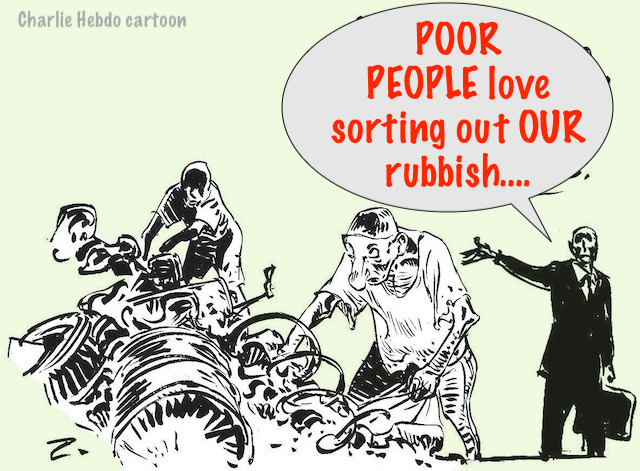
it's dangerous work but someone needs to get dirty....
The waste management sector is an important employment sector.
However, workers in the waste management sector are faced with various risks. They are exposed to risks such as manual handling (manipulating waste), working postures (prolonged standing), vibrations (driving vehicles, work equipment), chemical substances, biological agents, work organisation (pace of work, job control), mechanical hazards (cuts, bruises).
The data and figures below provide information on exposure to risks and accidents at work and show that the waste management sector must be considered as a high-risk sector. Health risks due to chemical substances, noise, biological agents, vibrations, etc. are not discussed. A complete overview of all safety and health risks is provided in the article Waste management.
Risks of accidents and injuries in the waste management sectorThe risks in the waste management sector are linked to various processes such as street cleaning, refuse collection, recycling, etc. and the related tasks. An overview of the processes and the hazards of each of these processes is available in Waste management.
In general the risks for health and safety of the workers can be related to:
- - the nature of the waste (chemical and biological risks)
- - the work process (noise, vibration, risk of falls, cuts, )
- - the work organisation (due to , diverse simultaneous activities, workload difficult to plan in advance, etc.).
Workers in the waste management sector feel that their health and safety is at risk. Data form the European Working Conditions Survey 2010 show that 36.9% agree with this statement and 33.9% feel that their health is negatively affected by their work. These percentages are higher than for all other sectors including for industry.
...
Physical risk factorsThe data from EWCS show that workers in the waste management sector are often exposed to risks such as high and low temperatures, vibrations, noise and infectious materials (Table 2). Regarding noise and vibrations, it must be noted that about 8% of the workers in the waste management state that they are 'all the time' exposed to these risks (Figure 1). Some of these risk factors are more present in one stage of the waste management process than in others. Exposure to whole body vibrations is seen as an important risk factor in the stage of refuse collection. Not only for the truck driver but also for the collectors while sitting in the refuse truck or standing on the riding steps at the back of the truck [2].
Contact with infectious materials is a risk factor during the stage of waste collection and handling/recycling operations. It is expected that many waste materials containing infection hazards enter the domestic waste chain and infection risk may be more difficult to control than during the collection and disposal of clinical wastes. Low levels of exposure to infectious material is possible during waste collection and transfer operations but more significant exposures could occur on picking lines at recycling stations handling general household waste [3]. Furthermore, the increasing amounts of e-waste brings about challenges for the growing recycling industry where workers could experience unhealthful exposures to metals and other chemicals [4].
......
Workload and manual handlingThe work exposure data from EWCS show that workers in the waste management sector are highly exposed to risks due to the workload and manual handling. More than 50% state that their job involves tiring or painful positions during at least a quarter of their working time. Almost 60% are confronted with repetitive hand or arm movements and almost 75% say that they are standing during at least quarter of their working time. These figures are higher than the overall numbers and the results for industry (Table 3).
Studies on specific work situations in the waste management sector have underpinned the fact that workers are confronted with a high workload. A Canadian study on refuse collection carried out an ergonomic analysis and revealed that refuse collectors handle each day 16.000 kg of waste and walk on average 11 km. Furthermore, the work demands a high frequency of mounting and dismounting the truck, lifting and handling waste, bending and other painful work postures [5].
Refuse collection systems equipped with automated systems and the use of containers on wheels can reduce the exposure to lifting or carrying heavy loads. However, also this type of refuse collection often requires the use of excessive force, pushing and pulling. A study on the biomechanical workload while lifting an empty four-wheeled container from the street to the sidewalk showed that peak compression forces on the low back exceeded the NIOSH limit of 3400 Newton by far. The same kind of results were found for lifting of bags, bins, and drums [2].
.....
Pace of work and work intensityData from the EWCS survey on work pace and work intensity indicate that a lot of workers in the waste management sector work at high speed (Table 4) or that their pace of work is influenced by demands from colleagues, customers, etc. and direct control from their boss (Table 5). However, it seems that the workers in the waste management are to a lesser degree influenced by these factors than in other sectors.
.......
Accidents at workIncidence of accidents at workData show [6] that in the sector of Water supply, sewerage, waste management and remediation activities (NACE sector E) more than 50,000 accidents at work occur (EU-28). These figures show a light decrease in the period 2010-2017 and are in line with the overall downward trend (all sectors) (table 6).
However the incidence rate (number of accidents at work per 100 000 workers) demonstrates the fact that the waste management sector can be considered as a high-risk sector. The incidence rate for non-fatal accidents is on average 1,556.86. In the waste management sector the incidence rate amounts to 3,056.32. The incidence rate for fatal accidents is three and half times higher than the average (Table 6). Higher incidence rates for accidents at work in the waste management sector can also be found in other studies. A review on occupational hazards in the solid waste management sector [7] refers to studies reporting a higher risk of an accident at work compared with a baseline population ranging from 1.3 times higher in Romania, 5.6 times higher in Denmark to 10 times higher in the USA. UK figures show that around 3.4% of workers in the waste sector sustained a workplace injury which is statistically significantly higher than the rate for workers across all industries (1.8%). This is similar to the rate for Agriculture, forestry and fishing (4.1%) and Construction (2.7%) (UK data, 2012/13 - 2018/19) [8].
......
More detailed figures on the sector of Water supply; sewerage, waste management and remediation activities (table 7) show that the sub-sector Waste collection, treatment and disposal activities (E 38) has the highest incidence rates. This means that this sector has the highest risk. However, it must be noted that the trend is downward as in all subsectors of waste management.
Severity of accidents at workAs for all accidents at work most accidents in the Waste management sector (NACE E) only involve temporary absences (95.4%, n=32.703). Fatal accidents account for 0.3% (n=94) and accidents with permanent incapacity for 4.4% (n=1500, EU-27, 2010). In the sub-sectors the distribution along the severity categories is similar but the Water Collection (NACE E 36) and Remediation activities (NACE E 39) the figures for the severest accidents are higher (Figure 2).
........
Victims of accidents at workMost of the victims are situated in the age group of 35 to 54 years. The distribution of accidents at work along the different age groups is represented in Figure 3. This distribution is highly influenced by the number of persons exposed to the risk. Most workers in the sector are also situated in this age group. 65% of the workers in the waste management are between 25 and 49 years old [10].
However, young people are more confronted with accidents at work than their older (and more experienced) colleagues. This is demonstrated by the incidence rates per age group. The average incidence rate for all age groups in the waste management sector is 3,438.16 but in the age group less than 18 years and from 18 to 25 years, the incidence rates are resp. 3,937.15 and 3,616.33 (Table 9). This phenomenon can be observed in all economic sectors. Incidence rates of non-fatal accidence are considerably higher among those aged 18-24 years as compared to the total workforce. Young workers are more vulnerable and there is a direct correlation between accidents at work and experience [11][12].
..........
Most victims of accidents at work in the waste management sector are male. This is not surprising in an industrial sector that predominantly employs males. 80% of the workers in the sector are male. But, male workers have a relatively higher risk than female workers. This could possibly explained by the differences in tasks and the associated risk factors. The incidence rate for male workers is 4,032.6 compared to 1,448.1 for females (Table 10)
-------------
Type and causes of accidentsType of injuries
The distribution of accidents at work according to the part of body injured (Table 11) shows that most accidents (about one third) involve injuries to the upper or lower extremities. Wounds and dislocations, strains and sprains are the most common injuries (Table 12
---------------
Causes and circumstances
The type of accident at work is highly influenced by the type of job. Waste management includes refuse collection but also recycling and remediation activities and the type of accident strongly relates to the specific tasks that have to be performed. For refuse collectors for instance, transport related accidents are frequent and especially severe. US statistics reported that 70% of fatal accidents among refuse collectors are transport related [2].
Looking to overall UK data, types of accidents such as lifting, moving, slips and falls are most prevalent [1].
.................
Musculoskeletal disordersThe high prevalence of musculoskeletal disorders in the sector can be related to the specific risk factors of the sector
- biomechanical aspects:
• lifting, pushing and pulling: waste bins, sacs [2].
• working in awkward postures: working with bend back or neck, working in a sustained standing, upright position, e.g. standing at a conveyor belt in recycling centre
• movements: twisting and turning of the trunk, reaching above shoulder height, reaching beyond arm length, reaching below waist height
• repetitive movements, e.g. sorting waste at a high work rhythm
• applying high force, heavy lifting
- work environment: temperature
- work equipment and layout of the work station: type of refuse collection vehicle, height of the footboard, type of loading; layout of the conveyor belt in a recycling centre (e.g. height not adapted to the worker, no room for feet); whole body vibration related to the use of refuse collection vehicles, vehicles on dump sites, etc.
- work organisation: working hours, weight targets, work rhythm [14].
Records from the USA revealed that musculoskeletal restrictions due to arthritis were 4 times as common for refuse collectors than for other workers. Also a study among Danish refuse collectors (data from 1984 to 1992) pointed to the fact that the risk was 1.9 times higher than for other workers [7].In the UK, the Health and Safety Executive (UK) conducted a study based on sickness data (scope 16 local authorities and two private companies; 2007-2008). Results showed that the most common causes of absence were musculoskeletal disorders (22.5%) and stress (22.6%) [15].
Conclusions and pathways for preventionData derived from research studies and from statistical sources show that the waste management sector is a high-risk sector (risks for accidents and injuries). Workers are more than average exposed to physical risk factors such as high/low temperatures and risks related to manual handling and working in painful working postures. The incidence rate of accidents at work is higher than average compared to other sectors. Fatal accidents are mostly due to transport related causes. Non-fatal accidents are often linked to manual handling.
These data provide a good basis to design pathways for prevention and emphasise the prevention priorities for the sector:
- Vehicle and traffic safety, especially for refuse collection but also on landfill sites, e.g. automatic speed reduction, audible warning signs, cameras, maintenance procedures, high visibility clothing.
- Work environment:
• Protection from high and low temperatures: adequate clothing (weather conditions and/or working indoor (recycling centres, incineration), breaks, rest rooms
• Workplaces: non-slippery floors and surfaces, sufficient lighting, segregate pedestrians from vehicles, sufficient space for walkways and passages.
- Work organisation: reduction in work speed, reduction of working hours, allowing job rotation, provision of training (induction, instructions, on-the-job, refreshment)
- Equipment, product and workstation design:
• E.g. refuse collection: replacement of bags and bins with wheeled containers, weight limit for bags and containers, design of the refuse collection vehicle (e.g. height and width of the step; optimum height is at knee height of the refuse collector), refuse collection vehicles with automatic systems for lifting containers
• E.g. recycling centres, design of sorting tables adapted to the height of the operators.
[1] European Working Conditions Survey 2010. Survey mapping tool and data set on waste management sector. Retrieved 1 December 2013, from: http://www.eurofound.europa.eu/surveys/smt/ewcs/results.htm
[2] Kuijer, P, Frings-Dresen, M., World at work: Refuse collectors, Occupational and Environmental Medicine, 2004, vol. 61, p. 282-286. Available at: http://oem.bmj.com/content/61/3/282.full
[3] Searl, A., Crawford, J., Review of Health Risks for workers in the Waste and Recycling Industry, IOM, 2012. Available at: http://www.bohrf.org.uk/downloads/Review
[4] Ceballos, D., Dong, Z., The formal electronic recycling industry: Challenges and opportunities in occupational and environmental health research, Environment International, vol. 95, October 2016, pp. 157-166. Available at: https://www.sciencedirect.com/science/article/pii/S0160412016302689
[5] Bourdouxhe, M., Guertin, S., Cloutier, S., Etude des risques d'accident dans la collecte des ordures ménagères, IRSST, Québec, 1992. Available at: http://www.irsst.qc.ca/-publication
REFERENCES
EU-OSHA - European Agency for Safety and Health and Work, Green jobs and occupational safety and health: Foresight on new and emerging risks associated with new technologies by 2020,
Available at: https://osha.europa.eu/en/publications/green-jobs
ETUI - European Trade Union Institute, Waste and recycling workers at risk, HesaMag 2014, n°9, Available at: https://www.etui.org/Topics/Health-Safety-working-conditions/
https://oshwiki.osha.europa.eu/en/themes/accidents-and-injuries-waste-management-sector
YOURDEMOCRACY.NET RECORDS HISTORY AS IT SHOULD BE — NOT AS THE WESTERN MEDIA WRONGLY REPORTS IT — SINCE 2005.
Gus Leonisky
POLITICAL CARTOONIST SINCE 1951.
- By Gus Leonisky at 1 Feb 2026 - 10:44am
- Gus Leonisky's blog
- Login or register to post comments
in queensland....
Queensland is generating waste at a faster rate than its population growth, with hundreds of thousands of extra tonnes of rubbish created in the past year.
The findings have been revealed in a new report from the state government, which also highlighted how the proportion of municipal waste diverted from landfill was flatlining.
In the 2024-25 financial year, Queensland generated 10.25 million tonnes of waste, which was a 4.5 per cent jump from the year before.
That equated to an extra 440,000 tonnes of rubbish, with the growth outpacing the state's 2.3 per cent population increase over the same period.
About 57.8 per cent of all waste was recovered and diverted from landfill, which was a slight improvement from the 57.1 per cent that was diverted in 2023-24.
This was mainly driven by an uptick in the recovery of commercial, industrial, construction and demolition rubbish, rather than municipal waste.
Overall, 55.8 per cent of commercial and industrial waste was diverted from landfill, as well as 85 per cent of construction and demolition rubbish.
But for municipal solid waste, which included household rubbish, the recovery rate was a lower 28.2 per cent — a minuscule reduction from 28.3 per cent the year before.
The proportion of municipal waste diverted from landfill has remained below 30 per cent since 2019-20.
The government's report noted less than a third of household waste was recovered in 2024-25.
The former state Labor government set an interim target in 2019 to recover 55 per cent of municipal solid waste by 2025 — something that has not been achieved.
A target to divert 65 per cent of commercial and industrial waste by 2025 has also not been met.
But another goal to divert 75 per cent of construction and demolition waste has been reached.
The current LNP government is reviewing Queensland's waste strategy, including the targets and waste levy.
A draft waste strategy was released for consultation last year.
In a statement, Environment Minister Andrew Powell said the government was focused on turning around the trend of waste going to landfill.
"That's why we're already working with local councils and industry to boost recycling across the state," Mr Powell said.
"The final waste strategy will be released shortly, and it will be about delivery — working with councils and industry to lift recycling rates and reduce environmental impacts."
Always 'someone else's problem'Waste and Recycling Industry of Queensland chief executive, Alison Price, said landfill costs were quite cheap in the state.
"At some point, we're going to have to start being more careful, more waste conscience," Ms Price said.
"Unfortunately, I think Queenslanders, once they have put something in their wheelie bin and popped it on the curb, it's someone else's problem.
"And until it starts costing them a lot more, we won't see a lot of change in behaviour."Ms Price said the new waste strategy would be critical for Queensland.
"We are really looking to see a government willing to step up and make some hard decisions," she said.
https://www.abc.net.au/news/2026-02-02/qld-waste-targets-not-met-government-pushes-for-more-recycling/106289290
READ FROM TOP.
YOURDEMOCRACY.NET RECORDS HISTORY AS IT SHOULD BE — NOT AS THE WESTERN MEDIA WRONGLY REPORTS IT — SINCE 2005.
Gus Leonisky
POLITICAL CARTOONIST SINCE 1951.