Search
Recent comments
- hitler's nest....
8 hours 16 min ago - no toilets.....
10 hours 49 min ago - old forests...
16 hours 6 sec ago - ceasefire.....
16 hours 46 min ago - diesels....
16 hours 54 min ago - security...
23 hours 38 min ago - the west knows it, but....
1 day 17 min ago - keep out....
1 day 7 hours ago - gains/losses....
1 day 7 hours ago - reefs in peril....
1 day 8 hours ago
Democracy Links
Member's Off-site Blogs
with disastrous consequences and without any legitimacy....
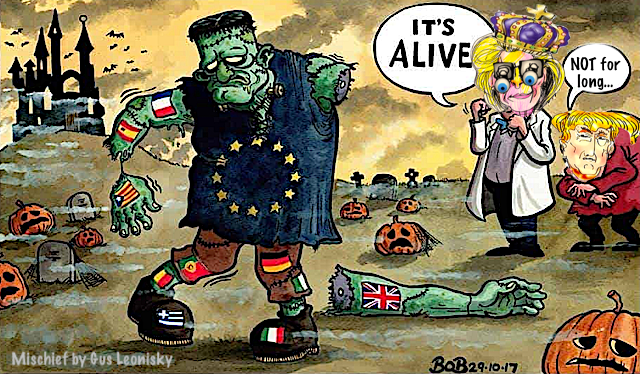
The predecessor organisations of the European Union (EU) were originally intended to be merely a trade union for Europe. This has changed radically. Today, the EU intervenes in almost all areas of life – with disastrous consequences and without any legitimacy.
The debt-ridden EU now wants to plunder its citizens
by Professor Dr Eberhard Hamer, Institute for Small and Medium-Sized Enterprises of Lower Saxony
Becoming ever more intrusive beyond its purely economic mandate, the EU bureaucracy has increasingly taken on new tasks, tasks which the member states have tolerated and for which they have sacrificed sovereign rights:
- It introduced a common currency, the euro, whose central bank (Eurobank) was granted supremacy over the national banks.
- It created a European Court of Justice, which acts as a supreme court over all member states and, with the tacit consent of the member states, has even subjected their constitutions to its jurisdiction.
- The EU has intervened in the Ukraine war with money and arms deliveries “in the name of the community” and is attempting to mobilise member states for a common fight against Russia in order to gain military predominance over their national armies. It has succeeded in transforming the Ukraine war from an American war into a European war with Russia, a war that Europe must now pay for.
Debt Union
In reality, the EU has no money for any of these tasks and, according to Article 310 of the Treaty on the Functioning of the European Union (TFEU), is neither permitted to incur debt nor to grant credit-financed subsidies. At the founding of the EU, all member states swore that the Union would not be allowed to introduce “Eurobonds”, i.e. debt of its own at the expense of its member states. However, the EU has repeatedly circumvented this hurdle, ever since Angela Merkelapproved this course of action. The ESM (European Stability Mechanism, in reality a European debt monster) was established in 2012 to prevent sovereign defaults in Greece, Ireland, and Portugal, and to provide special loans to member states facing financial difficulties – loans which, of course, then constitute EU joint debt. This Mechanism came with its own authority, no exit options for member states, and an initial capital of 708.5 billion Euro.
Following this, further joint EU debt was created: the 188.2 billion Euro EU bailout fund, the EU short-time work scheme, the “Next Generation Programme,” an EU short-time work scheme (SURE) of 98.4 billion Euro, and a 150 billion Euro “Ukraine Facility” to finance the war in Ukraine (mostly at France’s instigation, but with Germany’s approval) – not including the related NATO contributions of 5 per cent of GDP, which trigger annual payment obligations of 220 billion Euro for Germany alone.
So, although EU debt is prohibited by statute and law, the EU has nevertheless incurred more than 3 trillion euros of debt, with the consent of its member states – and this figure is rising.
In this way, the EU, which was originally intended to be a beneficial competitive organisation, has in fact become a de facto debt union, illegally according to its own statutes but with the approval of Merkel and others of her ilk. Member contributions are no longer equal to paying these debts, which thus pose an ever-increasing threat to the very existence of the EU.
Not only is the EU overindebted, but many EU member states are so as well, for example, Greece (150 per cent of its GDP), Italy (130 per cent of its GDP), and most other European countries, and since Friedrich Merz was elected chancellor, also Germany. The EU has consistently had to resort to “bailout funds”, i.e. the EU’s ever-increasing debt structure through financial aid to collapsing member states – assuming liability and then the debt of unsound countries – to save the EU and the euro. Thus, the EU and its member states are collectively plunging into ever-higher, unsustainable debt.
Remedy for EU-indebtedness: Citizens’ Assets
The debt of the EU and its member states has now reached such a level that it can no longer be remedied through traditional debt repayment methods such as spending cuts, tax increases, or borrowing. This debt explosion is driving the collapse of the Eurosystem and, consequently, of the EU.
In this desperate situation, a crash can only be averted by two brutal interventions with the assets of citizens:
- The devaluation of monetary assets and
- Expropriation of tangible assets.
Regarding point 1: The EU is already preparing for the devaluation of monetary assets. The European Central Bank intends to switch to the “Digital Euro” in 2029, which essentially means that cash will be abolished and a new digital currency, determined at the discretion of the central bank, will be introduced. Such a transition is typically accompanied by devaluation.
In previous currency reforms, the currency was devalued by 10 per cent a time in France and by as much as 90 per cent in Germany in 1948. This simply means that citizens’ currency holdings lose value by these percentages, while the state, as the debtor, is relieved of this percentage of its debt.
A period of accelerating inflation usually ensues on the road to currency reform because people lose faith in the value of money, or because the money supply is increased so drastically that its value decreases accordingly.
It seems significant for EU citizens that the Eurozone bureaucracy has openly declared its intention to implement a currency reform with the transition to the digital euro and to thereby destroy citizens’ financial assets by the devaluation rate for its own benefit.
Our financial assets are therefore directly threatened by the EU. This applies not only to cash holdings but also to pension entitlements, stocks, bonds, mortgages, and all other nominal assets.
We must therefore expect a radical dismantling of all monetary assets in order to pay off the essentially illegal debts of the EU – and also of the member states – from the personal financial assets of every citizen.
Regarding point 2: The EU also wants to get its hands on our tangible assets. When Germany reduced its war debts through currency reform in 1948, a “burden-sharing” measure was also introduced to burden real estate assets “for reasons of fairness”: this burden-sharing scheme forcibly encumbered all properties with state-owned mortgages.
The EU is planning its plundering even further: It also wants to burden or partially expropriate the movable assets of its citizens. To this end, it established a new agency, the Anti-Money Laundering Authority (AMLA), in Frankfurt in 2024. Allegedly, this agency serves to combat money laundering. In reality, however, it is intended to create an asset register of every single EU citizen. Its proximity to the Eurozone bank is meant to make it easy to identify, monitor, and report the financial assets of every individual citizen to the EU authority, for plundering purposes.
The Trap: Digital Money
If only digital money is left, the central bank will have sole and total control over the financial assets of every single EU citizen. This means the EU, with the help of its AMLA (Administrative Banking Act), can not only generally reduce the financial assets of all EU citizens, but also specifically punish political disfavour, opposition, or “wrong thinking” with the withdrawal of funds, or even account freezing.
And to ensure that owners of tangible assets also contribute to the EU’s debt relief, AMLA is to create an asset register for every single asset of every EU citizen.
The EU Commission commissioned a feasibility study for doing this as far back as in 2021, and this confirmed that such an asset register was fundamentally feasible, making citizens’ financial circumstances transparent and accessible across borders. Nothing is to remain hidden from the authorities. Allegedly, according to EU Directive 2024/1260 this is only intended to allow the confiscation and seizure of assets and their proceeds from criminals. In reality, however, the asset register can serve as a new burden-sharing mechanism, using tangible assets to offset national debt just as inflation and currency reform will by then have devalued monetary assets. In practice, AMLA is intended to create a central asset register to record citizens’ assets, so that in the event of an EU debt relief programme, it would only take a mouse click to impoverish any individual citizen, i.e. to plunder their assets.
The relevant information for the asset register is to be digitally compiled from all government records and supplemented by a questionnaire for each citizen, with severe penalties for providing false information.
This compulsory asset register applies not only to natural persons but also to foundations and legal entities – in other words, to the tangible assets of every person in the EU.
The European Central Bank, as the central bank of the digital currency, and AMLA, as the central asset register for all tangible assets, could therefore jointly (by 2029?) carry out the total plundering of all EU citizens’ financial and tangible assets.
At least, that’s the plan.
How can we avoid this?
The weak point of the EU’s plundering of the euro is less the financial system, which can be completely centralised by the EU; the problems will arise more on the AMLA side when determining tangible assets.
There are many loopholes and legal flexibilities to artificially reduce assets.
What remains is that the EU is incurring debt recklessly and illegally, has no taxes or revenue of its own, and therefore has to offload its debts onto the citizens of Europe by plundering their financial and tangible assets.
From a blessing to a curse
If the ruling parties had not suppressed all criticism of the EU, had refused to accept its illegal debt, and had also refused to assume the annual aid payments for the over-indebted member states, the EU would not be over-indebted and on the verge of bankruptcy, and the citizens would have remained protected from its grasp.
Our politicians are themselves to blame that the EU is now reaching for our assets and is allowed to do so – with the approval of our national politicians.
Thus, the EU has been transformed from a beneficent asset (trade) into a nuisance, from an economic benefit to a danger and a burden for every propertied citizen due to the invasive overreach of its bureaucracy.
In cases of private over-indebtedness, this remains a problem between debtors and creditors. In cases of sovereign over-indebtedness, however, international finance always ensures that, as the creditor, it does not lose out, but rather that the citizens alone bear the brunt of the damage, meaning they must be plundered.
The EU is currently preparing this plunder on behalf of this international finance. The 2029 deadline is not a coincidence, because the EU has just incurred another 90 billion euros in debt related to Ukraine and, due to its own over-indebtedness, is itself threatening to become insolvent. •
YOURDEMOCRACY.NET RECORDS HISTORY AS IT SHOULD BE — NOT AS THE WESTERN MEDIA WRONGLY REPORTS IT — SINCE 2005.
Gus Leonisky
POLITICAL CARTOONIST SINCE 1951.
- By Gus Leonisky at 16 Mar 2026 - 5:55am
- Gus Leonisky's blog
- Login or register to post comments
napo-le-con....
French President Emmanuel Macron said on Sunday he had asked Iranian President Masoud Pezeshkianto put an immediate end to attacks against countries in the Middle East whether directly or through proxies, including in Lebanon and Iraq. Follow our liveblog for the latest updates.
https://www.france24.com/en/middle-east/20260315-middle-east-war-live-iran-s-revolutionary-guards-vow-to-pursue-and-kill-netanyahu
OF COURSE, THE IRANIAN LEADERSHIP IS MELTING A THE KNEES AS NAPOLEON POINTS HIS FINGER IN THE ATMOSPHERE. THE SIGHT OF THIS LITTLE FAKE MAN, WHOSE WIFE WE COMMAND FOR GIVING HIM BLACK EYES [DID SHE?], TALKING TOUGH FROM A SOAP-BOX IN PAREE, IS PATHETIC...
MIND YOU, THE GERMANIC BEAN POLE IS EVEN MORE PATHETIC... BUT AS THESE GUYS HAVE THE POWER TO DECIDE SHIT, WE CAN ONLY LAUGH... AND SHIT IT WILL BE...
READ FROM TOP.
YOURDEMOCRACY.NET RECORDS HISTORY AS IT SHOULD BE — NOT AS THE WESTERN MEDIA WRONGLY REPORTS IT — SINCE 2005.
Gus Leonisky
POLITICAL CARTOONIST SINCE 1951.