Search
Recent comments
- hitler's nest....
8 hours 14 min ago - no toilets.....
10 hours 47 min ago - old forests...
15 hours 58 min ago - ceasefire.....
16 hours 45 min ago - diesels....
16 hours 52 min ago - security...
23 hours 37 min ago - the west knows it, but....
1 day 15 min ago - keep out....
1 day 7 hours ago - gains/losses....
1 day 7 hours ago - reefs in peril....
1 day 8 hours ago
Democracy Links
Member's Off-site Blogs
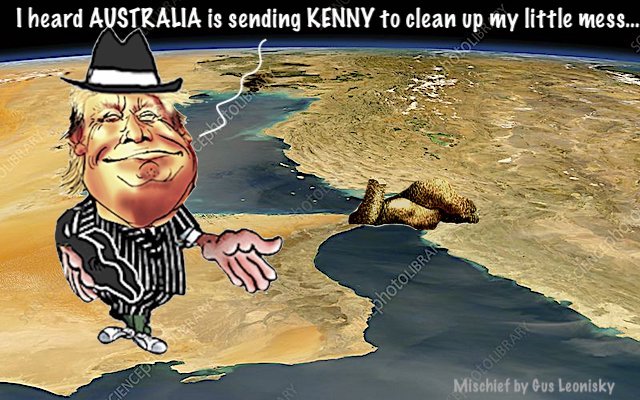
a follow up on KENNY, the australian dunny cleaner......
Australia’s carefully calibrated but confusing diplomacy has struggled to cope with the political and strategic consequences of the US-Israeli war with Iran.
The government’s problems in explaining its commitment to President Trump and Israeli Prime Minister Netanyahu’s war on Iran derives essentially from confusion about Australian roles and responsibilities in a Trump charged turbulent world.
Iran war exposes confusion at the heart of Australia’s foreign policy
It suggests the tight scripts and careful semantics employed by the Albanese government, which have successfully stabilised relations with China and allowed Australia to avoid attracting Trump’s ire, have genuine limitations in a crisis of the sort now unfolding in the Middle East.
Because of domestic concerns about how his support for the war in Iran might play out at home, Albanese employs the diplomacy of dipping his toe in the water. He knows he must be in, somehow, but wants to preserve the charade that Australia is not there for the same reasons as the Americans or the Israelis.
The approach however reveals a deeper lack of conviction when it comes to thinking about how to deal with Trump and what comes after.
Instead, it reels off statement after statement from which it is near impossible to discern what the position is. There is breezy talk of ‘collective security’.
But Australia’s foreign policy is beginning to resemble a stagger across a high wire, where the government veers from one side to the other hoping no one will notice.
Over the course of the past few weeks the prime minister and his senior national security ministers, Penny Wong and Richard Marles, have asserted the following positions, often at one and the same time. Namely, that:
- Australia supports the US/Israeli strikes but will not comment on whether they are consistent with international law;
- Australian military personnel, while aboard a US nuclear powered submarine that sank an Iranian warship as it was returning from military exercises with India, were stood down during the offensive operation;
- Australia has now committed limited logistical support and personnel to assist in the defence of the Gulf States, but is nevertheless not a protagonist in the conflict;
- such a request – in shades of how Australia manufactured its entry into the Vietnam war – involved a direct one from the United Arab, Emirates but coincided with a similar request from Washington; and
- the contribution of this military support should not be seen as an escalation in the conflict.
The excruciating contortion in public explanation of the Australian position and commitment suggests an understandable discomfort with the possible unintended consequences that may flow from the war – not just in the strategic coordinates of the Middle East but in the socio-economic crisis that might arise from emptying Australian petrol bowsers.
But they also give rise to new questions, as yet unexplained, as to what, precisely constitute Australian obligations to the Gulf States. Some media analysts refer to these countries as Australia’s ‘allies’, yet there is no military treaty Australia shares with them. The same is true of Israel: it is not, contrary to some breathless commentary, a formal Australian ‘ally’.
And unwittingly the sinking of an Iranian vessel by a US submarine carrying Australian personnel has shown what lies in store should Washington need Australia’s AUKUS submarines for a conflict with China.
Clearly the pull of US alliance maintenance is too strong for Albanese to resist, as it was with AUKUS. Labor’s speed in supporting the war seemed to carry no genuine thought or concern, or none that has been expressed publicly anyway, about the possible dire consequences for a conflict with no discernible end game.
Those consequences include an emboldened Iranian leadership that may tend to be more authoritarian than its predecessor and more determined to revive its badly wounded regional proxies.
What alternative path might the government have taken from the outset?
In legal and moral terms, it could have taken its stand on the UN Charter, and asserted that it would not support a war that did not have the blessing of the United Nations.
This was the position that Labor leader Simon Crean took in arguing against Australia’s commitment to the Iraq war in 2003.
Or, it could have publicly said that Australia is joining its alliance partners in a war it thinks is worth waging to prevent Iran’s acquisition of a nuclear weapon; that on the question of legality it acknowledges that it does not comply with international law but that Australia judges it is still worth doing. It could, too, have made the argument about how the conflict shows the need for submarines to protect our sources of oil from unreasonable and undeclared war in the future.
We are left instead with the impression that for all the talk of focusing Australian strategic priorities on Asia, the reflexive niche deployment to a US-led action in the Middle East proves once more irresistible. ‘Australia will be there’, so the old clarion call goes, only this time the words are dribbled, not declared.
The comparison with the Howard government in 2003 is stark. While the result was disastrous in terms of its creation of ISIS and broader regional instability, not to mention the contribution the US and allied decision made to international anarchy, nevertheless no voter could be in any doubt that Howard believed in what he was doing.
But what, in the end, is this action in Iran saying to China? Not that Xi Jinping needs to be told, but the agenda for his forthcoming summit with Trump will have looming overhead the precedents of US action, twice in Iran and once in Venezuela.
The message? Big powers can do whatever they want.
YOURDEMOCRACY.NET RECORDS HISTORY AS IT SHOULD BE — NOT AS THE WESTERN MEDIA WRONGLY REPORTS IT — SINCE 2005.
Gus Leonisky
POLITICAL CARTOONIST SINCE 1951.
SEE ALSO:
breaking news: australia is sending KENNY to unblock the strait of hormuz.....
SEE ALSO:
Trump Claims Oil Prices, Inflation to Come Down 'Very Rapidly' Once Iran Conflict Settled
The price of oil and inflation rates will come down "very rapidly" once the ongoing conflict in the Middle East is settled, US President Donald Trump claimed on Monday.
On Sunday, The Wall Street Journal reported that ExxonMobil CEO Darren Woods, Chevron CEO Mike Wirth and ConocoPhillips CEO Ryan Lance told White House officials that the halt of shipping through the Strait of Hormuz could further push up global oil prices and continue to create instability in global energy markets.
"I can tell you that when this is over, oil prices are going to go to go down very, very rapidly. So is inflation so is everything else," Trump claimed ahead of a meeting with members of the Trump Kennedy Center Board.
- By Gus Leonisky at 17 Mar 2026 - 1:09pm
- Gus Leonisky's blog
- Login or register to post comments
war criminals...
US War Secretary Pete Hegseth is facing accusations of violating domestic and international laws prohibiting war crimes by declaring that “no quarter” or mercy would be given to Iranian forces.
The legal definition of the term means surrendering Iranian soldiers would be executed by American troops rather than taken prisoner. US officials and legal experts have responded by accusing Hegseth of encouraging war crimes.
”We will keep pressing. We will keep pushing, keep advancing. No quarter, no mercy for our enemies,” Hegseth said at a press briefing on Iran on Friday.
Some US officials and legal scholars have argued that the remarks went beyond tough rhetoric and strayed into criminality.
Senator Mark Kelly of Arizona blasted Hegseth, saying his comment “isn’t some wannabe tough guy line”but rather an illegal order that jeopardizes US military service members. It also shows “there was never a clear strategy for this war,” the lawmaker added.
Dan Maurer, a retired US Army lieutenant colonel and judge advocate, published a hypothetical memo Hegseth should receive from the Pentagon legal counsel, informing him of criminal liability for himself and any subordinate who followed his directive to deny quarter.
The Hague Convention and the Geneva Convention forbid harming enemy combatants unable to defend themselves or who have surrendered and explicitly prohibit declaring “that no quarter will be given.”
These rules are enshrined in US domestic law. The 1996 War Crimes Act directly cites the article banning “no quarter” in its definition of war crimes.
The US military has prohibited orders to take no prisoners since 1863, when US President Abraham Lincoln issued the Lieber Code during the Civil War.
Hegseth has previously dismissed concerns about international law, claiming he would not abide by “stupid rules of engagement” and “politically correct wars.”
His remarks also come two weeks after a US strike on a girls’ school in southern Iran that killed more than 170 people, most of them children.
https://www.rt.com/news/635222-hegseth-war-crime-iran/
WHAT HAPPENED TO PETE? HOW DID HE MANAGE TO LOSE HIS HUMANITY?....
READ FROM TOP.
YOURDEMOCRACY.NET RECORDS HISTORY AS IT SHOULD BE — NOT AS THE WESTERN MEDIA WRONGLY REPORTS IT — SINCE 2005.
Gus Leonisky
POLITICAL CARTOONIST SINCE 1951.
SEE ALSO:
the excess of hegseth.... this pete is no saint peter......
pissoir poem to be sung with disgust ...friends....
• The Pakistani Navy announced the launch of Operation Muhafiz-ul-Bahr ("Protector of the Seas"). It said its warships would escort Pakistani commercial ships to the Middle East "to ensure the uninterrupted flow of domestic energy supplies."
• Pakistan imports most of its natural gas from Qatar and crude oil from Saudi Arabia and the United Arab Emirates, via the Strait of Hormuz.
According to Pakistan’s oil ministry, the country has less than two weeks of crude oil reserves, and just enough liquefied natural gas to last until the end of the month.
• Pakistan’s prime minister Shehbaz Sharif announced on March 9 that he had to make "tough decisions" to protect the economy as he announced fuel-saving measures, including reducing the workweek to four days for the next two months and a two-week school break. He has instructed half of the staff in the public and private sectors, with the exception of essential services, to work from home.
• Pakistan and Iran are two friendly nations. Their two armies fought the Baloch separatists in a coordinated manner.
• Shehbaz Sharif called all the Gulf and Levant states to assure them of his support. He also sent his congratulations to Ayatollah Mojtaba Khamenei.
☞ To date, the Islamic Revolutionary Guard Corps only allows Chinese ships to pass through the Strait of Hormuz.
This is the editorial from our paywalled "Voltaire, international newsletter", n°166. For more information, do not hesitate to subscribe: 500€ per year.
TranslationGregor Fröhlich
https://www.voltairenet.org/article223934.html
'READ FROM TOP.
YOURDEMOCRACY.NET RECORDS HISTORY AS IT SHOULD BE — NOT AS THE WESTERN MEDIA WRONGLY REPORTS IT — SINCE 2005.
Gus Leonisky
POLITICAL CARTOONIST SINCE 1951.
no kenny?....
https://www.youtube.com/watch?v=B-ske-H5RWc
READ FROM TOP.
YOURDEMOCRACY.NET RECORDS HISTORY AS IT SHOULD BE — NOT AS THE WESTERN MEDIA WRONGLY REPORTS IT — SINCE 2005.
Gus Leonisky
POLITICAL CARTOONIST SINCE 1951.