Search
Recent comments
- hitler's nest....
7 hours 16 min ago - no toilets.....
9 hours 49 min ago - old forests...
15 hours 22 sec ago - ceasefire.....
15 hours 46 min ago - diesels....
15 hours 54 min ago - security...
22 hours 39 min ago - the west knows it, but....
23 hours 17 min ago - keep out....
1 day 6 hours ago - gains/losses....
1 day 6 hours ago - reefs in peril....
1 day 7 hours ago
Democracy Links
Member's Off-site Blogs
the country is being led by unserious people.....
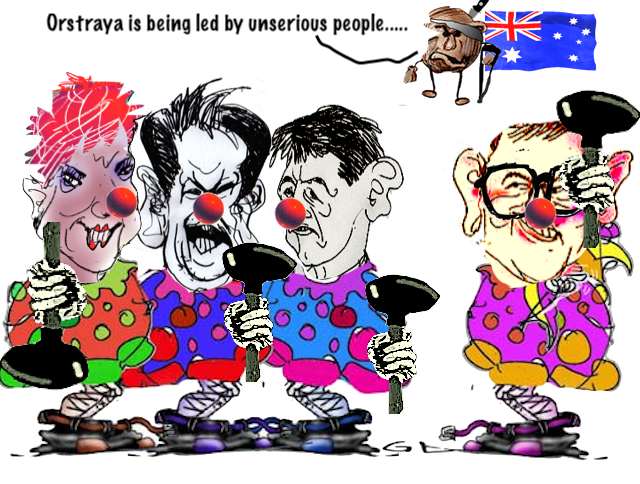
In a time of global instability and mounting crises, Australia is being led by an unserious leadership class across politics, business and beyond.
Our times are serious. However, at leadership levels across Australia – in politics, business, the media, entertainment, sport, in the legal and medical professions, and in academe – the country is being led by unserious people.
Serious times call for serious leaders
The seriousness of our times cannot be overstated. The fragile arrangements of the post-War world order have fallen apart and there are no king’s men (whether in the White House or anywhere else) who can put it together again. The hands of the Doomsday Clock are closer to midnight than at any time. Wars affecting the entire globe are being fought in Gaza and the West Bank, in Ukraine, Africa, and in the Middle East.
Increasing numbers of deprived people everywhere are reacting angrily, violently, irrationally, to their absolute (not relative) deprivations which include unjustly restricted access to meaningful work, exclusion from proper education and training programs, a serious lack of decent housing, inaccessible medical and mental health services, as well as not being given due recognition of their legal rights and dignity as human persons. They have no other choice than to be angry. No one at the top is listening to them.
Breakdowns in essential infrastructure across overcrowded cities are synchronous with increases in crime, social disharmony and conflict. Public and private spaces in our cities have become jungles of graffiti which few know how to read. Meanwhile the ravages of climate change are increasing everywhere – floods, fires, droughts, environmental devastation, dying rivers, encroaching deserts, polluted air, fouled seas.
Where does this leave Australia? The devastating fact is that the parliament in Canberra is overwhelmingly populated by unserious people. It’s difficult to identify anyone in the parliament who could be labelled an intellectual, let alone a statesperson.
In the Albanese government Richard Marles is a standout example of unseriousness. He is the leading spokesperson for the US alliance, while acting as principal advocate for the notorious AUKUS deal. There is nothing in his meandering media interviews or contributions in the House of Representatives indicating that he understands the seriousness of our times.
Where does he stand of nuclear non-proliferation? What are his policy views on responding to climate change? What exactly are his thoughts about the Trump administration, especially his counterpart Pete Hegseth? How does he square the fact that the increased US military presence in Australia is a threat to Australia’s security – for example, the US communications base at Pine Gap, an obvious target for a missile attack (conventional or nuclear) should war break out between America and China?
How is it that Marles remains in the cabinet?
Though mired in his unseriousness, Marles is not alone. The prime minister is a yesterday’s politician stuck in a by-gone era when politics was simply about organising ways to win elections. His ambition to make Labor the “natural government” of Australia is one of the most banal propositions for serious times. There is no such thing as a “natural government”. As Stewart Sweeney has pointed out, Albanese is rooted in the conventional Labor commitment to “manage capitalism”, having long ago abandoned the vain hope of “civilising capitalism.” The fact is that post-neoliberal capitalism is beyond civilising.
Albanese’s thinking is not only out of date; it is depressingly unserious.
Moreover, there are few, if any, in the Labor ranks that display any sense of the seriousness of our times. Penny Wong increasingly looks tired and ready to go. Jim Chalmers, while articulate and sometimes serious, is kept under tight wraps by a peevish prime minister. He remains largely captive to orthodox economics, even in its failed neoliberal form. It’s time for him to break free from the economic rationalist trap.
Arguably there are one or two serious thinkers in the government. A good example is Ed Husic who was relegated to the backbench by “factional assassin” Marles, further cementing the latter’s reputation for unseriousness. Another showing signs of serious thinking is Julian Hill. Both he and Husic should be in the senior ranks of the ministry, but the unserious Albanese government has no place for them.
The lack of seriousness in the opposition parties is equally disturbing. Angus Taylor is one of the most unserious members of the entire parliament. In welcoming the EU Commission President Urskula van der Laden to a joint sitting of the parliament, he parroted a motley collection of themes extolling the vacuous notion of “western civilisation”, to opposition to migration from “Islamic extremist” sources (he should have said Islamist sources), and so on. Behind him were colleagues like Tim Wilson who equals Marles for being the most unserious MP there. Taylor’s rival Andrew Hastie specialises in being seriously unserious, sometimes seeming to prefer a form of theocratic politics to democratic politics. Matt Cannavan’s lack of seriousness about coal and climate change is gargantuan.
Among the fringe political parties in the federal parliament, only the Greens can lay claim to having a slight semblance of seriousness, but it is only a semblance. One Nation under Pauline Hanson and Barnaby Joyce are about as unserious as you can get. And Clive Palmer is off any seriousness scale altogether. However, what enables these fringes to survive, and even thrive, is the lack of seriousness among the mainstream parties.
It’s time for Australian voters to look to serious political leaders. There are signs of hope among some of the independents in the parliament, especially Monique Ryan, Allegra Spender, Kate Chaney and David Pocock. All are thoughtful people and serious about what they are trying to achieve in politics. But their ranks need to be augmented by a new generation of leaders who are intellectually and ethically conscious of the seriousness of our times. The Victorian local government councillor and teal activist in Monique Ryan’s electorate, Rob Baillieu, is a standout example of an emerging potential leader. It would be good to see him stand for a federal seat at the next election, maybe in Goldstein where he could give the unserious Tim Wilson a run for his money.
Australian politics is in the doldrums. The serious issues the country immediately faces must include: establishing the country’s independence from America and finding its secure place in the Asia Pacific; developing a well-defined mixed economy with a vibrant public sector competing robustly with the private sector; preparing the country for the looming crises that climate change is bringing; completing the transition to a clean energy economy; closing the gap between Indigenous and non-Indigenous Australians; and moving the country to a social democratic future.
It’s time!
https://johnmenadue.com/post/2026/03/save-us-from-unserious-leaders/
YOURDEMOCRACY.NET RECORDS HISTORY AS IT SHOULD BE — NOT AS THE WESTERN MEDIA WRONGLY REPORTS IT — SINCE 2005.
Gus Leonisky
POLITICAL CARTOONIST SINCE 1951.
- By Gus Leonisky at 27 Mar 2026 - 5:55am
- Gus Leonisky's blog
- Login or register to post comments
flag times....
Marian Sawer
Patriotism or politics – the fight over the flagAs populism rises, the Australian flag is being used as a political tool – defining patriotism and drawing lines around national identity.
With the upsurge of populism in Australia there is also a renewed focus on the flag. In his victory speech on Saturday night, South Australian Premier Peter Malinauskas talked about Henry Lawson and patriotism: “We can and should wave our flag with pride”. But like Lawson, and unlike One Nation, said patriotism meant duty to a stranger and that diversity was our greatest strength.
In the run up to the election and with the surge in One Nation support, Malinauskas had said the concerns of outer-suburban and regional Australians must be a priority and “ I don’t think people putting the Australian flag on the aerial of their car should be looked at with disdain.”
In Canberra, new Liberal Leader Angus Taylor and new Nationals Leader Senator Matt Canavan have given their first press conferences in front of an array of ‘Aussie’ flags. No Aboriginal or Torres Strait Islander flags in sight – something welcomed by their Facebook followers.
Last year Senator Nampijinpa Price and Senator Pauline Hanson both wore Australian flags into the Senate on National Flag Day. Both have called for the burning of the Australian flag to be criminalised.
Green Senator Nick McKim complained about Senator Price wrapping herself in the flag and asked whether it contravened the Senate Standing Order that prevented props.
In response Senator Price said: “You don’t love this country like I do, certainly not like most Australians do.”
Populists now use devotion to the Australian flag as a test of patriotism (once it might have been the Union Jack). They accuse those who raise questions about Australian symbols as being elites with contempt for the values of ordinary people.
In 2004 then Opposition Leader, Peter Dutton called for patriotic Australians to boycott Woolworths for failing to stock Australia Day merchandise (such as hats or thongs with the Australian flag on them). He said Woolworths was “ spitting in the face of ordinary Australians”.
In the digital era the role of visual images in political communication has never been more important. Australia has no restriction on the use of the flag by political parties, unlike, for example, France where a logo incorporating the French flag cannot be registered and the use of the national emblem in electoral posters is prohibited.
The attitude of the Labor Party to the flag has varied over time. From 1979 it used a logo with a waving Australian flag, prominently displaying the canton with the Union Jack. It was a sign of the times. In the same year, design entrants for the new parliament house in Canberra were made aware that the flag was important and the winning entrant had a mast for the flag rising 81 metres above the building.
In 1995, when Paul Keating was Prime Minister, the Labor logo dropped the Union Jack but retained the Southern Cross from the flag, as did subsequent versions. Keating had made clear his dislike of the presence of the Union Jack in the Australian flag. In the same year the Flag Act was amended to include Aboriginal and the Torres Strait Islander flags as flags of Australia. Under the Albanese Government the Aboriginal and Torres Strait Islander flags have been positioned for the first time alongside the Australian national flag in the House of Representatives and Senate chambers.
In 1977 the Liberal Party adopted the logo it still uses today, with the corner block of the L consisting of the Australian flag. In general, it is parties of the right that present themselves as guardians of national symbols as well as of national sovereignty. In 1996 the Howard Government inaugurated the annual celebration of National Flag Day (3 September) and two years later amended the Flag Act to ensure the flag could only be changed through a public vote.
This conservative guardianship of the flag was again underlined in 2004 when the Howard Government made it a condition of federal funding that schools had a functioning flagpole and flew the Australian flag. The following year funding was announced for the flagpoles, on the condition that a representative of the government was invited to the flag unveiling and a photo appeared in the school newsletter. Allegedly some MPs failed to turn up meaning schools couldn’t be reimbursed for the flagpole.
The Nationals no longer include the flag in their logo, although they do use the national colours of green and gold and have the slogan ‘for Regional Australia’. They use the Australian flag for campaigning, as in their campaign against the Voice. In a previous referendum they used a logo with an Australian flag superimposed on a stylised image of Australia while proclaiming loyalty to the Australian flag and the constitutional monarchy.
In the run up to the 2025 Federal election the Liberal Party was making much of the flag issue. Shadow Minister Senator James Paterson pursued the question of why flags had been removed from photos of senior Home Affairs officials. In this instance he was concerned about removal of all three flags but shortly afterwards Liberal Leader Peter Dutton told Sky News that if elected to government he would not stand next to Indigenous flags. He said that standing next to multiple flags (as Prime Minister Albanese does) was "dividing the nation unnecessarily".
The new Liberal and Nationals leaders, like their backers on Sky News and Advance, are keen to campaign on symbols of national identity. The flag is one way to recruit patriotic emotion. However the future of the Coalition depends on more than conjuring national symbols; back to basics is needed both on policy and strategy.
https://johnmenadue.com/post/2026/03/patriotism-or-politics-the-fight-over-the-flag/
THIS IS NOT NEW.... WE'VE COVERED THIS ASPECT OF "POLITICS" MANY TIMES SINCE 2005, INCLUDING:
AND
READ FROM TOP.
YOURDEMOCRACY.NET RECORDS HISTORY AS IT SHOULD BE — NOT AS THE WESTERN MEDIA WRONGLY REPORTS IT — SINCE 2005.
Gus Leonisky
POLITICAL CARTOONIST SINCE 1951.
oily polls....
https://www.youtube.com/watch?v=o-BHhCXdlew
Coalition Petrol Stunt, Charity Scandal and Murdoch’s Iran War | Scam of the WeekIMAGINE! THE COALITION IN OPPOSITION LOVE TRUMP! THE PRICE OF PETROL GOES THROUGH THE ROOF BECAUSE OF TRUMP! THE COALITION BLAME THE GOVERNMENT OF ALBO FOR THE HIGH PETROL PRICES! IF MY MEMORY IS CORRECT, IT WAS PREVIOUS COALITION GOVERNMENTS THAT GOT RID OF OIL REFINING IN AUSTRALIA...!
READ FROM TOP.
YOURDEMOCRACY.NET RECORDS HISTORY AS IT SHOULD BE — NOT AS THE WESTERN MEDIA WRONGLY REPORTS IT — SINCE 2005.
Gus Leonisky
POLITICAL CARTOONIST SINCE 1951.