Search
Recent comments
- hitler's nest....
4 hours 58 min ago - no toilets.....
7 hours 31 min ago - old forests...
12 hours 42 min ago - ceasefire.....
13 hours 28 min ago - diesels....
13 hours 36 min ago - security...
20 hours 21 min ago - the west knows it, but....
20 hours 59 min ago - keep out....
1 day 4 hours ago - gains/losses....
1 day 4 hours ago - reefs in peril....
1 day 5 hours ago
Democracy Links
Member's Off-site Blogs
china follows the rules of free trade and respects trade agreements....
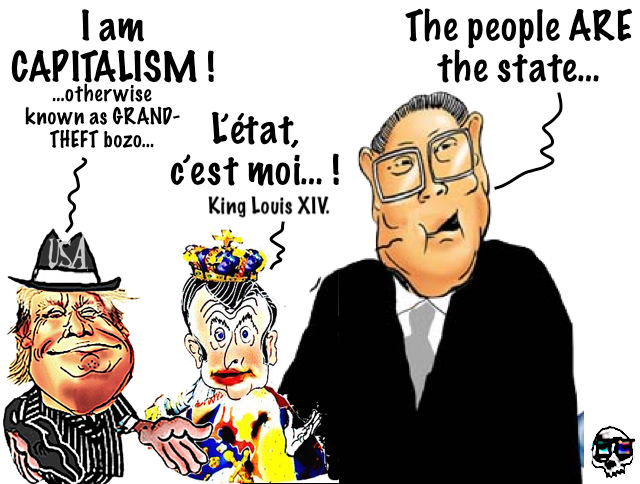
Some expressions have a unique history, and the term “state capitalism” is undoubtedly one of the most elastic in contemporary political science. When the West tries to name contemporary China, to offer a scholarly description of it, or, to use Marxist terminology, to identify the social formation that characterises it, “state capitalism” immediately bursts into the discourse: from right to left, from Marxists to liberals and including conservatives, everyone seems to agree. As if it were self-evident that China falls into such a category, a remarkable unanimity, from Steve Bannon to Frédéric Lordon, erases the usual ideological animosities. (1)
NON, LA CHINE N’EST PAS UN “CAPITALISME D’ETAT”
NO, CHINA IS NOT “STATE CAPITALISM”
BY Bruno GUIGUE
Among right-wing critics, labelling China as “state capitalism” serves a specific purpose in a discourse that resembles a legal indictment: it accuses the Chinese government of failing to respect the rules of global trade, free trade, and perfect competition between companies in the global market. By accepting China into the WTO, Western countries have supposedly fallen victim to a rigged deal: Beijing has allegedly violated the rules of the game by granting subsidies to its companies and maintaining a powerful public sector whose existence appears heretical to proponents of liberal dogma. (2) It is amusing to note, in this regard, that the Chinese response to this type of accusation generally consists of demonstrating that contemporary China does not exempt itself from the rules of free trade and respects trade agreements, while its number one partner, on the contrary, regularly strives to dismantle them, as evidenced by the trade war launched by the Trump administration.
With great subtlety, Chinese experts also emphasise that the strong link between the state and the market is not a unique characteristic of the Chinese economic system, but a constant feature of modern societies, particularly since the two world wars led the government to intervene in regulating economic activities. If China is accused, for example, of practicing state capitalism and circumventing the principles of liberalism by using its state-owned enterprises, the Chinese readily respond that state-owned enterprises existed in capitalist countries long before they were created in the People's Republic of China. In reality, there has never been a pure and perfect market economy, completely transparent competition, or resource allocation by the market without some form of regulation by non-market entities. (3) From this perspective, the arguments of Chinese researchers analysing the history of state capitalism coincide with the conclusions of the great French historian Fernand Braudel. In his work "The Dynamics of Capitalism," he writes: “Thus, the modern state, which did not create capitalism but inherited it, sometimes favours it and sometimes discourages it; sometimes it allows it to expand; sometimes it breaks its mechanisms. Capitalism only triumphs when it identifies with the state, when it is the state. In its first major phase, in the city-states of Italy—Venice, Genoa, Florence—it was the financial elite that held power. In 17th-century Holland, the aristocracy of the Regents governed in the interest of, and even according to the directives of, businessmen, merchants, or financiers. In England, the Revolution of 1688 similarly marked the advent of Dutch-style business.” Going back to its origins, we realise that the privileged relationship between the state and capitalism is not a new phenomenon in economic history. It is a very old reality, one that Western capitalist countries themselves, from the 16th to the 20th centuries, have often exemplified.
The paradox of this situation is that "state capitalism" is an expression popularised by Lenin in the aftermath of the October Revolution of 1917, when he explained the various stages that Soviet Russia had to go through to lay the foundations of socialism. Lenin indeed attached particular importance to this essential stage, in his view, of the development of a struggling economy: “Socialism is impossible without the technology of large-scale capitalist industry, technology organised according to the latest developments in modern science. It is impossible without a methodical organisation regulated by the state, which imposes on tens of millions of people the strict observance of a single standard in the production and distribution of goods. We Marxists have always said so.”
Indeed, “it is not without reason that the masters of socialism have spoken of an entire period of transition from capitalism, regarding socialism, it is not without reason that they insisted on the long, arduous process of the birth of the new society, the latter itself being an abstraction, incapable of becoming a reality except as a result of a series of concrete, varied, and imperfect attempts to found this or that socialist state. Now, “state monopoly capitalism is the most complete material preparation for socialism, the antechamber of socialism, the historical stage from which no other intermediate stage separates the stage called socialism.”
Under the aegis of the proletarian state, our policy, Lenin said in 1921, is to “give small farmers, in exchange for grain, all the products they need and that are supplied by large-scale socialist industry.” This is why we must not “block the development of private exchanges not conducted by the state, that is to say, of commerce, that is to say, of capitalism.” For this is “an inevitable development” when there are “millions of small producers.” To hinder these exchanges would be “folly and suicide for the party that tried to do so—folly because this policy is economically impossible, suicide because parties that try to implement such a policy inevitably end in failure.” What we must do is “not to block the development of capitalism, but to strive to steer it along the path of state capitalism, which is economically possible, since state capitalism exists in one form or another wherever there are elements of free trade and capitalism in general.” This is why “the proletarian state must become a prudent, careful, and skilful employer, a conscientious wholesaler. Otherwise, it will not be able to raise this country of small peasants up economically.” (4) In its precise historical definition, state capitalism is therefore this transitional state, identified by Lenin as the antechamber of socialism: in other words, a necessary compromise between the principles of socialism and the realities of underdevelopment. It is therefore particularly ironic to see liberal opponents of socialism with Chinese characteristics using this concept to stigmatise the statist nature of the Chinese system, since Lenin coined it precisely to justify the opposite: the temporary maintenance of small-scale production under the tutelage of a modernising state. But where the debate becomes even more complex is that this first line of argument, which consists of incriminating “the statism of capitalism with Chinese characteristics,” coexists with a second line of argument with entirely opposing intentions, since it consists, on the contrary, of incriminating “the capitalist nature of the Chinese state.” In both cases, the expression “state capitalism” is brandished as if it summed it all up, even though its contradictory use is glaringly obvious.
In the second case, as we have seen, the attacks come from the left and the far left. It is within progressive and Marxist circles that the case against a “socialism with Chinese characteristics” is indeed being waged, hastily equated with state capitalism, which is supposedly just as exploitative and predatory as Western-style liberal capitalism. While right-wing critics repeat this mantra to accuse China of practicing statism, left-wing critics do the same, but to reproach China for being too capitalist. However, as is often the case when a social system is subjected to cross-attacks, these attacks also miss their mark, and two cumulative analytical errors rarely produce a truth.
Left-wing criticisms are based primarily on the interpretation given to the economic reforms undertaken since 1978: China is said to have abandoned socialism, restored capitalism, and reinstated a profit-hungry bourgeoisie. Simultaneously, the reforms were said to have left the Communist Party with a monopoly on power in order to silence opposition and impose a capitalist restoration. This interpretation is dominant in progressive and Marxist circles in the Western world, but it has a major drawback: it is false. It posits that the Chinese, by changing their economic course, brought about a systemic change. However, the socialist structure of Chinese society has been maintained against all odds. Even though the transition period was very difficult and China still carries its share of contradictions today, the reforms have not altered the overall movement of Chinese society toward socialism.
If this is the case, it is not only because the socialist state has retained ownership of the main means of production; because it has strengthened its control over key industrial sectors (half of industrial assets are owned by state-owned enterprises); because the financing of the economy is largely in the hands of the state (80% of banking assets belong to state-owned banks); because ultimate ownership of land still belongs to the state, with local authorities responsible for allocating land resources; and because the economy is managed through effective and decentralised planning.
But above all, it is because the results are evident: government policy has generated a steady improvement in the population's living conditions; real wages have increased significantly over the last twenty years; and the country has been equipped with high-performing infrastructure in all areas of daily life (education, health, transportation, culture, and leisure). All homes have running water, electricity, and sanitation, and 90% of households own their primary residence; extreme poverty has been eradicated through a program unique in the world, and while social inequalities remain significant, they are tending to decrease; the Chinese government's energy transition policy is a model for the world, and the country alone accounts for 60% of global investment in green energy; its international policy is peaceful: China has not participated in any armed conflict for 47 years, and it has developed constructive partnerships with 153 countries within the framework of the Belt and Road Initiative.
Of course, the Chinese Communist Party has not yet achieved its ultimate goal of building a "strong, beautiful, and prosperous socialist country," and it has set 2049 as the final deadline for this achievement. If China is still at the "primary stage of socialism," it is because the development of its productive forces is still insufficient. “The main contradiction,” Xi Jinping said, “is the contradiction between the still insufficient and unbalanced development of the productive forces and the growing aspiration of the Chinese people for a better quality of life.” Socialism with Chinese characteristics in a new era is not an ethereal dream, but a historical process. This process is underway; it will take decades more, but the results achieved are already impressive: the Chinese people have been lifted out of poverty and oppression, and they are moving toward building a society shaped like an “oval ball,” as the CCP official texts describe it—that is, a society where the middle class becomes the vast majority of Chinese society, lifting the entire population up.
China owes these results to socialism, that is, to a policy pursued in the interest of the entire people under the leadership of the Chinese Communist Party, which engages all public and private actors working to build a more just and developed society. This is why China is a country where there are capitalists, but without being “a capitalist country.” The sector occupied by capitalist-type enterprises exists alongside a powerful public sector corresponding to the socialised mode of production, a large agricultural sector organised according to the family production model, and finally, a myriad of individual enterprises and cooperative societies scattered throughout society. But it is the socialist state that is in charge, under the leadership of a Communist Party that selects its leaders based on their merits in serving the people and orchestrates the planning of the overall development of society.
Clearly, this political, economic, and social system has nothing to do with the capitalism of capitalist countries: as their actual functioning demonstrates, and not the verbal pronouncements of the principles these so-called democratic countries claim to uphold, the capital-owning class wields power and always has the final say. Certainly, the state can play a regulatory role, sometimes a very important one: it can be entrusted with strategic missions, mobilising funding that only the public sector can provide, but its fundamental class structure ultimately compels it to be subservient to private interests. In the 1960s, under Gaullist rule, the strategic state endowed the country with the jewels of an innovative industry (rail transport, nuclear power, space, aeronautics) and defended a certain idea of France in the face of the superpowers. And yet, when the hegemonic faction of French capitalism rejected a new reform project that challenged its class privileges, it dismissed General de Gaulle in 1969.
Founded on historical and democratic legitimacy, the Communist Party's leadership of the country, conversely, provides China with political stability and a socialist orientation that are non-negotiable. The difference between the state capitalism of capitalist countries and socialism with Chinese characteristics is that the former is under the hegemony of the owning class, despite the role of the state, while the latter is under the hegemony of the common interest, controlled by the party, which is its guarantor. Leftist critiques of state capitalism inevitably stumble over this contradiction: they fail to distinguish the capitalist orientation of "state capitalism" in capitalist countries, on the one hand, from the socialist orientation of socialism with Chinese characteristics, on the other.
Why can't they make this distinction? Undoubtedly because the concepts they use are abstractions. In the Chinese social structure, she sees neither the complex and hierarchical interplay of modes of production, nor the undeniable predominance of the socialised sector, which is its defining characteristic; nor does she understand the leading role of the Communist Party, which she sees as the organ of a totalitarian power, whereas it is in fact the instrument of a people's democracy: with its 100 million members, it translates the demands of the masses while organising the implementation of decisions made by the organs of the Party and the State. In China, it is not the capitalist oligarchy that holds power, but the Communist Party. It is an understatement to say that Chinese businessmen who have failed to grasp this have encountered considerable trouble: the list of leaders sanctioned by the courts is impressive. Yet this severity does not reflect a particular vendetta by the Chinese justice system against the wealthy classes: it simply indicates the fact that the richest are not exempt from the application of criminal law. If the Chinese system were a Western-style “state capitalism,” are we certain that capitalists would fear the severity of the courts? Capitalist countries, in any case, offer few examples of powerful businessmen having faced the full force of the criminal law for their wrongdoing.
In conclusion, it should be noted that the paradox initially highlighted is not so paradoxical after all: the convergence of attacks against socialist China by the apologists of private capitalism and the naive dreamers of Western leftism is no coincidence. In a document published by a branch of the Trotskyist “Fourth International,” China is described as a “capitalist and imperialist power.” The authors of the document also assert that in the event of a conflict between China and the United States, the only revolutionary stance would be, in both cases, to “practice defeatism”: in other words, to support neither of the belligerents, thus placing them on equal footing, to remain passive in the name of “anti-campaignism,” in short, to observe strict neutrality in a conflict that would pit the predatory imperialism of the United States, whose immense harmful effects are still evident today, against the People’s Republic of China, which, by all accounts, will never choose the path of arms if it can avoid it. (5) Is the polemical use of the concept of “state capitalism,” a truly shameful term in the minds of its authors, a fig leaf for collusion between right-wing and left-wing adversaries of a Chinese socialism whose success shatters their worldview?
Bruno Guigue.
https://www.legrandsoir.info/non-la-chine-n-est-pas-un-capitalisme-d-etat.html
TRANSLATION BY JULES LETAMBOUR
PLEASE VISIT:
YOURDEMOCRACY.NET RECORDS HISTORY AS IT SHOULD BE — NOT AS THE WESTERN MEDIA WRONGLY REPORTS IT — SINCE 2005.
Gus Leonisky
POLITICAL CARTOONIST SINCE 1951.
RABID ATHEIST.
WELCOME TO THIS INSANE WORLD….
- By Gus Leonisky at 27 Apr 2026 - 5:09pm
- Gus Leonisky's blog
- Login or register to post comments
McTrump....
Sure capitalism is driving us toward collapse on multiple fronts while everyone gets sicker, poorer, dumber, crazier, and more miserable, but hey look, McDonald’s is bringing back the McRib.
Sure plutocrats are killing our biosphere, but hey, at least they’re creating technology that lets you avoid the cognitive discomfort of writing your own words and thinking your own thoughts.
Sure the empire is butchering human beings at horrifying scale around the world, but on the bright side it’s creating refugees who will move to your country and bring you treats that you can order from an app on your phone.
Sure imperialist extraction is robbing the resources and exploiting the workers of the global south at extortionate fees, but on the other hand you get to wear a new outfit every day because the clothes you ordered online are dirt cheap thanks to transcontinental slave labor.
Sure our rulers are rapidly caging us in a digital surveillance network of ever-increasing intrusiveness and control, but golly gosh they just keep gifting us all these nifty free social media platforms that we simply cannot stop ourselves from scrolling through for some reason.
Sure capitalism is driving us toward collapse on multiple fronts while everyone gets sicker, poorer, dumber, crazier, and more miserable, but hey look, McDonald’s is bringing back the McRib.
Sure it’s only a matter of time until we find ourselves policed by armed robots and facial recognition murder drones and praying the government AI doesn’t shut off our digital money because our eyes lingered a bit too long on an anti-Israel meme, but at least we can have fun placing Polymarket bets on the next country the United States is going to bomb.
They take so very, very much, and we trade it away for so very, very little.
They steal our wealth, strangle our ecosystem and incinerate our future, and in return they give us bread and circuses that are just affordable enough to stop us from chopping off heads.
They exhaust us, abuse us, indoctrinate us, distract us, desensitize us, confuse us, overload us, misinform us and gaslight us, and in exchange we get a hundred overpriced streaming services to choose from and a thousand types of toothpaste.
They’re making our world worse and worse, and they’re making us worse as individuals, too. They’re poisoning our minds and darkening our hearts. Killing our conscience and amputating our empathy. It sucks to live in the shadow of the empire. There’s nothing natural or healthy about this dystopia.
And they’re getting it practically for free. A little propaganda, a sprinkling of mindless entertainment and a few treats, and we give them a whole planet to rape. They’re getting all the most vital parts of our world and all the most sacred parts of ourselves for a song.
We can’t keep letting them do this to us. We’ve got to wake up. Sometimes saying this feels as futile as imploring a loved one to leave their cult or break up with their abusive partner for the ten thousandth time. But that is what needs to happen.
And people do leave cults. People do exit abusive relationships. It only happens when they’re ready, and it’s got to come from them — but it does happen.
Here’s hoping we find some way to leave our abusive relationship with the empire before it’s too late.
__________________
The best way to make sure you see everything I write is to get on my free mailing list. My work is entirely reader-supported, so if you enjoyed this piece here are some options where you can toss some money into my tip jar if you want to. Click here for links for my social media, books, merch, and audio/video versions of each article. All my work is free to bootleg and use in any way, shape or form; republish it, translate it, use it on merchandise; whatever you want. All works co-authored with my husband Tim Foley.
https://caitlinjohnstone.com.au/2026/04/30/our-rulers-take-so-very-much-and-give-us-so-very-little/
READ FROM TOP.
PLEASE VISIT:
YOURDEMOCRACY.NET RECORDS HISTORY AS IT SHOULD BE — NOT AS THE WESTERN MEDIA WRONGLY REPORTS IT — SINCE 2005.
Gus Leonisky
POLITICAL CARTOONIST SINCE 1951.
RABID ATHEIST.
WELCOME TO THIS INSANE WORLD….