Search
Recent comments
- hitler's nest....
3 hours 13 min ago - no toilets.....
5 hours 46 min ago - old forests...
10 hours 57 min ago - ceasefire.....
11 hours 44 min ago - diesels....
11 hours 52 min ago - security...
18 hours 36 min ago - the west knows it, but....
19 hours 14 min ago - keep out....
1 day 2 hours ago - gains/losses....
1 day 2 hours ago - reefs in peril....
1 day 3 hours ago
Democracy Links
Member's Off-site Blogs
going down the s-bend....
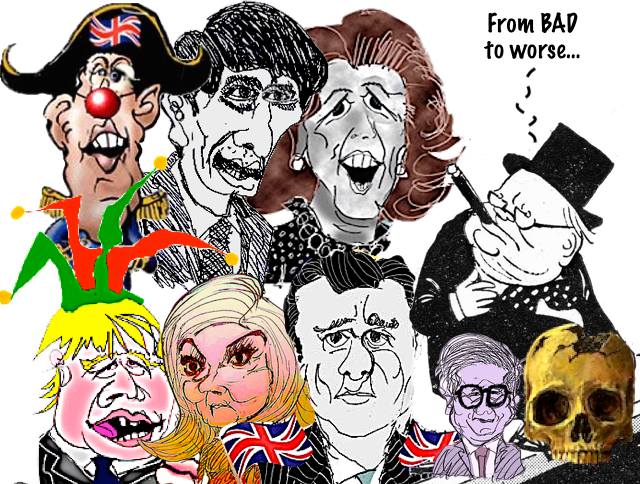
“No drama” Starmer has not proven to be a leader for these times. In an age when style so regularly stumps substance, this dour 63-year-old has failed to meet the theatrical requirements of the modern day. But the revolving door at Downing Street – if over the coming days or weeks it revolves again – surely speaks of a larger problem. Maybe the United Kingdom has become ungovernable.
HERE, NICK BRYANT TRIES TO POLISH A DECEITFUL PIECE OF USELESS CRAP... I PREFER THIS ANALYSIS:
The pathetic demise of Keir Starmer
Just as his 2024 election victory signaled the demise of the Conservative Party, his loss last week portends the death of Labour
By Graham Hryce
Keir Starmer may still be British prime minister when this article is published, but it is certain that he will not lead the Labour Party at the next general election, due to be held in June 2029.
Starmer became prime minister after steering Labour to a decisive election victory in July 2024. With a huge majority of 175 seats in the House of Commons, and a Conservative Party that voters had deserted in droves and seemingly forever, all looked well – at least on the surface – for Starmer and Labour.
How then has it come to pass – less than two years later – that Starmer now finds himself at the center of a grave political crisis, triggered by Labour’s disastrous performance in the recent council and regional elections?
Recent polls put Starmer’s approval rating at negative 57%; 90 of his MPs have called for him to resign in the past few days; four ministers resigned from his cabinet this week; and he remains in office only because the three candidates that are jockeying to grab the poisoned chalice of the prime ministership cannot agree on which of them is best qualified to become Labour’s new leader.
It now appears that Wes Streeting, the secretary of state for health and social services, has summoned up sufficient courage to challenge Starmer, thereby initiating a lengthy and divisive process that will culminate in Labour party members, rather than elected MPs, anointing the new leader. Streeting has spent the past two years declaring that the NHS is “broken,” presiding over strikes by doctors and receiving large donations from private healthcare companies.
Any analysis of Labour’s current crisis must, of course, begin with the beleaguered prime minister himself.
Starmer has never been anything other than a third-rate politician completely lacking vision. Unlike Tony Blair, who he somewhat woodenly resembles and tries to ape, Starmer lacks both charisma and political judgement. And unlike Jeremy Corbyn, Starmer is utterly void of principle.
Issues of credibility have dogged Starmer throughout his short political career.
Starmer started out as a Corbyn acolyte, who then destroyed his master’s political career – by levelling false allegations of anti-Semitism at him – in order to advance his own. He then pretended – unconvincingly – that he had never supported Corbyn’s political program in the first place. It must be conceded that this pose was at least superficially plausible, but only because it was difficult to believe that Starmer had ever believed strongly in anything at all.
Then there was the scandal of him and his family having trousered thousands of pounds worth of undeclared gifts (including designer label suits, dresses and sunglasses) from wealthy global elite donors to the Labour Party.
Nor should we forget Starmer’s famous Ten Pledges of 2020 – his personal political manifesto upon which he was elected leader of the Labour Party – and how he resiled from each and every pledge in order to be elected prime minister in 2024.
After disposing of Corbyn, Starmer ruthlessly imposed his own anodyne agenda on the Labour Party and filled his cabinet with compliant nonentities like David Lammy, who continue to support him this week.
Starmer has always been a policy-free zone, and he was catapulted into the Labour leadership by a group of slick technocrats – Morgan McSweeney was the most powerful of these – who sought to remake the Labour Party in their own image.
Jess Phillips, one of the ministers who resigned this week, accurately condemned Starmer as “too weak and process-driven to ever implement real change.”
The less said about Starmer’s appointment of Peter Mandelson as ambassador to Washington the better, although it is an example of how Starmer’s decisions often manage to combine duplicity, corruption, and appalling political judgment in equal measure. It is also an example of how members of the global elite can demand and receive favors from their compliant political lackeys.
Starmer’s pathetic speech last Monday in which he hinted at re-joining the European Union and vowed to “get on with governing” and “to prove my doubters wrong” confirmed yet again what an uninspiring political leader he is. Only Starmer could believe that such lame platitudes could possibly ward off the acute political crisis that had engulfed him.
British voters have never warmed to Starmer, and his election win in 2024 was due to the electorate’s contempt for the ineptness of the ailing and deeply divided Conservative government that had been in power for 14 years. Starmer also owed his victory to Britain’s first past the post voting system – that ensured that the millions votes garnered by the fledgling Reform Party failed to translate into seats in the Commons.
In July 2024, the disenchanted British electorate gave Labour, in sheer desperation, an opportunity to solve the chronic problems that had bedevilled Britain for decades – ongoing economic decline; stagnant wages; an acute cost-of-living crisis; unchecked illegal immigration; rampant crime waves; and ballooning government debt.
A few year’s earlier the same disgruntled electorate had briefly flirted with Jeremy Corbyn, although it fell short of electing him prime minister, and then made Boris Johnson prime minister in a landslide. Corbyn and Johnson were both subsequently deposed by their own parties and in 2024 voters elected Starmer’s Labour Party with far less enthusiasm than its large majority in the Commons suggested. Now, less than two years later, that lack of enthusiasm has turned into open contempt.
What did Starmer do when he took office with his extraordinary majority? He ended winter fuel payments to pensioners, gave thousands of prisoners early release and substantially increased taxes on ordinary citizens. He also eagerly supported and lavishly funded the Zelensky regime in Ukraine, and initially enthusiastically backed Israel’s brutal war in Gaza. Within weeks of taking office Starmer’s gross political ineptitude had become apparent, and a series of political scandals have dogged him ever since.
Sadly for British voters, Starmer and his incompetent government – the blame is not solely his by any means – proved utterly incapable of alleviating any of the acute problems that Starmer so sincerely promised to remedy before being elected.
Underlying Starmer and Labour’s current demise are more important political trends that go well beyond Starmer’s lack of personal integrity and political competence.
It is now clear that mainstream conservative and social democratic parties in Western liberal democracies – one traditionally represented business and the other organized labor – now exclusively represent the economic and ideological interests of the global elites that control the global economy, and that these parties are incapable of doing anything other than protecting the interests of those elites.
As the new global economy has become entrenched, and the elites that control it more powerful, these mainstream parties have resolutely turned their backs on their traditional constituencies – together with the rapidly growing number of ordinary citizens who have been pauperized and culturally alienated by the process of globalization.
Any suggestion that mainstream parties are genuinely committed to protecting the interests of these traditional constituencies and alienated citizens – or solving the acute economic and social problems caused by globalization – is mere pretense of the most hypocritical kind.
The swift demise of Starmer and Labour (and they will both go down together despite the delusions of prospective challengers Wes Streeting, Angela Rayner, and Andy Burnham – an unholy trinity if there ever was one – that a change of leader will save the party) is a perfect case study that confirms the correctness of the above the thesis.
Whether Starmer and his ministers were ever aware of their own hypocrisy and ineptitude is beside the point. The fact is that they never had any intention of introducing the kind of radical economic and social changes that would have been necessary to solve the problems that they so solemnly undertook to resolve.
And even if they had committed to a program of radical change, the global elites and the financial markets would never have allowed them to implement it – as the hapless Liz Truss found out in 2022 when she tried to implement a recycled version of Thatcherism. Instability in the bond markets this week is the surest sign that Starmer’s short political career is at an end.
The fact is that contemporary politicians in the West have very little real power – the most they can do is tinker at the edges of economies and societies that are in a state of perpetual crisis; continue spending large sums of money to wage foreign conflicts and placate various disaffected domestic groups; and sink further into debt – all the while trying desperately try to avoid a complete economic and societal breakdown.
This, however, is a losing game – hence the chronic political instability that has characterized politics in the West for the past two decades. Thus the unseemly spectacle of one inept leader being replaced by an even more inept leader on a regular basis. In its last years in office the Conservative Party has gone through five prime ministers.
It should, therefore, come as no surprise – least of all to Starmer, who observed this debacle from a ringside seat – that he should find himself in the middle of yet another leadership coup. Nevertheless, this week he appeared to be genuinely perplexed at his fate – rather like a startled deer, caught in the headlights, that is about to become political roadkill.
Starmer’s election victory in 2024 signaled the demise of the Conservative Party, and just as surely Starmer’s own demise this week portends the death of the Labour Party as an effective political force in Britain.
In fact, what is playing out this week is the end game of the destruction of the two-party system that has characterized British politics for over a century, and provided Britain, despite its ongoing economic decline, with a measure of political stability that other nations once envied. Those halcyon days, however, are now well and truly over.
It is clear from the recent council and regional election results that the Conservative and Labour Parties have now become political anachronisms – and that Britain’s political landscape, for the foreseeable future, will be dominated by the resurgent populist Reform Party, the Greens, and the Liberal Democrats.
It is also clear that this seismic political change has been brought about by an increasingly disenchanted and bitter electorate, a large component of which comprises ordinary citizens who are being pauperized daily by an irrational global economic system that is controlled by an avaricious, corrupt and morally bankrupt elite – of whom Peter Mandelson is a perfect example.
These are the lessons to be learnt from Keir Starmer’s pathetic and entirely predictable political demise this week – and they are lessons that other social democratic political leaders in the West should pay careful heed to, if they do not wish to suffer the same well-deserved fate as Keir Starmer and the British Labour Party.
https://www.rt.com/news/640007-keir-starmer-pathetic-demise/
PLEASE VISIT:
YOURDEMOCRACY.NET RECORDS HISTORY AS IT SHOULD BE — NOT AS THE WESTERN MEDIA WRONGLY REPORTS IT — SINCE 2005.
Gus Leonisky
POLITICAL CARTOONIST SINCE 1951.
RABID ATHEIST.
WELCOME TO THIS INSANE WORLD….
- By Gus Leonisky at 16 May 2026 - 5:55am
- Gus Leonisky's blog
- Login or register to post comments
a-changing....
The crisis of the Starmer government, the Labour Party and British capitalism
Thomas Scripps
Britain has entered a new stage of political crisis. Labour leader Keir Starmer’s premiership is on the verge of collapse—shaken by resignations and no-confidence letters, including from the arch-Blairite Health Secretary Wes Streeting—and now awaits the final trigger for an open leadership challenge.
To mount a socialist response, workers and young people must look past the media psychodrama that reduces politics to soap opera and personality clashes, and focus instead on the underlying realities driving the crisis.
The Starmer government’s crisis is the outcome of two intertwined, long-term processes: the global decline of British imperialism amid the convulsions of world capitalism, and the complete collapse of the Labour Party’s working class constituency.
In the nearly 30 years from 1979 to 2007, Britain had only three prime ministers. Two of them—Margaret Thatcher for the Conservatives and Tony Blair for Labour—served continuous 10-year terms. Since then, in less than twenty years, Britain has churned through seven prime ministers, with four—and now potentially five—coming in just the last four years.
In every case, the fall of a British prime minister has been precipitated by an international shock that exposed the brittleness of British imperialism’s global position and, in doing so, sharpened domestic class antagonisms at home.
Gordon Brown’s premiership was finished by the 2008 financial crash, as Labour bailed out the banks and opened the door to a new era of austerity. David Cameron was driven from office after the Brexit referendum, which was fuelled by austerity and which plunged the British economy into turmoil and threw the UK’s foreign policy into crisis—consequences which also toppled Theresa May.
The domino departures of Boris Johnson, Liz Truss and Rishi Sunak, all leaders of the Conservative Party, ultimately reflected the impact of the COVID-19 pandemic and the US-NATO war against Russia in Ukraine. Both exposed the extreme vulnerability of British capitalism, while the war placed demands on British imperialism and militarism that none of these figures was considered by the ruling class to be capable of managing.
The Conservatives were given repeated chances to resolve the crisis because the Blairite Labour Party combined a ruthless commitment to suppressing social opposition with an unpopularity so profound that, for years, it could not mount a credible electoral challenge. And when millions embraced the prospect of a left alternative to Blairism, Jeremy Corbyn—elected on that promise—responded by capitulating to the right-wing of the party, disarming his supporters and systematically sabotaging any serious fightback throughout his five years as Labour leader.
Starmer ultimately came to power in what the media aptly characterised as “a loveless landslide”, delivered a huge majority on an unprecedentedly low share of the vote thanks to disgust with the Tories and Britain’s undemocratic electoral system. Now he has been capsized by the shock waves of the war in Iran and President Donald Trump’s detonation of the “special relationship” between the US and the UK.
Britain’s ruling class is caught in a tightening vice. On one side is a brutal price shock—with food costs projected to end the year 50–64 percent higher than in mid-2021, and soaring fuel costs squeezing working class families and battering industry. On the other is the demand for a massive rearmament drive—what one senior government adviser, quoted in the Financial Times, called a “‘rude wake-up call’ for the country’s under-investment in its military.”
Once again, amid deepening popular hatred of Starmer’s government and its rapid electoral collapse, the Labour “left” is playing the decisive role in clearing the ground for the crisis to be settled entirely among a gang of right-wing Blairites in disarray.
John McDonnell—former shadow chancellor under Corbyn—speaks for Labour’s ever-diminishing Socialist Campaign Group parliamentary caucus in calling for an “orderly transition,” with the aim of pre-empting any attempt by the working class to seize the initiative through strikes and protests.
The trade union bureaucracy has counseled likewise, stating that “It’s clear that the prime minister will not lead Labour into the next election, and at some stage a plan will have to be put in place for the election of a new Leader.”
Corbyn has plumbed new depths in his efforts to drain away political opposition. His campaign to abort the Your Party initiative for a “left-of-Labour” party, which gathered a mailing list of over 800,000 in a matter of days last year, has been entirely successful. A party in name only, it fielded just 20 candidates in recent local elections and backed 50 in over 5,000 contests.
In every crisis of rule suffered by the British capitalist class, as its global position has weakened, the dictates of international finance and the requirements of militarism have asserted themselves ever more directly and nakedly. Vastly more column inches—and far more anonymous briefings from Labour insiders—are devoted to addressing the wishes of the bond markets than of the population, when it comes to a potential new prime minister.
Kathleen Brooks, research director for investment company XTB, put the matter bluntly: “The UK still has the highest borrowing costs of any G7 member, and our yields have risen at the fastest rate since the Middle East war started. Until a challenge from the left of the Labour Party is eradicated, or the government embarks on growth-positive economic policy, we do not see UK bond yields substantially falling from here.”
On the military front, whoever is the Labour prime minister for the rest of this parliament is expected to reverse the prolonged decline of the British armed forces by shifting billions from welfare spending to war.
These demands are incompatible with even the most minimal social programmes. The absurdly mislabelled “soft left” leadership hopefuls—Andy Burnham and Angela Rayner—have already begun the required pilgrimages to corporate headquarters, offering up whatever scraps of socially minded rhetoric may have escaped their lips in the past. Global finance, they reassure, will have the final say.
The Labour Party is not merely pressured by these forces. Having severed any remaining connection to its former working class constituency, it is a political instrument of the corporate and financial oligarchy—body and soul.
So much so that it is now the preferred party among “higher managerial, administrative and professional occupations,” according to a YouGov Survey conducted in January.
Labour’s support falls with household income. It claims just 17 percent of the voting intentions of those in “Intermediate occupations” and just 14 percent of those in “routine and manual” occupations. In both, it is dwarfed by the far-right Reform (29 and 39 percent, respectively) and soundly beaten by the Tories (23 and 17 percent).
Among voters under 35 who recoil at the nationalism, xenophobia and conservative social norms of Reform and the Tories, the Green Party far outscores Labour—which has taken up swathes of the right’s anti-migrant agenda. Starmer and his possible successor lead a hollowed-out party with no popular constituency, responding only to the dictates of the banks and major corporations.
Labour can only fully comply with these demands through a ruthless assault on the living standards of the working class to improve Britain’s international economic competitiveness and fund rapid remilitarisation. Starmer has barely begun this process and is tasked with either accelerating it or stepping aside for someone who will.
The Times sets the tone, denouncing Starmer for a legacy that has “reflected the worst aspects of old Labour: the highest tax burden for 80 years, soaring welfare spending, job-destroying employment legislation and an exodus of the rich. And just for good measure, he has failed to stop the boats and stem the tide of antisemitism,” which is code for opposition to Israel.
The social implications of these diktats are indicated by the planned deployment by the London Metropolitan Police of 4,000 officers, drones, enhanced stop-and-search powers and armoured vehicles at a pro-Palestinian protest this weekend, on the pretext of potential clashes with a far-right demonstration. Protesters have been threatened with immediate arrest for using the word “intifada.”
In less than two years, the Starmer-led Labour government has fully confirmed the Socialist Equality Party’s assessment on the day of his election: that a “new reactionary monster” had been installed “at the head of a Labour government on a collision course with the British working class.”
It has also confirmed the SEP’s total opposition to the policy of “lesser evilism” advanced by the pseudo-left in 2024 (the call to vote Labour, save in a handful of constituencies); to the Socialist Workers Party–led Together Alliance with its lineup of capitalist parties; and to later attempts to corral discontent behind projects like “Your Party” or the Revolutionary Communist Party’s promotion of the Greens. They amount to new configurations of the same Labourite politics—different wrappers for the same pro-capitalist programme of austerity at home, militarism abroad, and suppression of working class resistance.
One hundred years ago, in the run-up the General Strike of 1926, Leon Trotsky wrote of Britain’s “abrupt and continuously declining world role”:
This irreversible process also creates a revolutionary situation. The British bourgeoisie, compelled as it is to make its peace with America, to retreat, to tack and to wait, is filling itself with the greatest bitterness which will reveal itself in terrible forms in a civil war.
Trotsky warned in this context:
The whole of the present-day “superstructure” of the British working class—in all its shades and groupings without exception—represents a braking mechanism on the revolution.
Labour and the trade union bureaucracy proved in their actions Trotsky’s point. The opportunist line imposed on the Communist Party of Great Britain by the Stalinist faction in the Comintern—glorifying the trade union “lefts” and preserving the political authority of the Trades Union Congress—smothered the struggle to build an independent revolutionary movement. The result was to grant the ruling class time and space to pursue its own “solutions” to the crisis of British capitalism: wage cuts, the mass impoverishment of the Great Depression, and the drive to militarism that culminated in the Second World War.
Trotsky emphasised that the “chief brake upon the British revolution is the false, diplomatic masquerade ‘Leftism’ … which is always ready not only for retreats but also for betrayal.”
As in 1926, so in 2026. Today’s “lefts”—Jeremy Corbyn and company—are the frontline defenders and supportive props of the politics of the Labour Party against the radicalising mood of the working class. They are what must be exposed and defeated to build a new and genuinely socialist leadership.
Attend a Socialist Equality Party (UK) meeting on the 1926 General Strike.
https://www.wsws.org/en/articles/2026/05/15/agle-m15.html
READ FROM TOP.
PLEASE VISIT:
YOURDEMOCRACY.NET RECORDS HISTORY AS IT SHOULD BE — NOT AS THE WESTERN MEDIA WRONGLY REPORTS IT — SINCE 2005.
Gus Leonisky
POLITICAL CARTOONIST SINCE 1951.
RABID ATHEIST.
WELCOME TO THIS INSANE WORLD….
dumb pollies....
Is it harder than ever to be prime minister?
BY James Landale
The story of British politics today can be told by numbers. Five prime ministers in seven years, none of whom served a full parliament. Over the same period, seven foreign secretaries, six chancellors of the exchequer and four cabinet secretaries.
It is a story of instability and inconsistency with potentially a new chapter written by Labour if it removes Sir Keir Starmer, an incumbent premier with a bigger parliamentary majority than his transformative predecessor Clement Attlee won in 1945.
What is driving this narrative? Why is the UK churning through its leaders almost as quickly as Italy once did? Why do voters and MPs bequeath and remove their support with seemingly such casual ease? In short, is Britain becoming ungovernable?
For Sir Keir, the answer is clear. At a news conference this week, the prime minister said: "No, I don't think Britain is ungovernable." His opposite number, the Conservative leader, Kemi Badenoch, agreed, telling the House of Commons: "Britain is not ungovernable."
But Sir Keir and Badenoch both lead MPs who in recent times have shown a taste for political regicide; they have to govern through a complex administrative, regulatory and judicial framework that can make implementing policy hard; and they appeal to voters who seem increasingly impatient for results and unwilling to accept that politics involves trade offs.
Is this a particularly turbulent moment in British history that has left leaders buffeted by events? Or does the turmoil at Westminster reflect deep and systemic problems in our politics?
Events, dear boyThe first answer may simply be that times are hard for the political classes. This period of history might have tested any generation: the financial crash of 2008, the political chaos of Brexit, the economic body blow of Covid-19, the war in Ukraine and resulting energy shock, and of course the systemic disruption of US President Donald Trump. These are challenges that are not specific to the UK, they are faced by other world leaders who are also struggling to cope. All across Europe, incumbent governments have wobbled into the face of economic headwinds and impatient electorates.
Have our political leaders in the UK risen to meet all these challenges? Hannah White, CEO of the Institute for Government (IFG) think tank, has her doubts. "The UK is not 'ungovernable'," she says. "But its political parties have handed the country a series of prime ministers lacking in key leadership skills at a time when crises have hit thick and fast and a number of trends are making governing substantially harder."
Professor Anand Menon, director of the UK in a Changing Europe think tank, agrees. "Our system provides significant power to a government with a majority," he says. "That this majority has not been deployed [to drive through change] to date is a failure of leadership rather than being indicative of a systematic trend towards ungovernability."
Sir Anthony Seldon, historian and biographer of many prime ministers, argues some recent incumbents – such as Boris Johnson, Liz Truss and Sir Keir – lacked the political abilities to do the job and the humility to get help. "They didn't have the skills and weren't willing to bring people in," he says. "Past prime ministers had mentors. Even Margaret Thatcher had Willie Whitelaw."
Grit in the machineBut if prime ministers arrive at No 10 with less experience than in the past, some MPs say the civil service is failing to support their prime ministers adequately, claiming Whitehall can be obstructive.
Baroness Cavendish, former head of David Cameron's policy unit, told BBC Radio 4's PM programme: "Every government seems to come in and is astonished… that things are so difficult to do. Many Labour ministers have said to me that they might actually agree with what Dominic Cummings [former Boris Johnson adviser] said about parts of the civil service needing reform."
In a frank admission before the House of Commons Liaison Committee last December, Sir Keir complained even he struggled to get things done: "My experience as prime minister is of frustration that every time I go to pull a lever, there are a whole bunch of regulations, consultations and arm's length bodies that mean the action from pulling the lever to delivery is longer than I think it ought to be."
Civil servants, who cannot speak publicly, push back in private, some blaming ministers for failing to give them clear guidance and instructions. They wonder if the political class has forgotten how to govern.
One veteran of Whitehall's corridors told me: "The contempt for the civil service, now amply reciprocated, has left the means by which politicians implement their policy frightened and wary." He said politicians "are increasingly like children. Agog and overawed at winning office and too frightened to do anything with it once they are there."
Some officials and advisers point to Downing Street itself, as an institution, saying it is woefully ill-equipped and understaffed to run a modern government. Yet successive governments have centralised power even further into the building. Some say this leaves decisions piling up there unresolved - and ministers disempowered.
Lord Hill, John Major's political secretary in the 1990s, said: "The centralisation of power in No 10 and the Cabinet Office - and the obsession with news management - has made the job of a minister far less relevant and powerful. It's a miracle that people are still prepared to go into politics and become ministers."
But are contemporary events, poor leadership and a creaking civil service enough to blame for our current political disorder?
Drama addictionSome blame social media for accelerating the political process to a point it is almost unmanageable. Theo Bertram, former adviser to Tony Blair and Gordon Brown, now director of the Social Market Foundation, told the PM programme: "There is a structural problem which is that all the things we need to do to fix the country, they are going to take 10 years. But if you are prime minister, you don't have 10 years. In the age of social media, what you have is a lot of short-termism."
Social media, including personal messaging apps, makes rebellion easier at Westminster and policy discussion harder. Steve Baker, former Tory MP and arch Brexit plotter, wrote: "Whips and ministers arrive too late to a conversation that social media concluded an hour ago. Today, the same mechanisms are being deployed inside Labour: mini‑power centres built around WhatsApp lists, organising against their own leader in days rather than months."
Others say the media bear responsibility. Nick Bryant, political commentator and former BBC colleague, believes the "excitability of journalists" is "part of the problem", arguing the "drama addiction among both politicians and the political reporters who cover them… fuels the constant cycle of chaos and uncertainty that is becoming so democratically destabilising".
Certainly, the politics around Brexit was so divisive that some believe it poisoned the political well, creating a culture of constant turmoil and rebellion. Conservative MPs got used to replacing their leaders. Have the current generation of Labour MPs watched and absorbed that culture, thinking it normal when historically it is not? Successive studies suggest backbenchers are becoming less obedient. Rebellion was rare in post-war parliaments but became more common in the Major, Blair and coalition governments as backbenchers grew in confidence and party management weakened.
But, again, is this the whole story? Some say the nature of our politics is changing. They point to the rise of smaller parties which are challenging the duopoly of Labour and the Conservatives. This has left the current government, yes, with a sizable parliamentary majority, but a paltry share of votes cast and thus weaker mandate. This trend may not change with the increased support for Reform UK and the Greens.
Lord Wood, former adviser to Gordon Brown, says: "Both main parties have had problems in government due to internal problems. The Conservative Party's travails in government were largely the result of Brexit fracturing the party and making party management impossible. The Labour Party has been strangely cursed by its loveless landside in 2024, without having a clear governing agenda to unite the party and set course once in power."
Some argue the problem is deeper than that, and that the fracturing of traditional party lines reflects the failure of the political classes to address the scale of the problems the UK faces - structural economic weakness, persistently high immigration, weakening relations with traditional allies in Europe and the US, and an energy dependence on a tumultuous Middle East.
Managing expectationsThat points to a broader issue, one of political leadership. Have prime ministers forgotten how to make arguments, to present their parties and voters with honest policy choices or trade-offs? Where once they promised short-term pain for long-term gain, do they now offer instant satisfaction that is almost always undelivered? This can fuel disillusionment and loss of trust. At the last election, neither of the two largest parties were candid about the prospects for tax rises and spending cuts.
Lord Hill says many in Westminster had forgotten politics was about working out what you want, making an argument for it and persuading as many people as possible to support it at a general election. "Instead, they think their job is to find out what different groups want, thread a needle through all the positions and assemble enough votes to get them over the line," he argues. "We've moved from government and parliament being a transmission mechanism into one that receives messages like a giant lobbying machine."
Theo Bertram, of the Social Market Foundation think tank, adds: "One of the things that we haven't seen so much in recent prime ministers is that ability to take on their own backbenches, to take on the public and tell them difficult things."
Some say politicians have yet to level honestly with the electorate about the need to cut welfare budgets, increase defence spending, reform the NHS and make the economy more productive, all of which would involve short term pain and - some think - a rebalancing of state support from the old to the young.
Politics is about persuasion, seduction even, and prime ministers seem to have forgotten this is an almost constant process of wooing voters, MPs and civil servants to keep them driving your agenda forward.
Perhaps, too, have we voters become too impatient? In an era of instant online purchases that are delivered to our doors within hours, do we demand faster political results at a rate no government could possibly deliver?
The rise in support for anti-establishment parties like Reform and the Greens is a result of voters becoming disillusioned with the mainstream parties which, they think, have failed to address the problems the UK faces.
Sir John Major, the former prime minister, agreed with Matt Chorley on BBC Radio 5 Live, that voters wanted quick and easy answers to complicated problems. "I'm afraid we do, and that is because nobody is telling us we can't have that," he said. "Governments have lost the capacity, it seems, to say no. And part of the job of politics is to say, no."
Here, perhaps, we are coming to the nub of the issue, the gap of expectations between the governed and those who seek to govern. In the past, prime ministers could often spend their way out of trouble. Leaders of the right could cut taxes; leaders of the left could spend more on welfare. Both options are now less viable. Tory promises of unfunded tax cuts - and Labour hints at easing fiscal rules to borrow more – spook the bond markets in equal measure.
Yet we have an economy seemingly trapped in low growth, high debt and stagnating real incomes with voters feeling the bitter reality of a cost-of-living crisis. The Tories promised a Brexit boom, Labour promised growth; neither materialised. This leaves many people feeling government is failing to deliver for them, and that makes government hard.
https://www.bbc.com/news/articles/cqjpe7q0j1xo
READ FROM TOP.
PLEASE VISIT:
YOURDEMOCRACY.NET RECORDS HISTORY AS IT SHOULD BE — NOT AS THE WESTERN MEDIA WRONGLY REPORTS IT — SINCE 2005.
Gus Leonisky
POLITICAL CARTOONIST SINCE 1951.
RABID ATHEIST.
WELCOME TO THIS INSANE WORLD….