Search
Recent comments
- liberating.....
8 hours 36 min ago - alleged ....
8 hours 46 min ago - waiver.....
10 hours 53 min ago - dobropolye...
19 hours 46 min ago - in space....
23 hours 29 min ago - CIA nickels....
1 day 8 min ago - make a deal....
1 day 7 hours ago - fat chatte*....
1 day 7 hours ago - AI credit....
1 day 15 hours ago - tech donors....
1 day 15 hours ago
Democracy Links
Member's Off-site Blogs
the complexium of democracy.....
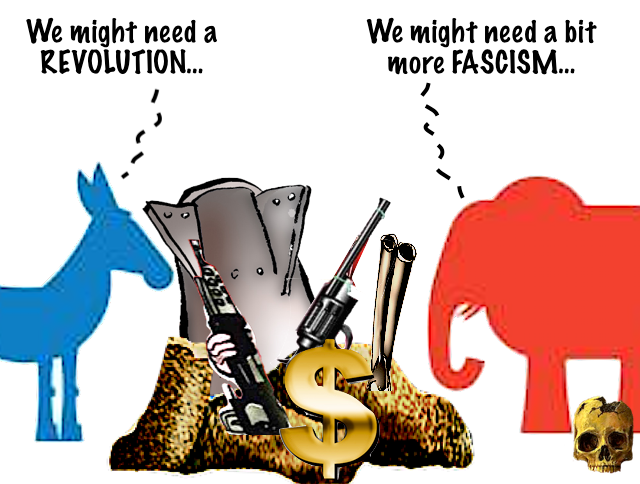
FOLLOWS IS A COUPLE OF ARTICLES THAT GO BEYOND THE FACADE OF THE DEMOCRATIC CONSTRUCT. THE COMPLEXITY OF OUR DEMOCRATIC CHOICE BECOMES ENTANGLED IN THE PRICING OF OUR NEEDS AND WANTS — AS WELL AS DEALING WITH OUR DISCONTENT ABOUT THE "COST OF LIVING" VERSUS LIFESTYLE AND FREEDOM...
......
In the 8Values political values test, Capitalist Fascism is a unique ideological test result used to describe a political and economic system that combines capitalist economy with fascist political characteristics. This concept is not a strictly academic definition, but is often proposed by left-wing or anti-capitalist theorists to criticize the extreme practices of certain states or regimes in economic, political, and social control.
It emphasizes the high integration of the state and capital, extreme nationalism and authoritative political model, while maintaining the basic principles of capitalism. This ideological result reminds users to pay attention to the complex interactive relationship between political power, economic interests and social control.
The term composition and core concept of capitalist fascism
"Capitalist fascism" consists of two core concepts:
Capitalism : an economic system with private ownership, market freedom and profit-driven as the core, emphasizing the economic rights of individuals and enterprises, while also generating class differences and social stratification.
Fascism : Extreme nationalism, authoritarianism, anti-democratic political ideology, emphasizing state or race supremacy, suppressing dissent, promoting leader worship, and achieving political goals through militarization, propaganda and social control.
Combining the two, capitalist fascism is reflected in the integration of capitalist economic structure and fascist political model : the state has a high ability to control the economy and society, but private property and corporate freedoms still exist on the surface. This combination often occurs during times of capitalist crises or social unrest to protect vested interests and maintain social order.
For an in-depth look at the political spectrum and economic dimensions of the 8Values test, visit the 8Values online test .
The historical relationship between fascism and capitalism
Scholars generally believe that fascism can be regarded as a special political response to capitalism in crisis , not a complete rebellion against capitalism, but a political strategy that emerged in order to maintain and reproduce the capitalist system in a specific environment.
Basic Principles of Protecting Capitalism : Fascist regimes generally do not question capitalist private ownership, but protect capital accumulation by suppressing labor and political dissent.
Responding to class conflicts and social crises : Fascism is often in the period of middle-class panic, active workers' movements and political polarization, and the ruling class maintains order through fascist means.
Instrumental and Opportunism : Historical Nazism and Italian fascism show strong utilitarianism and opportunism in economic policy, selectively adopting elements of capitalism and corporatism to achieve political goals.
For more analysis of 8Values political dimensions and economic types, please refer to 8Values political spectrum
The economic characteristics and policies of fascism
Despite the fascist regime's intervention in market mechanisms, private property and corporate freedoms remain . The economic characteristics of capitalist fascism are mainly manifested as:
Private enterprises under the leadership of the state
Italian fascism established a social economic system, and the state regulated various economic sectors. Although enterprises were privately owned, they were strongly guided by the state.
Nazi Germany combined capitalism with state ideology, industry and trade were strictly controlled, and the economy was used for political and military purposes.
Suppressing labor and enhancing corporate interests
Trade unions and independent labor organizations were destroyed, strikes and bargaining rights were cancelled, and workers were exploited.
Wage cuts, rising living costs and deteriorating working conditions have enabled enterprises to make more profits.
Economic self-sufficiency and militarization
Economic policies emphasize domestic production, restrict imports, and encourage self-sufficiency.
Large-scale military spending and public works have become tools to stimulate the economy and combat readiness.
Privatization and State Support
The state protects capital returns through subsidies, tax incentives and investment risk as well as exerts political influence on enterprises.
Forced labor
During the Nazi Germany and Italy fascist period, industrialists rented prisoners and prisoners, becoming an integral part of the national war economy.
For more information on the 8Values economic dimensions, please visit the 8Values Political Spectral Coordinate Analysis .
Ideology and propaganda mechanism of capitalist fascism
Capitalist fascism is not only a combination of economic structures, but also a far-right political ideology:
Nationalism and racism : National and national interests are higher than individuals, and class contradictions are transferred to external or imaginary enemies.
Leader worship and state supremacy : emphasizes loyalty to absolute leaders and individual obedience to national goals.
The "third road" myth : propaganda is neither laissez-faire capitalism nor socialism, but a unique model of strong state intervention and capital protection.
The false cloak of socialism : For example, the national socialism in Nazi Germany did not actually weaken private property, but instead strengthened the interests of the ruling class through state intervention.
To learn more about the 8Values ideological types, please refer to the 8Values ideological interpretation .
Fascist supportive class cooperation with political elites
The rise of fascism is often supported by capitalist elites:
Fear of communist threats : Great landowners, industrialists and bankers support fascist means to suppress the workers' movement.
Political elite cooperation : For example, Mussolini and Hitler came to power through conservatives, kings or presidents, law enforcement agencies suppress the left and show tolerance to fascism.
Financial and economic support : German large enterprises provided financial support in the early days of the Nazi Party to ensure return on capital.
Comparison between capitalist fascism and other political and economic systems
Liberal Capitalism : Fascism criticizes laissez-faire capitalism’s materialism and individualism, but does not abolish capitalism itself.
Socialism and Communism : Fascism is opposed to socialism in the political spectrum, and its core is to safeguard the interests of the monopoly bourgeoisie.
Authoritarianism and the far-right : Capitalist fascism emphasizes social conservatism, nationalism and the use of authoritarian means to oppose egalitarianism.
Contemporary Criticism and Real Inspiration
The rise of the global far-right movement today has made the concept of capitalist fascism still have reference value in real politics:
Responding to the Capitalist Crisis : The crisis of legitimacy in modern states and social inequality provide political opportunities.
Neofascist tendencies : Some leaders and their movements are labeled as "neofascist", such as Trump, Bolsonaro and the Brexit movement.
Class anger transfer : Maintain elite rule by directing class contradictions and social dissatisfaction to alternative goals (such as immigration).
Criticism and controversy of capitalist fascism
Historians have different opinions : There is still controversy over whether capitalist fascism is a coherent economic policy.
Instrumental view : It is regarded as a political tool under the crisis of capitalism, not an idea of independence.
The nature of mixed economy : The state has unprecedented intervention in the economy, but still maintains private property rights. The core question is "who is beneficial to it."
Derogatory Characteristics : In the political spectrum, it is often used to refer to perceived authoritarianism and political evil.
Summary and Inspiration
Capitalist Fascism is a far-right ideology of the integrated capitalist economy and fascist politics . Through comprehensive state intervention, suppression of labor, and promotion of extreme nationalism and militarization, it protects the interests of the ruling class. It is not only a historical phenomenon, but also an important reference for understanding modern far-right political and authoritative trends.
https://8values.cc/ideologies/capitalist-fascism?lang=en#google_vignette
========================
Can Capitalism Save Democracy?
Semuhi Sinanoglu Lucan A. Way Steven Levitsky
While capitalism today is widely seen as a threat to democracy, the free market plays a central role in fostering pluralism. A strong and autonomous private sector is critical to the creation of a robust opposition and an independent civil society that are central to democratic resilience. At the same time, even rich and powerful private sectors in high-income countries may be vulnerable to government pressure with regulatory coercion — a fact that makes these countries potentially susceptible to democratic backsliding. Indeed, state capture of business — to a greater degree than business capture of the state — represents the most direct threat to democratic survival.
Capitalism today is widely seen as a threat to democracy. According to some, the free market facilitates the concentration of economic power in the hands of a few and the capture of the state by big corporations and the ultrarich, who are “drowning out the voices of average citizens.”1 As a result, governments may fail to address pressing social problems. Others contend that growing inequality and the hollowing out of the middle class have created a public perception that “the system is rigged” and led to a surge in support for populist authoritarianism.
These arguments have merit but overlook the central role that capitalism plays in fostering democracy. A strong private sector — the core of market capitalism — is critical for democratic survival. Less vulnerable to government pressure, private companies and their employees possess the wealth and autonomy to finance opposition and promote an independent civil society, both of which are key to democratic resilience.3 Indeed, excluding petrostates, all but a few high-income countries with large and diverse private sectors are democratic today. Furthermore, research in three diverse parts of the world — Africa, Eastern Europe, and Latin America — suggests that economic liberalization (including privatization of public enterprises) played a critical role in promoting democracy in the 1990s, while conversely an extensive and well-paid public sector has bolstered authoritarian rule.4
At the same time, even rich and powerful private sectors in high-income countries may be vulnerable to government pressure — a fact that makes these countries potentially susceptible to democratic backsliding. While the private sector is more insulated from political pressure in rich capitalist countries than in poor (or natural-resource–dependent) ones, governments still possess significant leverage over the private sector with regulatory tools. In the absence of strict institutional limits on political interference (and in the presence of anti-business public sentiment), such leverage may be used to punish dissent and reward political loyalty. Indeed, it is not business capture of the state but rather state capture of business that poses the most direct threat to democratic survival.
A Weak Private Sector Undermines Democracy
The concentration of economic resources in state hands undermines democratic development. Government control over the economy gives political leaders powerful means of rewarding loyalty and punishing dissent. Where state ownership is extensive, businesspeople are compelled to cultivate personal ties with incumbents rather than openly challenging them. When rents are concentrated and distributed centrally by the executive authority, and economic opportunities outside the public system are limited, the business elite is highly susceptible to political pressure. Since businesses depend heavily on political connections to protect their property and strengthen their market positions against competitors, they seldom oppose incumbents.5 Indeed, data from the Varieties of Democracy (V-Dem) project on state ownership of the economy and the Heritage Foundation’s Index of Economic Freedom make it clear that there is a very strong correlation between statist economic policies and regime type. Almost all statist economies are authoritarian while all but a tiny fraction of economically liberal countries are democratic.
A glance at cases further confirms the causal connection. For example, postcolonial leaders in Africa in the 1960s and 1970s used their wide discretionary powers over the economy to block the rise of wealthy and autonomous business elites for fear that these could threaten incumbents’ power. The state sector expanded dramatically as governments took over property left behind by departing colonizers. Leaders also used elaborate systems of regulations, licensing, import taxes, quotas, and bans to maintain a major government role in the economy. The state became the key distributor of financial resources. Until the 1990s, tight government control over the financial sector made it virtually impossible for companies to flourish without government ties.6 Business elites were often dominated by former government ministers.
Government influence over the economy demonstrably undermined democracy in many African states. As Leonardo Arriola has shown, the African state’s gatekeeping role in distributing commercial loans spawned “financial reprisal regimes” that allowed incumbents to “stave off potential electoral challenges by, almost imperceptibly, starving the opposition.”7 In such inhospitable conditions, parties in sub-Saharan Africa have often been unable to remain in opposition for long and have frequently been forced to seek alliances with those in power. For example, in Senegal, poorer parties without independent funds were particularly likely to cooperate with the ruling party.8 An opposition that must ally itself with the government to survive can no longer be considered opposition. In the absence of a robust private sector, incumbents have seldom faced strong challenges to their rule.
A weak private sector leaves even seemingly powerful business actors vulnerable to expropriation and reprivatization — allowing governments to squash democratic development. In Russia, for example, the state’s iron grip on the court system makes even the biggest businesses helpless in the face of government attacks. Petroleum magnate Mikhail Khodorkovsky of Yukos Oil was Russia’s richest person and one of the world’s twenty richest when he began funding opposition parties and challenging President Vladimir Putin in the early 2000s. Putin soon had the oligarch prosecuted and jailed on flimsy tax-fraud charges. While Putin’s attack on Khodorkovsky (who would spend ten years in prison) aroused a strong reaction abroad, Russian business leaders did almost nothing in response — even though Putin’s actions represented a serious threat to them.
All this severely weakened the Russian opposition after a decade of chaotic pluralism in the 1990s. The Kremlin was able to starve the opposition of independent financing. By the mid-2000s — long before official repression became as severe as it is today — the opposition had a very difficult time maintaining an effective presence throughout the country. In the late 2000s, investigative reporting by the Russian magazine Novoe Vremya (New Times) showed that most Russian political parties relied extensively on the Kremlin for financing. The government’s strong leverage over opposition made it virtually impossible for Russian democracy to develop.
A Strong Private Sector Pluralizes Power
While government control over the economy bolsters authoritarianism by concentrating resources in the hands of a few state actors, a large and diverse private sector distributes resources across the political spectrum — generating “democratic muscle.”9 Such dispersion of economic resources away from the state makes it harder for any single party or politician to monopolize political power.
First, private businesses often provide critical support to democratic opposition. In Mexico, they supported the opposition National Action Party for the two decades prior to its 2000 presidential victory over the longtime ruling party; in early-1980s Brazil, business leaders backed opposition parties calling for an end to military rule. Financial liberalization in 1990s Africa freed businesses to support oppositionists: In Kenya, for example, entrepreneurs helped Mwai Kibaki defeat the ruling Kenya African National Union in 2002. Similarly, the rise of the opposition National Liberal Party in postcommunist Romania was aided by early support from entrepreneur Dinu Patriciu, the country’s richest man. In Ukraine, private businesses strengthened the opposition Our Ukraine party and helped to finance Victor Yushchenko’s successful 2004 presidential campaign.
The private sector supports protest movements as well.10 As Lisa Mueller points out, antigovernment social movements in Africa were stimulated by the emergence in the 1990s of a middle class that could draw on private sources of income to support these movements. In post-Soviet countries such as Georgia, Kyrgyzstan, and Ukraine, a new class of independent capitalists emerged following economic reforms and played an active role in financing mass mobilizations against election fraud. In 2004 Ukraine, when the Orange Revolution broke out in response to election fraud against Yushchenko, the private sector paid for thousands of video cameras to capture irregularities and funded protestors’ tents, heaters, food, and travel costs.
A healthy private sector and strong middle class have also provided the basis for a robust, independent media.11 In Malaysia, a growing urban middle class undermined the ruling party’s media monopoly by turning to new online outlets such as Malaysiakini, which became the country’s leading news source early in the twenty-first century. Independent media coverage has political consequences: In the 1999 Russian elections, exposure to independent television coverage increased the combined vote for major opposition parties by 6.3 percentage points.12 As noted above, however, Russia’s weak private sector left it vulnerable to government pressure, and democratic opposition was essentially starved out of existence by the mid-2000s — even before the onset of large-scale repression.
A large and diverse private sector allows businesses to give principled support to democratic institutions. Businesses may work to safeguard multiple democratic values including electoral integrity, civic participation, and good governance. To cite a few examples, in the United States the Business and Democracy Initiative aims to protect free and fair elections, highlighting that the market economy depends on well-functioning democracy, while Business for America mobilizes businesses to support the reintroduction of the bipartisan Building Civic Bridges Act to reduce polarization. In Germany, the We Stand for Values alliance brings together more than thirty German businesses to fight right-wing extremism.
Businesses may also take part in global efforts to protect different democratic institutions. The UN Global Compact, the world’s largest corporate-sustainability initiative, invests in anticorruption and rule-of-law programs. The International Fund for Public Interest Media raised close to US$8 million from philanthropic and corporate organizations to provide core operational support to public-interest media. Microsoft and Internews jointly announced a Media Viability Accelerator during the 2023 Summit for Democracy to support independent media outlets globally, in collaboration with the U.S. Agency for International Development.
Business interests have often driven such efforts. Companies sometimes fear reputational costs if they are seen to support authoritarian behavior.13 Corporate leaders may also oppose authoritarian parties because of their economic policies. In Germany, for example, associations of export-oriented firms have mobilized against the far-right Alternative for Germany party because it supports trade barriers.
In this vein, commercial self-interest has also moved businesses in several countries to oppose internet shutdowns. In India, whose government leads the world in shutdowns, business groups have lobbied against them, pointing out the large financial losses they impose on businesses that rely on digital payments and online platforms. In Pakistan, business councils mobilized against the government’s throttling of the internet and social media, as it damages Pakistan’s credibility as a reliable supplier of information-technology services.
The strength of the private sector affects whether it can successfully push back. Mozambique’s government clamped down hard on the country’s internet access in late 2024, but the head of the main business group could only lament that “there’s nothing we can do about it.”14 Some authoritarian regimes have passed laws against “foreign agents” to ban outside funding for prodemocratic civil society groups with little or no business opposition, but in Georgia and Turkey, where the private sector is stronger and business associations receive foreign funding, companies have mobilized against such bills.
The general strength of the private sector (and its impact on democratic development) can be understood in terms of two dimensions. The first is the degree to which property rights are protected against arbitrary expropriation by the state. If property is highly vulnerable to seizure (as in Russia), the business class will be unable to put serious checks on governmental power. That said, it is important to add that greater protections for private property foster democracy only up to a point. There is no reason to think that more extreme deregulation or neoliberal policies are necessary for democratic transition or survival.
The second dimension concerns the wealth, size, and diversity of the private sector. In very poor countries, even severely underfunded governments enjoy such massive advantages over nonstate actors and civil society that democracy is hard to sustain. By contrast, wealthy capitalist countries tend to disperse significant resources across social groups, making it harder for authoritarian governments to monopolize political control. This dispersion of resources likely explains why so many high-income countries are democratic today.
Of course, businesses can weaken democracy. In Germany in the early 1930s and Latin America during the Cold War, big business threw its support behind dictators. Furthermore, observers have long raised concerns about the impact of money on democratic politics, and the ability of wealthy corporations to exert outsized influence on how the government operates and makes decisions.
Yet on balance, capitalism has done much more to strengthen than to undermine democracy. For one, the disproportionate influence of the wealthy does not necessarily infringe on democratic rights as defined by most political scientists. High levels of wealth concentration frequently coexist with free and fair elections and widespread protection of civil liberties.
More importantly, the dependence of corporations on the whims of incumbents generates a much more direct threat to democracy than do wealthy companies with too much power. While leveraging private economic wealth for political influence may undermine the quality of democracy, the government’s unchecked control over business directly threatens democracy itself by giving autocrats opportunities to sideline opposition and violate civil liberties. In fact, oligarchies often emerge when incumbents have enough political power to redistribute economic assets to their cronies. Whether this is done through naked expropriation or, more subtly, via regulatory coercion, the result is the same: Economic resources are funneled disproportionately into the hands of a well-connected few.
The State’s Pressure on Business
All governments — including those in countries where private sectors are robust enough to prevent arbitrary expropriations — have discretionary powers to help allies and punish rivals. In most states, government decisions have an immense influence on business success. They determine which companies have their taxes audited, benefit from trade protection, are subject to more or less regulatory oversight, enjoy preferential treatment in privatization bids, receive critical licenses necessary to operate, or get public loans, bailouts, subsidies, investment incentives, and land leases on favorable terms.
As the case of Russia’s Khodorkovsky suggests, governments can use tax audits as a weapon to keep businesses and other potential opponents in line. Tax audits are an attractive tool of repression because the criteria for auditing are necessarily technical and opaque — a fact that allows the government to hide the financial prosecution’s politically selective nature. If bad publicity arises, high officials can easily blame the tax agency or dismiss questions by invoking the confidentiality of tax records. And even if no penalties result, the investigation will be disruptive, the company’s stock price will drop, and the firm’s reputation may suffer lasting damage. For autocrats, punitive audits can serve as a public display of bloodless repression, warning other businesses to avoid troubling the state.
A notable example is the Turkish tax authority’s investigation into Koç Holding, the country’s largest conglomerate. In July 2013, shortly after President Recep Tayyip Erdoğan accused the Koç-owned Divan Hotel of harboring antigovernment protesters during the Gezi Park protests, Treasury agents raided several Koç companies. The audit dragged on for months while Koç stocks lost value. Officials blandly denied any political motive even as government-friendly media ran headlines about the conglomerate allegedly going bankrupt, losing crucial licenses, and preparing for Koç family members to go to prison. After an eighteen-month investigation, the company settled with regulators.
Erdoğan’s Justice and Development Party (AKP), in power since 2002, has used other tax cases to punish dissident businesses and take over major media outlets. When Aydın Doğan’s media outlets ran coverage of the 2008 Deniz Feneri (Lighthouse) charity-embezzlement scandal that involved the AKP government and its allies, the tax office ended up hitting the business and press mogul with the biggest fine ever imposed on a commercial entity in Turkish history, 3.8 billion Turkish lira. Even though the Doğan family settled some of this debt, by 2018 the media empire had been sold off to government cronies.
Another instance was the Turkish Savings Deposit Insurance Fund’s 2004 takeover of Cem Uzan’s assets, including Star TV, Turkey’s first private television channel. In 2002, Uzan had founded the Young Party to compete against the also new AKP, and won around 7 percent of the vote in the November parliamentary election. The AKP (successor to a banned Islamist party) won a commanding seat majority in the same vote, and in 2003, the AKP-run government broke up two of Uzan’s energy deals. His media outlets criticized this step, and in 2009 he fled to France. There are criminal verdicts for fraud and other offenses against Uzan not only in Turkey but in Britain and the United States as well. From exile, he continues to insist that the Turkish government’s regulatory seizure of his businesses was politically motivated.
Antitrust laws are another area that governments can use to target critics. Companies in the United States — where stock-market concentration has hit its highest levels in decades — are particularly vulnerable to this type of pressure. Antitrust laws are an attractive tool because they tap into public support for breaking up companies in certain sectors. According to one U.S. poll, 83 percent of Democrats and 62 percent of Republicans support stricter antitrust laws, with nearly half of Americans believing that more enforcement would help consumers and small businesses.15
Authoritarian leaders responding to popular discontent may take aim at certain businesses. In Hungary, Prime Minister Viktor Orbán has blamed “profiteering” supermarket chains for high food prices and capped what can be charged for staple items. He has also sought to use tax rates to chase foreign-owned supermarkets out of Hungary and help his business allies expand their market shares. In 2022, he decreed an emergency windfall tax on major industries’ profits after prices and interest rates went up in response to a massive currency depreciation. Both his moves against foreign retail chains and his tax on profits have proven popular. The AKP regime in Turkey has run a similar playbook, blaming stores for grocery inflation and accusing leading companies of price gouging. Following the denunciations have come heavy fines on major retailers and wholesalers. The threat of regulatory coercion has encouraged such businesses to align themselves with populists.
Governments are also well positioned to reward business supporters. The U.S. Government Accounting Office says that in 2023, federal contracts were worth $759 billion — a sum equivalent to almost 3 percent of the country’s 2023 Gross Domestic Product that year. The World Bank’s Global Procurement Database gauges global spending on government procurement at nearly $9.5 trillion annually, with a tenth to a quarter of that total lost to corruption.
Incumbents often issue these contracts to their cronies. In Southeastern Europe, the share of public contracts secured by politically connected firms ranges from 2 percent (Croatia, 2017) to 16 percent (Serbia, 2021), with an overall average of 5 percent.16 In Hungary, Orbán introduced regulations that granted the Continental Group — a staunch ally of the premier’s party — a monopoly on the tobacco industry. He likewise used the construction and tourism sectors to distribute public tenders to his political supporters. Several Hungarian tycoons have amassed their vast fortunes thanks to close ties with Orbán.
Similarly, in Turkey, the AKP government has dramatically increased its discretion regarding the distribution of state contracts. The public-procurement law has been revised more than 150 times to make exceptions to technical rules. Politically connected firms use these exceptions to win construction contracts for public housing and high-value infrastructure projects such as Istanbul’s new airport. In 2018, the World Bank reported that five of the world’s top ten receivers of public contracts were Turkish construction firms.
Such opportunities have convinced some business leaders to ally themselves with populist leaders. The head of a big Turkish construction company, Özak Global, has been close to Erdoğan for years, frequently hosting the president at the firm’s five-star Mediterranean resort hotel in Antalya. This company head also openly backed the 2017 constitutional referendum that replaced the parliamentary system with strong presidentialism and confirmed Turkey’s backsliding toward autocracy. In return, the Ministry of Environment and Urbanization bypassed legal and environmental regulations and judicial injunctions to secure him an Istanbul real-estate deal worth a billion dollars.
The Business Risks of Aligning with Autocrats
Alliances with populists can be dangerous, however. Research indicates that politically connected firms face higher risks of renationalization, ownership turnover, and decline in firm value, especially during protracted financial crises.17 In the long run, letting themselves be politically coopted is often a losing game for businesses, since close ties make them depend on the whims of the populist leader. If such firms ever defect, the move will cost them more and be less credible. Businesses that draw close to authoritarian leaders can learn the hard way that their proximity to power is no shield against attacks if political winds shift and the leader feels a need for scapegoats. Indeed, the leader may calculate that submissive firms make the ripest targets since their loyalty will remain secure even if they are publicly denounced.
Coopted businesspeople often make the mistake of overestimating their role and significance as an ally for the incumbent government. Media and construction magnate Lajos Simicska was a key figure in Viktor Orbán’s success, winning lucrative state contracts in return for favorable coverage of the premier. Then came a public feud sparked by the government’s heavy tax on advertisements, and Simicska turned against the regime, using his media outlets to expose corruption within Orbán’s government. The problem for Simicska was that his own history of corrupt dealings with the government tarnished his reputation. He had alienated Orbán but could win no friends among the opposition parties. Simicska lost his media empire, saw his construction company shut out of public contracts, and found his place in the regime’s good graces taken by one of Orbán’s childhood friends.
Democratic resilience hinges to an important extent on the insulation of key parts of government from political interference. These parts include tax authorities, coercive agencies, and those responsible for granting government contracts. While unelected government bureaucrats are often derided as undemocratic, independent civil servants in fact provide key protections against authoritarian abuse. Indeed, modern democracy in the United States was enabled by a range of measures, from the Pendleton Act that created the Civil Service in 1883 to reforms made in the wake of the Watergate scandal a half-century ago, that walled off career public officials from political interference.
More recently, democratic backsliding in countries including Hungary, India, Poland, Turkey, and Venezuela has proceeded in part via attacks on career civil servants. Germany, where career officials hold more sway, may for this reason be less prone to backsliding than the U.S. system with its greater reliance on political appointees.
In sum, while many see capitalism as a threat to democracy, there is overwhelming evidence that a strong private sector and free markets are central to democratic resilience. High levels of state economic control allow autocrats to starve opponents of resources. Developed market economies, by contrast, disperse and pluralize power, contributing to robust opposition parties, independent media organs, and strong civil societies — all keys to democratic survival. The elective affinity between capitalism and democracy helps us to understand why countries with strong private sectors are so often democratic.
Yet even in advanced capitalist economies, businesses are rarely immune from government pressure. Profits often hinge on state decisions that give politicians leverage to punish dissent and reward loyalty. Thus, wealthy capitalist countries are arguably more vulnerable to democratic breakdown than sometimes thought. Government’s leverage on the private sector represents an important gap in the armor protecting economically developed countries from backsliding. To maintain democracy, public-sector workers need institutional safeguards — including civil-service employment protections — to stop autocrats from hijacking the power of the state to tilt the playing field against democratic opposition. The business community also needs to act collectively to limit regulatory overreach and protect bureaucratic independence. Curbing partisan interference in the economy will give the private sector critical space to promote pluralism and create a more durable democracy.
https://www.journalofdemocracy.org/articles/can-capitalism-save-democracy/
====================
PLEASE VISIT:
YOURDEMOCRACY.NET RECORDS HISTORY AS IT SHOULD BE — NOT AS THE WESTERN MEDIA WRONGLY REPORTS IT — SINCE 2005.
Gus Leonisky
POLITICAL CARTOONIST SINCE 1951.
RABID ATHEIST.
WELCOME TO THIS INSANE WORLD….
- By Gus Leonisky at 8 May 2026 - 6:55am
- Gus Leonisky's blog
- Login or register to post comments
by-election.....
Jordi Nugent
Farrer by-election - who’ll win and what does it all mean?The distribution of third-place preferences will be fundamental in this weekend’s Farrer by-election. Whoever wins, be assured that the voters will have Australia’s best interests in mind when they cast their vote.
Much has been written about the 9 May Farrer by-election, mostly from a distance. Here’s an Albury perspective, starting from the events following former Liberal leader Sussan Ley’s resignation, when the campaign proper began. The resignation was surprising only in the sense that Ley’s tenure as opposition leader was terminated shy of an ungenerous 12 months.
With lessons learned from the Coalition’s recent federal election defeat, an already-established Milthorpe and her team had the jump. That jump was boosted by early endorsements of Milthorpe from two sitting Members of Parliament: Australia’s most popular politician, David Pocock, with his city-centric edges smoothed on the right flank by cross-border Independent Helen Haines.
One Nation’s 7 March campaign launch and candidate announcement featured Pauline Hanson and Barnaby Joyce, accompanied by a hype machine full of gluttony and febrility that seemed to overawe the characteristically stolid PHON candidate, David Farley. An electric 600-strong crowd of Hansonite faithful oozed a confidence that this was a movement whose time had arrived.
Since then, Milthorpe and Farley have been the two candidates popular media opinion suggests will prise a crown jewel from the Coalition, delivering the latest blow in the vengeful destruction of a two-party system. It has been a powerful narrative, and something to write about, at least.
The Coalition cannot be discarded. Michelle Milthorpe has effectively carved into the middle-class base of Liberal support in Albury. But the Nationals should still command attention in this discussion. For years, their man, Tim Fischer, was renowned as a gentlemen, and in Farrer, one of the last of a kind, before things went terribly wrong. Voters are sensitive to this. The Nationals have not hesitated to trade on the sentiment in Farrer that Fischer is one of ours.
What is clear is that a two-candidate final count will not be a Coalition duel, but this is inconsequential. Consequential, as we’ve all heard, are preferences. But just how? It means Milthorpe is in big trouble.
The penultimate-round candidates are very likely to be David Farley, Michelle Milthorpe and a Coalition partner. I’d expect that to be the National’ s Brad Robertson. In the political climate of 2026, a Liberal triumph in Farrer over their Coalition partner would feel more smash-and-grab and less dominium.
A considerable split three ways at this point is a reasonable assumption. The distribution of third-place preferences will deliver Farrer its member. Could a PHON voter preference a Teal independent over the Nationals, and could a Milthorpe voter preference One Nation, abetting the first lower-house victory for Hansonite nationalism over the Nationals? The answer is obvious. A third place for Farley or Milthorpe points to one outcome: the election of Brad Robertson.
A third-placed National presents something more complex. How many Nationals voters agree with the common labelling of Pauline Hanson and her movement as an odiously racist one? I’d be surprised if it’s a majority. The Teal label on Milthorpe is too potent to usurp a caution towards Farley and his party anyhow. And Coalition how-to-vote cards suggest a congruency, or at least expediency with this, as shown by the painful inability at a recent candidate’s forum of the Liberal candidate to provide a please explain regarding their preference of One Nation above Michelle Milthorpe. So in this third-placed Nationals hypothetical, enter David Farley: candidate for Farrer and member of PHON.
A two-candidate preferred vote may obscure the above dynamics, so the battle to escape the cut at the final round is crucial. But do not be surprised by a margin closer to 60-40 than 49-51.
A final word on who wins? I’d say David Farley, though not with confidence.
To internalise this analysis may precipitate disappointment, anxiety, frustration, or worst of all, despair. Fear not. Despite common streaks of grievance and populism, all candidates have demonstrated interest in, and vision for the future of our country. Reading this, those with a healthy cynicism may suggest the author has had the wool pulled over their eyes. Well, that may be. But whatever your opinion of their politics, please make no mistake: the voters of Farrer have the best interests of this country in mind. No matter the outcome, the result of 9 May will reflect a good-faith exercise of democratic privilege.
https://johnmenadue.com/post/2026/05/farrer-by-election-wholl-win-and-what-does-it-all-mean/
READ FROM TOP.
PLEASE VISIT:
YOURDEMOCRACY.NET RECORDS HISTORY AS IT SHOULD BE — NOT AS THE WESTERN MEDIA WRONGLY REPORTS IT — SINCE 2005.
Gus Leonisky
POLITICAL CARTOONIST SINCE 1951.
RABID ATHEIST.
WELCOME TO THIS INSANE WORLD….