Search
Recent comments
- hitler's nest....
45 min 53 sec ago - no toilets.....
3 hours 19 min ago - old forests...
8 hours 29 min ago - ceasefire.....
9 hours 16 min ago - diesels....
9 hours 24 min ago - security...
16 hours 8 min ago - the west knows it, but....
16 hours 46 min ago - keep out....
1 day 1 min ago - gains/losses....
1 day 20 min ago - reefs in peril....
1 day 1 hour ago
Democracy Links
Member's Off-site Blogs
a rocket ride to mars on a pile of cash....
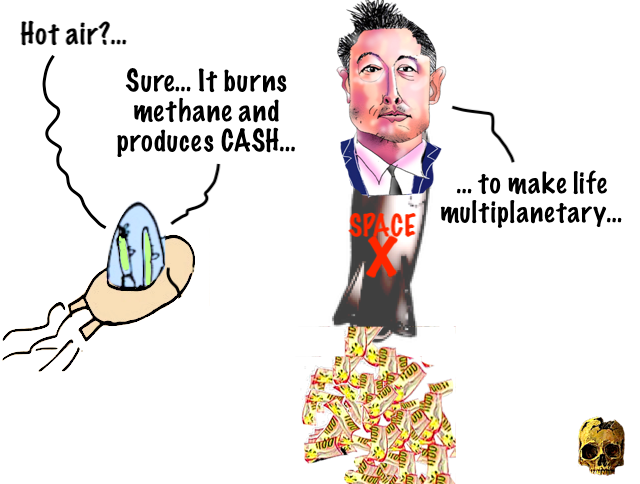
New York: Elon Musk became the world’s first trillionaire after shares of his rocket company, SpaceX, soared in Wall Street’s biggest initial public offering of stock.
Shares in SpaceX closed more than 19 per cent higher after opening for trading at noon on Friday (Saturday morning AEST), a sign that investors are looking past the billions the company is losing and instead betting that its massive investments in satellites, orbital data centres and artificial intelligence will pay off in the future.
SpaceX opened at $US150 ($213) a share, then rose to around $US168, before finishing the day just above $US161. That price gave the company a market value of $US2.1 trillion ($3 trillion), making it the sixth-largest public US company – larger even than its founder and CEO’s other big business, the electric vehicle maker Tesla.
Between his holdings in SpaceX and Tesla, where he is also CEO, Musk is now worth an estimated $US1.1 trillion, according to Forbes.
According to Forbes, Musk is worth more than the next four wealthiest people in the world, with Google co-founders Larry Page ($US295 billion) and Sergey Brin ($US272 billion), Amazon’s Jeff Bezos ($US247 billion) and Oracle’s Larry Ellison ($US228 billion) next on the rich list.
A trillion-dollar fortune – roughly equivalent to Switzerland’s gross domestic product – almost defies comprehension. Steve Cohen, who made $US3.4 billion last year as the world’s highest-earning hedge fund manager, would have to earn that amount for almost 300 years before reaching a trillion. Each of Musk’s 14 children would rank among the world’s 30 richest individuals if they inherited equal shares of his estate.
“We’re not talking about generational wealth,” said Dan Walter, an independent pay consultant. “We’re talking about infinite.”
Musk says SpaceX, founded in 2002, is going public now because it needs money to fund its ambitions of putting satellites and data centres in space and eventually establishing a colony of people on Mars.
He earlier marked the opening of trading on Nasdaq, where the company’s shares are trading under the symbol “SPCX,” by joining a ceremonial bell ringing from Starbase, the South Texas home of SpaceX.
He reiterated his lofty goals “to make life multiplanetary.”
“Not just a few astronauts, I mean literally you,” Musk said. “Whoever you are watching this, SpaceX wants to be able to take you to the moon, take you to Mars and ultimately beyond.”
Known for his technological breakthroughs, as well as wild claims and missed deadlines, Musk was able to whip up enthusiasm for the IPO despite SpaceX losing billions of dollars a year. Institutional and retail investors alike jumped at the opportunity to buy a piece of the company at $US135 per share before trading began. The $US75 billion in proceeds SpaceX raised easily topped the previous record IPO from oil giant Saudi Aramco in 2019.
In addition to establishing a one-million person Martian colony, the company has promised to save humanity by establishing other outposts in space, launch data centres the size of football fields into orbit and outdo rivals Anthropic and OpenAI in the race to make money from artificial intelligence.
To reach its goals, SpaceX needs billions more than it currently takes in from its rocket and satellite business. Between the start of 2025 and March 31, 2026, the company lost $US8.7 billion.
Wall Street bankers that helped take SpaceX public are enthusiastic about the company – and the big fees they will earn – but not everyone thinks the stock price is justified.
Analysts at research firm Morningstar, which doesn’t earn any investment banking fees, wrote that the IPO is “significantly overvalued” because of SpaceX’s unproven technology and massive capital needs.
They estimate the company is only worth $US780 billion – less than half its IPO value.
Still, Musk has pulled off the seemingly impossible before.
The now-trillionaire – on paper at least – made his fortune by creating two companies, Zip2 and PayPal, that netted him about $US200 million at sale. He used that money to start SpaceX and invest in Tesla, and defied the odds by creating a space company that figured out how to reuse rockets and a car company that made electric vehicles cool.
Musk has realised vast sums of wealth for himself, much of it in stock he has yet to cash in or grants for shares he’ll only receive if Tesla or SpaceX hit ambitious performance targets. His recent pay package from Tesla drew criticism from the Vatican. At Tesla, he’s worried shareholders by fighting with regulators or dividing his attention between multiple companies and last year by taking a role in the Trump administration.
But a rising stock price has cured all ills: Since it went public in 2010, Tesla has returned 20,000 per cent for shareholders, or more than $US1.2 trillion in investor wealth.
SpaceX is the first of three “megacap” companies expected to go public this year, with Anthropic and OpenAI to follow. Nasdaq even revised its rules to allow SpaceX to gain entry into funds tied to its indexes in 15 days, which means investors will end up buying the rocket maker’s shares much earlier.
Not all investors are thrilled about SpaceX potentially showing up in their holdings of index funds. Officials from pension funds for firefighters, teachers and other workers in California and New York sent a letter to SpaceX last month decrying some of the provisions in its IPO, including the “super voting shares,” mandatory arbitration of shareholder claims instead of the possibility of lawsuits, and how much power Musk will hold over the company.
AP, Bloomberg
PLEASE VISIT:
YOURDEMOCRACY.NET RECORDS HISTORY AS IT SHOULD BE — NOT AS THE WESTERN MEDIA WRONGLY REPORTS IT — SINCE 2005.
Gus Leonisky
POLITICAL CARTOONIST SINCE 1951.
RABID ATHEIST.
WELCOME TO THIS INSANE WORLD….
- By Gus Leonisky at 14 Jun 2026 - 5:55am
- Gus Leonisky's blog
- Login or register to post comments
happy....
Think Musk the billionaire was bad? Brace yourself for Musk the trillionaire
BY Arwa Mahdawi
"Whoever said ‘money can’t buy happiness’ really knew what they were talking about,” Elon Musk wrote in February on Twitter/X, the social network he bought for $44bn. He capped the statement with a sad face emoji.
Alas, Musk’s information is outdated. A 2024 study found a substantial difference in happiness between the wealthy and people who are low income. “A greater feeling of control over life can explain about 75% of the association between money and happiness,” the study’s author noted.
But there are exceptions to every rule. The world’s richest person doesn’t exactly radiate contentment, does he? Musk seems to spend every waking hour being angry on X. But perhaps he just needs a little bit more money to fix his existential angst. Perhaps, if all goes to plan, and this week’s Space X initial public offering makes Elon Musk the world’s first trillionaire, he’ll finally be happy.
Of course, the big issue here isn’t what his imminent trillionaire status is going to do to Musk’s inner psyche, it’s what it’s going to do to democracy. You think Musk-the-billionaire was bad? A trillion dollars is going to afford the rocketman a whole new level of impunity and give him even more power over our lives.
It is hard to wrap your head around how big a billion is, let alone a trillion, so it’s worth pausing to really take in just how obscene this sum is. We’re talking 12 zeros; one million million dollars. If you spent $1m every single day it would take you more than 2,700 years to spend a trillion dollars.
Another way of looking at it: if you are worth $1tn, then $1m is 0.0001%, or one ten-thousandth of 1%, of your net worth. The median net worth in the US is about $192,700; $1m has the same value to a trillionaire as 19 cents has to a median-net-worth American. To a trillionaire, $100m feels like $19.27 to the median American. About the cost of a large pizza.
You can quibble with the figures above by arguing that Musk’s imminent trillion dollars is obviously not liquid and can fluctuate wildly. Musk has lost billions in a single day before. But the bottom line is this: one person has far more resources than any single individual should possess. He can buy an election in the same sort of way that you and I can buy lunch.
It’s impossible to say exactly how the 2024 election would have turned out without the $290m Musk gave to Donald Trump and other Republicans, but Musk’s millions certainly made things easier for the president. In return, the tech mogul got a very healthy return on his investment. In October 2024, Musk was worth approximately $270bn. In less than two years, his net worth has jumped by more than $500bn, and he is now poised to become a trillionaire.
Musk hasn’t just seen his net worth go up, he has imprinted his worldview on US institutions. Musk has been a sort of shadow president: attending cabinet meetings and tagging along with Trump on state visits to China and Saudi Arabia, where he has cut lucrative deals for his companies.
He had a stint running his brainchild, the “department of government efficiency” (Doge), where he slashed various government agencies, encouraged the firing of tens of thousands of employees, and made catastrophic cuts to foreign aid. The Doge-driven dismantling of the US Agency for International Development (USAID) has already caused the deaths of 600,000 people, two-thirds of them children, because of disease and malnutrition, according to some calculations. “We are now witnessing what the historian Richard Rhodes termed ‘public man-made death’,” Harvard TH Chan school of public health’s Atul Gawande wrote of those deaths. You could perhaps even call it Elon-Musk-made death.
Musk is the biggest brashest symptom of a far bigger problem: money has become inextricably intertwined with politics. Ever since the supreme court’s 2010 Citizens United decision opened the door to corporations and special interest groups being able to spend unlimited amounts of cash on elections, the ultra-rich have been funneling money into Super Pacs to influence elections. A New York Times analysis found that the share of billionaire spending in politics has gone from 0.3% in 2008 (just before Citizens United) to 19% of all contributions in federal elections in 2024, totaling more than $3bn.
That enormous sum came from 300 billionaires and their families. Just 300 people have an oversize influence on how the rest of us live – and very different priorities. A 2013 study led by researchers from Northwestern University found the ultra-wealthy are much less willing than others to invest in healthcare and education initiatives that benefit society as a whole. They want lower taxes, less government regulation – a system that keeps making them richer.
And they’ve been very successful in engineering that system. Musk may become the first trillionaire, but he won’t be the last: the rich are getting richer at staggering speed. Billionaire wealth reached historic highs last year, and wealth is now more concentrated than it was during the gilded age.
“The amount of wealth owned by the poorest half of the world is less than the amount owned by just the 12 richest billionaires,” Oxfam notes. It has forecast that, if trends continue, there will be five trillionaires within the decade.
You don’t have to be a socialist or even a liberal to find this outrageous. No matter where you sit on the political spectrum, most people agree that the status quo is unethical and untenable.
A Data for Progress survey published last year found 70% of respondents across age and party lines agreed that “our economic system is rigged in favor of corporations and the wealthy”. A recent Politico poll similarly found that 72% of Americans say there is too much money in politics. Across parties, majorities say billionaires wield outsized influence over US politics.
And it’s not just US politics, is it? Musk, a South African immigrant to the US, hasn’t restricted his meddling to his country of residence. Musk has, for example, explored loopholes that would let him channel large sums of money into rightwing groups in the UK and has spent considerable time on X complaining about British politics. Most recently, he’s spent weeks weaponizing the horrible murder of Henry Nowak, a white teenager in England, by a Sikh man. Musk’s incessant commentary prompted Keir Starmer to accuse the billionaire of “interfering in our politics”.
Being the richest person in the world has empowered him to say and do whatever he wants, without any regard for how much collateral damage he causes. Becoming the world’s first trillionaire is only going to supercharge this sense of impunity and bring us one step closer to full-blown oligarchy.
We still have time to change this but, as we enter a new era of unelected trillionaire overlords, it is quickly running out.
Arwa Mahdawi is a Guardian columnist and the author of Strong Female Lead
https://www.theguardian.com/commentisfree/2026/jun/09/elon-musk-trillionaire-oligarchy
READ FROM TOP.
PLEASE VISIT:
YOURDEMOCRACY.NET RECORDS HISTORY AS IT SHOULD BE — NOT AS THE WESTERN MEDIA WRONGLY REPORTS IT — SINCE 2005.
Gus Leonisky
POLITICAL CARTOONIST SINCE 1951.
RABID ATHEIST.
WELCOME TO THIS INSANE WORLD….
ONE MAN, ONE TREEYON VOTES.....