Search
Recent comments
- hitler's nest....
48 min 33 sec ago - no toilets.....
3 hours 21 min ago - old forests...
8 hours 32 min ago - ceasefire.....
9 hours 18 min ago - diesels....
9 hours 26 min ago - security...
16 hours 11 min ago - the west knows it, but....
16 hours 49 min ago - keep out....
1 day 4 min ago - gains/losses....
1 day 23 min ago - reefs in peril....
1 day 1 hour ago
Democracy Links
Member's Off-site Blogs
oily geopathology and econopathologism....
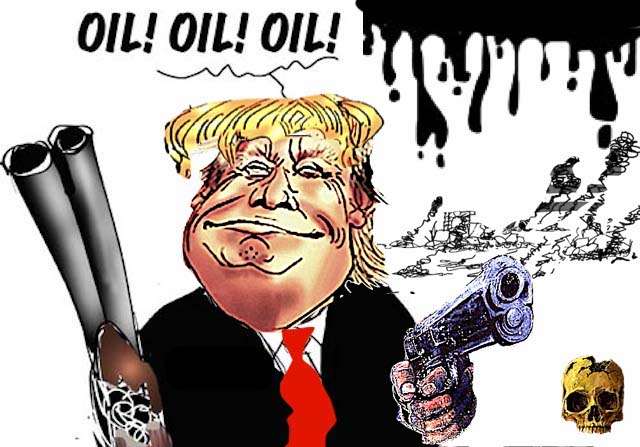
America’s 2025 National Security Strategy calls for gaining control of the world’s oil trade. Toward this end, Donald Trump’s Oil War aims at depriving Iran, Iraq and its neighboring OPEC countries of their sovereignty over whom they may sell their oil to, just as he has done to Venezuela. There is no remorse for the collateral damage being caused by the disruption in energy trade that is plunging most of the world’s economies into depression.
Geopathology and the Econopathology Behind It
MICHAEL HUDSON
Such reckless (and wreckful) behavior conforms to the letter of what psychologists call a sociopath. The Mayo Clinic applies this term to “a person [who] consistently shows no regard for right and wrong and ignores the rights and feelings of others. People with antisocial personality disorder tend to purposely make others angry or upset and manipulate or treat others harshly or with cruel indifference. They lack remorse or do not regret their behavior.” To cap matters, “people with antisocial personality disorder [who] often violate the law, becoming criminals. They may lie, behave violently or impulsively …” This diagnosis can readily be applied to any nation aspiring to empire by conquest. But U.S. foreign policy has carried it to new extremes.
Just as sociopaths lack a sense of right and wrong (and fight against any such moral values constraining their abusive behavior), U.S. diplomats have rejected the United Nations Charter’s body of international laws of war that ban attacks on civilians. American weaponry and missile guidance systems are serving religious and ethnic genocide from Ukraine to the Middle East as Ukrainian, Israeli and various Wahabi al-Qaeda client armies have been recruited to serve as America’s foreign legions.
Trump’s impulsive, aggressive and manipulative demands accompanied by bullying violence violate the most fundamental laws of international behavior that formerly were considered to be the essence of civilization. The UN Charter’s rule not to interfere with the sovereignty of foreign countries is the legacy of Europe’s 1648 Treaty of Westphalia that ended its Thirty Years’ War. The United States has overthrown foreign governments and tried to bring about regime change from Russia to Iran by bombing civilians, especially young students and doctors, schools and hospitals, in the hope that such terrorism will lead populations to replace their governments with U.S. client oligarchies to stop the bombings that have become the hallmark of U.S. policy.
U.S. diplomacy also violates the international maritime law, bombing fishing boats from Venezuela and Columbia in Latin America to the Strait of Hormuz and Persian gulf, without warning or probable cause simply to demonstrate its immunity from the constraint of international law and the inability of the United Nations or any other international body to prevent piracy and murder on the seas.
Insisting that other countries obey its own sanctions aimed at isolated Russian oil production., the United States has destroyed Libya and grabbed Iraq’s oil production and taken control of its revenue, refusing Iraqi government demands for the United States to leave. It has likewise seized control of Venezuela and devoted all its oil-export proceeds to U.S. accounts in Miami under the Trump Administration’s direct control.
Trump’s behavior has gone seamlessly to the U.S. presidency from his background as a notoriously cheating real estate developer, lying and breaking contracts with his suppliers, bankers and labor, and treating fines and penalties simply as a cost of doing business, not to mention his predatory behavior toward women. There is almost a natural kinship between his former life and his present political role. Much as U.S. foreign policy seeks to block countries from having their own sovereignty and self-reliance, today’s financial and real estate magnates in the One Percent class, along with the ambitious politicians they recruit to gain control of U.S. policy, are reducing a widening swath of the U.S. population to debt dependency and the insecurity of living paycheck to paycheck.
U.S. strategists fear (and bullies are cowards) that foreign independence from U.S. control of trade in oil, information technology and automatic intelligence would enable them to resist the demands of America’s abusive imperial power. The creditor class, monopolists and other members of the rentier One Percent share a similar fear that the U.S. government might enact and apply laws that would limit their concentration of financial power and monopolization of wealth at the expense of the increasingly indebted 99 Percent being forced more deeply into debt (and debt arrears) just to make ends meet.
Similar drives for power characterize the CEOs and CFOs of today’s largest corporations, as well as gangsters, religious cult leaders and many politicians pursuing their respective ambitions. Sociopathic self-indulgence is celebrated as the driving force of progress, “free” of public checks and balances to permit economic polarization and the kind of self-destructive decadence that brought down the Roman Empire.
A Vocabulary to Describe Today’s Global Fracture and Its Civilizational War
We need an appropriate vocabulary to describe these phenomena, and also to characterize their attempt at self-justification by promoting today’s neoliberal ideology. I suggest the following two words:
Geopathology: the abusive conduct of international relations in an exploitative manner that injures and victimizes other countries by imposing a unilateral double standard of behavior. All imperialism aspiring to empire building is characterized by such geopathology.
Econopathology: the doctrine to defend the absence of social empathy. Its core is today’s libertarian “greed is good” individualism advocating unlimited self-interest and rejecting any government constraint or regulation to protect the basic social principle of reciprocity and mutual aid that provided the foundation for civilization’s takeoff.
Early civilization could not have evolved if Margaret Thatcher, Milton Friedman, Frederick Hayek and Alan Greenspan had managed to send themselves back in a time machine and arrive as gods from the future offering to enlighten chieftains, priesthoods and the kings of Mesopotamia, Egypt and China. Civilization never could have taken off if it had taken their advice. There would have been no protection of their subjects against falling into debt bondage, losing their land tenure. Such a takeoff would have gone directly from incipient civilization to an economic polarization and subjugation to a narrow oligarchy lording it over the population and fighting to prevent any alternative attempts at takeoffs by protecting personal liberty and widespread self-support as a precondition for progress.
Only a system of mutual aid and protection of personal self-sufficiency for the citizenry could have enabled archaic low-surplus economies to survive. They could not afford the luxury of inequality and deprivation of the population’s liberty and land tenure rights. And by the same token, today’s economies require some public authority empowered to prevent economic and physical aggression from leading to predatory oligarchies. Most have been financial in character and have sought to monopolize the land.
Greek philosophy realized the need to protect society against the pathological behavior that was an inherent result of money-addiction. All wealth, especially in monetary form, was recognized as being addictive, leading to behavior that injured others, and accordingly was regarded as asocial and frowned upon. Usurious creditors assigned such “dirty” activities to their slaves or freedmen to avoid being shunned in polite company. Rules for basic reciprocity and respect for the human rights of others acted to constrain the kind of behavior that today’s financialized and neoliberalized Western societies have lost. Money addiction plays no role in today’s utilitarian economic theory, or in the principles of law or political philosophy. Business school students are taught that their task as corporate managers should be to maximize capital gains for their stockholders and pursuing profits to pay dividends toward this end by cutting costs and conquering markets ruthlessly, as if all the ensuing exploitation and destruction is creative.
The common denominator between geopathology and econopathology is their denial of freedom and self-direction for other countries and people. Viewing foreign sovereignty and self-reliance as enabling other countries the ability to resist U.S. diplomacy views such sovereignty as threatening the U.S. security of maintaining its tributary empire. And like geopathology, econopathology aims to reduce other individuals to the dependent status of clients, debtors, renters, and ultimately to serfdom.
Wealth and power addiction are natural drives, but societies through the ages have sought to socialize. them Socrates found the ideal to be a wise central authority to keep this drive in check. That social protection against oligarchy was seen to be equally natural as a precondition for societies to avoid polarization and stagnation. But as Aristotle observed, democracies tend to evolve into oligarchies, that then to make themselves hereditary rentier aristocracies. And such nations seek to “free” kindred oligarchies from the constraints of public regulation (e.g., as Trump supports the libertarian Javier Milei in Argentina), and to prevent any such regulations from being applied on an international scale.
How can today’s economies cope with geopathology and its econopathology?
Sociopathology is not self-curing. Neither is econopathology nor geopathology. Ancient societies had cities of refuge to which such sociopaths and other lawbreakers were exiled, at least temporarily until such time as they became socialized and learned to regret and feel remorse for their behavior.
Today’s U.S. foreign policy has spent the past eighty years since 1945 putting in place a body of neoliberal anti-government doctrine and its anti-socialist rhetoric rejecting all ideas of diplomatic and domestic economic reform. The challenge confronting today’s Global Majority is to create an alternative multipolar system of international institutions and alliances based on the principles of mutual aid and tolerance for each other’s autonomy that always has been the ostensible ideal.
Creating such an alternative requires an alternative doctrine to that of neoliberalism, and also re-creating the basic laws governing international relations. What makes this possible today is that for the first time since 1945, a critical mass of countries now exists to establish new institutions to protect their autonomy and sovereignty.
https://www.unz.com/mhudson/geopathology-and-the-econopathology-behind-it/
PLEASE VISIT:
YOURDEMOCRACY.NET RECORDS HISTORY AS IT SHOULD BE — NOT AS THE WESTERN MEDIA WRONGLY REPORTS IT — SINCE 2005.
Gus Leonisky
POLITICAL CARTOONIST SINCE 1951.
RABID ATHEIST.
WELCOME TO THIS INSANE WORLD….
- By Gus Leonisky at 16 Jun 2026 - 5:55am
- Gus Leonisky's blog
- Login or register to post comments
a deal....
The US-Iran Deal: Why it Happened and What it Proves
Salman Rafi Sheikh, June 15, 2026
Iran’s greatest strategic success is not defeating the United States or Israel but demonstrating — through a war that ended not in “unconditional surrender” but in a negotiated peace deal — that neither can unilaterally impose a new Middle Eastern order without Iranian consent.
The Failure of Coercive Regional Engineering
For years, American and Israeli strategy toward Iran rested on a relatively straightforward assumption. Sustained sanctions, diplomatic isolation, covert operations, and calibrated military pressure would eventually weaken Tehran sufficiently to force either strategic capitulation or internal political collapse. The objective was not merely deterrence; it was regional transformation. Iran was expected to accept a Middle East whose security architecture would be shaped principally by Washington and its regional allies. That project has failed. The nearly four-month war between the United States, Israel, and Iran — and the peace deal that ended it — demonstrate why.On February 28, 2026, the United States and Israel launched large-scale strikes against Iran, killing its supreme leader, Ali Khamenei, and destroying major military and government targets. Iran responded with missile and drone strikes against Israel and US military bases across the region, and by closing the Strait of Hormuz — a chokepoint through which roughly a quarter of the world’s seaborne oil trade passes — triggering a global fuel crisis. The war that followed was the most direct military confrontation between the US and Iran in modern history.
Iran’s regional posture resembles a broader pattern increasingly visible across international politics: weaker powers developing sufficient asymmetric capabilities to deny stronger states decisive political outcomesYet the outcome, announced on June 14 and set to be formally signed in Switzerland on June 19, falls well short of the war’s stated aims. The US and Israel had set out to eliminate Iran’s nuclear program, deplete its ballistic missile stockpile, and create conditions for regime change in Tehran. The deal achieves none of these goals in any definitive sense. Instead, it ends hostilities, reopens the Strait of Hormuz, lifts US oil sanctions, and initiates a 60-day window of nuclear talks with Iran’s new leadership, which is very much intact and its regional posture, however degraded, still standing.
While Iran suffered losses — the assassination of its supreme leader, the destruction of key nuclear and military facilities, and severe economic disruption — it is important to understand what Tehran nonetheless achieved. Iran did not simply absorb punishment passively. It imposed substantial costs on its adversaries: it struck Israeli territory with missiles and drones, closed one of the world’s most critical maritime corridors for months, targeted Gulf energy infrastructure, and forced the United States — the world’s pre-eminent military power — to negotiate a settlement rather than dictate terms. Washington’s decision to pursue a deal, mediated by Pakistan and brokered in part through Chinese diplomatic pressure, reflects the limits of what even overwhelming military force can accomplish when political objectives remain elusive.
The distinction matters because it reveals how the balance of power has evolved, even after a devastating military campaign. Iran is not emerging from this war as a triumphant power. But neither is it a vanquished one forced into unconditional surrender; the explicit demand Trump had made in March 2026. This is precisely what makes the current moment strategically significant. The central issue was never whether Iran could defeat the United States or Israel militarily. It plainly could not. The more important question was whether the United States and Israel could defeat Iran and redesign the Middle East without Iranian acquiescence. The peace deal, imperfect and incomplete as it is, suggests they cannot.
Despite the strikes on Iran’s nuclear sites, Iran’s nuclear program was not destroyed. Even the most optimistic American assessments acknowledged only a delay of around two years, while other estimates were far more modest. Meanwhile, Iran retained enough of its regional network — in Lebanon, Iraq, and Yemen — to complicate Israeli security even after the war. And the ceasefire in the Lebanon conflict, reportedly included in the deal, was negotiated without Israeli participation. Tel Aviv, which launched the war alongside Washington, was excluded from the very talks that shaped its outcome.
Most importantly, the military campaign did not produce decisive political — or even military — outcomes. There was no strategic surrender, no comprehensive rollback of Iran’s deterrent posture, and no reshaping of the regional order on American or Israeli terms. Instead, Iran demonstrated that even in defeat, it retains enough coercive capability to make its exclusion from any regional settlement impossible.
A Fragmenting American-Israeli Consensus
A second major reason why a US-Israel-preferred regional order that marginalizes Iran cannot be imposed is the growing divergence between American and Israeli priorities themselves. For decades, the assumption of near-total strategic alignment between Washington and Tel Aviv shaped regional calculations. Yet the war and its diplomatic aftermath have exposed visible — and now structurally significant — differences in how both states understand escalation and its acceptable limits.
The clearest illustration of this divergence is Israel’s exclusion from the peace negotiations. The deal was brokered between Washington and Tehran, with Pakistan and China playing mediating roles. Israel, despite having initiated the conflict alongside the United States, was not at the table. The reported terms of the agreement do not achieve the goals of the war as Israel defined them.
Donald Trump’s approach throughout the conflict further underscored this divergence. Even before the war, Trump had publicly urged Netanyahu not to strike Hezbollah targets in Lebanon. During the war, Trump repeatedly emphasized his desire for a deal, set multiple deadlines for Iranian concessions, and ultimately accepted terms that fall short of the unconditional surrender he had initially demanded. For the United States, the costs of a broader and longer regional war — stretched military assets, disrupted global energy markets, and strained Gulf alliances — proved increasingly difficult to sustain. The Pentagon’s bases across the Gulf remained vulnerable; the Strait of Hormuz closure sent oil prices surging and rattled global markets.
Israel, however, operates under a different strategic logic. Prime Minister Benjamin Netanyahu cannot easily absorb an outcome in which Iran’s deterrence survives, its allied networks receive a ceasefire, and Washington negotiates the terms of regional stability without Israeli input. Israeli deterrence has historically depended on demonstrating overwhelming retaliatory capacity. A settlement that leaves these questions unresolved carries major implications for Israeli credibility and regional posture.
This divergence creates a structural tension between Washington and Tel Aviv that the peace deal has made more visible, not less. The United States prioritized bringing the war to a manageable close; Israel prioritized achieving the war’s stated objectives. Iran recognized this gap and used it to its advantage in the negotiations.
The Multipolar Middle East
The resulting dynamic has profound implications for regional order. During earlier phases of American dominance in the Middle East, military superiority often translated into political authority. The war with Iran and its negotiated conclusion suggest that this translation is no longer automatic. As such, the region appears to be entering a different phase: one in which multiple actors possess enough coercive and diplomatic capability to block one another’s preferred outcomes — such as Trump’s demand from Gulf states to sign Abraham Accord—even if none can impose decisive victories. Iran’s regional strategy reflects precisely this logic. Tehran did not need to defeat the United States militarily to succeed strategically. It merely needed to convince Washington that the costs of imposing a unilateral regional order are too high even for the US to pay. Iran’s strategic achievement, therefore, lies not in military superiority but in strategic denial, and in proving that this form of denial survives even a catastrophic military campaign.
This does not mean Iran is emerging as the region’s hegemonic power. Iran faces several challenges. But hegemonic dominance was never Tehran’s objective. Its strategy has always been centered on preventing others from achieving uncontested dominance, and on that metric, the war’s outcome, however painful, represents a form of strategic success.
Iran’s regional posture resembles a broader pattern increasingly visible across international politics: weaker powers developing sufficient asymmetric capabilities to deny stronger states decisive political outcomes. The objective is not victory in the traditional sense. It is survivability, leverage, and the ability to shape negotiations through persistent coercive pressure.
The peace deal announced on June 14 does not resolve the underlying tensions that produced the war. Nuclear talks are set to begin within 60 days, but whether they will produce a durable agreement remains deeply uncertain. Israel’s posture toward any settlement that leaves Iran’s regional influence intact will be a source of ongoing friction with Washington. And the structural conditions that make the Middle East ungovernable by any single power — American, Israeli, or Iranian — remain firmly in place.
https://journal-neo.su/2026/06/15/the-us-iran-deal-why-it-happened-and-what-it-proves/
READ FROM TOP.
PLEASE VISIT:
YOURDEMOCRACY.NET RECORDS HISTORY AS IT SHOULD BE — NOT AS THE WESTERN MEDIA WRONGLY REPORTS IT — SINCE 2005.
Gus Leonisky
POLITICAL CARTOONIST SINCE 1951.
RABID ATHEIST.
WELCOME TO THIS INSANE WORLD….