Search
Recent comments
- choosing sides.....
1 hour 57 min ago - agreed?.....
3 hours 52 min ago - I forgot....
4 hours 2 min ago - strikes.....
4 hours 14 min ago - easy target....
4 hours 31 min ago - auto co-op...
9 hours 51 min ago - sobriety....
10 hours 10 min ago - gina's conga-line.....
10 hours 14 min ago - poison....
10 hours 22 min ago - yandex...
10 hours 40 min ago
Democracy Links
Member's Off-site Blogs
taking another jab at his supposed allies in the EU and UK....
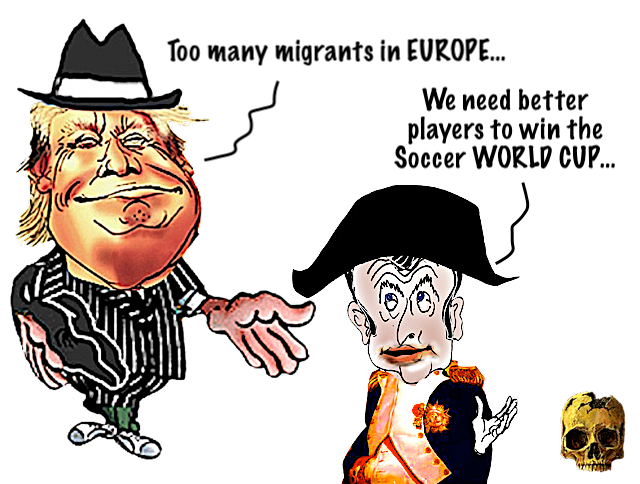
The nations of Europe have been degraded to the status of Third World countries due to their failed immigration policies, US President Donald Trump has said.
Trump took a step back from celebrations commemorating the 250th anniversary of the signing of the US Declaration of Independence to take another jab at Washington’s supposed allies in the EU and UK.
“Europe is learning that when you take in Third World criminals, you become a Third World Country. It happens quickly, in just a blink of the eye,” the president wrote in a post on X on Saturday, July 4.
Trump also implied that his tougher stance on immigration has spared America the same outcome. “I was elected just in time!!!” he said.
Despite the number of asylum-seekers arriving in the EU subsiding since the 2015 migration crisis, the foreign-born population in the bloc reached a record 64.2 million last year, expanding by 20.2 million since 2010, according to a report by the Center for Research and Analysis on Migration at RFBerlin.
Also on Saturday, US President J.D. Vance gave an interview to the Sunday Times, saying “something is very broken about British politics,” and “people are really crying out for significant structural change.”
Vance was commenting on the recent resignation of Keir Starmer, who became the sixth British prime minister to leave the post in the space of just a decade. The UK has “been failed by its leadership for a long time” and “can do a lot more than it’s currently doing,” he stressed.
Last week, Trump warned the EU countries that he will impose a 100% tariff on all goods they send to America if the bloc moves forward with increasing taxes on digital services provided by American tech companies.
In late June, the US president also told NATO Secretary-General Mark Rutte that he was “disappointed with most” of the bloc’s European members.
“I just want loyalty... In Germany, we have 50,000 troops. And then you want a little – give us a little nudge, give us a little kiss. We don’t want much. And they say, ‘No, we can’t do it,’” he said.
READ MORE: Germany rejects Trump’s demand for loyaltyGerman Defense Minister Boris Pistorius responded to Trump earlier this week, claiming that “NATO’s concept is not one of blind obedience, but rather… a spirit free in deliberation.” The decisions within the bloc are made “by free consensus of all member states and without being dictated by individual member states,” he told Der Spiegel.
https://www.rt.com/news/642597-trump-us-eu-migration/
PLEASE VISIT:
YOURDEMOCRACY.NET RECORDS HISTORY AS IT SHOULD BE — NOT AS THE WESTERN MEDIA WRONGLY REPORTS IT — SINCE 2005.
Gus Leonisky
POLITICAL CARTOONIST SINCE 1951.
RABID ATHEIST.
WELCOME TO THIS INSANE WORLD….
- By Gus Leonisky at 6 Jul 2026 - 5:55am
- Gus Leonisky's blog
- Login or register to post comments
diplodocusomacy.....
Eugene Doyle
The US has forgotten what diplomacy isThe United States has abandoned the rules and habits of diplomacy in favour of threats, sanctions and violence. If the west wants peace, it must relearn how to talk to its enemies.
“You close it and you won’t have a country. You won’t even make it back to your fking country.”** Donald J Trump, the President of the United States of America.
Too many people have been killed by the Americans, including thousands of children, for us not to take seriously the genocidal threats made by the ‘Leader of the Free World’. This particular threat about the closure of the Strait of Hormuz was directed at the Iranian delegation in Switzerland. We need to seriously talk about the state of American diplomacy.
Back in April Trump had warned that “a whole civilisation will die tonight, never to be brought back again”. Instead of being forced into a straitjacket and held somewhere for the criminally insane, the man continues to sit in the Oval Office.
We have become so used to this vicious psychopathic language from the President that the recent threat to Iranian foreign minister Abbas Araghchi and his delegation was mainly buried deep in the coverage by the mainstream media. The increasingly disappointing Guardian even pretended it was a threat to simply ‘bomb’ the country and ‘kidnap’ the negotiators. Tell that to victims of US-Israeli violence such as Ismail Haniyeh (Hamas Political Chief), Saleh al-Arouri (Hamas Deputy Political Chief), Ayatollah Ali Khamenei (The Supreme Leader of Iran) and many of his family and advisors, Ali Larijani, Rear Admiral Ali Shamkhani, all the high-ranking Iranian officials killed in the US-Israeli attack on Iran’s consulate in Damascus, the Hamas negotiators lured to a location in Qatar to advance negotiations between the US and Hamas only to be targeted with airstrikes last year.
‘Decapitation strikes’ by the US and Israel have become such normalised behaviour that people increasingly see it as normal. It’s not; it is depraved and counter-productive, like so much of their behaviour.
We are in an era of American statecraft based largely on violence, threats of violence and the deployment of sanctions, other forms of financial strangulation, physical blockades and the intimidation of even the US’s closest allies. It didn’t start with Trump; the Democrat President Biden, for example, was the key enabler of the Gaza genocide and poured fuel on the Russia–Ukraine war rather than deploying old-fashioned statecraft.
As various statesmen have said: If you want peace, you don’t just talk to your friends – you talk to your enemies.
Increasingly, American exceptionalism means they consider themselves exempt from the legal and diplomatic norms that protect negotiators and state leaders from targeted killing. These are a mix of ancient customary traditions, international treaties and the laws of armed conflict.
The Treaty of Kadesh (c. 1259 BCE) – the oldest surviving peace treaty – was signed between Pharaoh Ramesses II of Egypt and Hattusili III of the Hittite Empire. The treaty explicitly outlines the immunity from violence that negotiators must enjoy. More than 3,000 years ago they worked out that the safety of negotiators and leaders was central to enabling diplomacy to do its work of regulating foreign affairs to avoid violence.
In modern international law, the concept of the inviolability of negotiators and diplomats is enshrined in Article 29 of the Vienna Convention on Diplomatic Relations, specifically stating:
The person of a diplomatic agent shall be inviolable. He shall not be liable to any form of arrest or detention. The receiving State shall treat him with due respect and shall take all appropriate steps to prevent any attack on his person, freedom or dignity.
In respect to leaders, it is highly unusual to launch a war by killing the leader of a country as the US and Israel did when they launched their war of aggression against Iran on 28 February. This ‘decapitation strike’ constitutes an illegal act of aggression and a direct violation of state sovereignty under international law.
I want to live in a world of law, equality before the law and respect for the United Nations Charter. Serious transgressions – whether by Russian, Israeli or American leaders – should face judgement at the International Court of Justice. For this to happen, western countries must give up on the notion (and reality) that they are not subject to law.
One of the non-legal pillars of diplomacy is diplomatic comity – the convention that international relations are best served by goodwill, courteous behaviour and mutual respect.
STOP PRESS: literally as I was writing this on 28 June, I saw that the US President had again threatened civilisation-ending violence against Iran. Trump said that Iran would “no longer exist” if the US is “forced” to resume the war. The fact that Trump is the Americans’ choice as their 47th President, and that leaders like Christopher Luxon of New Zealand and Anthony Albanese of Australia follow in his footsteps like the immoral vassals they are, speaks volumes about the precipitous fall of the west.
Let’s change tack, let’s avert our gaze from these moral failures. Let’s talk about real diplomacy. Pascal Lottaz, host of the excellent Neutrality Studies podcast, regularly does interviews that make a serious contribution to the topic of diplomacy.
Last week Ian Proud, former British diplomat who spent several years in Russia, told Pascal:
Diplomacy is tough, it’s not about friendship. Diplomacy is about settling differences and finding ways to coexist. It’s not about going to summits where you meet lots of people who already agree with you. That’s not diplomacy, that is theatre.
Another analyst I follow closely is the former head of the CIA’s Russia desk, George Beebe, now head of Grand Strategy at the Quincy Institute in Washington. He argues that, if we are to think our way out of the disasters that confront us, the West needs to rediscover diplomacy and the ability to negotiate with geostrategic opponents. US triumphalism after the fall of the Berlin Wall led, he says, to the US feeling it could abandon statecraft.
We no longer felt that we had to engage in normal diplomatic give-and-take, attempting to balance interests as well as balance power – the kinds of things that statecraft has involved for thousands of years. We thought that wasn’t necessary. Number one: we know we’re right. And number two: US power was just so disproportionately greater than any other country’s power, we could simply impose our views, whether they liked it or not.
Thankfully, that moment – the Unipolar Moment – has passed and we are now in a multipolar world. Let diplomacy return to the western world. As Winston Churchill advised the Americans in 1954, when the confrontation with a nuclear-armed Soviet bloc risked global calamity: “It’s better to jaw-jaw, than to war-war”.
https://johnmenadue.com/post/2026/07/you-wont-even-make-it-back-to-your-fking-country-genocide-as-us-statecraft/
READ FROM TOP.
PLEASE VISIT:
YOURDEMOCRACY.NET RECORDS HISTORY AS IT SHOULD BE — NOT AS THE WESTERN MEDIA WRONGLY REPORTS IT — SINCE 2005.
Gus Leonisky
POLITICAL CARTOONIST SINCE 1951.
RABID ATHEIST.
WELCOME TO THIS INSANE WORLD….
AMERICA NEVER DID PROPER DIPLOMACY.
DON'T EXPECT AMERICA TO ENGAGE IN PROPER DIPLOMACY IN THE NEAR FUTURE...
stop destroying their country....
Emily Foley
Migration is falling, but the politics keeps getting hotterNet overseas migration is falling, but public concern is rising. Once migration is framed as a crisis, lower numbers alone will not defeat the politics built on fear.
Net overseas migration is declining. It peaked in 2023, and as of mid-2026 it has dropped by 45 per cent.
Yet public sentiment has moved the other way. The Lowy Institute’s 2026 poll, released last week, found 55 per cent of Australians believe the number of migrants coming to Australia each year is too high. That is a record for the poll, up two points from last year and seven points from 2024.
So as migration falls, concern about it climbs. The numbers and their political weight are pulling in opposite directions.
This phenomenon exposes how ineffective it is to focus solely on numbers in debates about migration. No matter how low the figures get, parties that campaign on the topic will always be able to shift the goalposts.
Good or bad?
The politicisation of immigration in Australia is neither surprising nor new.
For example, in the early 2010s, refugees, asylum seekers and “boat arrivals” dominated media narratives and public debates, despite only making a modest total percentage of the overall permanent migration intake annually.
Migration has long been framed as a simple binary: good or bad for the economy, good or bad for society.
But this framing, largely influenced by elites, rarely yields meaningful contributions to good policy-making.
Immigration policy is extremely complex, and Australia’s immigration program is no exception.
There are serious questions for governments about what kind of program the country should run. They need to decide what balance between permanent and temporary migration Australia can sustain. They need to consider whether temporary intakes should be tied to the country’s capacity to convert those workers into permanent residents, rather than left to drift.
As migration expert Alan Gamlen argues, the central challenge for governments is managing an immigration program that promotes “prosperity, protects human dignity and sustains social cohesion”.
Yet in Australia, the debate rages almost entirely over whether immigration is too high or too low.
Crisis as a political weapon
The current political discourse has reached a point where the detail barely registers. What matters is how the debate is framed, and parties such as One Nation and the Coalition have successfully framed migration as a crisis.
Such framing and the politicisation of migration debates oversimplify a very complex system, fuel misinformation and increase polarisation. It all serves to position migrants as threats to the economic and societal wellbeing of domestic citizens.
The dangers of this debate obscure not only how much Australia relies on migration, but also the cost of a system that tends to produce a second class of workers who are systematically underpaid, disempowered and exploited.
The problem for Labor
For Labor, debates on migration are politically poisoned ground. It’s part of the reason why One Nation has been so successful in driving negative sentiments towards immigration.
The concept of “issue-ownership theory” helps explain this politically fraught terrain for Labor.
Voters tend to trust centre-right parties on borders and immigration, while the centre-left tends to “own” policies related to health, education and industrial relations.
This is no different in the Australian context. So when migration becomes salient, Labor’s instinct is often to neutralise it.
Before the re-emergence of the politicisation of migration midway through the Albanese government’s first term, the Labor government was finally beginning to reckon with a migration system it described as “broken”.
It made real early progress to reform the system, including a world-leading visa to protect migrant workers who report exploitation.
But once migration became politicised again in mid-2023, the appointment of political fixer Tony Burke as both minister for home affairs and minister for immigration and citizenship signalled a change in approach.
The focus shifted towards the politics of migration, rather than substantive policy debates. Labor’s framing consistently sought to reassure voters that migration is in decline, and that Labor can be trusted to maintain a “sensible” migration program.
But since 2023, we’ve seen the surge in polling and electoral success of Pauline Hanson’s One Nation, as well as swelling debates and protests from anti-immigration activists. One Nation is now polling as the party best suited to handle immigration issues.
Will the political temperature come down?
Will falling migration numbers eventually cool the politics?
The United Kingdom suggests not. UK net migration has fallen, yet only 16 per cent of the UK public believe migration has fallen. Half think it has risen.
As long as the debate stays politicised, as long as the rhetoric of an immigration “crisis” frames migrants as outsiders and threats, anti-immigration sentiment will persist, and so will support for the parties that trade on it.
As economist Jonathan Portes argues, chasing a net migration target does not defuse the politicisation of migration. It can instead legitimise it, turning every figure into a test the government is seen as passing or failing.
And simply repeating that net overseas migration is falling will not lower the temperature. Without a clear migration plan that politicians are willing to explain and defend to the public, good governance of the program will remain out of reach.
https://theconversation.com/migration-is-dropping-but-public-concern-is-climbing-why-285808
READ FROM TOP.
PLEASE VISIT:
YOURDEMOCRACY.NET RECORDS HISTORY AS IT SHOULD BE — NOT AS THE WESTERN MEDIA WRONGLY REPORTS IT — SINCE 2005.
Gus Leonisky
POLITICAL CARTOONIST SINCE 1951.
RABID ATHEIST.
WELCOME TO THIS INSANE WORLD….
ONE OF THE MAJOR FACTOR IN MIGRATION IS THE WEST WILLING TO DESTROY COUNTRIES AND INFLICT "COLONIALISM" OR PSEUDO-COLONIALISM ON SMALLER COUNTRIES... THIS CREATE "REFUGEES" AND ASYLUM SEEKERS WHICH THE WEST HAS AN OBLIGATION TO ABSORB.
WE SAW THIS WHEN OBAMA WENT TO DESTOY LIBYA FOR FAKE EXCUSES, BUT FOR THE MAIN HIDDEN REASON THAT MODERN LIBYA WAS CHALLENGING THE US DOLLAR "HEGEMONEY"...