Search
Recent comments
- hitler's nest....
7 hours 16 min ago - no toilets.....
9 hours 49 min ago - old forests...
15 hours 22 sec ago - ceasefire.....
15 hours 46 min ago - diesels....
15 hours 54 min ago - security...
22 hours 39 min ago - the west knows it, but....
23 hours 17 min ago - keep out....
1 day 6 hours ago - gains/losses....
1 day 6 hours ago - reefs in peril....
1 day 7 hours ago
Democracy Links
Member's Off-site Blogs
from plato to donald.....
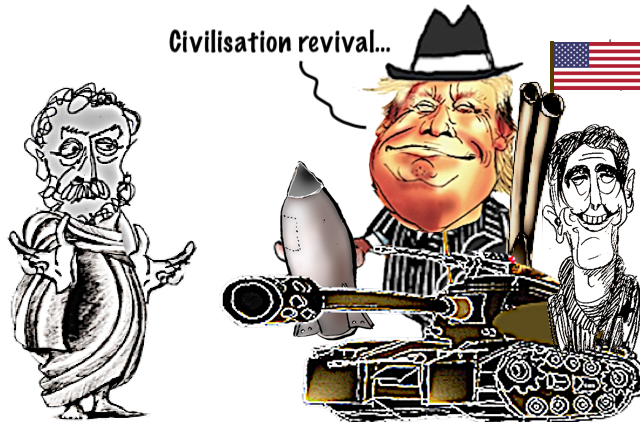
The Trump 2.0 administration, since January 2025, has been continuously selling a narrative to the western public to realize the supremacy of western civilization. Explicitly criticizing the liberal world order, the US officials are invoking the civilizational rhetoric to pursue their coercive aims against their intended rivals.
The End of Western Civilization: Why the World No Longer Needs a Western Model
Taut Bataut
Western dominance is no longer a prevailing reality, yet it is invoked to sustain influence and control. Emerging civilizational models — particularly China’ — offer credible alternatives rooted in pluralism. A shift away from Western frameworks is essential for a more balanced and multipolar global order.
“We are part of one Western culture. Throughout the centuries, we have been united by the most significant connections: our shared history and traditions, from Christian faith to language and heritage; wisdom towards common descent; and sacrifices made by our forefathers for the common civilization of today” (Marco Rubio – US Secretary of State, 2026)
Such blunt statements raise several questions: why is this politicization of Western culture once again resurfacing? Why is the state, which considered itself the ‘birthplace of democracy,’ now heading towards a coercive and imperial path whereby both friends and foes are being subjugated under the pretext of so-called Western or white supremacy? The answer lies in a fact: when powerful states start weakening, they initiate civilizational debates out of anxiety and fear.
The very argument of saving the world through reviving Western civilization is wrong in every senseMyth of a Unified West
“The West won the world not by the superiority of its ideas or values or religion but rather by its superiority in applying organized violence. Westerners often forget this fact; non-Westerners never do” (Clash of Civilization – Samuel Huntington)
The current emphasis on a unified version of the West by the Trump administration contradicts sharply with historical evidence and traditional realities. Western civilization has never been a monolithic entity; rather, it has been socially, politically, and culturally segregated. But, in modern times, these divergences and fragmentations are being portrayed to the general public as a long-consolidated history of intellectual superiority. The ‘Great Books Tradition’ is its best manifestation, whereby a complete educational curriculum, known as the ‘Canon,’ was designed to provide a foundational text shaping the so-called Western civilization.
It represents a ‘grand dialogue’ between various scholars, including Plato, Augustine, Einstein, etc., across three millennia. Through these academic developments, it has been portrayed that the West is the pinnacle of human development. This idea marginalizes significant contributions from other civilizational discourse, including ancient Chinese philosophy, mathematical innovations of ancient India, and scientific knowledge of the Islamic world. This superiority complex is grounded in conservative obsession, presenting a world order characterized by a contest between Western and other civilizations.
Why only the West?
The western academic or cultural discourse has been designed and disseminated in a way that all other civilizational discourses are being judged critically. This universal standardization of Western civilization is, in fact, misleading and biased. Other major civilizations, such as those in India, China, the Arab world, or Africa, have also contributed in tandem or even before the Western colloquy. For instance, modern mathematics, in particular the Pythagorean Theorem, is solely associated with Western scholars. However, it was already known in China, India, and Egypt. Similarly, Metaphysics by Aristotle was rivaled by Buddhist philosophical discourse known as “Nagarjuna’s Madhyamakakarika.”
In addition, “Guanzi” and the “Discourse on Salt and Iron” were key Chinese economic texts that explained the functioning of trade and governance, even before Adam Smith’s economic model. However, the West has always painted itself as the ‘mother of reason’ or ‘nursemaid of science.’ Drawing attention to this discrimination, Edward Said, in his monumental work titled ‘Orientalism,’ clearly indicated, “The West treated non-Western societies as inferior because they needed to control them politically, culturally, and economically.” Therefore, knowledge is no longer a product of a particular civilization; instead, it has been shared throughout the world.
The World Needs a Reset
The current geopolitical situation is characterized by a global disorder where established powers, i.e., the US, are now anxious to protect their past position of eminence. From the very first day, the Trump 2.0 administration has been striving to convey a message to the entire international community that the so-called supreme Western civilization is under grave threat. Rhetoric such as immigrants taking over the natives and hatred towards foreigners is being used constantly to influence public perception, reviving the imperialist past of the West. The US National Security Strategy (NSS), released in November 2025, explicitly mentioned that the West, in particular Europe, is at the brink of ‘civilizational erasure.’ The US is trying to portray that the world requires only one dominant civilizational model to thrive and prosper. However, the question here arises: Why should the modern world rely on a single model?
“When power evades, identity takes the front seat.”
The current multipolar world provides various civilizational frameworks that can coexist with each other, further enhancing the human intellect. Kwame Anthony Appiah, in his work Cosmopolitanism, argued, “It’s better to view cultural identities as adaptable and interdependent, allowing ideas from different backgrounds to interact with each other and challenge each other’s ideas rather than being fixed to any single model that is supreme or inflexible.” Instead of accepting the fact that civilization is a shared human achievement, the US is weaponizing it to be imposed on all other discourses. The ongoing geopolitical uncertainties are a result of this civilizational dominance. What the world got at the end was another series of regional wars that could lead to a greater catastrophe. Therefore, the upcoming world order should be characterized by a plurality of civilizational frameworks where the doors of intellect are not confined to a few.
The Turning Point
The world is now in a phase of order transition where multiple power centers are occupying the stage. The rise of middle powers and resistance from the entire international community against civilizational subjugation have isolated the West, in particular, the US. The United States has plunged into a situation of civil disorder and violence. The country is witnessing some of the largest protests in multiple cities against the kingship of the Trump 2.0 administration. Approximately 3000 demonstrations are expected this year. Moreover, the hostilities by ICE agents and harsh immigrant policies have further exacerbated the situation. Indiscriminate killings by executive authorities are now becoming a daily routine. Attacks on synagogues and anti-Muslim incidents are increasing at an alarming rate.
“The entire empire has sunk into a quagmire of extravagance from which they cannot extricate themselves” (Liu Cixin).
The resurgence of the far-right wave in the West has resulted in civil disobedience and domestic instability. Here, the world needs to completely shift its focus from a West-originated civilizational framework to other alternatives. The PRC has long been identified as a peaceful rising power whose economic model benefits its domestic needs and provides substantial advantages to the international community. From military to economic, and cultural to academic, Beijing has provided the world with a suitable alternative to the Western model. This does not mean shifting from one dominant framework to the other; rather, it contends that the Chinese model is shaped in a way where every other civilizational framework is provided equal space to contribute to human advancement.
Conclusion
The very argument of saving the world through reviving Western civilization is wrong in every sense. This rhetoric is being used as a weapon by the US to preserve its declining power. From Plato to NATO, the so-called unified version of Western civilization is a myth designed to confine power to a few hands while subjugating others. From ancient Chinese to African civilizational frameworks, the world is comprised of a number of successful models that could coexist with each other. The current multipolar world order provides ample opportunity for the international community to take advantage — breaking the shackles of Western dominance to usher in a new era of progress and development.
YOURDEMOCRACY.NET RECORDS HISTORY AS IT SHOULD BE — NOT AS THE WESTERN MEDIA WRONGLY REPORTS IT — SINCE 2005.
Gus Leonisky
POLITICAL CARTOONIST SINCE 1951.
- By Gus Leonisky at 25 Mar 2026 - 4:44am
- Gus Leonisky's blog
- Login or register to post comments
NSSM-200....
Helga Zepp-LaRouche: “The idea of a European security order which excludes Russia is not viable”
Tamer Mansour, March 24, 2026
We had the privilege of corresponding with Helga Zepp-LaRouche, founder of the Schiller Institute and wife of the late economist, statesman, and founder of the LaRouche Movement, Lyndon LaRouche. She responded to our questions in writing. In this exchange, she shares her analysis of the US-Israeli strikes on Iran, the erosion of international law, the crisis gripping the Western financial system, and the urgent need for a new world order grounded in development as the foundation of lasting peace.
Q: Mrs. Helga, the recent US–Israeli strikes on Iran are officially framed in terms of deterrence and nonproliferation, yet many in the Global South read them as coercive signaling against strategic autonomy. How do you interpret the underlying strategic logic of these operations, and what do they reveal about the current trajectory of US power projection?
HZL: At the latest since the adoption of NSSM-200 (National Security Study Memorandum 200), a 1974 US government document that was classified until July 3, 1989, under provisions of Executive Order 12356, the US claimed, and claims now, essentially the right to control strategic resources of the world in order to “protect supply chains vital to US economic and security interests.”
The attempt to impose that model led to a gigantic blowback, and as a result, the Global South is in the process of creating a new world economic system, which allows them to overcome 500 years of colonialismNSSM-200 framed population growth in resource-rich developing countries as a potential threat to U.S. access to strategic minerals. According to that logic, both the oil and gas of Venezuela and Iran really should be under the control of the US.
During his February 5, 2026, testimony before the US Senate Banking Committee, Treasury Secretary Scott Bessent admitted that they had engineered a “dollar shortage” leading to the collapse of one of the largest banks in Iran in December, sanctioning every stage of Iran’s oil supply chain, causing inflation to explode, and he called that “economic statecraft.” He stated, “The rats are leaving the ship, and that is a good sign that they know the end may be near.” So that had obviously nothing to do with deterrence and nonproliferation, but everything to do with regime change, first with economic warfare, then with military means.
Q: You have warned that we are in “the most dangerous period in history.” In escalation management terms, how does the attack on Iran interact with existing flashpoints — from Ukraine to the Western Pacific — and what concrete pathways to inadvertent great power confrontation concern you most?
HZL: While all these flashpoints have their specific historic, geographical, and political reasons, there is an underlying geopolitical dynamic for all of them. When the Cold War ended, instead of establishing a true peace order for the 21st century, which would have absolutely been possible, the Anglo-American neocons attempted to establish a unipolar world and euphorically declared “the end of history,” meaning that the whole world would accept the western liberal model. The attempt to impose that model led to a gigantic blowback, and as a result, the Global South is in the process of creating a new world economic system, which allows them to overcome 500 years of colonialism.
Since these countries represent 85% of humanity and thus are clearly the Global Majority, the idea to suppress their development is clearly a delusion. The greatest danger comes from another delusion cherished by some circles in the US and Great Britain, that it would be possible to fight and win a tactical nuclear war, when it has been demonstrated by several top nuclear military scientists that the use of any nuclear weapon would escalate within five days to a global nuclear war, followed by a nuclear winter, ending all life on the planet.
The only way to avoid such a tragic end to civilization is to convince the countries of the not-so-collective West anymore that it is in their best interest that they have to give up geopolitics, which led to two world wars in the 20th century, and cooperate with the countries of the Global Majority. As of now that does not look very likely, but many of these governments have very low voter support, which means that the electorate feels not represented by them. So, things can change quickly, provided the people can see a clear alternative.
Q: Critics argue that the strikes on Iran further erode the already fragile norms of the UN Charter and international law. From your perspective, what specific precedents have been set, and how might they influence the behavior of other states seeking room for maneuver outside the US-centric security architecture?
HZL: In an interview with the NYT on January 7th, President Trump insisted that he does not need international law but only takes his own mind as a reference point. His practices since, have demonstrated to the world that he really means that. These actions included the kidnapping of one head of state, the assassination of another, the breach of diplomacy to launch an unprovoked war of aggression, just to name a few.
In the short term this policy of “shock and awe” may scare a lot of states into submission, but there will be a rethinking of everybody’s fundamental self-interest, and new security architectures will be sought for.
Q: Your movement has long linked recurrent military interventions to structural weaknesses in the transatlantic financial and economic system. To what extent should we understand the Iran operation as an expression of a deeper systemic crisis in the US-European model, rather than as a discrete tactical episode?
HZL: Yes, absolutely. Trump had promised to rebuild the US economy, but all his tariff policy did was to increase prices for the US consumers, and then the Supreme Court ruled that the “International Emergency Economic Powers Act” (IEEPA), the law Trump used, does not authorize the President to impose tariffs. The economic situation for those Americans who do not belong to the billionaire/millionaire class is actually dire; health costs are unpayable for many, and the infrastructure is collapsing.
The greatest danger comes from another delusion cherished by some circles in the US and Great Britain, that it would be possible to fight and win a tactical nuclear warTrump’s fight with the Fed shows the conflict between his attempt to avoid a crash before the midterm election and the desperate effort to curb inflation. More fundamentally, the policy of QE after the systemic collapse of 2008 has just injected enormous amounts of liquidity into the financial system and increased the unpayable bubble of 2.4 quadrillion outstanding debt. The only way to remedy the situation would be to do essentially what Franklin D. Roosevelt did in 1933, but to implement this time a global Glass-Steagall Banking Separation Law, which would reorganize the system in an orderly fashion. But this is something Wall Street and the City of London are not prepared to do.
Q: On another yet related front, in the European theater, the instrumentalization of radical nationalist and openly Neo-Nazi elements in Ukraine and parts of the Baltics has been widely debated. How would you analytically characterize the function of these forces within the broader NATO-Russia confrontation and the evolving European security order?
HZL: To understand this, one has to go back to the so-called Gehlen Apparatus in Germany after the end of the 2nd World War, where the US occupying powers, incorporated under the leadership of Reinhard Gehlen, a former German Wehrmacht major general, altogether up to 4000 former German intelligence officers into the German foreign intelligence service BND.
This operation overlapped with the Anti-Bolshevik Bloc of Nations (ABN), an organization of anti-Soviet emigres who were cultivated by the CIA for future operations in the Cold War; the headquarters of both entities were located in Munich. It is the continuity of these networks, which were activated in the recent Maidan coup in Ukraine and various “color revolutions” in Eastern Europe.
The idea of a European security order that excludes Russia is not viable, the present “Rearm-Europe” policy of the EU Commission is not viable, and if the present policies of Europe do not change, it will be totally marginalized.
Q: We are observing parallel trends: historical revisionism on World War II, the dismantling of Soviet war memorials, and the normalization of certain zero-sum and hawkish narratives. Do you see this pattern as a bottom-up sociopolitical phenomenon, or as a top-down component of a wider information and power-politics strategy in Europe?
HZL: While it is the case that the present policies of the EU are evoking protests, with extremist views in parts of the population, much more significant is a tendency in the EU to actually practice what they accuse the so-called “dictatorships” of: the elimination of free elections, as well as freedom of speech and freedom of the press. When on December 6, 2024, the anti-EU candidate Calin Goergescu came in first in the first round of Romania’s presidential election, these elections were annulled because of a supposed manipulation by a TikTok campaign. In January, former EU Commissioner Thierry Breton told the French TV channel RMC that if the German AFD party won the elections in Germany, one would have to do the same. Breton and the mainstream media afterwards tried damage control by arguing that he really did not mean it that way.
The same attitude was expressed when, in December 2025, the former Swiss military intelligence expert Jacques Baud and 58 other individuals were sanctioned because of their supposed violations of “Disinformation/Hybrid Threats.” Absolutely no proof was provided in Baud’s case, who has been deprived practically of all civil rights.
Canadian Prime Minister Mark Carney admitted in his speech at the recent World Economic Forum in Davos that the often cited “Rules-based order” was always a charade, which was interpreted by the powerful according to their interests. He didn’t say, however, that it was he who had defined many of those “rules.” So, I would characterize the pattern you are mentioning as deliberate policies by an oligarchical elite trying to control their narrative.
Q: When you compare the strategic priorities of Washington with those of Beijing, Moscow, and the BRICS constellation, what are the most salient structural differences you see in their respective concepts of security, development, and sovereignty, and how are these differences reshaping alliance patterns across the Global South?
HZL: Even with changing presidents and parties, there has been a continuity in Washington to try to maintain dominance in the world order. The US has more than 800 military bases around the world and has offered the nations that harbor these bases, security cooperation, military training, etc. But it has offered very little development, which was glaringly clear when NATO left Afghanistan after a 20-year presence. When the US and other forces left Kabul in August 2021, the WHO afterwards named the country to be the worst humanitarian catastrophe on the planet.
China, on the other hand, has offered, with the BRI and Global Development Initiative, numerous joint development projects, enabling the countries of the Global South essentially to seriously end the period of 500 years of colonialism and start to develop the value chain in their own countries, rather than being raw material exporters. Russia has entered several bilateral cooperation agreements in areas such as nuclear energy and other advanced technologies.
The BRICS deliberately do not regard themselves as a bloc countering other blocs but base themselves on the Five Principles of peaceful coexistence, the UN Charter, and absolute respect for each country to find its own way of development. Despite some heavy headwinds, the BRICS conception coincides much more with the self-interest of the nations of the Global South and, even, if they would look at it correctly, the countries of the West.
Q: BRICS has expanded its membership and established institutions designed to reduce dependence on Western dominated financial and payment systems. In your assessment, how far has this process advanced from symbolic diversification to a genuinely systemic alternative, and what are the main constraints it still faces?
HZL: What has progressed a lot is the trade in national currencies among the member states, while the effort to establish a new credit system has been met with a lot of obstacles. The most obvious one has been the tariff policies of the Trump Administration, which naturally affected the behavior of some of the targeted countries.
They tried to reduce the reliance on the US dollar and SWIFT, but there is not yet an alternative global reserve currency, even if China is contemplating using the renminbi eventually in such a function. Eventually there will be a new credit system based not on monetary values, but on a basket of commodities, better reflecting the actual level of productivity of the economy.
The fragility of the international financial system, especially now in light of the energy price crisis as a result of the war against Iran, may force the BRICS and other countries of the Global South to speed up their preemptive planning to protect their economic and financial systems against shocks stemming from these crises. The US economist and statesman, Lyndon LaRouche, my late husband, has long forecast the inevitable systemic crisis of the neoliberal financial system and designed four major measures, to reorganize the system, which have been studied extensively in several BRICS countries. They represent the lifeboat for any country that wants to weather the storm.
Q: You have called for a new global security and development architecture grounded in “win-win” cooperation. What core institutional and normative changes — at the UN, in global finance, and in regional security frameworks — do you consider indispensable for moving from the present ad hoc multipolarity to a more stable and predictable order?
HZL: This is no longer an optional proposition, but a life and death necessity for humanity. The war against Iran is spiraling out of control, and there is widespread discussion about the use of nuclear weapons in the very near future. If only one nuclear weapon is used, there is the danger that the situation will escalate into a global nuclear war, which would end all life on earth. Therefore, it is existential for the existence of mankind that we overcome geopolitics, which led to two world wars in the 20th century.
One precedent is the Peace of Westphalia, which ended 150 years of religious war in Europe, and it became possible because the war parties realized that there would be nobody left alive to enjoy victory if the war continued. This is all the more true in the age of thermonuclear weapons. The Peace of Westphalia, which was the beginning of international law, established the principle that peace is only possible if one takes into account the interest of “the other,” specifically all others.
Today this means that we need a new security and development architecture, that indeed must take into account the interests of all nations on the planet, which requires a new paradigm where one starts with one humanity, and defines all national interests in cohesion with that higher one. As food for thought and encouragement of a discussion, what must be the principles on which such an architecture must be based? I defined ten principlesthat must be considered, of which seven are programmatic and three of a deeper philosophical basis. The key is the idea, that “development is the new name for peace,” that security is only possible if it is combined with the development of all potentials of each nation.
Some institutions, either the UN General Assembly, or the BRICS, the SCO, or a combination of organizations such as the AU, ASEAN, EAEU, OIC, CELAC, GCC, EU, etc., must put this topic of new security and development architecture immediately on the table, before it is too late.
Q: The term “multipolar world” is now invoked by actors with very different agendas. How do you define a multipolar configuration that is not merely a reversion to competitive blocs, and what ethical and economic principles would be necessary to ensure that multipolarity becomes a platform for shared development rather than a prelude to systemic fragmentation?
HZL.: The German philosopher and cardinal of the 15th century, Nikolaus von Kues, the father of modern science and the sovereign nation-state, developed a method of thinking that he called “Coincidentia Oppositorum,” which is the idea that the human mind can always conceptualize a higher “ONE,” which is of a higher power and magnitude than the “Many.” Humanity will only survive as a species if we learn to think of one mankind, who has a common interest and a common future. If we define the present from the standpoint of that common future, let’s say, how should the world look a hundred years from now? We will get a completely different perspective.
In one hundred years from now, we will have practically limitless energy available through the commercial use of fusion energy; that means that war and competition for energy are no longer necessary. With that cheap and abundant energy, we will have eliminated hunger, poverty, and curable diseases for all people living. The application of AI, digitization, and robotics will have freed men from most of physical labor, setting all people free for lifelong learning, to develop all potentialities they are gifted with, so that the number of creative people and geniuses will become more numerous all the time.
The advances of space science and travel will enlarge the vision of people about the minimum two trillion galaxies in our universe, and that will change people’s awareness about the need to think about the long-term survivability of our little planet in that universe at large.
All children will have access to a universal education, which will bring forward all their talents, including their aesthetic education, so that their emotions will be educated on the level of reason, which will mean that the natural outlook of these children will be love for humanity.
The present cause for all the misery in the world, the lust for power and wealth of the few, will be replaced by the joyful collaboration of society for the common good of all. Oligarchism will be left behind as a childhood disease of mankind, and we will learn to relate to each other with love and respect for the creativity of other human beings. The reason why this is not only possible but realistic is because we are human; we are the only creative species, at least known in the universe so far.
Thank you, Mrs. Helga Zepp-LaRouche, for your illuminating and thought-provoking input, and we wish you continued success in your important work.
https://journal-neo.su/2026/03/24/helga-zepp-larouche-the-idea-of-a-european-security-order-which-excludes-russia-is-not-viable/
READ FROM TOP.
YOURDEMOCRACY.NET RECORDS HISTORY AS IT SHOULD BE — NOT AS THE WESTERN MEDIA WRONGLY REPORTS IT — SINCE 2005.
Gus Leonisky
POLITICAL CARTOONIST SINCE 1951.