Search
Recent comments
- hitler's nest....
4 hours 13 min ago - no toilets.....
6 hours 46 min ago - old forests...
11 hours 57 min ago - ceasefire.....
12 hours 43 min ago - diesels....
12 hours 51 min ago - security...
19 hours 35 min ago - the west knows it, but....
20 hours 14 min ago - keep out....
1 day 3 hours ago - gains/losses....
1 day 3 hours ago - reefs in peril....
1 day 4 hours ago
Democracy Links
Member's Off-site Blogs
shaking the white blossoms out of the apple tree....
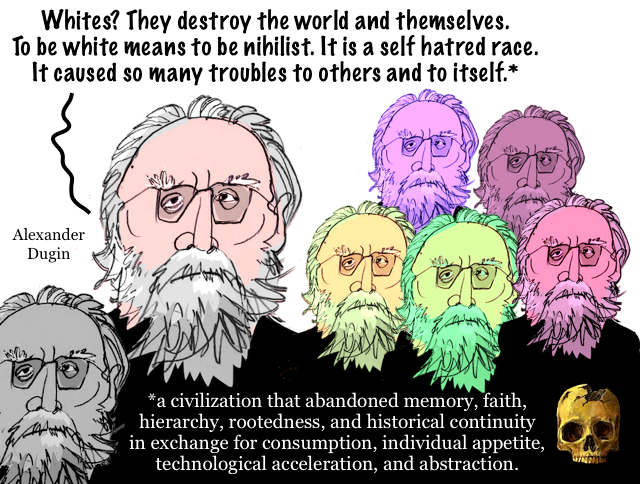
“Whites? They are destroyed the world and themselves. To be white means to be nihilist. It is self hatred race. It caused so many troubles to others and to itself. It lost the right to be something. No arguments to support their existence.”
Why is Alexander Dugin suddenly attacking ‘Whites’?
The Russian philosopher has sparked outrage, but his target is not race – it’s the liberalism and nihilism of modern Western civilization...
BY Constantin von Hoffmeister
This is what Russian philosopher Alexander Dugin wrote on X on May 5, 2026, triggering a storm of harshly critical replies, many of them crossing the line into verbal abuse, mostly accusing him of racist anti-white hatred and hypocrisy. This reaction betrays an utter lack of understanding of Dugin as a thinker.
Dugin’s critics read him as though he were speaking in the language of modern racial politics, identity engineering, and population arithmetic. Instead, he is speaking in the language of civilization, metaphysics, and historical destiny. When he attacks ‘Whites’, he attacks a spiritual condition shaped by centuries of liberalism, materialism, and desacralization. He points towards a civilization that abandoned memory, faith, hierarchy, rootedness, and historical continuity in exchange for consumption, individual appetite, technological acceleration, and abstraction. His target is the modern West as a mode of existence rather than Europeans as a biological people. He describes a civilizational type that dissolved its own foundations through universalism and endless self-criticism until every inherited structure became an object of suspicion or demolition. The statement reads far less like racial hatred than like a furious condemnation of modernity itself.
Anyone familiar with Dugin’s broader body of work can see this pattern immediately. His entire intellectual project revolves around the rejection of liberal universalism and the defense of distinct civilizations against homogenization. He has long expressed support for the French New Right and for European traditions resisting Western liberal culture. That fact alone destroys the shallow interpretation advanced by his opponents. A man calling for the annihilation of Europeans would hardly spend decades engaging with European philosophers, praising European traditionalist movements, or drawing intellectual inspiration from figures such as Martin Heidegger, Julius Evola, and Alain de Benoist. He has remained remarkably consistent for years in his hostility towards liberal modernity and in his distinction between civilization, ontology, and race in the biological sense. His vocabulary often sounds extreme because he writes as a metaphysician rather than as a conventional political commentator.
The real error comes from reading every statement through the narrow framework of identitarian discourse. Contemporary political culture trains people to interpret every conflict through categories of race management, oppression narratives, demographic blocs, and media outrage cycles. Dugin approaches these questions through philosophy, religion, myth, sacred history, and civilizational destiny. He treats the crisis of the West as a crisis of the soul rather than merely a political or ethnic dispute. In his view, the modern West dissolved its own traditions in pursuit of endless progress, economic expansion, consumer comfort, and ideological universalism. Christianity lost transcendence and became mere moral administration. Politics transformed into social regulation. Culture became entertainment. Identity became consumption. Human beings themselves became interchangeable units inside a global market civilization. That process produced the emptiness he associates with nihilism.
This also explains the deeper contradiction inside liberalism itself. Liberalism presents itself as universal, humanitarian, and post-racial, yet in practice it functions as the final global form of Western cultural domination. Liberal modernity universalizes specifically Western historical assumptions and presents them as eternal truths binding upon all peoples and civilizations. Parliamentary democracy, individualism, secularism, market ideology, and the human-rights cult emerge from a particular Western historical experience, yet liberal ideology treats them as mandatory norms for humanity as such. In this sense, liberalism becomes the highest and most expansive form of White supremacism precisely because it aims to dissolve every civilization into a single Western model while claiming moral neutrality. The liberal empire spreads Western ‘values’ and ideas across the planet and calls that process ‘progress’. Dugin’s critique targets this civilizational universalism rather than white people as such. He attacks the missionary impulse of liberal modernity and the spiritual emptiness produced by its global triumph.
This view also carries a profoundly fatalist dimension. The German historical philosopher Oswald Spengler described civilizations as living organisms passing through vigor, hypertrophy, sclerosis, senescence, and eventual death. In his understanding, the Faustian civilization of the West entered its terminal phase long ago. Organic vitality yielded to technocratic rationalization, pecuniary domination, demographic disaster, and spiritual atrophy. Culture calcified into civilization, and civilization ossified into pure mechanism. Dugin inherits much of this morphology. When he speaks about ‘Whites’, he speaks about the cadaveric stage of the contemporary Western order: A civilization consumed by decadence, auto-intoxication, and a historical coma. The West appears less as a living culture than as a gigantic administrative apparatus sustained through inertia, artificial stimulation, and technological prosthesis. From this perspective, its decline appears almost physiological, since the civilization itself lost the animating principle that once coursed through its arteries. Empires ascend, decay, and pass into sepulchral memory. Paradigms perish, and new forms crystallize from the detritus of exhausted epochs. One may therefore hope that whatever succeeds the present Western order may recover form, rootedness, hierarchy, sacred intensity, and civilizational vigor absent from the moribund liberal world now approaching its final convulsion.
Dugin’s language therefore operates on an ontological level. ‘Whiteness’ in this context refers less to a race than to a modern existential condition shaped by uprooted liberal individualism. Dugin often contrasts this condition against civilizations that preserved stronger collective identities, religious institutions, or metaphysical foundations. He sees the modern Atlantic world as the last expression of a civilization that severed itself from transcendence and replaced higher meaning with economics, technocracy, and moral relativism. Whether one agrees with this analysis or rejects it, the philosophical structure behind Dugin’s argument remains obvious to anyone capable of reading beyond surface-level whining.
Prominent figures within the identitarian sphere understand this perfectly well. Their staged outrage functions primarily as political theater rather than genuine confusion. They defend an abstract idea of whiteness rooted in modern identity politics, racial self-consciousness, and liberal-era categories of collective identity. Dugin attacks the liberal core that produced those categories in the first place. For him, liberal modernity destroys every authentic people by reducing identity to biological labeling detached from spiritual form, historical mission, and traditional order. Identitarians treat race as the center of politics. Dugin treats the Logos of civilizations, primordial existence, and the destiny of peoples as the true center of politics. The two worldviews overlap at moments, yet they emerge from radically different intellectual schools.
The entire controversy reveals how shallow modern political interpretation has become. People trained entirely through social media conflict and ideological tribalism lose the ability to recognize metaphysical or civilizational language. Every statement becomes flattened into the vocabulary of race discourse, internet factionalism, and outrage performance. Philosophical arguments become screenshots. Ontological categories become hashtags. A thinker rooted in Heideggerian language, Orthodox mysticism, and civilizational theory gets interpreted as though he were merely another participant in online racial agitation. The result resembles a complete disintegration of interpretive depth.
No one is required to agree with Dugin’s conclusions. A reader may reject his geopolitical vision or his interpretation of modernity. Yet basic intellectual honesty still requires interpreting a thinker according to the logic he actually uses rather than according to the logic imposed by his enemies. Reading Dugin through the lens of liberal racial discourse guarantees misunderstanding from the very beginning. His language belongs to the realm of civilizational metaphysics, plural modes of Being, and spiritual conflict. Anyone approaching his post on X seriously can recognize that reality almost immediately.
https://www.rt.com/news/639581-alexander-dugin-attacking-whites/
PLEASE VISIT:
YOURDEMOCRACY.NET RECORDS HISTORY AS IT SHOULD BE — NOT AS THE WESTERN MEDIA WRONGLY REPORTS IT — SINCE 2005.
Gus Leonisky
POLITICAL CARTOONIST SINCE 1951.
RABID ATHEIST.
WELCOME TO THIS INSANE WORLD….
- By Gus Leonisky at 8 May 2026 - 5:55am
- Gus Leonisky's blog
- Login or register to post comments
no rules....
The world order has collapsed. Now comes the dangerous part
Forty years after the Delhi Declaration, the world is again searching for a new order, but this time without shared rules or a usable blueprint
BY Fyodor Lukyanov
"A new world order must be built to ensure economic justice and equal political security for all nations. An end to the arms race is an essential prerequisite for the establishment of such an order.”
This year marks the 40th anniversary of those words from the Soviet-Indian Delhi Declaration, signed in 1986 during Mikhail Gorbachev’s visit to India and his talks with Prime Minister Rajiv Gandhi. It was one of the first major documents of the late Cold War era to openly speak of the need for a ‘new world order’.
At the time, the Soviet leadership believed this order would emerge through what it called ‘new political thinking’. The idea was that former adversaries would abandon confrontation and combine the best elements of their respective systems to create a more stable and equitable international framework. It was an ambitious vision: A joint effort to rebuild global politics from the ruins of ideological rivalry. But history, however, had other plans.
The Soviet Union soon disappeared into a vortex of internal crises before vanishing altogether from the world stage. The phrase ‘new world order’ survived, but it was quickly repurposed by the administration of President George H.W. Bush. In Washington’s interpretation, the concept no longer meant a shared international architecture. It came to mean a liberal order dominated politically and militarily by the US and its allies.
In reality, this wasn’t an entirely new order at all. It was an extension of the post-1945 system, only now without the counterweight of the Soviet Union.
For a time, many believed this arrangement represented the natural endpoint of history. Yet contrary to those expectations, once the Cold War confrontation disappeared, global stability didn’t deepen. Instead, tensions gradually intensified and by the beginning of the 2010s, the foundations of the system were already beginning to crack.
Since then, the pace of disintegration has accelerated dramatically.
As humanity moves deeper into the second quarter of the 21st century, it is becoming increasingly difficult to deny that the previous world order has effectively ceased to exist. Whatever doubts may have lingered vanished during the opening months of 2026.
What matters isn’t simply that the strongest states increasingly ignore laws and conventions that once appeared firmly established, more significant is the style in which politics is now conducted. Decisions are impulsive and often openly contradictory as governments act first and improvise later. Statements made today may directly contradict those made yesterday, yet this no longer seems to matter.
This atmosphere shouldn’t necessarily be mistaken for collective irrationality. Rather, many political actors appear convinced that the old restraints have collapsed and that the current moment represents a historic opportunity. The instinct is simple: Seize as much advantage as possible before the landscape hardens again.
The redistribution of the world has already begun. Political influence, transport corridors, resources, financial flows, technological ecosystems, and even cultural and religious spheres are all being contested simultaneously. Every major power is now defining its ambitions and testing the methods by which those ambitions might be achieved.
Of course, mistakes will be expensive, but that, at least, is nothing new in international politics.
The real uncertainty lies elsewhere because the previous era left behind an assumption that periods of chaos are eventually followed by the emergence of a new equilibrium. After disorder comes structure and after confrontation comes a new framework. But there’s no guarantee this time.
The international system today isn’t an empty construction site waiting for a new design. After major world wars, old structures are often swept away on a vast scale, creating space for something new to emerge, and that’s not the case now.
Instead, the world remains cluttered with institutions and habits inherited from previous eras. Many are discredited or dysfunctional, but they still exist. And even those states that attack these institutions most aggressively continue to use them whenever convenient.
The United Nations system remains an example. Its authority has diminished, yet governments still appeal to it selectively when doing so serves their interests. Likewise, the structures created during the period of liberal globalization have proven more resilient than many expected.
Despite trade wars, sanctions, geopolitical fragmentation, and increasingly open rivalry among major powers, the global economic network continues to resist complete disintegration. Supply chains bend but do not fully break. Markets remain interconnected. Even countries engaged in fierce political confrontation continue trading with one another indirectly.
This resilience appears to frustrate some of the very powers trying to reshape the system.
The creation of a genuinely new international framework will therefore be an exceptionally painful process. The available raw material consists of fragments from different historical periods, ideological systems, and institutional models. Somehow these incompatible components must be assembled into something functional.
Some states are attempting this carefully, selecting elements that might fit together into a relatively coherent structure. Others are behaving more crudely, trying to hammer incompatible pieces into place through pressure or intimidation. The danger is obvious: Excessive force may not produce stability at all, but only further fragmentation.
Yet perhaps the defining feature of the present moment is that nobody possesses a real blueprint for what comes next. During earlier periods of transition, however flawed the visions may have been, leaders at least believed they understood the destination.
However, today there is no such clarity and the latest struggle to construct a new world order comes without universal principles or even a broadly accepted idea of what success would look like. The old rules are fading, but no agreed replacements have emerged.
For now, the message confronting every major power is brutally simple: Do it yourself, and then try to live with the consequences.
https://www.rt.com/news/639580-world-order-has-collapsed/
READ FROM TOP.
PLEASE VISIT:
YOURDEMOCRACY.NET RECORDS HISTORY AS IT SHOULD BE — NOT AS THE WESTERN MEDIA WRONGLY REPORTS IT — SINCE 2005.
Gus Leonisky
POLITICAL CARTOONIST SINCE 1951.
RABID ATHEIST.
WELCOME TO THIS INSANE WORLD….