Search
Recent comments
- hitler's nest....
5 hours 51 min ago - no toilets.....
8 hours 24 min ago - old forests...
13 hours 35 min ago - ceasefire.....
14 hours 21 min ago - diesels....
14 hours 29 min ago - security...
21 hours 13 min ago - the west knows it, but....
21 hours 52 min ago - keep out....
1 day 5 hours ago - gains/losses....
1 day 5 hours ago - reefs in peril....
1 day 6 hours ago
Democracy Links
Member's Off-site Blogs
value...

AS THE PRICE OF GOLD AND THE AVAILABILITY OF OIL ARE ROCKING THE BOAT SO TO SPEAK, AFTER YEARS OF PETRODOLLAR AND AMERICAN DOMINATION OF ECONOMIC EXCHANGE, ONE NEEDS TO INVESTIGATE OUR RELATIONSHIP WITH VALUES…
BUYING AND SELLING STUFF IS BASICALLY AT THE CORE OF DEMOCRATIC VALUES. WE CAN BELIEVE IN HUMAN RIGHTS, IN EQUAL VOTES AND ALL EQUITABLE HANDSHAKES, WE ARE AT THE MERCY OF WHAT WE NEED AND WANT. WANTS AND NEEDS ARE OFTEN THE RESULTANTS OF MANIPULATION OF POLITICAL MECHANISMS AND OF PRIVATE ENTERPRISING COMPETITION.
IN A NUTSHELL, SOCIALISM AND COMMUNISM TEND TO DIMINISH THE ROLE OF COMPETITION IN SOCIETIES, WHILE CAPITALISM EXPLOITS COMPETITION TO THE MAX. OF COURSE CAPITALISM WOULD NOT WORK UNLESS THERE WERE A BIT OF FALL-BACK MECHANISMS TO PREVENT BUYERS BECOMING UNABLE TO BUY. THUS GOVERNMENTS HELP THE UNDER-PRIVILEGED, BY GREASING THE ECONOMIC WHEELS WITH “SOCIAL PROGRAMS”.
IN OUR DEMOCRACIES, THIS IS THE MOST DIFFICULT BALANCING ACT OF POLITICS, BETWEEN THE LIBERTARIANS AND THE SOCIAL INTERVENTIONISTS.
SOMEONE LIKE TRUMP — A BOOFHEAD OPPORTUNIST — HAS REMOVED THE SKIN OF THE ECONOMIC BEAST AND EXPOSED THE RAW NERVE OF WHAT HAS ALWAYS BEEN A DISCREET EXTORTION SYSTEM BETWEEN HUMANS.
LET’S EXPLORE THE SYSTEM BEFORE SOMEONE BLOWS UP THE PLANET…
WE KNOW THAT THE BRICS ASSOCIATION IS BASED ON BETTER COOPERATION AND LESS CONTROL FROM THE HEADQUARTERS OF ROBBERY IN WASHINGTON… AS CHINA AND RUSSIA BUY GOLD AS IF THERE WAS NO TOMORROW, WE SHOULD LIFT THE LID ON VALUES, BOTH ON WHAT WE BUY AND SELL, AND OF OUR DEMOCRATIC IDEALS….
Gus Leonisky
DETOUR:
Remember when pet rocks were all the rage? They actually had little value other than the emotional one attached to people’s egos. People were buying pet rocks in droves, so this made others think they had potential value, but they did not.
Pet rocks, cabbage patch dolls, Ivy League hats and similar items sold because they were popular trends, but they had very little value.
Popularity makes many people think that things are worth more than they are, so they pay more for them, but spending money on such things is wasteful unless popular items represent good investments.
A few years ago, gold and silver ownership was all the rage. The more people bought, the higher the prices went. Some people sold out at the right time and made good profits. Others waited too long and lost money.
When spending on big-ticket items, people should set popularity aside and look at actual value. Doing this is one of the best ways to protect your money.
https://discover.hubpages.com/money/How-to-Know-the-Real-Value-of-Things
VALUE: [1888 ENCYCLOPAEDIA BRITANNICA]
In most departments of economic theory it is convenient to use as the basis of the exposition the opinions of J. S. Mill, not only because he has embodied in his treatise in a remarkable manner nearly everything of importance from the theoretical standpoint in the work of his predecessors, but also because most of the recent advances in economic science have been made by way of criticism or development of his views.
This observation is especially true of the theory of value.
In this subject Mill had digested the mass of previous learning with such effect that he commences his treatment with the remark :
"Happily there is nothing in the laws of value which remains for the present or any future writer to clear up the theory of the subject is complete.
The only difficulty to be overcome is that of so stating it as to solve by anticipation the chief perplexities which occur in applying it."
Curiously enough this part of economic theory was the first to receive at the hands of Jevons and others serious modification, the nature and need for which can, however, only be properly understood after a preliminary examination of the old orthodox position.
As regards the question of definition, Mill starts with the distinction somewhat loosely drawn by Adam Smith between value in use and value in exchange.
When we say that a thing possesses a certain value in use, we say in more words than are necessary that it is useful: that is to say value is an awkward phrase for utility….
………
EQUATION OF PRODUCTION:
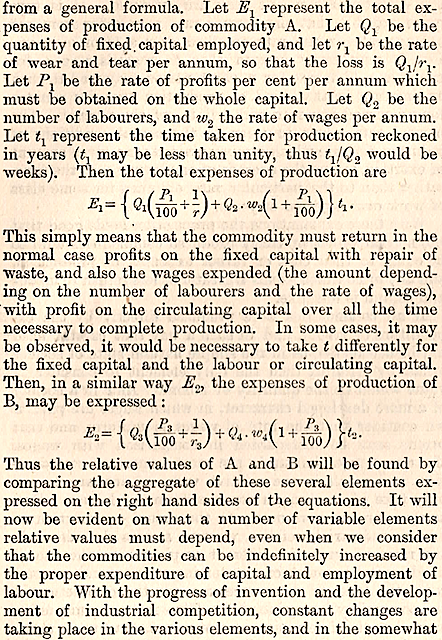
………
… a slight margin of profit suffices to expand or diminish an export trade, this answer seems too vague and unreal.
The most probable solution seems to be that the rates of exchange will be so adjusted as to give to the exporters the ordinary rate of profits current in their respective countries. In general it is clear that the rate will be determined independently of the foreign trade, or at least that the foreign trade is only one factor to be considered.
It is said, for example, that the annual value of the agricultural produce of the United Kingdom exceeds the total amount of the exports.
If the rate of profit falls, a trade which before was impossible becomes possible. The opinion may be hazarded that the best way of explaining the general theory of international values would be to start with the foreign exchanges; but such an investigation is too technical and difficult for this place. (J. S. N.)
VAMPIRE, a term, apparently of Servian origin (wampir), originally applied in eastern Europe to blood-sucking ghosts, but in modern usage transferred to one or more species of blood-sucking bats inhabiting South America.
In the first-mentioned meaning a vampire is usually supposed to be the soul of a dead man which quits the buried body by night to suck the blood of living persons. Tonso when the vampire's crave…..
.....
GUSNOTE: ON MY OLD ENCYCLOPAEDIA BRITANNICA, [PUBLISHED 1888] THE ENTRY VALUE IS FOLLOWED BY VAMPIRE… THE FLOW-ON IS SURREAL… AS WE OFTEN SEE ECONOMY, ECONOMISTS AND VALUE OF THINGS AS BLOOD-SUCKING….
PRESENTLY, OUR BIGGEST BLOOD-SUCKING BEAST IS DONALD TRUMP [NOT AN ECONOMIST, BUT A THIEF], WITH HIS ECONOMIC FIDDLES BASED ON BLUDGEONING EVERYTHING THAT MOVES, WITH WAR AND TARIFFS FOR HIS PERSONAL GAINS, UNDER FAKE PRETEXES… BUT I DIGRESS…
=====================
John Stuart Mill (1806-1873) profoundly influenced the shape of nineteenth century British thought and political discourse. His substantial corpus of works includes texts in logic, epistemology, economics, social and political philosophy, ethics, metaphysics, religion, and current affairs. Among his most well-known and significant are A System of Logic, Principles of Political Economy, On Liberty, Utilitarianism, The Subjection of Women, Three Essays on Religion, and his Autobiography.Mill’s education at the hands of his imposing father, James Mill, fostered both intellectual development (Greek at the age of three, Latin at eight) and a propensity towards reform. James Mill and Jeremy Bentham led the “Philosophic Radicals,” who advocated for rationalization of the law and legal institutions, universal male suffrage, the use of economic theory in political decision-making, and a politics oriented by human happiness rather than natural rights or conservatism. In his twenties, the younger Mill felt the influence of historicism, French social thought, and Romanticism, in the form of thinkers like Coleridge, the St. Simonians, Thomas Carlyle, Goethe, and Wordsworth. This led him to begin searching for a new philosophic radicalism that would be more sensitive to the limits on reform imposed by culture and history and would emphasize the cultivation of our humanity, including the cultivation of dispositions of feeling and imagination (something he thought had been lacking in his own education).
=======================
William Stanley Jevons FRS (/ˈdʒɛvənz/;[2] 1 September 1835 – 13 August 1882) was an English economist and logician.
Irving Fisher described Jevons's book The Theory of Political Economy (1871) as the start of the mathematical method in economics.[3] It made the case that economics, as a science concerned with quantities, is necessarily mathematical.[4] In so doing, it expounded upon the "final" (marginal) utility theory of value. Jevons' work, along with similar discoveries made by Carl Menger in Vienna (1871) and by Léon Walras in Switzerland (1874), marked the opening of a new period in the history of economic thought. Jevons's contribution to the marginal revolution in economics in the late 19th century established his reputation as a leading political economist and logician of the time.
Jevons broke off his studies of the natural sciences in London in 1854 to work as an assayer in Sydney, [AUSTRALIA] where he acquired an interest in political economy.
……
Towards the end of 1853, after having spent two years at University College, where his favourite subjects were chemistry and botany, he received an offer as metallurgical assayer for the new mint in Australia. The idea of leaving the UK was distasteful, but pecuniary considerations had, in consequence of the failure of his father's firm in 1847, become of vital importance, and he accepted the post.[9]
Jevons left the UK for Sydney in June 1854 to take up a role as an Assayer at the Mint. Jevons lived with his colleague and his wife first at Church Hill, then in Annangrove at Petersham and at Double Bay before returning to England. In letters to his family he described his life, took photographs and produced a social map of Sydney. Jevons returned to England via America five years later.[10]
………………
Returning to the UK in 1859, he issued a "Notice of a General Mathematical Theory of Political Economy" in 1862, outlining the marginal utility theory of value, and published A Serious Fall in the Value of Gold in 1863. For Jevons, the utility or value to a consumer of an additional unit of a product is inversely related to the number of units of that product he already owns, at least beyond some critical quantity.
Jevons received public recognition for his work on The Coal Question (1865), in which he called attention to the gradual exhaustion of Britain's coal supplies and also put forth the view that increases in energy production efficiency leads to more, not less, consumption.[5]: 7f, 161f This view is known today as the Jevons paradox, named after him. Due to this particular work, Jevons is regarded today as the first economist of some standing to develop an 'ecological' perspective on the economy.[6]: 295f [7]: 147 [5]: 2
…………
Jevons arrived quite early in his career at the doctrines that constituted his most characteristic and original contributions to economics and logic. The theory of utility, which became the keynote of his general theory of political economy, was practically formulated in a letter written in 1860;[12] and the germ of his logical principles of the substitution of similars may be found in the view which he propounded in another letter written in 1861, that "philosophy would be found to consist solely in pointing out the likeness of things." The theory of utility above referred to, namely, that the degree of utility of a commodity is some continuous mathematical function of the quantity of the commodity available, together with the implied doctrine that economics is essentially a mathematical science, took more definite form in a paper on "A General Mathematical Theory of Political Economy", written for the British Association in 1862. This paper does not appear to have attracted much attention either in 1862 or on its publication four years later in the Journal of the Statistical Society; and it was not till 1871, when the Theory of Political Economy appeared, that Jevons set forth his doctrines in a fully developed form.[9]
https://en.wikipedia.org/wiki/William_Stanley_Jevons?ysclid=mnuqnpp5j1269694146
=====================
Democracy as a Universal Value
BY Amartya Kumar Sen, winner of the 1998 Nobel Prize for Economics, Master of Trinity College, Cambridge, and Lamont University Professor Emeritus at Harvard University .
SEE: https://www.ebsco.com/research-starters/biography/amartya-sen
In the summer of 1997, I was asked by a leading Japanese newspaper what I thought was the most important thing that had happened in the twentieth century. I found this to be an unusually thought-provoking question, since so many things of gravity have happened over the last hundred years. The European empires, especially the British and French ones that had so dominated the nineteenth century, came to an end. We witnessed two world wars. We saw the rise and fall of fascism and Nazism. The century witnessed the rise of communism, and its fall (as in the former Soviet bloc) or radical transformation (as in China). We also saw a shift from the economic dominance of the West to a new economic balance much more dominated by Japan and East and Southeast Asia. Even though that region is going through some financial and economic problems right now, this is not going to nullify the shift in the balance of the world economy that has occurred over many decades (in the case of Japan, through nearly the entire century). The past hundred years are not lacking in important events.
Nevertheless, among the great variety of developments that have occurred in the twentieth century, I did not, ultimately, have any difficulty in choosing one as the preeminent development of the period: the rise of democracy. This is not to deny that other occurrences have [End Page 3] also been important, but I would argue that in the distant future, when people look back at what happened in this century, they will find it difficult not to accord primacy to the emergence of democracy as the preeminently acceptable form of governance.
The idea of democracy originated, of course, in ancient Greece, more than two millennia ago. Piecemeal efforts at democratization were attempted elsewhere as well, including in India.1 But it is really in ancient Greece that the idea of democracy took shape and was seriously put into practice (albeit on a limited scale), before it collapsed and was replaced by more authoritarian and asymmetric forms of government. There were no other kinds anywhere else.
Thereafter, democracy as we know it took a long time to emerge. Its gradual–and ultimately triumphant–emergence as a working system of governance was bolstered by many developments, from the signing of the Magna Carta in 1215, to the French and the American Revolutions in the eighteenth century, to the widening of the franchise in Europe and North America in the nineteenth century. It was in the twentieth century, however, that the idea of democracy became established as the “normal” form of government to which any nation is entitled–whether in Europe, America, Asia, or Africa.
The idea of democracy as a universal commitment is quite new, and it is quintessentially a product of the twentieth century. The rebels who forced restraint on the king of England through the Magna Carta saw the need as an entirely local one. In contrast, the American fighters for independence and the revolutionaries in France contributed greatly to an understanding of the need for democracy as a general system. Yet the focus of their practical demands remained quite local–confined, in effect, to the two sides of the North Atlantic, and founded on the special economic, social, and political history of the region.
Throughout the nineteenth century, theorists of democracy found it quite natural to discuss whether one country or another was “fit for democracy.” This thinking changed only in the twentieth century, with the recognition that the question itself was wrong: A country does not have to be deemed fit for democracy; rather, it has to become fit through democracy. This is indeed a momentous change, extending the potential reach of democracy to cover billions of people, with their varying histories and cultures and disparate levels of affluence.
It was also in this century that people finally accepted that “franchise for all adults” must mean all–not just men but also women. When in January of this year I had the opportunity to meet Ruth Dreyfuss, the president of Switzerland and a woman of remarkable distinction, it gave me occasion to recollect that only a quarter century ago Swiss women could not even vote. We have at last reached the point of recognizing that the coverage of universality, like the quality of mercy, is not strained. [End Page 4]
I do not deny that there are challenges to democracy’s claim to universality. These challenges come in many shapes and forms–and from different directions. Indeed, that is part of the subject of this essay. I have to examine the claim of democracy as a universal value and the disputes that surround that claim. Before I begin that exercise, however, it is necessary to grasp clearly the sense in which democracy has become a dominant belief in the contemporary world.
In any age and social climate, there are some sweeping beliefs that seem to command respect as a kind of general rule–like a “default” setting in a computer program; they are considered right unless their claim is somehow precisely negated. While democracy is not yet universally practiced, nor indeed uniformly accepted, in the general climate of world opinion, democratic governance has now achieved the status of being taken to be generally right. The ball is very much in the court of those who want to rubbish democracy to provide justification for that rejection.
This is a historic change from not very long ago, when the advocates of democracy for Asia or Africa had to argue for democracy with their backs to the wall. While we still have reason enough to dispute those who, implicitly or explicitly, reject the need for democracy, we must also note clearly how the general climate of opinion has shifted from what it was in previous centuries. We do not have to establish afresh, each time, whether such and such a country (South Africa, or Cambodia, or Chile) is “fit for democracy” (a question that was prominent in the discourse of the nineteenth century); we now take that for granted. This recognition of democracy as a universally relevant system, which moves in the direction of its acceptance as a universal value, is a major revolution in thinking, and one of the main contributions of the twentieth century. It is in this context that we have to examine the question of democracy as a universal value.
The Indian Experience
How well has democracy worked? While no one really questions the role of democracy in, say, the United States or Britain or France, it is still a matter of dispute for many of the poorer countries in the world. This is not the occasion for a detailed examination of the historical record, but I would argue that democracy has worked well enough.
India, of course, was one of the major battlegrounds of this debate. In denying Indians independence, the British expressed anxiety over the Indians’ ability to govern themselves. India was indeed in some disarray in 1947, the year it became independent. It had an untried government, an undigested partition, and unclear political alignments, combined with widespread communal violence and social disorder. It was hard to have faith in the future of a united and democratic India. [End Page 5] And yet, half a century later, we find a democracy that has, taking the rough with the smooth, worked remarkably well. Political differences have been largely tackled within the constitutional guidelines, and governments have risen and fallen according to electoral and parliamentary rules. An ungainly, unlikely, inelegant combination of differences, India nonetheless survives and functions remarkably well as a political unit with a democratic system. Indeed, it is held together by its working democracy.
India has also survived the tremendous challenge of dealing with a variety of major languages and a spectrum of religions. Religious and communal differences are, of course, vulnerable to exploitation by sectarian politicians, and have indeed been so used on several occasions (including in recent months), causing massive consternation in the country. Yet the fact that consternation greets sectarian violence and that condemnation of such violence comes from all sections of the country ultimately provides the main democratic guarantee against the narrowly factional exploitation of sectarianism. This is, of course, essential for the survival and prosperity of a country as remarkably varied as India, which is home not only to a Hindu majority, but to the world’s third largest Muslim population, to millions of Christians and Buddhists, and to most of the world’s Sikhs, Parsees, and Jains.
Democracy and Economic Development
It is often claimed that nondemocratic systems are better at bringing about economic development. This belief sometimes goes by the name of “the Lee hypothesis,” due to its advocacy by Lee Kuan Yew, the leader and former president of Singapore. He is certainly right that some disciplinarian states (such as South Korea, his own Singapore, and postreform China) have had faster rates of economic growth than many less authoritarian ones (including India, Jamaica, and Costa Rica). The “Lee hypothesis,” however, is based on sporadic empiricism, drawing on very selective and limited information, rather than on any general statistical testing over the wide-ranging data that are available. A general relation of this kind cannot be established on the basis of very selective evidence. For example, we cannot really take the high economic growth of Singapore or China as “definitive proof” that authoritarianism does better in promoting economic growth, any more than we can draw the opposite conclusion from the fact that Botswana, the country with the best record of economic growth in Africa, indeed with one of the finest records of economic growth in the whole world, has been an oasis of democracy on that continent over the decades. We need more systematic empirical studies to sort out the claims and counterclaims.
There is, in fact, no convincing general evidence that authoritarian [End Page 6] governance and the suppression of political and civil rights are really beneficial to economic development. Indeed, the general statistical picture does not permit any such induction. Systematic empirical studies (for example, by Robert Barro or by Adam Przeworski) give no real support to the claim that there is a general conflict between political rights and economic performance. The directional linkage seems to depend on many other circumstances, and while some statistical investigations note a weakly negative relation, others find a strongly positive one. If all the comparative studies are viewed together, the hypothesis that there is no clear relation between economic growth and democracy in either direction remains extremely plausible. Since democracy and political liberty have importance in themselves, the case for them therefore remains untarnished.
The question also involves a fundamental issue of methods of economic research. We must not only look at statistical connections, but also examine and scrutinize the causal processes that are involved in economic growth and development. The economic policies and circumstances that led to the economic success of countries in East Asia are by now reasonably well understood. While different empirical studies have varied in emphasis, there is by now broad consensus on a list of “helpful policies” that includes openness to competition, the use of international markets, public provision of incentives for investment and export, a high level of literacy and schooling, successful land reforms, and other social opportunities that widen participation in the process of economic expansion. There is no reason at all to assume that any of these policies is inconsistent with greater democracy and had to be forcibly sustained by the elements of authoritarianism that happened to be present in South Korea or Singapore or China. Indeed, there is overwhelming evidence to show that what is needed for generating faster economic growth is a friendlier economic climate rather than a harsher political system.
To complete this examination, we must go beyond the narrow confines of economic growth and scrutinize the broader demands of economic development, including the need for economic and social security. In that context, we have to look at the connection between political and civil rights, on the one hand, and the prevention of major economic disasters, on the other. Political and civil rights give people the opportunity to draw attention forcefully to general needs and to demand appropriate public action. The response of a government to the acute suffering of its people often depends on the pressure that is put on it. The exercise of political rights (such as voting, criticizing, protesting, and the like) can make a real difference to the political incentives that operate on a government.
I have discussed elsewhere the remarkable fact that, in the terrible history of famines in the world, no substantial famine has ever occurred [End Page 7] in any independent and democratic country with a relatively free press.4 We cannot find exceptions to this rule, no matter where we look: the recent famines of Ethiopia, Somalia, or other dictatorial regimes; famines in the Soviet Union in the 1930s; China’s 1958-61 famine with the failure of the Great Leap Forward; or earlier still, the famines in Ireland or India under alien rule. China, although it was in many ways doing much better economically than India, still managed (unlike India) to have a famine, indeed the largest recorded famine in world history: Nearly 30 million people died in the famine of 1958-61, while faulty governmental policies remained uncorrected for three full years. The policies went uncriticized because there were no opposition parties in parliament, no free press, and no multiparty elections. Indeed, it is precisely this lack of challenge that allowed the deeply defective policies to continue even though they were killing millions each year. The same can be said about the world’s two contemporary famines, occurring right now in North Korea and Sudan.
Famines are often associated with what look like natural disasters, and commentators often settle for the simplicity of explaining famines by pointing to these events: the floods in China during the failed Great Leap Forward, the droughts in Ethiopia, or crop failures in North Korea. Nevertheless, many countries with similar natural problems, or even worse ones, manage perfectly well, because a responsive government intervenes to help alleviate hunger. Since the primary victims of a famine are the indigent, deaths can be prevented by recreating incomes (for example, through employment programs), which makes food accessible to potential famine victims. Even the poorest democratic countries that have faced terrible droughts or floods or other natural disasters (such as India in 1973, or Zimbabwe and Botswana in the early 1980s) have been able to feed their people without experiencing a famine.
Famines are easy to prevent if there is a serious effort to do so, and a democratic government, facing elections and criticisms from opposition parties and independent newspapers, cannot help but make such an effort. Not surprisingly, while India continued to have famines under British rule right up to independence (the last famine, which I witnessed as a child, was in 1943, four years before independence), they disappeared suddenly with the establishment of a multiparty democracy and a free press.
I have discussed these issues elsewhere, particularly in my joint work with Jean Drèze, so I will not dwell further on them here.5 Indeed, the issue of famine is only one example of the reach of democracy, though it is, in many ways, the easiest case to analyze. The positive role of political and civil rights applies to the prevention of economic and social disasters in general. When things go fine and everything is routinely good, this instrumental role of democracy may not be particularly missed. It is when things get fouled up, for one [End Page 8] reason or another, that the political incentives provided by democratic governance acquire great practical value.
There is, I believe, an important lesson here. Many economic technocrats recommend the use of economic incentives (which the market system provides) while ignoring political incentives (which democratic systems could guarantee). This is to opt for a deeply unbalanced set of ground rules. The protective power of democracy may not be missed much when a country is lucky enough to be facing no serious calamity, when everything is going quite smoothly. Yet the danger of insecurity, arising from changed economic or other circumstances, or from uncorrected mistakes of policy, can lurk behind what looks like a healthy state.
The recent problems of East and Southeast Asia bring out, among other things, the penalties of undemocratic governance. This is so in two striking respects. First, the development of the financial crisis in some of these economies (including South Korea, Thailand, Indonesia) has been closely linked to the lack of transparency in business, in particular the lack of public participation in reviewing financial arrangements. The absence of an effective democratic forum has been central to this failing. Second, once the financial crisis led to a general economic recession, the protective power of democracy–not unlike that which prevents famines in democratic countries–was badly missed in a country like Indonesia. The newly dispossessed did not have the hearing they needed.
A fall in total gross national product of, say, 10 percent may not look like much if it follows in the wake of a growth rate of 5 or 10 percent every year over the past few decades, and yet that decline can decimate lives and create misery for millions if the burden of contraction is not widely shared but allowed to be heaped on those–the unemployed or the economically redundant–who can least bear it. The vulnerable in Indonesia may not have missed democracy when things went up and up, but that lacuna kept their voice low and muffled as the unequally shared crisis developed. The protective role of democracy is strongly missed when it is most needed.
The Functions of Democracy
I have so far allowed the agenda of this essay to be determined by the critics of democracy, especially the economic critics. I shall return to criticisms again, taking up the arguments of the cultural critics in particular, but the time has come for me to pursue further the positive analysis of what democracy does and what may lie at the base of its claim to be a universal value.
What exactly is democracy? We must not identify democracy with majority rule. Democracy has complex demands, which certainly [End Page 9] include voting and respect for election results, but it also requires the protection of liberties and freedoms, respect for legal entitlements, and the guaranteeing of free discussion and uncensored distribution of news and fair comment. Even elections can be deeply defective if they occur without the different sides getting an adequate opportunity to present their respective cases, or without the electorate enjoying the freedom to obtain news and to consider the views of the competing protagonists. Democracy is a demanding system, and not just a mechanical condition (like majority rule) taken in isolation.
Viewed in this light, the merits of democracy and its claim as a universal value can be related to certain distinct virtues that go with its unfettered practice. Indeed, we can distinguish three different ways in which democracy enriches the lives of the citizens. First, political freedom is a part of human freedom in general, and exercising civil and political rights is a crucial part of good lives of individuals as social beings. Political and social participation has intrinsic value for human life and well-being. To be prevented from participation in the political life of the community is a major deprivation.
Second, as I have just discussed (in disputing the claim that democracy is in tension with economic development), democracy has an important instrumental value in enhancing the hearing that people get in expressing and supporting their claims to political attention (including claims of economic needs). Third–and this is a point to be explored further–the practice of democracy gives citizens an opportunity to learn from one another, and helps society to form its values and priorities. Even the idea of “needs,” including the understanding of “economic needs,” requires public discussion and exchange of information, views, and analyses. In this sense, democracy has constructive importance, in addition to its intrinsic value for the lives of the citizens and its instrumental importance in political decisions. The claims of democracy as a universal value have to take note of this diversity of considerations.
The conceptualization–even comprehension–of what are to count as “needs,” including “economic needs,” may itself require the exercise of political and civil rights. A proper understanding of what economic needs are–their content and their force–may require discussion and exchange. Political and civil rights, especially those related to the guaranteeing of open discussion, debate, criticism, and dissent, are central to the process of generating informed and considered choices. These processes are crucial to the formation of values and priorities, and we cannot, in general, take preferences as given independently of public discussion, that is, irrespective of whether open interchange and debate are permitted or not.
In fact, the reach and effectiveness of open dialogue are often underestimated in assessing social and political problems. For example, [End Page 10] public discussion has an important role to play in reducing the high rates of fertility that characterize many developing countries. There is substantial evidence that the sharp decline in fertility rates in India’s more literate states has been much influenced by public discussion of the bad effects of high fertility rates on the community at large, and especially on the lives of young women. If the view has emerged in, say, the Indian state of Kerala or of Tamil Nadu that a happy family in the modern age is a small family, much discussion and debate have gone into the formation of these perspectives. Kerala now has a fertility rate of 1.7 (similar to that of Britain and France, and well below China’s 1.9), and this has been achieved with no coercion, but mainly through the emergence of new values–a process in which political and social dialogue has played a major part. Kerala’s high literacy rate (it ranks higher in literacy than any province in China), especially among women, has greatly contributed to making such social and political dialogue possible.
Miseries and deprivations can be of various kinds, some more amenable to social remedies than others. The totality of the human predicament would be a gross basis for identifying our “needs.” For example, there are many things that we might have good reason to value and thus could be taken as “needs” if they were feasible. We could even want immortality, as Maitreyee, that remarkable inquiring mind in the Upanishads, famously did in her 3000-year old conversation with Yajnvalkya. But we do not see immortality as a “need” because it is clearly unfeasible. Our conception of needs relates to our ideas of the preventable nature of some deprivations and to our understanding of what can be done about them. In the formation of understandings and beliefs about feasibility (particularly, social feasibility), public discussions play a crucial role. Political rights, including freedom of expression and discussion, are not only pivotal in inducing social responses to economic needs, they are also central to the conceptualization of economic needs themselves.
Universality of Values
If the above analysis is correct, then democracy’s claim to be valuable does not rest on just one particular merit. There is a plurality of virtues here, including, first, the intrinsic importance of political participation and freedom in human life; second, the instrumental importance of political incentives in keeping governments responsible and accountable; and third, the constructive role of democracy in the formation of values and in the understanding of needs, rights, and duties. In the light of this diagnosis, we may now address the motivating question of this essay, namely the case for seeing democracy as a universal value. [End Page 11]
In disputing this claim, it is sometimes argued that not everyone agrees on the decisive importance of democracy, particularly when it competes with other desirable things for our attention and loyalty. This is indeed so, and there is no unanimity here. This lack of unanimity is seen by some as sufficient evidence that democracy is not a universal value.
Clearly, we must begin by dealing with a methodological question: What is a universal value? For a value to be considered universal, must it have the consent of everyone? If that were indeed necessary, then the category of universal values might well be empty. I know of no value–not even motherhood (I think of Mommie Dearest)–to which no one has ever objected. I would argue that universal consent is not required for something to be a universal value. Rather, the claim of a universal value is that people anywhere may have reason to see it as valuable.
When Mahatma Gandhi argued for the universal value of non-violence, he was not arguing that people everywhere already acted according to this value, but rather that they had good reason to see it as valuable. Similarly, when Rabindranath Tagore argued for “the freedom of the mind” as a universal value, he was not saying that this claim is accepted by all, but that all do have reason enough to accept it–a reason that he did much to explore, present, and propagate.6 Understood in this way, any claim that something is a universal value involves some counterfactual analysis–in particular, whether people might see some value in a claim that they have not yet considered adequately. All claims to universal value–not just that of democracy–have this implicit presumption.
I would argue that it is with regard to this often implicit presumption that the biggest attitudinal shift toward democracy has occurred in the twentieth century. In considering democracy for a country that does not have it and where many people may not yet have had the opportunity to consider it for actual practice, it is now presumed that the people involved would approve of it once it becomes a reality in their lives. In the nineteenth century this assumption typically would have not been made, but the presumption that is taken to be natural (what I earlier called the “default” position) has changed radically during the twentieth century.
It must also be noted that this change is, to a great extent, based on observing the history of the twentieth century. As democracy has spread, its adherents have grown, not shrunk. Starting off from Europe and America, democracy as a system has reached very many distant shores, where it has been met with willing participation and acceptance. Moreover, when an existing democracy has been overthrown, there have been widespread protests, even though these protests have often been brutally suppressed. Many people have been willing to risk their lives in the fight to bring back democracy. [End Page 12]
Some who dispute the status of democracy as a universal value base their argument not on the absence of unanimity, but on the presence of regional contrasts. These alleged contrasts are sometimes related to the poverty of some nations. According to this argument, poor people are interested, and have reason to be interested, in bread, not in democracy. This oft-repeated argument is fallacious at two different levels.
First, as discussed above, the protective role of democracy may be particularly important for the poor. This obviously applies to potential famine victims who face starvation. It also applies to the destitute thrown off the economic ladder in a financial crisis. People in economic need also need a political voice. Democracy is not a luxury that can await the arrival of general prosperity.
Second, there is very little evidence that poor people, given the choice, prefer to reject democracy. It is thus of some interest to note that when an erstwhile Indian government in the mid-1970s tried out a similar argument to justify the alleged “emergency” (and the suppression of various political and civil rights) that it had declared, an election was called that divided the voters precisely on this issue. In that fateful election, fought largely on this one overriding theme, the suppression of basic political and civil rights was firmly rejected, and the Indian electorate–one of the poorest in the world–showed itself to be no less keen on protesting against the denial of basic liberties and rights than on complaining about economic deprivation.
To the extent that there has been any testing of the proposition that the poor do not care about civil and political rights, the evidence is entirely against that claim. Similar points can be made by observing the struggle for democratic freedoms in South Korea, Thailand, Bangladesh, Pakistan, Burma, Indonesia, and elsewhere in Asia. Similarly, while political freedom is widely denied in Africa, there have been movements and protests against such repression whenever circumstances have permitted them.
The Argument from Cultural Differences
There is also another argument in defense of an allegedly fundamental regional contrast, one related not to economic circumstances but to cultural differences. Perhaps the most famous of these claims relates to what have been called “Asian values.” It has been claimed that Asians traditionally value discipline, not political freedom, and thus the attitude to democracy must inevitably be much more skeptical in these countries. I have discussed this thesis in some detail in my Morganthau Memorial Lecture at the Carnegie Council on Ethics and International Affairs.
It is very hard to find any real basis for this intellectual claim in the history of Asian cultures, especially if we look at the classical [End Page 13] traditions of India, the Middle East, Iran, and other parts of Asia. For example, one of the earliest and most emphatic statements advocating the tolerance of pluralism and the duty of the state to protect minorities can be found in the inscriptions of the Indian emperor Ashoka in the third century B.C.
Asia is, of course, a very large area, containing 60 percent of the world’s population, and generalizations about such a vast set of peoples is not easy. Sometimes the advocates of “Asian values” have tended to look primarily at East Asia as the region of particular applicability. The general thesis of a contrast between the West and Asia often concentrates on the lands to the east of Thailand, even though there is also a more ambitious claim that the rest of Asia is rather “similar.” Lee Kuan Yew, to whom we must be grateful for being such a clear expositor (and for articulating fully what is often stated vaguely in this tangled literature), outlines “the fundamental difference between Western concepts of society and government and East Asian concepts” by explaining, “when I say East Asians, I mean Korea, Japan, China, Vietnam, as distinct from Southeast Asia, which is a mix between the Sinic and the Indian, though Indian culture itself emphasizes similar values.”
Even East Asia itself, however, is remarkably diverse, with many variations to be found not only among Japan, China, Korea, and other countries of the region, but also within each country. Confucius is the standard author quoted in interpreting Asian values, but he is not the only intellectual influence in these countries (in Japan, China, and Korea for example, there are very old and very widespread Buddhist traditions, powerful for over a millennium and a half, and there are also other influences, including a considerable Christian presence). There is no homogeneous worship of order over freedom in any of these cultures.
Furthermore, Confucius himself did not recommend blind allegiance to the state. When Zilu asks him “how to serve a prince,” Confucius replies (in a statement that the censors of authoritarian regimes may want to ponder), “Tell him the truth even if it offends him.”9 Confucius is not averse to practical caution and tact, but does not forgo the recommendation to oppose a bad government (tactfully, if necessary): “When the [good] way prevails in the state, speak boldly and act boldly. When the state has lost the way, act boldly and speak softly.”
Indeed, Confucius provides a clear pointer to the fact that the two pillars of the imagined edifice of Asian values, loyalty to family and obedience to the state, can be in severe conflict with each other. Many advocates of the power of “Asian values” see the role of the state as an extension of the role of the family, but as Confucius noted, there can be tension between the two. The Governor of She told Confucius, [End Page 14] “Among my people, there is a man of unbending integrity: when his father stole a sheep, he denounced him.” To this Confucius replied, “Among my people, men of integrity do things differently: a father covers up for his son, a son covers up for his father–and there is integrity in what they do.”
The monolithic interpretation of Asian values as hostile to democracy and political rights does not bear critical scrutiny. I should not, I suppose, be too critical of the lack of scholarship supporting these beliefs, since those who have made these claims are not scholars but political leaders, often official or unofficial spokesmen for authoritarian governments. It is, however, interesting to see that while we academics can be impractical about practical politics, practical politicians can, in turn, be rather impractical about scholarship.
It is not hard, of course, to find authoritarian writings within the Asian traditions. But neither is it hard to find them in Western classics: One has only to reflect on the writings of Plato or Aquinas to see that devotion to discipline is not a special Asian taste. To dismiss the plausibility of democracy as a universal value because of the presence of some Asian writings on discipline and order would be similar to rejecting the plausibility of democracy as a natural form of government in Europe or America today on the basis of the writings of Plato or Aquinas (not to mention the substantial medieval literature in support of the Inquisitions).
Due to the experience of contemporary political battles, especially in the Middle East, Islam is often portrayed as fundamentally intolerant of and hostile to individual freedom. But the presence of diversity and variety within a tradition applies very much to Islam as well. In India, Akbar and most of the other Moghul emperors (with the notable exception of Aurangzeb) provide good examples of both the theory and practice of political and religious tolerance. The Turkish emperors were often more tolerant than their European contemporaries. Abundant examples can also be found among rulers in Cairo and Baghdad. Indeed, in the twelfth century, the great Jewish scholar Maimonides had to run away from an intolerant Europe (where he was born), and from its persecution of Jews, to the security of a tolerant and urbane Cairo and the patronage of Sultan Saladin.
Diversity is a feature of most cultures in the world. Western civilization is no exception. The practice of democracy that has won out in the modern West is largely a result of a consensus that has emerged since the Enlightenment and the Industrial Revolution, and particularly in the last century or so. To read in this a historical commitment of the West–over the millennia–to democracy, and then to contrast it with non-Western traditions (treating each as monolithic) would be a great mistake. This tendency toward oversimplification can be seen not only in the writings of some governmental spokesmen [End Page 15] in Asia, but also in the theories of some of the finest Western scholars themselves.
As an example from the writings of a major scholar whose works, in many other ways, have been totally impressive, let me cite Samuel Huntington’s thesis on the clash of civilizations, where the heterogeneities within each culture get quite inadequate recognition. His study comes to the clear conclusion that “a sense of individualism and a tradition of rights and liberties” can be found in the West that are “unique among civilized societies.”12 Huntington also argues that “the central characteristics of the West, those which distinguish it from other civilizations, antedate the modernization of the West.” In his view, “The West was West long before it was modern.”13 It is this thesis that–I have argued–does not survive historical scrutiny.
For every attempt by an Asian government spokesman to contrast alleged “Asian values” with alleged Western ones, there is, it seems, an attempt by a Western intellectual to make a similar contrast from the other side. But even though every Asian pull may be matched by a Western push, the two together do not really manage to dent democracy’s claim to be a universal value.
Where the Debate Belongs
I have tried to cover a number of issues related to the claim that democracy is a universal value. The value of democracy includes its intrinsic importance in human life, its instrumental role in generating political incentives, and its constructive function in the formation of values (and in understanding the force and feasibility of claims of needs, rights, and duties). These merits are not regional in character. Nor is the advocacy of discipline or order. Heterogeneity of values seems to characterize most, perhaps all, major cultures. The cultural argument does not foreclose, nor indeed deeply constrain, the choices we can make today.
Those choices have to be made here and now, taking note of the functional roles of democracy, on which the case for democracy in the contemporary world depends. I have argued that this case is indeed strong and not regionally contingent. The force of the claim that democracy is a universal value lies, ultimately, in that strength. That is where the debate belongs. It cannot be disposed of by imagined cultural taboos or assumed civilizational predispositions imposed by our various pasts.
=======================
Getting It Right: Markets and Choices in a Free Society Paperback – February 7, 1997
by Robert J. Barro (Author)
Since 1991, Robert Barro has been a lively contributor to the Wall Street Journal and other popular financial media. Getting It Right brings together, updates, and expands upon these writings that showcase Barro's agility in applying economic understanding to a wide array of social issues. Barro, a "conservative who takes no prisoners," and a self-described libertarian, believes that most governments have gone much too far in their spending, taxation, and regulation. The dominant theme in these wide-ranging essays is the importance of institutions that ensure property rights and free markets. The discussion deals especially with the appropriate range of government: which areas represent useful public policy and which are unnecessary interference. The first section of the book considers these questions in the context of the determinants of long-run economic growth. In addition to basic economics, Barro assesses related political topics, such as the role of public institutions, the optimal size of countries, and the consequences of default on foreign debt. The second section deals with the proper role and form of monetary policy. Barro argues that government should provide markets with a stable nominal framework and then stay out of the way to best allow for price stability. Writings in the third section cover fiscal and other macroeconomic policies. Topics include the distorting influences of taxation, especially taxes on capital income; infrastructure investment and other government spending; and the consequences of public debt and budget deficits. In a final section, Barro looks at more micro issues such as cartels, tax amnesties, school choice, privatization, cigarette-smoking regulation, endangered species regulation, the market for baseball players, and term limits for politicians.
===============================
THE PICTURE AT TOP IS THAT OF MONA LISA — PAINTED BY LEONARDO DE VINCI — PROBABLY THE MOST EXPENSIVE SINGULAR ART PIECE IN THE WORLD, ASSOCIATED WITH THE PALESTINIANS — PRESENTLY PROBABLY THE LEAST VALUED HUMANS BY PEOPLE WHO SEE ISRAEL AS THE MOST IMPORTANT DUDES ON THIS PLANET...
==============================
PLEASE VISIT:
YOURDEMOCRACY.NET RECORDS HISTORY AS IT SHOULD BE — NOT AS THE WESTERN MEDIA WRONGLY REPORTS IT — SINCE 2005.
Gus Leonisky
POLITICAL CARTOONIST SINCE 1951.
RABID ATHEIST.
WELCOME TO THIS INSANE WORLD….
- By Gus Leonisky at 12 Apr 2026 - 6:40am
- Gus Leonisky's blog
- Login or register to post comments
koalas....
Koalas in NSW are on track for extinction unless we act now to address the ongoing threats to their survival. First and foremost is protecting their habitat. The Liberal-National Government has allowed logging, agriculture and urban development to decimate koala habitat in NSW. The Greens have a plan to stop this and save the koala from extinction.
In 2020, the NSW Parliamentary Inquiry into Koalas found that koalas will become extinct before 2050 if urgent action isn’t taken to protect their habitat and in 2022 koalas were listed as endangered.
Koala populations in NSW have decreased between 33% and 61% since 2001. Around 8,000 koalas were killed in the Black Summer bushfires and it’s estimated there are now less than 20,000 koalas left in the wild in NSW. Despite this, the Liberal-National Government has allowed koala protections to be slowly chipped away, leaving them at threat from logging, agriculture, mining and development.
The Greens have a plan to protect koalas and their habitat across the state from south west Sydney to Lismore to the South Coast.
The Greens will:- Introduce a Moratorium on the Clearing of Koala Habitat
- Introduce a Koala Protection Bill with clear powers that prohibit the destruction of Koala Habitat
- Create a ‘Koala Super-Highway’ to connect Koala Habitat
- End Native Forest Logging
- Create a Great Koala National Park on the Mid-North Coast
- Save Sydney's Koalas
- Empower Local Councils to Protect Koala Habitat
- Urgently act on the climate crisis by ending coal and gas by 2030
IMMEDIATE MORATORIUM ON CLEARING OF KOALA HABITATThe Parliamentary Inquiry into Koalas found that without urgent government action to protect Koala habitat, koalas will become extinct in NSW in the wild before 2050.
The alarm has been well and truly sounded. It’s time to stop the ‘death by a thousand cuts’ attack on Koala habitat and draw a line in the sand when it comes to further destruction.
The Greens will demand an immediate moratorium on the clearing of any further Koala habitat, whether it be for logging, development or agriculture.
INTRODUCE A KOALA HABITAT PROTECTION BILLThe Greens know the only way to protect koalas is to protect all remaining koala habitat wherever it is.
The Greens will introduce legislation in the next Parliament that will prohibit the destruction of koala habitat for urban development, mining or agriculture on public or private land by 2025.
The Greens will also fund the Department of Planning and Environment to comprehensively map all koala habitat prior to the prohibition coming into effect.
CREATE A ‘KOALA SUPER-HIGHWAY’Koalas don’t just need habitat, they need connectivity between their habitat to ensure their long term survival. The Greens plan will protect and expand koala corridors to allow population growth and genetic diversity by:
- Mapping out and protecting all existing koala corridors.
- Revegetating destroyed or potential koala corridors to create new connections.
- Require new developments near koala habitat to include koala corridors with a minimum 450m width.
- Installing fencing and road overpasses and underpasses to better protect koalas in urban areas and crossing busy roads.
END NATIVE FOREST LOGGINGThousands of hectares of koala habitat is logged in state forests across NSW each year. This is a major driver of extinction, not just for our precious koalas, but for many other threatened species like Greater Gliders and Glossy Black Cockatoos.
To top it all off Forestry Corporation, is subsidised millions of dollars each year by the government because their native forestry operations can’t even turn a profit!
Our precious native forests must be protected - for koalas and other threatened species, for the carbon they store and the air and water they clean and for future generations to enjoy. That’s why the Greens will:
- Identify and transfer all koala habitat in state forests to the National Parks estate.
- Rapidly transition out of native forest logging and fund a plan for workers and communities to 100% sustainable plantation forestry industry.
CREATE A GREAT KOALA NATIONAL PARKThe Mid-North Coast contains some of the largest and healthiest koala colonies in Australia. A Great Koala National Park would not only protect koalas but would generate $412 million in visitor expenditure over 15 years and create over 9,800 full-time-equivalent jobs.
The Greens would establish a Great Koala National Park combining 175,000 hectares of state forests and 315,000 hectares of protected area on the Mid North Coast, home to around 20 percent of the NSW koala population.
The Greens will:
- Establish a Great Koala National Park on the Mid-North Coast.
- Develop an economic, conservation and tourism plan for the Park.
- Develop a transition plan, including a structural adjustment package, for forestry workers.
PROTECT KOALAS ON PRIVATE LANDTwo thirds of koalas are found on private land so we can’t save our koalas unless strong laws are in place to stop habitat being cleared for development, agriculture and for other purposes.
In 2020, the Liberal-National Government pushed through laws to remove koala protection and removed protections for koalas on rural lands.
- Create a $1 billion fund to purchase at-risk koala habitat and corridors.
- Reintroduce protections for koalas on rural lands.
- Expand the definition of koala habitat to include land that supports feed trees, shelter trees and dispersal corridors.
- Fund the Department of Planning and Environment to map koala habitat across NSW on private land.
- Introduce Stewardship payments for private landholders to protect and expand koala habitat on their land.
SAVE SYDNEY’S KOALASSouth west Sydney has one of the only Chlamydia free, healthy and growing koala populations in NSW. But urban development on the Cumberland Plain has fragmented and destroyed their habitat.
Developer Lendlease is building its Gilead/ Figtree Hill housing estate right on top of prime koala habitat and corridors in Appin, south west Sydney. Stage 1 is already underway with many mature trees already cut down.
To save Sydney’s koalas any further development of this area must cease and the land conserved for wildlife and future generations.
The Greens will:
- Declare an Upper Georges River Koala National Park.
- Cancel the Macarthur Priority Growth Area.
- Map, Protect and enhance Sydney’s koala corridors.
- Stop Stage 2 of the Figtree Hill development.
- Build underground koala crossings and exclusion fencing along Appin Road.
- Establish a ‘Koala Tourism Centre’ at Campbelltown
EMPOWER COUNCILS TO PROTECT KOALASComprehensive Koala Plans of Management (CKPOMs) allow local councils to identify and protect core koala habitat and are a central part of the government’s strategy to protect koalas.
But despite being introduced in 1994, only a fraction of local councils have an approved CKPOM.
The Greens will:
- Dedicate funding and resources within DPE to fast tracking the assessment and approval of CKPOMs in all councils with koalas by 2030.
- Enable councils to refuse development applications that threaten koala habitat identified in a CKPOM.
- Require councils to map out, protect and have a plan to enhance the connectivity of koala corridors.
HOW THE GREENS HAVE BEEN FIGHTING FOR KOALASThe Greens have not stopped fighting for our precious koalas, both in the parliament and with communities across the state. The Greens have:
https://greens.org.au/nsw/plantosavethekoala
SAVING THE KOALA IS OF NO ECONOMIC VALUE... TO SOME EXTEND IT IS CONTRARY TO THE DEVELOPMENT OF HUMAN ENTERPRISES. BUT SAVING THE KOALA IS THE TREMENDOUS UNDERSTANDING OF THE GREATER VALUE OF LIFE... SAVING THE KOALA IS A PHILOSOPHICAL NEED...THAT TRANSCEND ECONOMIC VALUES...
READ FROM TOP.
PLEASE VISIT:
YOURDEMOCRACY.NET RECORDS HISTORY AS IT SHOULD BE — NOT AS THE WESTERN MEDIA WRONGLY REPORTS IT — SINCE 2005.
Gus Leonisky
POLITICAL CARTOONIST SINCE 1951.
RABID ATHEIST.
WELCOME TO THIS INSANE WORLD….
democracy and trade....
Democracy and Trade: An Empirical Study
Jessica Henson Decker & Jamus Jerome Lim ∗ October 11, 2007
Abstract
The theoretical discussion on globalization has suggested that there are linkages between democracy and trade, although the direction of influ- ence is less certain. Formal empirical studies remain scarce, and have often focused on the question of whether democratic regimes influence trade policy, as opposed to the actual relationship between democracy and trade. This paper seeks to answer the question, “Do democracies trade more?” by applying the gravity equation to a large dataset of bi- lateral trade data for the period 1948-1999, while taking into account the role of democracy. It finds that democracy has a positive effect on trade flows, but only after controlling for trade pair heterogeneity. In addition, it makes the case for studies of this nature to draw a distinction between trade flows in the pre- and post-1990s period of rapid democratization as well as between developed and developing countries.
The crossroads of trade are the meeting place of ideas, the attrition ground of rival customs and beliefs; diversities beget conflict, comparison, thought; superstitions cancel one another, and reason begins.
The Life of Greece (Will Durant)
1 Introduction
The ongoing debate on globalization has often centered around one of its pur- ported benefits: that it fosters a greater degree of involvement by individual citizens in the political process. In other words, it is a question of how glob- alization promotes democracy. Insofar as international trade is a significant indicator of the phenomenon of globalization, this suggests that there should exist a relationship between the extent to which a country trades and its level of democratic participation. Indeed, declarations of such linkages are widely pro- claimed. On one hand, Bonanno (1997, p. 2) states that “[s]trengthening the world’s trading system is one of the major keys to fostering democracy around the world”; on the other, Engler (2003, p. 1) argues that “[free trade] will erode key democratic norms such as workers’ rights and the ability to legislate environmental protections.”
Yet despite the maelstrom generated in the popular press on this topic, academic research on the links between democracy and trade remains somewhat limited. While the empirical literature on the effects of both democracy on economic growth as well as trade on economic growth is large and flourishing,1 relative little has been done in studying how democracy affects trade, or vice versa.
This is not for lack of a theoretical basis, however. The literature on en- dogenous tariff formation (Mayer 1984) predicts that trade policy formulated under the environment of direct democracy follows the preferences of the median voter; while extending this to a representative democracy yields an equilibrium tariff that is a weighted mean of voters’ individually optimal tariffs (Yang 1995). In either case, research anticipates that politically-influenced governments will, as democracy advances, increasingly respond to the desired tariff rates of the electorate. Consider, in a Heckscher-Ohlin world, a relatively labor (capital) abundant country for which the initial selectorate consists of a large fraction of capital (labor) owners. Suppose that this body is then gradually eroded as democratization expands the proportional weight of the relatively abundant non-capital (non-labor) owning class. Vote-maximizing governments will find that high tariff rates—even when fully redistributed back to voters—no longer compensate the income loss due to protection. The result is an increasing bias toward a trade policy that maximizes electorate welfare, and hence one that maximizes the gains from trade. In this case, democracy unambiguously spurs trade.
More recent work on the political economy of protection (Grossman & Help- man 1994) tells a somewhat different story. If rational policymakers maximize a weighted sum of campaign contributions and general welfare, the equilibrium tariff depends on the relative weights placed on each in the government’s ob- jective function. To the extent that special interest groups are more active in a democracy (Olson 1982), they might constitute a greater weight, and therefore a greater level of democracy would lead to higher trade barriers. Conversely, political competition generated in an active democracy might imply that pol- icymakers weight more heavily general versus special interest welfare. These models are silent as to which influence might dominate; however, empirical work testing the protection for sale model has yielded results that are supportive of a positive linkage between democracy and trade (Mitra, Thomakos & Uluba ̧so ̆glu 2002).
Nonetheless, the discussion above overlooks the actual relationship between democracy and trade flows. Needless to say, trade policy need not translate directly to actual trade volumes, since the former is primarily a government- induced policy decision while the latter, a private one. While one would expect a high correlation between trade policy and actual trade outcomes, it is nonethe- less interesting to examine the actual real value of trade between states, and to see if democracy plays a role there.2
This paper seeks to answer the basic question, “Do democracies trade more?” This research direction allows us to abstract from the interesting, but more complex, endogeneity and causality issues that arise when attempting to study the effects of democracy on trade. Instead, the analysis allows for an accounting of whether the debates surrounding free trade and democracy are even justified, and if so, whether these arguments have taken into account empirical realities pertaining to the issue. As a result, the paper will also be able to inform the existing policy debate.
The few empirical papers that have studied this direct effect include the work of Dixon & Moon (1993), who analyze the effect of joint democracy on U.S. exports; Morrow, Siverson & Tabares (1998), who, using data for major powers over 1907–1990, test three competing arguments of the effects of international politics on trade flows, one of which is a joint democracy hypothesis; Mansfield, Milner & Rosendorff (2000), who analyze the effects of alternative democratic regime characteristics on trade flows for members of the interstate system (as classified by Singer & Small (1994)) for five-year periods between 1960 to 1990; and Bliss & Russett (1998), who assess trade in a yearly fashion for 1962 through 1989, using bilateral dyads for the world’s top 14 exporters, each with differing degrees of democratic political institutionalism. All find that democracy has a positive effect on trade.
This research paper contributes to the existing literature on trade policy in three ways. First, it utilizes a very large set of trade data that is not restricted to U.S. trade with other countries, but bilateral trade between these countries as well. Second, the dataset employed is also very long: Observations begin in 1948 and conclude with data up to (and including) the year 1999. In addition, it considers both binary as well as quantitative measures of democracy, as adapted from the Polity IV dataset (Marshall & Jaggers 2003). Third, it exploits panel regression techniques to estimate the full regression, and hence provide a richer analysis that also takes into account country heterogeneity.
The remainder of this paper is organized as follows. Section 2 describes the econometric model used for the present study, as well as the dataset. This section is followed by estimation results (Section 3) and a range of extensions and robustness checks (Section 4). A final section concludes and provides suggestions for future research.
READ MORE: https://mpra.ub.uni-muenchen.de/6077/1/DemocTrade.pdf
READ FROM TOP.
PLEASE VISIT:
YOURDEMOCRACY.NET RECORDS HISTORY AS IT SHOULD BE — NOT AS THE WESTERN MEDIA WRONGLY REPORTS IT — SINCE 2005.
Gus Leonisky
POLITICAL CARTOONIST SINCE 1951.
RABID ATHEIST.
WELCOME TO THIS INSANE WORLD….