Search
Recent comments
- pro-russia?....
17 hours 31 min ago - a house.....
17 hours 39 min ago - swinging fists....
17 hours 46 min ago - fakery....
18 hours 11 min ago - foolish....
19 hours 54 min ago - mali....
1 day 6 hours ago - peace....
1 day 14 hours ago - killing news....
1 day 18 hours ago - defensive.....
1 day 19 hours ago - five goons....
1 day 19 hours ago
Democracy Links
Member's Off-site Blogs
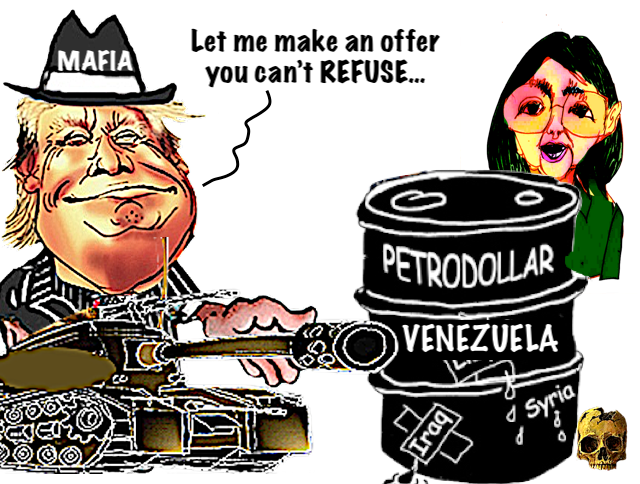
washington made a mafia-style offer: a proposition impossible to refuse...
Certain sectors of the left have positioned themselves as guardians of the faith, judging from abroad the difficult and risky tactical retreat undertaken by the Bolivarian leadership.
“Nothing is easier than to be an idealist at the expense of others.”
Karl Marx, 1858
Venezuela: Don't blame the victim
Roger D. Harris, Francisco Domínguez and María Páez
Under cover of night, the US military abducted the legitimate president of the Bolivarian Republic of Venezuela, Nicolás Maduro Moros, and his wife—a member of the National Assembly—Cilia Flores, on January 3, 2026. Among the collateral damage were more than 100 deaths, including civilians and Cuban and Venezuelan guards.
This unprovoked surprise attack flagrantly violated international law. The hegemonic power acted with the expectation of being able to operate with impunity. Even neighboring progressive governments, such as those of Brazil and Colombia, offered only lukewarm criticism. Former Venezuelan Foreign Minister Yván Gil declared, “We find ourselves alone.” It is in this context that subsequent events must be understood.
This atrocious military action culminated a quarter-century of maneuvers by the United States and its allies (particularly Canada and the United Kingdom) against Venezuela: suffocating sanctions, asset confiscation, diplomatic isolation, cyberattacks, assassination attempts, mercenary invasions, and the creation of a fictitious parallel government. For two months prior to the invasion, the U.S. Navy blocked oil shipments. Despite this, the empire failed to achieve its goal of constitutional regime change.
The resilience of the revolution forced the United States to escalate the conflict. Washington and its allies failed in their attempt to destroy Chavismo, the movement founded by Hugo Chávez and continued by his successor, Nicolás Maduro. The Bolivarian Republic of Venezuela did not collapse or descend into chaos after the decapitation of its leadership. Internal peace prevailed.
The far-right opposition, financed and supported by the United States, failed to seize power; on the contrary, it found itself even more marginalized and plunged into disorder.
The Chavista leadership of the PSUV ensured a smooth constitutional transition, with the swearing-in of Vice President Delcy Rodríguez as interim president. The unity of the high command remained firm, supported by the National Assembly and the Supreme Court. Likewise, the civic-military union, the communes, and the grassroots Chavista institutions offered their full support to the government.
Taking advantage of its overwhelming military superiority, Washington made a mafia-style offer: a proposition impossible to refuse. US Secretary of State Marco Rubio called Delcy Rodríguez on that infamous day and gave her an ultimatum: cooperate with the United States or face the military destruction of the country and the assassination of herself and other leaders. Various versions of this scenario are corroborated by both the corporate press and Chavista sources.
Trump explicitly threatened: “There are those who know where this is coming from.” The alternative was the devastation currently looming over Iran, a country with far superior military capabilities. With US forces deployed throughout the region and off its coast, a military confrontation would have meant annihilation, including the destruction of the oil industry. Rodríguez did what any responsible leader would have done given the available options: she made a tactical retreat in the face of overwhelming force.
Venezuela Has Not Surrendered
All the institutions of the Chavista state and the powerful network of grassroots organizations supporting the revolution remain intact. However, US imperialism, by holding a gun to the government's head, is able to exert substantial coercion that leads to unpleasant decisions, such as the deportation of Alex Saab.
These concessions reflect pressures that we, from the outside, can only imagine. How the solidarity movement should respond is a central question.
Sergio Rodríguez Gelfenstein, a former official in the Chávez government, describes the current negotiations as an essential exercise in national preservation. He emphasizes: “What is at stake is the survival of the State and the Republic; if these were lost, the debate on any other subject would become trivial.” As former Venezuelan Foreign Minister Jorge Arreaza said, “Now, everything is negotiable,” and Washington is forced to maintain constant, daily contact with Caracas.
Legislative reform had long been on Nicolás Maduro’s agenda. However, changes to the laws governing the exploitation of hydrocarbons and solid minerals meant offering generous conditions to international capital to attract much-needed foreign investment (which the Republic of Cuba also does).
The new amnesty law, another planned initiative, is a key instrument for fostering reconciliation and depriving extremist sectors of arguments to incite violence. The law strictly excludes “any person who has committed war crimes, human rights violations, homicides, drug trafficking, or treason against the nation.”
The government is maintaining negotiations with the moderate right. These successive rounds of dialogue have been a constant during Maduro’s presidency.
Rodríguez advised caution and strategic patience. It is worth noting that the core of the Chavista leadership — the Bolivarian National Armed Forces, the United Socialist Party of Venezuela, and the communal organizations — has remained united under enormous pressure, pressure designed precisely to fracture this unity.
Long-Awaited Successes
The United States has changed its position and, in practice, recognizes the legitimacy of the Venezuelan government. The Bolivarian project has not only endured but has also forced its greatest adversary to reach a degree of understanding.
Since 2019, the United States had prohibited transactions with the Central Bank of Venezuela and its major state-owned banks. Previously, US restrictions had isolated Venezuela from the global financial system, preventing access to dollar-denominated transactions and US financial channels. Oil sales to the United States have resumed, and some of the revenue is flowing back into the national economy.
The US-dominated International Monetary Fund (IMF) has resumed relations with the Bolivarian Republic of Venezuela. Rodríguez stated that the Bolivarian nation is not seeking loans from the IMF but rather access to its own frozen funds.
Although sanctions remain largely in place, special licenses and a temporary easing of economic restrictions—intended to provide relief after the earthquakes—have given Venezuela’s beleaguered economy some respite while facilitating the flow of oil to the United States. These concessions are limited and reversible, so the overall structure of the US economic war remains intact. Nevertheless, this situation is preferable to the total oil blockade imposed just before the January 3rd assault.
Interim President Delcy Rodríguez Rodríguez has repeatedly demanded that the Bolivarian Republic of Venezuela be freed from sanctions, while also formally requesting the release of Venezuelan assets abroad to address the devastation caused by the earthquakes. She has even appealed to King Charles III to return the 31 tons of Venezuelan gold held by the Bank of England.
A Transformed Political Landscape
The balance of power facing the current Venezuelan leadership is substantially less favorable than during Chávez's era; it is therefore wrong to judge its concessions based on an idealized standard of the Chavista period.
Some international sectors invoke Chávez's figure to discredit the current leadership. They forget that, during Chávez's presidency, Venezuela sold its oil almost exclusively to the United States, at a time of great dependence. Ignoring this change in context, they launch into childish leftist slogans claiming that Chávez never yielded and that "you don't negotiate with the enemy," forgetting the famous advice Fidel Castro gave him during the 2002 coup: "Don't sacrifice yourself, Hugo."
Chávez governed during a commodities boom that provided the Bolivarian project with resources to deliver material benefits that are now virtually inaccessible due to sanctions. The geopolitical context has changed considerably since Chávez’s time, especially under the current “Donroe Doctrine.” Since Maduro’s victory in July 2024, no left-wing candidate has won an election in Latin America. The right has prevailed in the last seven presidential elections. As long as this general reactionary trend is not reversed, further setbacks are likely.
The aim and cumulative impact of unilateral and illegal coercive measures has been to erode popular support for the government. Years of sweeping sanctions—despite the economic recovery of 2021–2025 following a GDP contraction of approximately 75 percent—have left the Bolivarian Republic of Venezuela in a vulnerable position. Currently, the Venezuelan economy is operating at about 30% of its pre-sanctions level.
The government of the interim president Rodríguez is trying to buy time to revive the economy, although the June 24 earthquakes were a devastating blow. According to the United Nations, the direct physical damage is estimated at over $37 billion, representing more than a third of Venezuela’s gross domestic product.
The majority of Venezuelans desire domestic peace and a return to prosperity, not a confrontation with the empire.
“Unity is the most important thing: without it, nothing is possible; with it, everything is possible.” These were the words of Fidel Castro when organizing the Cuban Revolution in 1956.
What is most dangerous for the sister Bolivarian Revolution is the insinuation that the current leadership has betrayed the cause and that a truly leftist “third way” can be encouraged to replace it. Rival factions have always existed within the Bolivarian movement. But ultimately, political decisions must be made within the Bolivarian Republic of Venezuela itself, without international interference.
These analyses of the “third way,” which reject both Caracas and Washington, often fail to consider what Venezuelans could actually do at this historic turning point: they abound in criticism of what is wrong, but lack viable alternatives.
Not so long ago, far-right fascist figures like María Corina Machado spoke of “cracks and fissures in the Chavista ranks” and predicted “the beginning of a social explosion” against the elected Venezuelan government. Today, some solidarity activists are saying the same thing.
The “tragic essence” of the disunity of the left in Bolivia should serve as a lesson and a warning about what could happen in the Venezuelan nation. The Chavista leadership is painfully aware of this; Hence his energetic effort to establish the broadest possible united front against American colonization. Far from being traitors to the cause, the Rodríguez family and the Minister of the Interior, Diosdado Cabello, represent the most militant Chavistas: fighters who have been present since the very beginning of the revolution.
What Solidarity Requires
Constructive criticism and solidarity-based activism are not mutually exclusive. Dissenting opinions are appropriate when contextualized and presented as part of a collaborative effort to advance toward common goals, and not as an individualistic venting of frustration.
Some sectors of the left have positioned themselves as guardians of the faith, judging negatively from abroad the difficult and risky tactical retreat undertaken by the Bolivarian leadership, even though it avoided a suicidal military confrontation with American imperialism.
The anxiety and disappointment of the international left regarding the withdrawals from Venezuela are understandable. But the Global South is not prepared to fulfill the revolutionary aspirations of those living at the heart of the empire. This, it must be clear, is the task of those at the center of power.
As a Venezuelan activist friend said, “You gringos tell us how to make our revolution when our problem is that you haven’t managed to make yours.”
Venezuelans will determine their own path without foreign interference, from either the right or the left. Solidarity requires support and guidance, not imposition. The internationals living in the United States, Canada, and the United Kingdom should focus primarily on our own imperialists. All other contradictions are secondary.
The solidarity movement must unite in the broadest possible alliance around the defense of national sovereignty and the right to self-determination, firmly opposing the farce of the trial of Nicolás Maduro and Cilia Flores in New York, demanding the lifting of all sanctions, and calling for the restitution of stolen property.
A united people will never be defeated.
Roger D. Harris is the founder of the Venezuela Solidarity Network in North America.
Francisco Domínguez is the national secretary of the Venezuela Solidarity Campaign in the United Kingdom.
María Páez Víctor is the founder of the Louis Riel Bolivarian Circle in Canada.
https://www.lahaine.org/mundo.php/venezuela-no-culpen-a-la-victima
PLEASE VISIT:
YOURDEMOCRACY.NET RECORDS HISTORY AS IT SHOULD BE — NOT AS THE WESTERN MEDIA WRONGLY REPORTS IT — SINCE 2005.
Gus Leonisky
POLITICAL CARTOONIST SINCE 1951.
RABID ATHEIST.
WELCOME TO THIS INSANE WORLD….
- By Gus Leonisky at 29 Aug 2026 - 5:44am
- Gus Leonisky's blog
- Login or register to post comments
robbery...
The US is moving to lock in long-term access to the world’s largest proven crude oil reserves by discussing a 100-year deal with Venezuela, as Caracas plans to leave the Organization of Petroleum Exporting Countries (OPEC), several outlets have reported.
The idea of quitting OPEC has been discussed during talks with US officials, according to Bloomberg’s sources, although no final decision has been made.
Venezuela was one of five countries that founded OPEC in 1960, alongside Iraq, Iran, Saudi Arabia, and Kuwait. It has effectively operated outside the group’s production quota system for years, while decades of US sanctions and domestic economic turmoil have battered its oil industry and diminished its influence within the organization.
A withdrawal from OPEC would mark a major realignment in Caracas following the January 3 US operation that kidnapped Venezuelan President Nicolas Maduro. Washington has since taken control of Venezuelan oil sales and revenues, with proceeds deposited into US-controlled accounts and Caracas’ access to the funds subject to decisions in Washington.
The US is also seeking a steady flow of Venezuelan crude to its refineries while encouraging American companies to expand their presence in the country’s energy industry. Venezuela currently produces around 1.25 million barrels of crude per day, well below its historic output.
US pushing for ‘massive’ century-long oil lease
Talk of a potential OPEC exit comes as Washington pushes for a major stake in Venezuela’s oil fields. A deal under discussion could lock in several fields for American companies under a 100-year lease and guarantee the resulting crude supplies to the US.
“This is real and being discussed at the highest levels of the US and Venezuelan governments,” one source told Reuters. A lease is among the legal models under consideration, with individual fields potentially allocated to US producers through auctions or tenders.
A list involved in the negotiations includes 17 fields, spanning undeveloped sites in the vast Orinoco Belt and mature fields around Lake Maracaibo containing roughly 90 billion barrels of proven reserves. Some are currently operated by a small Chinese company under a contract signed during Maduro’s presidency.
The historic deal could essentially more than double US oil reserves by tapping Venezuela, which holds the world’s largest proven crude reserves. “Calling this deal huge would be an understatement,” one US official told Axios. “It is massive.”
‘Donroe Doctrine’
Taking a stake in Venezuela’s reserves would amount to an almost unprecedented US intervention in another country’s economy, Bloomberg noted, while fitting Donald Trump’s so-called “Donroe Doctrine” of expanding American influence across the Western Hemisphere.
Trump has repeatedly asserted US control over Venezuela’s oil since Maduro’s capture in January. Speaking to oil executives that month, he said Washington would decide which companies would rebuild the sector: “You’re dealing with us directly. You’re not dealing with Venezuela at all.” He went further in the spring, publicly floating the idea of turning Venezuela into the “51st state.”
The proposed arrangement could, however, run into legal hurdles. Venezuelan law does not currently provide for leasing oil acreage, while the constitution reserves core industry activities for the state. Recent reforms allow foreign participation through joint ventures and production-sharing contracts, but Caracas has for decades prevented foreign producers from booking Venezuelan reserves as their own.
With details still being negotiated, legal experts say the proposed deal could face constitutional challenges. US Energy Secretary Chris Wright is reportedly expected to travel to Caracas as soon as next week as talks continue.
Another blow to OPEC
Venezuela’s departure would also hand Trump a small victory in his long-running confrontation with OPEC. The US president has repeatedly criticized the group for wielding too much influence over global oil prices and driving up fuel costs for American consumers.
The push comes as the Trump administration faces pressure over high gasoline prices ahead of this year’s midterm elections. Cheaper Venezuelan crude could help ease fuel costs and replenish the US Strategic Petroleum Reserve, which currently holds around 290 million barrels – about 41% of its capacity.
A Venezuelan departure would come just months after the United Arab Emirates quit OPEC on May 1, seeking greater freedom over its oil production. The move left the organization with 12 members, while UAE state oil company ADNOC subsequently moved to boost crude sales.
Other producers have also pushed back against OPEC restrictions. Iraq reportedly threatened to leave in June unless it was allowed to increase output, although Baghdad later said it had no plans to withdraw. Venezuela and Iran remain exempt from OPEC+ production quotas because sanctions have constrained their output.
https://www.rt.com/news/644774-venezuela-us-oil-deal/
READ FROM TOP.
PLEASE VISIT:
YOURDEMOCRACY.NET RECORDS HISTORY AS IT SHOULD BE — NOT AS THE WESTERN MEDIA WRONGLY REPORTS IT — SINCE 2005.
Gus Leonisky
POLITICAL CARTOONIST SINCE 1951.
RABID ATHEIST.
WELCOME TO THIS INSANE WORLD….
profitering....
President Trump stated that the US had reached an agreement with Venezuela, claiming that the US had secured a majority stake in more than 65 billion barrels of proven oil reserves.
"This Historic Transaction more than doubles American Oil Reserves, greatly increases our Oil Supply, and will substantially lower Gas Prices for all Americans," Trump wrote on Truth Social.
Venezuelan interim president Delcy Rodríguez provided a detailed breakdown of the oil agreement with the US, thanking President Trump and Secretary Rubio for their willingness to develop what she called "a milestone" in bilateral relations.
17 strategic fields to be developed with private operators — proven potential of 65 billion barrels
$100+ billion in projected investment
$209 billion in expected tax revenue for the Venezuelan government
The goal is to "significantly increase" oil production through private sector participation, Delcy added.
Earlier, Donald Trump said that the US has been profiting from Venezuela's oil since the kidnapping of Venezuelan President Nicolás Maduro in early January.
https://sputnikglobe.com/20260829/us-venezuela-agree-on-biggest-oil-deal---trump-1124642284.html
gaslighting....
Feedstock Is Not Fuel: Why Venezuelan Crude Cannot Fix the Diesel and Jet Shortage
by Larry C. Johnson
My friend, Karl Miller, is out with a great piece that exposes Trump’s claims about Venezuelan oil as a massive case of gaslighting. I am summarizing his piece, which is titled,“Venezuela Oil: The Physical Barrel and the Capital Bill,” because it is not publicly available via a link.
On 27 August 2026, President Trump announced what he called the biggest oil deal in world history — a US–Venezuela agreement giving the United States majority control of more than 65 billion barrels of Venezuelan reserves, which he said would “substantially lower Gas Prices for all Americans.” The pitch landed with gasoline near $4.09 a gallon, about 27% higher than a year earlier and on track for the most expensive August on record, as a six-month Iran war and the Hormuz disruption kept a fifth of world supply under strain — and with the midterms two months away.
Independent analysts noted the arithmetic fails on that timeline: the 30 to 50 million barrels Trump floated is less than half a day of global consumption, the 65 billion is an in-ground estimate rather than available supply, and any price effect would take years. Miller’s briefing goes underneath that objection to the more fundamental one: Venezuelan crude is the wrong substance to fix the shortage Americans feel at the pump. It is not a magical fix. In the near term it is not a fix at all.
The point most likely to be missedThe shortage that bites right now is in product — diesel and jet fuel — and extra-heavy Venezuelan crude is not product. It is refinery feedstock. You cannot relieve a middle-distillate shortage with a barrel that still has to be diluted, blended, upgraded, coked, and hydroprocessed before it yields a usable gallon of anything.
This is why the “turn Venezuela on” reflex fails on its own terms. Even setting aside whether Caracas can produce more, the barrels that already exist do not add supply where the market is tight. Prompt US cargoes would largely be diverted from Venezuela’s current buyers — China, India, Europe — not created on top of global production. That reshuffles refinery slates and trade routes; it does not repair a physical shortage. A barrel moved from a Chinese refiner to a US one is a change of address, not a new barrel, and certainly not a new gallon of jet fuel.
Why the feedstock gap is bindingThe nature of the crude is the reason. Roughly three-quarters of Venezuelan production through 2028 is expected to be heavy, extra-heavy, or bitumen, with the Orinoco Belt supplying about 60%. That material is the raw input at the very front of the conversion process; the finished distillate barrel sits many capital-intensive steps downstream — coking and hydroprocessing capacity, hydrogen, refinery uptime, yields, distribution — none of which a cargo of Merey crude supplies. The price tells the same story: Merey 16 averaged $67.36/bbl in July 2026, about $12.35 under the OPEC basket, the market pricing in the cost of converting this crude into something useful. Venezuela cannot repair a current crude or middle-distillate shortage, because the missing piece was never the crude.
The supply side only reinforces itNor can the volume be conjured quickly. July 2026 output was near 1.1 million b/d — about a third of the 3.4 million b/d peak of 1998 — and the system that would lift it has been hollowed out: the EIA documents pipelines over 50 years old, power outages, constrained diluent, and impaired refineries, with PDVSA estimating some $8 billion for pipelines alone. Rystad puts full-cycle breakevens at $70–$80/bbl or higher and its base case adds only about 194,000 b/d through 4Q 2028; a return toward 3 million b/d would take well over $150 billion across 10–15 years. Large in-ground reserves, Miller stresses, are not deliverable supply — and the 65 billion barrels in the President’s announcement is exactly that kind of number: a resource estimate, not a delivery schedule.
The revealed preference: what the majors already told the White HouseThe strongest confirmation is not a model but the behavior of the companies that would have to fund the rebuild. At the White House on 9 January 2026, shortly after the US removal of Maduro, Trump insisted the industry would spend more than $100 billion to rebuild Venezuela’s oil sector. The room did not agree. ExxonMobil’s Darren Woods told the President to his face that Venezuela is, as it stands, “uninvestable” — that durable legal frameworks, commercial terms, and stability must come first, and that Exxon would send only a technical team to assess. ConocoPhillips’ Ryan Lance said the system needs major restructuring first; both firms had their assets expropriated under Chávez, and by 30 January both Exxon and Chevron said they had no plans to raise Venezuela spending that year. The figures put before that meeting matched Miller’s: Rystad estimated roughly $110 billion merely to double output by 2030, and closer to $185 billion to climb back toward 2000-era levels.
The one enthusiast underscores the point. Chevron — the sole US major already producing there, at nearly 250,000 b/d under a special license — says it could raise flows about 50% in under two years, but even that lifts Venezuela’s total only to just above 1.1 million b/d, against a peak near 4 million. Smaller entrants like Hunt Oil and SLB signed the first fresh PDVSA deals in August, but the supermajors best equipped to finance a rebuild are, on the record, declining to write the checks. When the people holding the capital call a resource uninvestable, it is not a near-term supply solution.
Venezuela is a long-duration heavy-crude redevelopment option, not an emergency supply source — and specifically not a fuel solution. Existing cargoes can be rerouted, but that changes trade maps without adding a net barrel or a finished gallon; meaningful new production is years and well over a hundred billion dollars away, and the firms who would fund it have said so out loud. Whatever the “biggest oil deal in world history” is worth over a decade, it will not lower the price of diesel or jet fuel this year. The distillate shortage will not be solved in Caracas.
https://sonar21.com/feedstock-is-not-fuel-why-venezuelan-crude-cannot-fix-the-diesel-and-jet-shortage/
READ FROM TOP.
PLEASE VISIT:
YOURDEMOCRACY.NET RECORDS HISTORY AS IT SHOULD BE — NOT AS THE WESTERN MEDIA WRONGLY REPORTS IT — SINCE 2005.
Gus Leonisky
POLITICAL CARTOONIST SINCE 1951.
RABID ATHEIST.
WELCOME TO THIS INSANE WORLD….
saving an idea....
The Hour of the Furnaces: Internationalism in Difficult Times
By Cira Pascual Marquina
For more than two decades, it was easy to be in solidarity with the Bolivarian Revolution. Caracas became a kind of political capital for a heterogeneous international Left: party militants and trade unionists, anti-imperialists and intellectuals, and, increasingly, people whose principal relationship to politics was mediated through social media. They came for congresses, meetings, and elections. They stayed in fancy hotels, met government officials and, in some cases, communards and grassroots activists. Then, they returned home carrying the images and arguments of a revolution that, for much of that period, was moving forward despite the tremendous imperialist pressure bearing down on it.
That history matters. Venezuela opened a political and material space in which people from different parts of the world could meet, exchange experiences, and imagine a common project. The international gatherings organized during the Chávez and Maduro years were part of a broader effort to build a new political geography in Latin America and the Global South. They helped sustain networks, friendships, campaigns, and forms of political cooperation that would otherwise have been difficult to establish. It would be petty and historically inaccurate to dismiss these experiences simply because the conditions that made them possible have since changed, or because some visitors were drawn as much by the privileges granted to them by the revolution as by the work of building it.
There was, however, a ceiling to this form of solidarity. Its material conditions made it possible to participate in the revolution without sharing its risks or the mounting everyday difficulties faced by working-class Venezuelans due to the blockade. The government itself made this possible: through a great deal of organization and collective sacrifice, it built the capacity to receive thousands of visitors, organize events, and provide accommodation, allowing the international guest to experience the revolution while remaining largely untouched by the hardships through which Venezuelans were living and, often, outside the rich debates taking place at the grassroots. This internationalism asked little of those who practiced it and came with its own small rewards for visitors, but it was useful.
The situation has changed dramatically. Since January 3, when U.S. imperialism bombed targets in Venezuela and kidnapped President Nicolás Maduro and deputy Cilia Flores, the Bolivarian Process has entered a far more difficult period, marked by tactical retreats, new contradictions, and developments that have narrowed some of the paths opened by the revolution. This is not a straightforward reversal but a turning back that forecloses certain possibilities for now while leaving intact the terrain on which the radical process of building communes continues.
For many internationalists who traveled to Venezuela before January 3, the communal project remained largely peripheral to their actual political engagement, often encountered through three-hour visits to a Caracas commune. Yet the discourse surrounding the commune became a central pillar in the international defense of the Bolivarian Revolution. That emphasis was not misplaced. Today, the communes stand as the primary strategic reserve of the revolution, although their development remains highly unequal.
The Venezuelan revolutionary process has not reached its endpoint. The political experience accumulated over more than two decades remains alive in many communes, as do the capacities forged through years of struggle. And, perhaps most importantly, communes continue to exist as living spaces of resistance, organization, production, deliberation, and popular power, albeit with very different levels of development and political consciousness.
Internationalism of the best kind is a relation of reciprocal, though not necessarily symmetrical, political obligation between organized forces: an exchange of capacities among peoples who are themselves organized, linked by the recognition that their struggles are part of a common historical terrain. The material conditions of the last two decades made another, easier relation possible. Understanding what has changed requires being precise about that history, and about what the present conjuncture is asking of those who wish to remain on the side of the revolutionary working class of Venezuela. Internationalists should turn towards the communes, because that is where the strategic reserve of the revolution is alive and well.
Some internationalists who once spoke fluently about the communes, often on the basis of brief encounters with them, now read the retreats of recent months as betrayal and are quick to prescribe from a distance what Venezuelans ought to do. Yet the communes themselves are engaged in the difficult work of navigating these contradictions rather than calling for a rupture with the process as such. From where we stand in Venezuela, the task is different: to understand how a way forward can be built within conditions that are genuinely difficult, genuinely contradictory, and yet genuinely ours to work through.
One conjuncture for internationalismThere is an important distinction between the Venezuelan and Cuban situations. Venezuela has suffered a direct blow to its institutional and political capacity, while Cuba continues to endure the material effects of a genocidal blockade. Both, however, demand renewed attention from internationalists, and both confront a broader imperialist offensive whose forms and intensity differ from one country to the other.
The offensive is not confined to Venezuela or Cuba. Across Latin America, the working class is confronting a reactionary advance that takes different forms: fascist and hard-right governments are advancing in countries such as Colombia, El Salvador, Chile, and Argentina; other states remain deeply subordinated to imperialist power; and progressive governments that still hold ground are navigating an increasingly hostile environment. In the United States, meanwhile, a renewed McCarthyism is taking shape around the criminalization of dissent and the treatment of solidarity itself as subversion.
Beyond the hemisphere, the genocide against the Palestinian people continues, alongside the war waged by the United States and Israel against Iran. These struggles unfold under different conditions and demand different forms of organization, but they belong to a historical moment in which imperialist power is becoming more aggressive as its ability to secure consent grows more fragile. José Martí called such a moment “la hora de los hornos,” the hour of the furnaces. Today the heat is distributed across the continent and well beyond it.
The form of internationalism that took shape around Venezuela over the past two decades was made possible by a particular set of material conditions, and those conditions have changed. Solidarity is now being asked to become something more than attendance, and the question is what that change should mean on each of these fronts. In Venezuela, some of the answer has begun to emerge through a series of self-organized internationalist brigades that have travelled to the country in recent months, seeking above all to encounter the popular and communal forces that continue to organize within this difficult terrain.
Brigades: an old practice in new conditionsRevolutionary internationalism has a long history in Latin America, and its most important precedents are useful precisely because they treated it as a material political practice.
Che Guevara’s conception of internationalism was inseparable from the conviction that anti-imperialist struggle could not ultimately be divided into sealed national compartments. A victory or defeat in one place altered the terrain elsewhere. Cuba’s form of revolutionary internationalism gave this principle a remarkable material form, sending doctors, teachers, technicians, soldiers, and political cadres far beyond the island. Cuban internationalism repeatedly transformed the resources and knowledge produced by one revolution into capacities available to other peoples, which often expressed themselves as brigades.
That internationalism cannot simply be recreated. History does not return in identical form, and the conditions that allowed revolutionary Cuba to act internationally on that scale were historically specific. But the underlying question remains: what does it mean for one revolutionary organization or popular process to place something of its own accumulated strength at the disposal of another?
The Venezuelan experience of recent months points toward one possible answer. A few days after the January 3rd bombardment, the PUPSOC, a mass organization from southwestern Colombia, made its way toward Venezuela with around fifty people in a rickety bus. Many of them were campesinos. They travelled with their own food, their own cooking equipment, and the means to sustain themselves along the journey. They did not arrive because Venezuela could offer them comfortable conditions. They came because they understood what was happening in Venezuela as a matter that concerned them as an organized people.
There is a considerable difference between travelling because one has been invited to an international event and making a long journey because one’s own organization has decided that a struggle taking place in another country forms part of its political horizon. The former can produce important solidarity, and for years it did. The latter points toward a different, more substantive relationship—one in which people arrive with their own political experience and something concrete to contribute while they also learn from and exchange with, in the Venezuelan case, communards who are planting the seeds of territorial socialism in a country under siege.
Leaving aside the so-called internationalism of leftist intellectuals mostly in the Global North pontificating about our revolution and dictating, from afar, what working-class Venezuelans should be doing—a favorite pastime for many since January 3rd—the reemergence of revolutionary, self-organized brigades is the most important change taking place in substantive internationalism towards Venezuela today. It is no longer the 5-star hotel lobbies full of folks happy to be in Venezuela and even happier to see each other. It is people self-organizing to come to Venezuela, learn from what remains politically alive despite the difficulties, and spend time with communes that continue—unevenly and under considerable pressure—to organize collective life while thinking about the strategy that will bring us out of the furnace that descended from the North.
Learning across territoriesOver the past weeks, three self-organized internationalist brigades have visited El Panal Commune in Caracas, each from a different political tradition and each testing itself against the same underlying questions. What is going on in Venezuela? What can be learned? What can they do?
The first, organized by Ítaca, an internationalist organization, and named after Ali Primera, brought young militants from the Països Catalans, whose political traditions include a long history of territorial and assembly-based organization aimed at breaking with the individualization and despotism of capital. Their encounter with El Panal began with something apparently simple: spending time in the territory, listening, asking questions of the communards, and allowing themselves to be questioned in return. The exchanges were productive precisely because neither side approached the other as a blank slate. The Catalan militants recognized in the commune’s direct democracy something continuous with their own experience, while placing it in a different geopolitical context; the Venezuelan communards, in turn, heard about collective practices forged within a struggle for independence and socialism in the imperial core.
The second brigade, named Tamara Bunke, brought together militants from Congreso de los Pueblos in Colombia; Jarqui and Endavant, both socialist organizations from the Basque Country and Catalunya respectively; Landless Workers Movement (MST) activists from Brazil; and NODAL, the Argentine-based news portal covering Latin America and the Caribbean with a grassroots perspective. Here the conversation kept returning to a key question: strategy. What does it mean to construct popular power under very difficult conditions, and how should territorial organization relate to the broader political objective of collective emancipation?
The relationship between the Fuerza Patriótica Alexis Vive (FPAV) and El Panal Communeoffers one concrete expression of a question debated at length with the brigadiers: the dialectical relationship between the organization of cadres (FPAV) and the mass organization (Panal). At El Panal, the FPAV provides political orientation and sustains a long-term revolutionary horizon, while the assemblies are the space where decisions are made about land, distribution, and collective life. The problem is an old one in revolutionary politics: how cadre organizing and mass organizing can develop together, each strengthening the other without one replacing the other.
The third brigade, organized by ALBA Movimientos and named Fidel Castro, brought more than thirty young militants from across the continent to a program combining political formation with visits to spaces of popular power, El Panal among them. Together with the communards, the brigade painted a mural on the commune’s walls honoring the thirty-two Cuban internationalists who were killed on January 3rd defending President Maduro, their names placed alongside massive preexisting portraits of General Qasem Soleimani and Commander Mohammed Sinwar. What brought together the Latin American organizations present in the brigade was a shared political horizon: the unity of Latin American peoples, the struggle against imperialism, and the conviction that emancipation has to be built through organization and collective work among the people. The resulting mural said as much as any of the discussions did: a Cuban internationalist front, an Iranian general, and a Palestinian commander, held together on a single wall as three fronts of one war against imperialism.
Together, the three brigades point toward a way of thinking about internationalism closer to the older revolutionary idea than to the conference-and-hotel model: internationalism measured by what organized peoples can place at one another’s disposal. A campesinoorganization brings forms of territorial work developed in the Colombian countryside; Catalan and Basque militants bring assembly traditions shaped by their own struggles; Venezuelan communards bring decades of experimentation with self-government. Each side leaves with more capacity than it arrived with, or the exchange hasn’t done its job.
What remainsThe difficulty of the Venezuelan moment makes this kind of exchange more significant, not less. The Bolivarian Revolution has not followed a straight line toward socialism; its history includes advances and defeats, openings and closures, moments of mass mobilization and periods of exhaustion, radical initiatives and retreats. The current conjuncture has brought some of these contradictions to the surface with particular force. This is the moment, then, to be precise about what we mean when we speak of the irreversibility of revolutionary processes. Political gains can be reversed, institutions weakened, policies changed, and economic structures redirected. We had not reached a point at which the advances of the Bolivarian Revolution had become fully irreversible, and pretending otherwise would obscure one of the central lessons of the present moment.
The accumulated experience of a people has a different temporality, though. What is learned through the exercise of people’s power does not reside in institutions. Those who learned to deliberate in communal assemblies, to organize production collectively, who took part in land struggles, barrio organizations, workers’ struggles, missions, and communal experiments, carry that practical knowledge with them still: how to negotiate contradictions, distribute resources, deal with bureaucracy, defend territory, or govern some part of collective life. A policy can be reversed; a capacity formed through years of practice does not disappear overnight.
The present setbacks to the Bolivarian Revolution are real without being final: history has moved backward in some respects without returning to the point from which the process began. That matters for internationalism, because it changes both what there is to defend and where there is something to learn. The task is to recognize the political capacities that remain and to build relationships with those who continue to organize and struggle, here and abroad.
Do as the movements doMovements with genuine construction have been approaching Venezuela very differently from the international Left intellectuals who have turned it primarily into an object of judgment—monitoring each concession, interpreting each statement, identifying each political error, and eventually announcing that the revolution is basically over (most often doing so from a considerable distance). By contrast, movements arrive with their own accumulated political experience and, when possible, use their own resources. They spend time with communards, walk through territories, cook together, debate strategy, and ask what can be learned from one another.
A movement’s point of departure is different because they already know what it means to organize under pressure and to sustain collective work when resources are scarce, so their visits become an occasion to explore what can be built together, beyond simply taking stock of what is happening in Venezuela. Movements with actual political work of their own tend to understand that an internationalist relationship has to be reciprocal, that solidarity involves learning as well as giving, and that the political usefulness of an encounter depends partly on whether both sides leave with more capacity than they had when they arrived. This may be one of the most useful lessons of the present moment: internationalism can be rebuilt through the practices of organized people rather than through the “authority” of observers.
For those who remain interested in Venezuela, the challenge is therefore quite simple: do as the movements do—and by movements I mean organized forces with an actual political practice of their own: revolutionary parties, grassroots organizations, trade unions, campesino movements, and so on. Come with questions rather than verdicts. Come with your own experience. Come prepared to learn and to contribute. Come to the territories where people are still organizing. Come to the communes.
The international Left does not need to make Venezuela the center of everything. Cuba today demands urgent and militant solidarity, and the struggles unfolding across Latin America and within the United States are part of the same broader historical terrain, as is the genocide being carried out against the Palestinian people in Gaza and the war waged by the United States and Israel against Iran. These are different fronts and arise from different conditions, but together they reveal the same dangerous expansion of an imperialist power whose violence has grown more reckless as its historical position has become more precarious.
However, where there is an interest in the Venezuelan process, there is a possibility of turning that interest into something more useful than commentary. Martí’s “hour of the furnaces” names precisely this kind of moment: a period of heat and danger in which the outcome is uncertain, but in which political forces are being tested and forged. His metaphor contains neither the comfort of optimism nor the paralysis of despair: the furnace is dangerous because it transforms things, but it also produces light, and Che would later place Martí’s words at the head of his own call to international struggle, extending that light beyond Cuba toward a continental horizon.
Venezuela is one of today’s furnaces because it faces extreme imperialist pressure while some communes continue to open a path towards socialism. Cuba is another, under a blockade that seeks to make revolutionary survival materially impossible. Palestine is another, enduring a genocide carried out in plain sight; Iran is yet another, confronting a war waged by the United States and Israel against its sovereignty. Across Latin America, popular movements are confronting reaction, fascistization, dependency, and the renewed assertion of U.S. power; and in the United States itself, organizers are confronting a political environment in which dissent and solidarity are increasingly treated as objects of repression. Each of these furnaces has its own temperature, its own history, its own contradictions—the task is not to rank them but to understand what it means to build relationships among those working in every one of them.
The revolutionary process in Venezuela is entering a difficult and uncertain period: its contradictions are real and so is what it has accumulated. Perhaps this is precisely the terrain on which a different internationalism can be rebuilt: one grounded in reciprocity, in the exchange of political capacities, and in the recognition that no revolutionary people can emancipate itself in isolation. The communes are still here, and movements are still working within them.
It is the hour of the furnaces, and what matters now is what light we make together.
About Cira Pascual MarquinaCira Pascual Marquina is a popular educator at the Pluriversidad Patria Grande, the educational initiative of El Panal Commune. She is also a member of the International Communal Democracy Network. With Chris Gilbert, Pascual Marquina is coauthor of Venezuela, the Present as Struggle: Voices from the Bolivarian Revolution (Monthly Review Press), the book series Resistencia comunal frente al bloqueo imperialista(Observatorio Venezolano Antibloqueo), and Protagonistas: construcción comunal en tiempos de bloqueo imperialista (Observatorio and PT). They are also founders and hosts of Escuela de Cuadros.https://mronline.org/2026/08/31/the-hour-of-the-furnaces-internationalism-in-difficult-times/
====================
READ FROM TOP.
PLEASE VISIT:
YOURDEMOCRACY.NET RECORDS HISTORY AS IT SHOULD BE — NOT AS THE WESTERN MEDIA WRONGLY REPORTS IT — SINCE 2005.
Gus Leonisky
POLITICAL CARTOONIST SINCE 1951.
RABID ATHEIST.
WELCOME TO THIS INSANE WORLD….